How to Teach First Words at Home: A Parent’s Guide
Last Updated: July 6, 2026
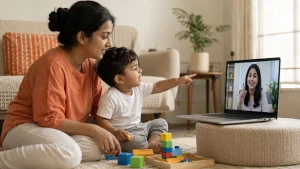
Simple speech-language strategies parents can use during daily routines, with guided videos, games, and printables in the BASICS app.
Every parent longs to hear that first clear “mama,” “dada,” or “more.” The good news is that you don’t need a special degree or a room full of flashcards to help it happen. The most powerful language teaching happens in the ordinary moments you already share — snack time, bath time, the walk to the door — when you know a few simple techniques and use them consistently. This guide gives you those techniques, step by step, and shows how the BASICS app turns them into an easy daily routine.
Whether your child is just starting out, taking their time, or working alongside a speech therapist, these approaches meet them where they are. And throughout, remember one thing: a word doesn’t have to be spoken to count. A sign, a gesture, or a tap on a communication device is a real word, and every one of them deserves celebrating.
Start With the Right Words
Not all words are equally useful to a child who is just beginning. The best first words are the ones your child can use often, across the day, to make things happen. Aim for words that are:
- Motivating — things your child loves: a favourite food, toy, or person.
- Useful — words that get a result: “more,” “open,” “go,” “up,” “all done.”
- Frequent — words that come up many times a day, so there’s lots of natural practice.
- Easy to say — short words with early sounds like p, b, m, and w (“bye,” “ball,” “bubble”).
A helpful tip: powerful early words are often actions and social words (“hi,” “more,” “go”), not just names of objects. These little words unlock whole moments of connection and are used far more often than the name of any single toy.
Six Techniques That Build First Words
These are the same core strategies speech therapists use — simple to learn, and remarkably effective when woven into daily life.
1. Get face to face
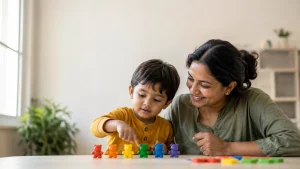
Come down to your child’s level so they can see your face and mouth. When you’re eye to eye, your child can watch how you make the word and is far more likely to tune in. This one small change makes everything else work better.
2. Model the Word Simply
Say the target word clearly and on its own, then use it again in a short phrase: “Ball. Big ball!” Keep your language just a step above where your child is — if they use no words yet, model single words; if they use single words, model two.
3. Follow Your Child’s Lead
Watch what your child is interested in and put words to it. If they’re reaching for a banana, that’s your moment: “Banana. You want banana.” Words attached to genuine interest are learned far faster than words drilled out of context.
4. Pause and Wait
After you model a word, stop and wait with a warm, expectant look. Count to five in your head. That pause hands your child the turn and gives them space to try — with a sound, a sign, or a word. Waiting feels awkward at first, but it’s where the magic happens.
5. Create reasons to communicate
Gently engineer little moments where your child needs to ask. Put a favourite toy in sight but out of reach. Offer a snack in a tricky-to-open container. Give a small piece, then wait for “more.” Blow bubbles once, then hold the wand and wait. These tiny pauses turn the day into dozens of natural chances to communicate.
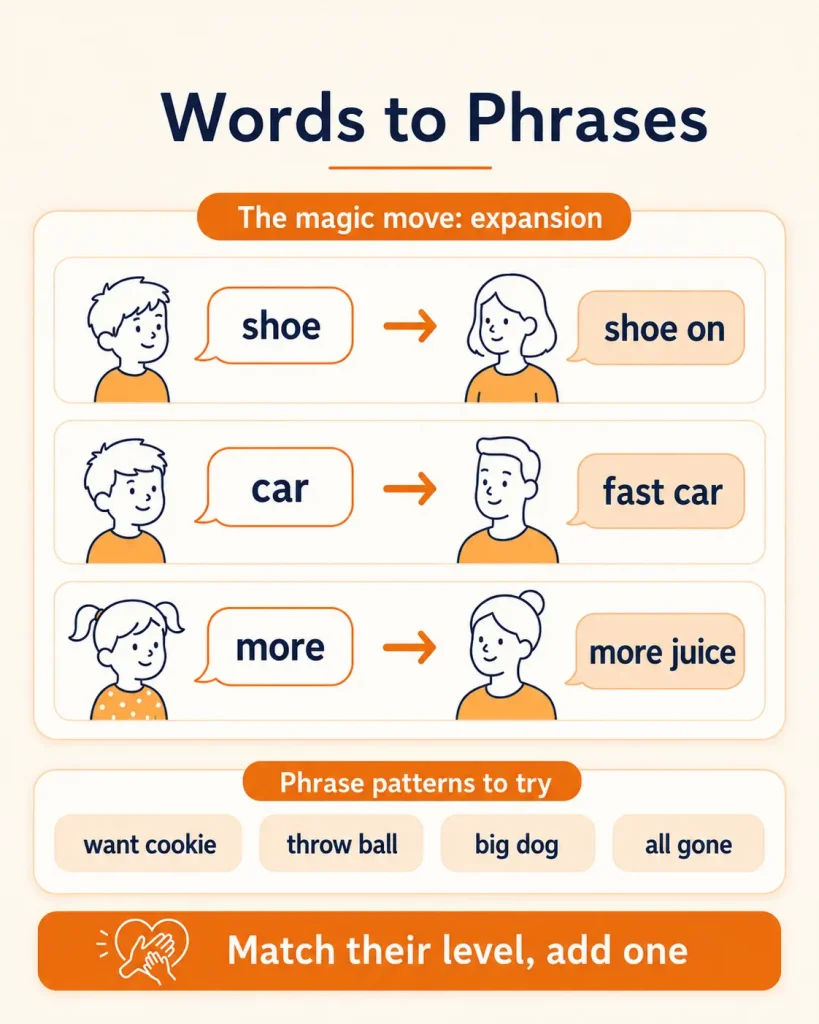
6. Respond and expand
When your child communicates in any way, respond immediately and warmly, then add a little. If they say “car,” you say “Car! Fast car.” This shows their message worked — the biggest motivator of all — and gently models the next step up.
Keep It Playful, Not a Test
Avoid drilling or demanding (“Say it! Say ball!”). Pressure makes many children clam up. Model warmly, offer the chance, and celebrate whatever comes — then move on. Learning to talk should feel like a game you play together, not an exam. If your child works with a speech therapist, these techniques sit comfortably alongside that professional guidance.
Build First Words Into Daily Routines
Consistency beats intensity. Ten small moments across a normal day will teach more than one long “lesson.” Anchor your practice to routines you already do:
- Mealtimes: “more,” “all done,” “eat,” food names.
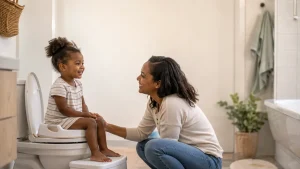
- Bath time: “water,” “splash,” “wash,” “bye-bye” (to the water).
- Getting dressed: “on,” “off,” “shoe,” “up.”
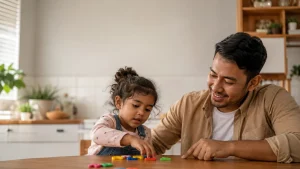
- Play: “go,” “uh-oh,” “again,” “open.”
- Book sharing: naming pictures, making animal sounds, pointing together.
What Progress Can Look Like
Progress with first words is rarely a straight line. Many children understand a word for weeks before they ever say it, so a lot of important learning is happening quietly, out of sight. You might also notice your child practices a new word for a few days and then seems to drop it — this is normal, and the word usually returns, often more clearly. Early attempts may sound only a little like the real word (“ba” for “ball,” “nana” for “banana”), and that’s exactly right — approximations are the first step, and clarity comes with time and practice. Celebrate the attempt, model the full word gently, and resist correcting. Your warm response, not perfect pronunciation, is what keeps your child trying.
If your child has very few words, has stopped using words they once used, does not respond consistently to sounds, or you feel unsure about their progress, an online speech assessment for kids can help you understand what may be going on and what support may be useful next.
How the BASICS App Supports First-Word Practice
The techniques above are simple, but doing them consistently — and knowing which word to target next — is where many parents feel stuck. The BASICS app is built by speech therapists and child-development specialists to remove that guesswork, turning these strategies into a clear routine you can follow a few minutes at a time.
A Ready-Made Practice Plan
BASICS sits within a structured Communication module that spans seven connected areas — from Early Communication Skills and Vocabulary & Word Learning through to Social Communication and beyond. For a child building first words, it focuses on the earliest of these and gives you a small, manageable set of daily activities, each with clear steps, ready-to-use parent prompts, simple adaptations, and therapist tips. No planning, no wondering what to do today.
Short Videos for First Words
The First Words video library gives you a short, clear, repeatable clip for each word, across the categories that fill a young child’s world — animals, fruits, vegetables, everyday actions, familiar places and more, with a dedicated video for each item. Watch together, pause, and try. The calm, predictable format models the word perfectly every time and is exactly what many children learn best from, especially those who find busy live interaction hard to follow.
Games That Make Repetition Feel Like Play
New words stick through repetition — and BASICS makes that repetition feel like fun rather than work. Foundation Forest and the wider Vocabulary & Word Learning games (Vocabulary Valley) reinforce the very words you’re targeting, and as your child grows, Phrase Park and Sentence Symphony carry them from single words into phrases and sentences. Throughout, wrong answers gently teach rather than simply redirect, so every tap is a chance to learn.
Printables for Screen-Free Practice
For moments away from the screen, BASICS includes printable resources you can use at the table or on the go — so first-words practice can be tactile and playful, not tied to a device.
Every form of communication counts
Signs, gestures and communication devices are treated as fully equal to spoken words throughout BASICS. However your child chooses to tell you something, BASICS is built to honour it and build on it — which matters enormously for children who need a little more time, or a different route, to find their voice.
Start Practicing First Words With BASICS – Try free for 7 days — no pressure, cancel anytime.
Final Thoughts
First words rarely arrive on a schedule, and they rarely arrive because we pushed hard. They come when a child feels safe, delighted, and gently invited to join in. Keep your moments short, warm, and playful; celebrate every attempt; and trust that the small things you do each day are quietly adding up. You are your child’s favourite teacher — and you already have everything you need to begin.
Small moments, big words — one gentle step at a time.
Related Reading
- My Toddler Is Not Talking Yet: What Parents Should Check First
- How BASICS App Helps Kids Develop Speech and Language
- How to Help a Child with Speech Delay at Home – Easy Tips
Clinically Reviewed By
Reviewed by Shravanaveena Gajula, BASLP, M.Sc. Speech and Language Pathology, Audiologist and Speech-Language Pathologist at Wellness Hub.
Shravanaveena supports children and families with speech and language assessment, early communication concerns, speech sound difficulties, autism-related communication needs, and parent-guided home practice. This article was reviewed for clinical accuracy, parent-friendly language, and safe guidance.
This content is for educational purposes only and does not replace professional assessment, diagnosis, or therapy.
View therapist profile: Shravanaveena Gajula
Frequently Asked Questions
1. What counts as a first word?
A first word is any sound, sign, gesture, or word your child uses consistently to mean something. It does not need to sound perfect. For example, “ba” for “ball,” “nana” for “banana,” a sign for “more,” or a tap on a communication device can all count when your child uses it with meaning.
2. What are the best first words to teach at home?
The best first words are useful words your child can use many times a day. Start with words like “more,” “go,” “open,” “up,” “all done,” “mama,” “dada,” “bye,” or names of favorite foods, toys, and people. Action words and social words often help more than object names because children can use them in many daily routines.
3. How can I help my child say first words at home?
You can help by getting face to face, saying one simple word, waiting, and responding warmly to any attempt. Use daily routines like meals, bath time, dressing, books, and play. Short, repeated moments work better than long teaching sessions.
4. Should I ask my child to “say” the word again and again?
No, it is better not to pressure your child to repeat words. Instead of saying “Say ball,” model the word naturally: “Ball. Big ball.” Then pause and give your child a chance to respond. Children usually learn better when communication feels playful, not like a test.
5. What should I do if my child only makes sounds, not clear words?
Treat early sounds as communication when they seem meaningful. If your child says “ba” while reaching for a ball, respond as if the message worked: “Ball! You want the ball.” Then model the full word gently without correcting or forcing repetition.
6. Can signs and gestures count as first words?
Yes, signs and gestures can count as communication when your child uses them with meaning. Pointing, waving, signing “more,” reaching, or using a communication device are all important steps. Spoken words can grow more easily when children learn that communication helps them connect and get their needs met.
7. How long should I practice first words each day?
You do not need a long practice session. Aim for many short moments across the day. A few minutes during snacks, bath time, dressing, books, and play can give your child repeated chances to hear and try words naturally.
8. When should I worry if my child is not saying first words?
You should ask for professional guidance if your child has very few words, has stopped using words they once used, does not respond consistently to sounds, does not use gestures like pointing or waving, or you feel concerned about their progress. A speech-language professional or pediatrician can help you understand whether your child needs support.
9. Can videos or apps help teach first words?
Videos and apps can support first-word practice when they are simple, slow, repeatable, and used with a parent. They work best when you watch together, pause, repeat the word, and then use the same word in real life. An app should support parent-child interaction, not replace it.
10. What if my child understands everything but does not talk yet?
Some children understand more than they can say, but it is still worth watching their progress closely. Keep modeling simple words, give choices, wait for a response, and accept sounds, signs, or gestures. If your child is not adding new ways to communicate or you feel unsure, a speech-language assessment can help you decide the next step.
References & further reading
The techniques above reflect widely used, evidence-based early-language strategies described by the following authoritative sources.
- American Speech-Language-Hearing Association. Activities to Encourage Speech and Language Development.
https://www.asha.org/public/speech/development/activities-to-encourage-speech-and-language-development/ - American Speech-Language-Hearing Association. Communication Milestones: Birth to 5 Years.
https://www.asha.org/public/developmental-milestones/ - National Institute on Deafness and Other Communication Disorders. Speech and Language Developmental Milestones.
https://www.nidcd.nih.gov/health/speech-and-language - Centers for Disease Control and Prevention. Important Milestones: Your Baby by Fifteen Months.
https://www.cdc.gov/act-early/milestones/15-months.html - The Hanen Centre. It Takes Two to Talk: Program for Parents of Children with Language Delays.
https://www.hanen.org/programs/it-takes-two-to-talk - HealthyChildren.org / American Academy of Pediatrics. Language Delays in Toddlers: Information for Parents.
https://www.healthychildren.org/English/ages-stages/toddler/Pages/language-delay.aspx
Book your Free Consultation Today
Parent/Caregiver Info:
Client’s Details:
* Error Message