BASICS Daily Living Skills App for Kids: Guided Routine Practice at Home
By Wellness Hub
Last Updated: August 10, 2026
Parent-guided demonstrations and activities for dressing, toothbrushing, eating and other everyday routines – with safety, dignity and the child’s participation at the centre.
A daily living skills app for kids can show a routine, break it into manageable actions and guide a parent through practice. BASICS does this through questions about observable skills, suggested goals, three guided activities, demonstration videos, parent prompts and a simple record of how practice went. It does not assess why a task is difficult or guarantee that a child will complete it without help.
Daily living skills – also called activities of daily living, or ADLs – include routines such as dressing, brushing teeth, eating, washing and toileting. BASICS is a parent-guided home-support app, not a screen-only course. The demonstration is the starting point; the meaningful practice happens with real clothes, utensils, bathroom items and family routines.
Start With a Practical Participation Goal
Before choosing an activity, decide what would make the routine safer, more comfortable or easier to join. The goal does not have to be complete self-sufficiency. For one child, progress may mean choosing between two shirts. For another, it may mean putting one arm into a sleeve, using an adapted spoon, asking for a pause or completing the routine with fewer prompts.
This matters because “independence” is not the same for every child. Some children will continue to need reminders, adaptive equipment or hands-on help. A useful plan respects that support while looking for genuine participation, choice and safety.
BASICS can organise the next practice step, but its activity rating is not a clinical measure of mastery. Completing a task once in one bathroom or with one caregiver does not prove that the child can use the skill in every setting.
Why Daily Living Skills May Need Step-by-Step Teaching
An instruction such as “get dressed” hides many separate actions: find the front of the shirt, open the neck, place it over the head, find each sleeve and pull the fabric down. The child may also need balance, hand control, body awareness, language comprehension, attention and tolerance for the fabric. A difficulty at any point can stop the whole routine.
Task analysis is the practical name for breaking a routine into observable steps. It helps the adult identify where the child can already participate and which one step needs teaching. It also prevents vague judgments such as “not trying” when the real problem may be a zip that is hard to start, pain, poor balance, an unclear instruction or a texture the child cannot tolerate.
Not every child needs the same sequence or teaching method. A picture, a live demonstration, extra time, a different tool or changing the environment may be more useful than repeating the verbal instruction. The aim is to find the least demanding support that makes participation possible.
See Everyday Routines Before You Practise Them
BASICS App describes Show Me How video modelling for everyday tasks and gives examples including getting dressed, brushing teeth and using a spoon. A demonstration can make the order of a routine easier to see, especially when spoken instructions disappear too quickly.
Watching is not the same as doing. A child may understand the video but still need help with grip, balance, planning, sensory comfort or remembering the steps in a different room. Watch the model before the routine, pause when necessary, then move the device away from water, food and the active workspace before practising together.
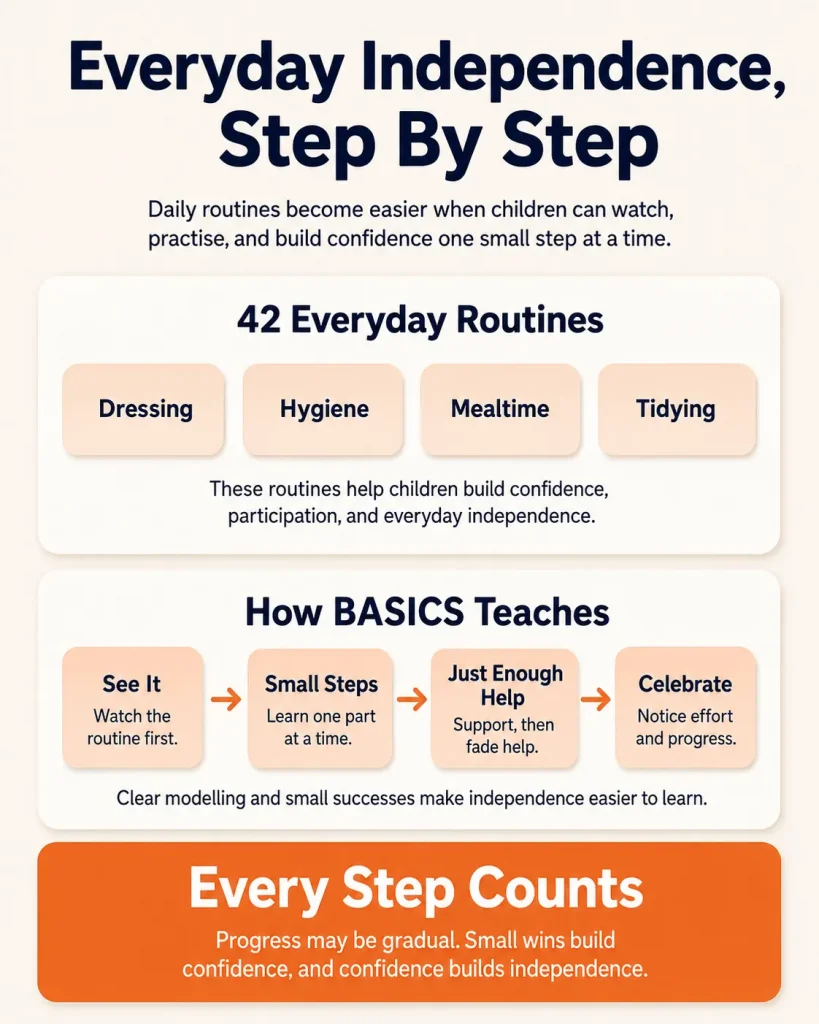
Use the video as an option, not a test. Some children will prefer a live demonstration, a picture sequence or no screen at all. If the video adds distraction or distress, stop it and use a simpler cue. The value of a video is that it can make the sequence visible; it does not show whether the child can complete the routine safely or use the skill in another setting.
Follow a Guided Path From Observation to Practice
The BASICS workflow is straightforward: a parent answers questions about observable skills, reviews suggested goals, receives three guided activities, watches the demonstration and follows the steps and parent prompts, then records how the activity went. The BASICS App Guide explains that the rating is a practice record, not proof that a skill has been mastered across settings.
Teach One Step at a Time
Start with the part the child is ready to practise. You might model the full dressing sequence, then help with most actions while the child pulls the shirt down. Once that final action is familiar, the child can try the previous action as well.
This approach is called backward chaining: the adult completes all but the final step, then gradually leaves more of the sequence for the child. Children and Family Health Devon describes it as one method for multi-step self-care tasks such as dressing. Backward chaining is a general teaching method rather than a required BASICS sequence. Use it only when it suits the child and task.
Choose the Least Intrusive Prompt That Works
A prompt can be a picture, gesture, demonstration, short spoken cue, change to the setup or physical assistance. There is no fixed ladder that works for every child. Use the prompt that helps without taking over, and reduce it only when the child remains successful and comfortable.
Before hands-on help, explain what you plan to do and wait for cooperation. Never force the child’s body through dressing, toothbrushing, toileting or another personal-care action. Stop if the child pulls away, freezes, says no, uses a stop signal or becomes distressed. Privacy and bodily autonomy take priority over finishing the task.
Adapt the Task and Environment Safely
An adaptation should remove an unnecessary barrier. That might mean clothes with easier fastenings, a utensil the child can hold, a quieter time, a dry floor or a stable non-slip stool at the sink. Supervise hot water and do not leave a child balancing at a sink without the support they need.
Eating and spoon use: Seat the child securely, supervise, and use food textures and sizes that match their established skills. Stop and seek appropriate feeding or medical advice for coughing, choking, prolonged chewing, food held in the mouth, a wet-sounding voice, breathing changes or persistent distress. These are among the signs listed in ASHA’s paediatric feeding and swallowing guidance.
Toothbrushing: A child who can copy the sequence may still need an adult to clean the teeth effectively. The American Academy of Pediatrics advises assisting or supervising until the task is mastered, often around age ten, and gives age-based fluoride-toothpaste amounts. Follow your child’s dentist and local health guidance.
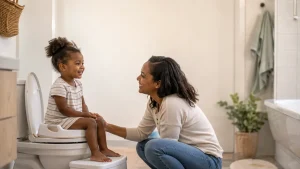
Toileting: Protect privacy; never photograph, record or share intimate practice. Avoid punishment, forced sitting or pressure to continue through pain. Constipation, pain, blood, stool withholding or urinary symptoms need medical attention, not more app practice.
Record Participation, Not Perfection
After the routine, record what actually happened. Which step did the child attempt? What prompt was used? Could they ask for help or stop? Was the routine safe and tolerable? Did the same support work with a different caregiver or in a different place?
Separate introduction, participation, completion with support, completion with fewer prompts and independent use in familiar settings. This prevents a single successful attempt from being labelled “mastered” and makes the next goal more honest.
Make Practice Fit the Real Routine
Practising in daily life can help connect a step to the place where it is used, but every meal, bathroom visit or school morning does not need to become a lesson. When the family is rushed, the child is unwell or the routine is already stressful, completing the task for the child may be the safest and kindest choice.
A more workable rhythm is to choose one routine, one step and one cue. Practise at the natural time when that is manageable, or rehearse at a quieter time with a toy, spare clothing or an empty utensil. Stop before practice becomes a struggle. Repetition is useful only when the child has a fair chance to participate safely. BASICS also supports communication, motor and social-emotional goals, including activities designed with autistic children in mind; this guide stays focused on daily living practice.
- Choose: One routine that matters now, not every ADL at once.
- Preview: Watch the BASICS demonstration yourself, then decide whether the child should watch it too.
- Practise: Offer one clear step with the least intrusive useful prompt.
- Review: Record comfort, communication, safety and participation, then keep, adapt or pause the plan.
What BASICS Adds to Daily Living Practice
The useful difference is not a guaranteed outcome. It is a clearer structure for deciding what to practise and how to review it. BASICS provides:
- Questions and suggested goals: Parents answer about observable skills rather than making a clinical judgment.
- Three guided activities: The daily plan gives the family a small starting point instead of an unfiltered activity library.
- Demonstrations, steps and prompts: The adult can see the activity before trying it with the child in real life.
- Parent ratings: Families can record how practice went and review the child’s own goals without treating the rating as a clinical assessment.
- Daily-living examples: The current app descriptions include dressing, brushing teeth and eating or using a spoon within occupational-therapy and video-modelling content.
These features can make home practice easier to organise. They do not establish that BASICS performs an occupational-therapy assessment, chooses the right adaptation for every child or produces lasting independence.
Explore Daily Living Activities in BASICS
Download BASICS to explore goal-based plans, demonstration videos and parent-guided daily-living activities. Use the app to structure practice alongside the child’s preferences and professional care, not as a promise that every routine will become independent.

Know What to Practise With Your Child Today


What to Remember and When to Seek Advice
Use a daily living skills app for kids to make a routine visible and the next practice step clearer. Judge the approach by safety, comfort, communication and participation – not by speed, obedience or whether the child can do everything without help.
Consider qualified professional guidance when a daily-living difficulty:
- Regularly prevents dressing, washing, eating, toileting, sleep, school attendance or other necessary participation.
- Causes pain, fear, frequent conflict, falls, burns, choking or another safety risk.
- Includes coughing, choking, breathing changes, weight or nutrition concerns, or a very restricted diet.
- Involves constipation, painful toileting, blood, urinary symptoms or persistent stool withholding.
Includes unusual weakness, fatigue, poor coordination, a marked difference between the two sides of the body, sudden change or loss of a previously used skill.
An occupational therapist can assess how motor, sensory, cognitive and environmental factors affect the routine. Depending on the concern, a paediatrician, dentist, physiotherapist, dietitian, feeding specialist or speech-language pathologist may also be relevant. BASICS can supplement that care; it cannot replace individual assessment.
Clinically Reviewed By
Reviewed by Rajini Darugupally, M.Sc. Speech Language Pathology, Speech Language Pathologist at Wellness Hub.
Rajini supports children with speech and language delays, receptive and expressive language difficulties, social communication needs, autism, ADHD, and parent-guided home practice. This article was reviewed for clinical accuracy, parent-friendly language, and safe guidance.
This content is for educational purposes only and does not replace professional assessment, diagnosis, or therapy.
View Rajini Darugupally’s Profile
Related Reading and References
- BASICS App Guide: Speech Therapy, Autism and Early Intervention Activities for Kids
- BASICS Fine Motor Skills App: Guided Hand Practice for Kids at Home
- BASICS Sensory App for Kids: Guided Support at Home
References and further reading
Book your Free Consultation Today
Parent/Caregiver Info:
Client’s Details:
* Error Message