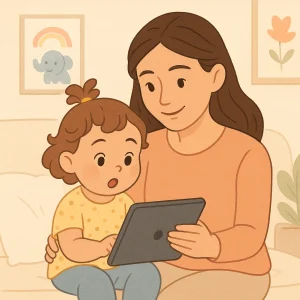
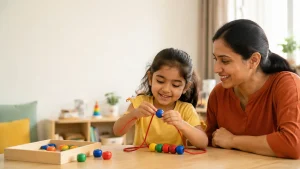
BASICS is a therapist-created early intervention and home support app for parents of children with autism, speech delay and other developmental needs. Instead of giving families a large library and asking them to decide what to do next, BASICS builds a goal-based plan and turns it into three guided activities for the day.
The app brings several areas of child development into one place, including communication and speech, occupational therapy activities, oral motor skills, social-emotional learning, daily living skills, toilet training, early reading and writing, video modeling and learning games. Parents can watch how an activity is done, try it with their child during everyday routines and record how the activity went.
BASICS is designed to make home practice clearer, not to turn parents into therapists. It can be used between therapy sessions or as structured developmental support at home while a family is seeking services. It does not diagnose autism, speech or language disorders, sensory differences or developmental delay, and it does not replace assessment or individualized care from qualified professionals.

Speech and Autism Learning App for Kids Ages 2–8


What is the BASICS App?
BASICS is a child-development app from Wellness Hub that organizes home practice around developmental goals rather than random activities. Parents begin by choosing an area they want to work on and answering simple questions about what they observe their child doing in everyday life. These are not diagnostic tests. The answers are used inside the app to suggest relevant goals and activities.
The current BASICS app includes modules for communication, occupational therapy, oral motor skills, social and emotional learning, toileting, and reading and writing. Its content is developed by a multidisciplinary team that includes speech therapists, occupational therapists, behavioral therapists, special educators and child-development professionals.
This matters because early development rarely fits into one neat category. A child working on communication may also need support with turn-taking, dressing, fine-motor skills or coping with everyday routines. BASICS gives parents one place to organize that practice while keeping each activity small enough to use at home.
Who is BASICS Designed For?
Parents may use BASICS when their child is learning first words, building vocabulary, combining words, practicing conversation, developing motor or self-care skills, learning about emotions, or needing more structure around routines such as toileting. The app also includes activities designed with autistic children and children with developmental differences in mind.
A diagnosis is not required to use the app. However, an app should not be used to decide whether a child has autism, ADHD, a speech-language disorder or another developmental condition. If you are worried about how your child plays, learns, communicates, behaves or moves, discuss those specific concerns with your pediatrician or an appropriate developmental professional. Early identification can help families connect with appropriate services sooner.
How BASICS Creates a Personalized Plan for Your Child
One of the biggest changes in the new BASICS experience is the shift from choosing isolated learning levels to following a developmental plan. The basic flow is simple: choose a focus area, answer questions about your child, review suggested goals, complete guided activities and record how the practice went.
1. Start With What You See at Home
The app asks parents about observable skills rather than expecting them to make clinical judgments. For example, the questions may focus on what a child currently communicates, manages or does during daily activities. This gives the plan a practical starting point.
2. Work Toward Clear Developmental Goals
BASICS uses those observations to recommend goals within the selected area. A goal gives the parent a reason for doing an activity: instead of opening a game because it looks useful, you know which skill the activity is intended to practice.
3. Focus on Three Activities a Day
Parents receive three guided activities for the day based on active goals. The point is not to keep a child on a screen for a long session. Many activities are meant to be demonstrated in the app and then practiced together through play, conversation, meals, dressing or other ordinary routines.
4. Record How the Activity Went
After practice, parents can rate the activity and follow progress goal by goal. This creates a simple record of what has been introduced and practiced. It should be read as an in-app practice record, not as a clinical measurement or proof that a developmental skill has been mastered across every setting.
What Parents Get With a BASICS Activity
A useful home program has to answer more than “what should we practice?” Parents also need to know what the activity looks like and what to do when a child responds differently than expected. BASICS therefore pairs activities with demonstration videos, step-by-step guidance, parent prompts and therapist tips.
The practical advantage is that the screen becomes the instruction point rather than the whole intervention. A parent can watch the model, put the phone down when appropriate, and practice the same idea with real objects, real people and real routines. For young children, that connection to everyday interaction is important: developmental learning happens through repeated experiences with caregivers and the environment, not simply through completing digital tasks.
Speech and Language Activities in BASICS
For families searching for a speech therapy app for kids, the communication module is one of the central parts of BASICS. It covers early communication through more advanced language skills, including first words, vocabulary, word combinations, sentences, WH questions, conversation and speech-sound practice.
First Words and Vocabulary
Early language practice can begin with useful words connected to a child’s daily life: people, foods, toys, actions and familiar routines. BASICS combines visual examples, modeling and parent-led practice so that a word learned in the app can be used again while eating, playing, getting dressed or going outside.
Phrases, Sentences and WH Questions
As a child’s language grows, activities can move from single words toward combinations and longer messages. Parents can practice two-word phrases, simple sentences and questions such as who, what and where in meaningful situations rather than treating language as a memorization exercise.
Conversation and Social Communication
Communication is also about using language with other people. BASICS includes practice around greetings, taking turns, responding and participating in simple conversations. For autistic children, the aim should be functional, respectful communication—not forcing a child to appear less autistic.
Support for Different Ways of Communicating
Not every child communicates primarily through speech. A child may use gestures, signs, pictures or an augmentative and alternative communication (AAC) system. BASICS activities can be approached in ways that acknowledge these forms of communication rather than treating spoken words as the only meaningful response. Research reviewed by the American Speech-Language-Hearing Association has found that AAC intervention does not appear to prevent speech development.
Occupational Therapy Activities for Everyday Skills
The occupational therapy section broadens BASICS beyond speech and language. It includes activities related to fine-motor skills, gross-motor coordination, hand-eye coordination, sensory processing, motor planning and daily living skills.
That can mean practicing the smaller movements needed to handle everyday objects, larger body movements used in play, or routines such as dressing, brushing teeth and eating. The goal of home practice is not to recreate a clinic. It is to give parents manageable ways to practice a skill in the places where the child actually needs to use it.
Fine and Gross Motor Practice
Fine-motor activities may involve hands and fingers, while gross-motor activities involve larger movements of the body. BASICS also uses playful movement examples, including animal walks, that parents and children can try away from the screen.
Sensory Processing and Motor Planning
Some activities address how children participate in movement and sensory experiences. Because sensory needs vary widely, parents should avoid assuming that one activity will calm, organize or help every child in the same way. When sensory responses interfere significantly with daily life, an occupational therapist can assess the child and recommend individualized strategies.
Daily Living Skills
Self-care routines become easier to teach when they are broken into small, visible steps. BASICS includes support for activities of daily living (ADLs), such as getting dressed, brushing teeth and eating, so parents can practice the same sequence repeatedly in the real routine.
Social Skills, Feelings and Emotional Learning
BASICS includes social-emotional activities designed to help children notice feelings, communicate needs, take turns, solve simple social problems and participate in everyday interactions. For autistic children, social support should respect differences in communication and regulation rather than reward masking or demand unnecessary eye contact.
Parents can use the activities to put language around emotions and situations: “You look frustrated,” “Do you need a break?” or “My turn, then your turn.” These short, repeated moments are often easier for a young child to understand than a long explanation given after a difficult situation.
Oral Motor and Articulation Activities
BASICS also separates oral motor practice from broader communication work. Oral motor activities may focus on movements involving the lips, tongue and jaw, while articulation work focuses on producing speech sounds clearly.
These areas should not be treated as interchangeable. A child who is hard to understand may need an assessment to determine whether the difficulty relates to speech-sound production, language, motor speech, hearing or another factor. Parents should be cautious with claims that nonspeech mouth exercises automatically improve speech. When speech clarity is a concern, a speech-language professional can help identify an appropriate target.
Toilet Training Support in BASICS
Toilet training can require more structure for some children, including autistic children and children with developmental differences. BASICS includes a step-by-step toileting program intended to help parents make the routine more predictable and practice it consistently.
Progress may be uneven, and there is no single timetable that fits every child. Medical issues such as constipation, pain or urinary problems can also affect toileting. When those concerns are present, families should seek appropriate medical advice rather than treating toileting only as a behavior or learning issue.
Reading, Writing and Early Learning
BASICS includes early literacy and academic practice alongside developmental modules. Children can work with letters, letter sounds, early spelling, numbers and counting through sequential activities and games.
These features are useful as an extension of the app, but they are not its main distinction. BASICS is better understood as a parent-guided developmental support system with learning games inside it—not simply another ABC, phonics or preschool game app.
250+ Learning Games: Practice That Feels Like Play
BASICS includes more than 250 learning games across speech and language, early academics, and feelings and friendships. Games can give children another way to repeat a skill, but repetition is most useful when parents connect it back to real life.
A vocabulary game about food, for example, can lead into naming or requesting food at snack time. A feelings game can lead into talking about a character in a book or something that happened at the playground. The strongest use of the app is therefore not “more screen time.” It is using the digital activity as a prompt for interaction and practice beyond the screen.
How Video Modeling Works in BASICS
Video modeling shows a child a clear example of an action or interaction before asking them to try it. BASICS uses real demonstration videos across communication, self-care, social and movement activities.
A child might watch someone use a first word, brush their teeth, get dressed, use a spoon, greet another person, say thank you, join play or perform a movement such as a bear walk. Parents can watch with the child, point out the important step and then practice the same action in context.
Video modeling has been studied as a teaching strategy in autism, but no strategy works identically for every child or every skill. The useful question for a parent is not simply whether the child watched the video; it is whether the child is beginning to understand or use the skill during everyday life.
How BASICS Fits Alongside Speech or Occupational Therapy
BASICS is designed to extend practice beyond a therapy appointment. A therapist may work on a skill during a session, but children have many more opportunities to use that skill at home. A guided activity can help parents know what to practice between visits and make repetition easier to fit into the week.
The app can also give families something structured to do while they are waiting for services. That does not make waiting for an evaluation unnecessary. The CDC advises families to act early when they have developmental concerns because early identification can help children access appropriate services and support. Developmental monitoring by parents is useful, but formal developmental screening and evaluation serve different purposes.
What BASICS Does Not Replace
BASICS does not diagnose autism, ADHD, speech-language disorders, sensory processing difficulties or developmental delay. It does not replace a hearing assessment, developmental screening, speech-language evaluation, occupational therapy evaluation, medical assessment or an individualized treatment plan when one is needed.
Seek professional guidance when you are concerned about your child’s development, when a skill has been lost, when communication difficulties are affecting daily life, or when feeding, swallowing, pain or other medical concerns are present. An app can organize practice; it cannot examine the full clinical picture.
How to Start Using the BASICS App
Getting started is intentionally simple. Download BASICS, create your child’s profile and choose the developmental area you want to focus on. Answer the initial questions based on what you actually observe rather than what you think your child “should” be doing.
- Choose a focus area such as communication, occupational therapy, oral motor skills, social-emotional learning, toileting, or reading and writing.
- Complete the short parent questions about your child’s current skills.
- Review the goals suggested in the app and activate the ones that fit your current priorities.
- Use the three daily activities as guided practice. Watch the demonstration, follow the parent prompts and move the practice into real routines when possible.
- Rate how the activity went and use the progress view to see what you have been practicing over time.
- Use learning games and additional videos for extra practice rather than making them the entire routine.
Is BASICS the Right Kind of Support for Your Child?
BASICS may be useful when you want more structure at home but do not want to spend hours planning activities yourself. It can also help when several areas overlap—for example, a child who is working on communication as well as dressing, turn-taking and emotional regulation.
| BASICS may be useful when… | Professional assessment is especially important when… |
|---|---|
| You want clear, parent-guided home activities. | You are trying to determine whether your child has a developmental condition. |
| You want to practice skills between therapy sessions. | Your child has lost skills they previously used. |
| Your child is working across communication, motor, social or daily living areas. | Speech, language, movement or behavior concerns significantly affect daily life. |
| You prefer short daily practice over a large unstructured activity library. | There are feeding, swallowing, pain, hearing or other medical concerns. |
| You want demonstrations that show how to practice a skill. | Your child needs an individualized clinical treatment plan. |
BASICS App Features at a Glance
| Feature | |
|---|---|
| Personalized goals | Goals are suggested from the developmental area and parent observations entered in the app. |
| Three daily activities | A small daily plan gives parents a clear place to start. |
| Demo videos | Parents can see an activity before trying it with their child. |
| Parent prompts and tips | Guidance explains how to carry the activity into interaction at home. |
| Communication support | Practice can include first words, vocabulary, phrases, sentences, WH questions and conversation. |
| OT and daily living activities | Activities cover motor, sensory and everyday self-care skills. |
| Social-emotional learning | Practice includes feelings, regulation, turn-taking and social problem-solving. |
| Toileting | Structured steps support consistent toilet-training routines. |
| 250+ learning games | Games provide additional practice across language, academics and social-emotional skills. |
| Progress tracking | Parents can record how activities went and follow practice goal by goal. |
What Parents Often Want to Know
Is BASICS a speech therapy app for kids?
BASICS includes a substantial speech and language module covering early communication, vocabulary, phrases, sentences, WH questions, conversation and speech-sound practice. It is best described as a broader early intervention and home support app rather than a replacement for individualized speech therapy.
Can BASICS be used by autistic children?
Yes. BASICS includes communication, social-emotional, daily living, sensory, motor and toileting activities designed with autistic children among its intended users. Support should be individualized and should respect the child’s communication style, sensory needs and autonomy.
Does my child need a diagnosis to use BASICS?
No. Parents can use BASICS to support developmental practice without a diagnosis. The app itself should not be used to determine whether a child has autism, ADHD or another developmental condition.
Can BASICS replace a therapist?
No. BASICS is intended for guided home practice and can complement professional care. A qualified clinician can assess the reasons behind a child’s difficulty, individualize goals and change treatment based on clinical findings in ways an app cannot.
Can BASICS support a child who does not use spoken words?
Activities can be approached with different forms of communication, including gestures, signs, pictures and AAC where appropriate. Parents should recognize meaningful communication rather than requiring speech as the only acceptable response.
How much should we do each day?
The current BASICS plan is built around three daily activities. That is a structure, not a test. A child may need repetition, a break, an easier variation or a different day. Quality of interaction matters more than rushing through activities to mark them complete.
A Better Way to Think About Home Practice
Parents do not need to recreate a therapy clinic at home. The more useful goal is to notice the skills your child is working on and create small chances to practice them during ordinary life.
A first-word activity can continue at breakfast. A dressing activity can continue before preschool. A turn-taking activity can happen with blocks. A feelings activity can come back when a story character is upset. BASICS provides the plan and demonstration; the parent-child interaction is where that practice becomes part of daily life.
That is also why progress should not be reduced to streaks or comparisons with other children. Development is not a leaderboard. A useful plan helps you see what your child can do now, what you are practicing next and when you may need additional professional guidance.
Start With a Personalized BASICS Plan
BASICS brings speech and language, occupational therapy activities, social-emotional learning, oral motor practice, daily living skills, toileting, early literacy, video modeling and learning games into one parent-guided plan.
Start by choosing the area that matters most right now, answer the parent questions and review the goals suggested for your child. Then use the three daily activities as short opportunities to watch, practice and connect the skill to real life.
About BASICS
BASICS is an early intervention and home support app developed by Wellness Hub for parents of children with autism, speech delay, and other developmental needs. The app brings together speech and language activities, occupational therapy activities, social-emotional learning, oral motor and articulation practice, daily living skills, toilet training, early literacy, video modeling, and learning games.
BASICS content is developed with input from Wellness Hub’s multidisciplinary team, including speech therapists, occupational therapists, behavioral therapists, special educators, and child-development professionals. Activities are designed to help parents turn developmental goals into simple, guided practice during everyday routines at home.
Content by: Wellness Hub BASICS Team
Last updated: July 2026
Editorial Disclosure
This guide is published by Wellness Hub, the developer of the BASICS app. Product information reflects BASICS features available at the time of publication. Developmental and therapy-related information is provided for educational purposes and is not a substitute for individualized assessment, diagnosis, or therapy from a qualified professional.
Related Reading
- Helping Your Child Pause, Think and Make Good Choices
- Storytelling Activities for Kids: Build Narrative Language at Home
- My Child Is Hard to Understand: How to Support Clearer Speech
References & Further Reading
Book your Free Consultation Today
Parent/Caregiver Info:
Client’s Details:
* Error Message