Receptive Language Skills: How to Help Your Child Understand Words and Directions
Last Updated: July 9, 2026
Simple receptive language activities, games, videos, and printables to help your child understand words, follow directions, and build communication at home.
Many children understand some words before they can say them clearly. These listening and understanding skills are called receptive language skills. They help your child follow directions, connect words to people and objects, answer simple questions, and understand daily routines.
Receptive language grows through simple everyday moments. When you say “give me the cup,” “shoes on,” or “where is the ball?”, your child is learning how words connect to actions, objects, and routines.
Some children may seem to ignore instructions, rely on gestures, or understand words only in familiar places. This does not always mean something is wrong, but it gives parents a useful clue about what to watch and practise at home.
In this guide, you’ll learn simple receptive language activities to help your child understand words, follow directions, answer questions, and build communication during daily routines. You’ll also see how BASICS can support parent-guided home practice with activities, videos, games, and printables.
What Are Receptive Language Skills?
Receptive language skills are your child’s ability to understand words, gestures, sentences, questions, and everyday instructions.
These skills help your child know what familiar things are called, follow simple directions, understand routines, and make sense of what people say during play, meals, bath time, dressing, and story time.
Receptive language is different from expressive language. Receptive language is what your child understands. Expressive language is how your child communicates back through sounds, words, signs, gestures, pointing, pictures, or a communication device.
For many children, understanding develops before clear speech. A child may know what “shoes,” “come here,” “give me the cup,” or “where is the ball?” means before they can say those words clearly.
This is why receptive language activities matter. They help your child connect words with meaning, routines, people, objects, and actions. Over time, this understanding supports stronger communication at home, in school, and during therapy.
This is why receptive language activities matter. They help your child connect words with meaning, routines, people, objects, and actions. Over time, this understanding can support stronger communication at home, in school, and during therapy.
Some children may have difficulty with both understanding and speaking. If your child often does not respond to their name, does not follow simple directions, seems confused in familiar routines, or loses skills they once had, speak with speech-language professional.
Signs Your Child Is Understanding Language
Because understanding is not always visible, parents need to watch how their child responds during real daily moments.
Signs of growing language comprehension may include:
- Responding when you call their name.
- Looking at or pointing to a person, toy, or object you name.
- Following simple directions, such as “give me the cup” or “come here.”
- Understanding familiar routines, such as getting shoes when it is time to go out.
- Recognizing names of family members, favorite foods, toys, or body parts.
- Pointing to pictures in a book when you name them.
- Answering simple questions by pointing, choosing, looking, gesturing, using words, or using a communication device.
Children are also very good at reading clues. Your child may follow “get your shoes” because you are standing near the door, pointing to the shoe rack, or holding their bag. That still shows learning, but it may not show whether they understood the words by themselves.
Every now and then, try one familiar instruction without pointing, showing, or repeating it many times. For example, say “give me the cup” when the cup is nearby, then wait a few seconds.
If your child responds, they may be understanding the words. If they need help, gently show them and say the words again.
This should not feel like a test. Use it as a small window into what your child understands. If your child needs gestures, visuals, or extra time, that is useful information. It tells you how to support them better during daily routines, BASICS activities, or speech therapy sessions.
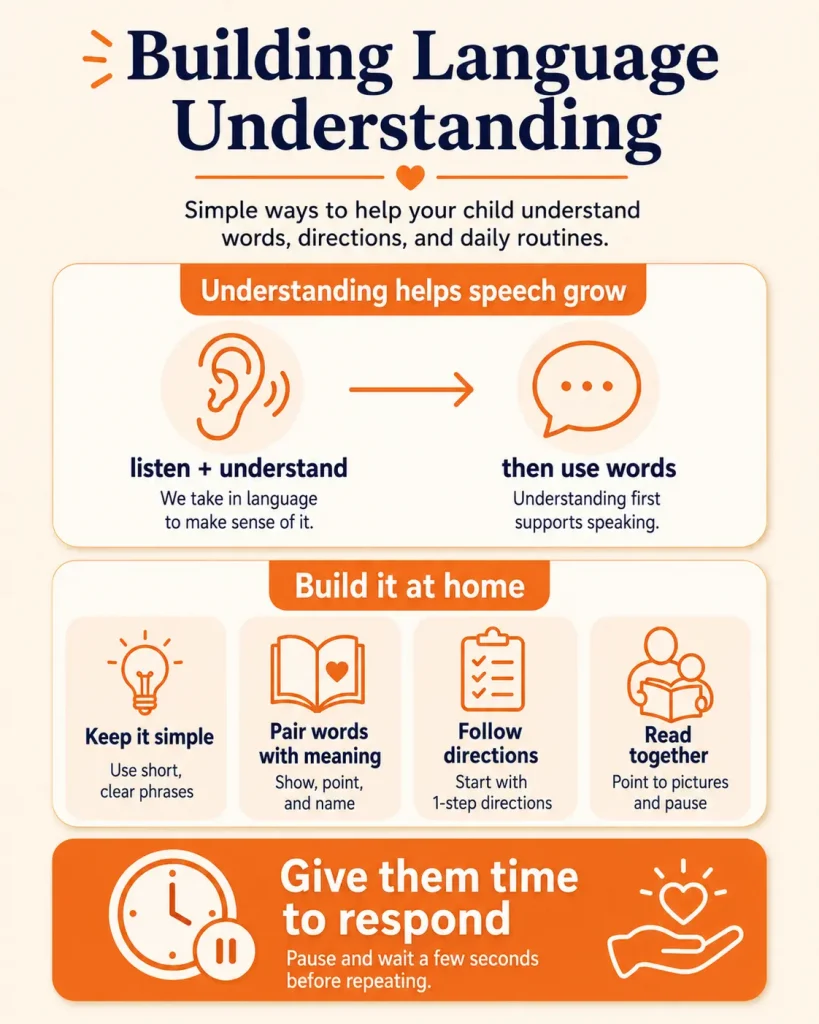
How to Build Receptive Language Skills at Home
You do not need special materials to build your child’s receptive language skills. The best practice often happens during normal routines, such as getting dressed, eating, cleaning up, playing, reading, and going outside.
The goal is to help your child connect words with real people, objects, actions, and routines. Keep practice short, clear, and playful. If your child works with a speech-language professional, these activities can support the goals they are already practising in therapy.
1. Use short, clear language
Use short sentences that match your child’s current level.
If your child understands single words, start with one- or two-word phrases like “cup,” “ball,” “come here,” or “shoes on.”
If your child already follows simple instructions, you can add a little more, such as “put cup here” or “give ball to Daddy.”
Try not to give too many words at once. “Get your shoes and bring them to the door” is easier than “Come on, we’re getting late, go find your shoes quickly and bring them here.”
Clear language helps your child focus on the words that matter.
2. Pair words with real objects and actions
Children understand language better when words are connected to something they can see, touch, or do.
Say “ball” while rolling the ball. Say “up” as you lift your child. Say “open” while opening a box. Say “wash” while washing hands.
This turns language into something concrete. Your child is not just hearing a word. They are seeing what it means.
3. Practise following directions in daily routines
Following directions is one of the most useful receptive language activities for home practice.
Start with one-step directions your child hears often, such as:
- “Give me the cup.”
- “Sit down.”
- “Open the box.”
- “Put it in.”
- “Come here.”
Once your child can follow one-step directions more consistently, move to simple two-step directions, such as “get your cup and put it on the table.”
Keep the objects nearby at first. Later, try the same direction in different rooms or routines.
If your child does not follow the direction, show them calmly. Then say the same words again while helping them do it.
The goal is not to quiz your child. The goal is to help them understand what the words mean.
4. Teach concept words during play and routines
Receptive language is not only about naming objects. Children also need to understand concept words.
These are words like:
- big and small
- in, on, under, and next to
- hot and cold
- fast and slow
- same and different
- first and next
- more and all done
Use these words during real moments.
Say “the big spoon,” “teddy is under the blanket,” “your hands are cold,” or “first socks, then shoes.”
These small words help children understand instructions, questions, stories, and classroom routines later.
5. Read books in a way that builds understanding
Books are one of the easiest ways to build language comprehension for kids.
You do not need to read every word on the page. You can point, name, pause, and talk about the pictures.
Try simple prompts like:
- “Where is the dog?”
- “Show me the baby.”
- “What is the boy eating?”
- “Who is sleeping?”
- “Point to the big one.”
Your child can answer by pointing, looking, choosing, gesturing, using a sound, saying a word, or using a communication device.
Understanding does not have to be shown only through speech.
6. Wait before repeating the instruction
After you say something, pause.
Many children need a few extra seconds to process language and respond. If you repeat the instruction too quickly, your child may have to start processing again.
Try this simple pattern:
Say the instruction once. Wait. Watch your child. If they need help, show them gently and repeat the same words.
For example, say “give me the spoon,” then wait. If your child looks unsure, help them pick up the spoon and say, “Give me the spoon.”
This gives your child language, support, and time.
If you want more structure, BASICS can support these same skills with guided activities, videos, games, and printables for home practice. This is important because children build receptive language skills through clear input, routine, repetition, visuals, and calm support.
Common Worries About Receptive Language Skills
“My child only follows directions when I point.”
This can happen when a child is using gestures, routines, or the setting to understand what you mean. For example, your child may follow “get your shoes” because you are pointing to the shoe rack or standing near the door.
That is still communication support. Gestures can help children connect words with meaning.
To build more word understanding, use gestures when your child needs help, then slowly reduce them during familiar instructions. For example, say “give me the cup” with a point first. Later, try the same words with a smaller gesture. When your child is ready, try the instruction without pointing.
If your child still needs gestures for most simple directions, practise the same short instructions in daily routines and speak with a speech-language professional if you are concerned.
“My child understands at home but not at school or nursery.”
This is common because home routines are familiar. Your child may understand “get your shoes” at home because the shoes, door, bag, and routine are predictable. In a new place, the same words may feel harder.
This does not always mean your child has lost the skill. It may mean they need more practice understanding the same words in different places.
Try using the same simple instructions across routines. For example, practise “put it in” during cleanup, laundry, bath time, and play. Practise “give me” with toys, snacks, books, and clothes.
BASICS can help parents repeat receptive language activities across routines through guided goals, videos, games, and printables. This makes home practice more structured instead of random.
“My child seems to ignore me.”
What looks like ignoring may actually be difficulty understanding, slow processing, background noise, tiredness, or an instruction that is too long.
Try this first:
- Get close to your child.
- Say their name.
- Use one short instruction.
- Pause for a few seconds.
- Show them gently if they need help.
For example, instead of saying, “Come here quickly and pick up all these toys,” try “come here.” Wait. Then say “pick up car.”
If your child often does not respond to their name, does not follow simple directions, seems confused in familiar routines, or you are unsure whether they can hear you clearly, speak with a pediatrician, audiologist, or speech-language professional. A hearing check is often an important first step when language understanding is unclear.
BASICS can support daily communication practice at home, but it should not replace professional help when concerns continue.
How the BASICS App Helps Build Receptive Language and Comprehension
Receptive language can be hard for parents to track because understanding is not always visible. Your child may follow some directions, understand some words, or answer some questions, but you may still wonder what to practise next.
The BASICS App gives parents a clearer path. It works like a visual developmental roadmap with structured goals, video-led activities, games, and printables. If you are looking for a speech therapy app for kids, an autism app for kids, or a speech therapy app for autism and speech delay, BASICS helps turn home practice into small daily steps.
BASICS does not replace professional speech therapy, autism assessment, or developmental support. It can support daily home practice and help parents work on communication goals between therapy sessions or as part of a simple routine.
A guided path for communication goals
Inside Communication BASICS, parents can work on speech, language, vocabulary, articulation, social communication, storytelling, questions, and comprehension.
For receptive language, this means practising skills such as:
- understanding words
- following directions
- learning concept words
- answering simple questions
- understanding WH questions
- matching words with pictures and actions
- making sense of short stories and daily routines
Instead of giving parents random activities, BASICS starts with goals. You answer simple questions based on what you observe at home, and the app gives you activities linked to your child’s current needs.
This helps you know the next small step instead of guessing.
Daily activities that fit into home routines
Receptive language practice works best when it becomes part of everyday life. BASICS supports this by giving parents guided activities that can be used during play, reading, mealtime, dressing, bath time, and clean-up routines.
Each activity gives you a clear idea of what to do, what to say, and how to help your child respond.
This is useful when you want home speech therapy practice to feel simple and repeatable, not overwhelming.
Games that help your child show understanding
A child does not need to speak clearly to show understanding. They may show what they know by pointing, choosing, matching, looking, gesturing, or using a communication device.
BASICS includes games and activities that allow children to respond in different ways. In question-based and reasoning games, children can practise understanding by choosing answers, matching pictures, or responding to prompts.
This makes BASICS useful as a speech and language app for children who are still developing spoken words, as well as children with autism, speech delay, ADHD, or early communication needs.
Videos and visuals that make meaning clearer
Many children understand better when they can see what a word means. BASICS uses short videos, visuals, and activity models to connect words with actions, objects, pictures, and routines.
For example, a child may understand words like “open,” “under,” “big,” “give,” or “where” more easily when they see the action and practise it with a parent.
This kind of visual support can be helpful for children who learn through pictures, repetition, modelling, and predictable routines.
Printables for screen-free practice
BASICS also includes printable resources for hands-on practice away from the screen.
These printables can support receptive language activities such as following directions, sorting by concept, matching pictures, naming objects, answering simple questions, and talking about picture scenes.
Printables are helpful because they let parents repeat the same skill in a simple, practical way at the table, during play, or as part of a short daily routine.
Understanding can be shown in many ways
Not every child shows understanding by speaking. Some children point. Some choose a picture. Some follow a direction. Some use signs, gestures, sounds, or a communication device.
BASICS supports different ways for children to respond, so parents can notice understanding even before clear speech appears.
This matters for children with autism, speech delay, ADHD, or receptive language difficulties. The goal is not to force one type of response. The goal is to help your child understand language, respond in a way they can manage, and build toward the next step.
Final Thoughts: Build Receptive Language Skills One Step at a Time
Receptive language is easy to miss because it does not always look like progress. But every time your child understands a word, follows a direction, points to the right picture, responds to a question, or joins a routine, they are building language comprehension.
You can support this at home by using short sentences, pairing words with real objects and actions, practising simple directions, reading together, and giving your child time to respond. Small daily moments matter more than long practice sessions.
If you want more structure, the BASICS App can help you turn these everyday moments into guided home practice. As a speech therapy app for kids with autism, speech delay, ADHD, or early communication needs, BASICS gives parents communication goals, videos, games, and printables to support receptive language practice at home.
BASICS can be used alongside speech therapy or as a starting point for parent-guided practice. It does not replace a professional evaluation, diagnosis, or therapy plan. If your child often does not respond to their name, does not follow simple directions, seems confused in familiar routines, or loses skills they once had, speak with a pediatrician or speech-language professional.
Understanding grows one small step at a time. Keep your words clear, keep practice playful, and use the support your child needs to understand, respond, and communicate better in daily life.
Common Parent Questions
What are receptive language skills?
Receptive language skills are the skills your child uses to understand words, gestures, questions, sentences, and everyday instructions. These skills help your child follow directions, understand routines, point to named objects, answer simple questions, and make sense of stories or conversations.
How do I know if my child understands language?
You may notice your child responding to their name, following simple directions, pointing to things you name, recognizing familiar people or objects, or understanding daily routines. Some children show understanding by looking, pointing, choosing, gesturing, using signs, using words, or using a communication device. Understanding does not have to be shown only through speech.
What receptive language activities can I try at home?
Start with simple daily activities. Name objects during play, give one-step directions, read picture books, ask your child to point to named items, and use concept words like “in,” “on,” “big,” “small,” “hot,” and “cold.” Keep your language short, pair words with real actions, and give your child a few seconds to respond before repeating the instruction.
Can a speech therapy app help with receptive language?
A speech therapy app can support receptive language practice when it gives parents clear goals, simple activities, visuals, and repeatable routines. It should be used as home practice, not as a replacement for a speech-language evaluation or therapy plan when a child has ongoing concerns.
Is BASICS useful as an autism app for kids?
Yes, BASICS can be useful for parents looking for an autism app for kids that supports communication, receptive language, daily routines, and early developmental goals. It gives parents structured activities, videos, games, and printables that can be used at home. BASICS does not require a diagnosis and can support children with autism, ADHD, speech delay, or early communication needs.
Can BASICS work as a speech therapy app for autism and speech delay?
BASICS can support home speech and language practice for children with autism, speech delay, receptive language difficulties, or early communication needs. It helps parents work on goals such as understanding words, following directions, answering questions, building vocabulary, and using communication during daily routines. It should be used alongside professional guidance when a child needs assessment or therapy.
Is BASICS a replacement for speech therapy?
No. BASICS is not a replacement for speech therapy, autism assessment, hearing evaluation, diagnosis, or professional developmental support. It is a parent-guided app that can help families practise communication and developmental goals at home. If your child often does not respond to their name, does not follow simple directions, seems confused in familiar routines, or loses skills they once had, speak with a pediatrician or speech-language professional.
How often should parents practise receptive language activities?
Short, regular practice is usually better than long sessions. You can practise receptive language during normal routines such as meals, dressing, bath time, reading, play, and clean-up. Even a few focused minutes a day can help when the activity is clear, repeated, and matched to your child’s level.
Clinically Reviewed By
Reviewed by Shravanaveena Gajula, BASLP, M.Sc. Speech and Language Pathology, Audiologist and Speech-Language Pathologist at Wellness Hub.
Shravanaveena supports children and families with speech, language, communication, speech sound, and developmental concerns. Her work includes speech and language assessments for children, language comprehension and expression, autism-related communication support, and caregiver guidance for home practice.
This article was reviewed for clinical accuracy, parent-friendly language, safe guidance, and practical home strategies for building receptive language skills.
This content is for educational purposes only and does not replace professional assessment, diagnosis, speech therapy, autism assessment, hearing evaluation, or medical advice.
Related Reading
- How to Help Your Child Answer WH Questions
A simple parent guide for teaching what, where, who, when, and why questions at home. - Top Strategies for Managing Receptive Language Disorder
Helpful if your child struggles to understand words, directions, questions, or daily instructions. - Toddler Speech Delay: Warning Signs & What to Do Next
A useful next read for parents wondering whether their child’s speech or language delay needs support. - How BASICS App Helps Kids Develop Speech and Language
Learn how BASICS supports speech, language, vocabulary, and home communication practice. - Online Speech Therapy for Kids
For parents who want professional help with speech delay, language development, autism, ADHD, or communication concerns.
References & Further Reading
The guidance in this article is informed by trusted speech-language, child-development, and pediatric health sources:
- American Speech-Language-Hearing Association. Childhood Language Disorders
https://www.asha.org/public/speech/disorders/preschool-language-disorders/ - American Speech-Language-Hearing Association. Late Talker or Language Problem?
https://www.asha.org/public/speech/disorders/late-blooming-or-language-problem/ - American Speech-Language-Hearing Association. Tips for Your Child’s Speech and Language Development
https://www.asha.org/public/speech/development/activities-to-encourage-speech-and-language-development/ - National Institute on Deafness and Other Communication Disorders. Speech and Language Developmental Milestones
https://www.nidcd.nih.gov/health/speech-and-language - HealthyChildren.org / American Academy of Pediatrics. Language Delays in Toddlers: Information for Parents
https://www.healthychildren.org/English/ages-stages/toddler/Pages/language-delay.aspx - Centers for Disease Control and Prevention. Important Milestones: Your Child by Eighteen Months
https://www.cdc.gov/act-early/milestones/18-months.html - Centers for Disease Control and Prevention. Important Milestones: Your Child by Two Years
https://www.cdc.gov/act-early/milestones/2-years.html - National Institute on Deafness and Other Communication Disorders. Autism Spectrum Disorder: Communication Problems in Children
https://www.nidcd.nih.gov/health/autism-spectrum-disorder-communication-problems-children - HealthyChildren.org / American Academy of Pediatrics. Augmentative and Alternative Communication for Children
https://www.healthychildren.org/English/health-issues/conditions/developmental-disabilities/Pages/augmentative-and-alternative-communication-for-children.aspx
Book your Free Consultation Today
Parent/Caregiver Info:
Client’s Details:
* Error Message