Child Vocabulary Development: How to Grow Your Child’s Words at Home
Last Updated: July 10, 2026
Help your child learn more words through everyday talking, reading, and play — with guided vocabulary activities in the BASICS app when you need structure.
A strong vocabulary helps your child understand more, express more, and take part in everyday conversations. You can build your child’s vocabulary at home by talking during daily routines, reading together, naming what your child sees, and repeating useful words through play. The goal is not to drill words, but to help your child hear and use words in real moments.
This guide explains simple ways to support child vocabulary development at home, from first words to richer word learning. It also shows how the BASICS app can give parents guided vocabulary activities, visual practice, and playful structure through Vocabulary Valley.
Children Often Understand Words Before They Say Them
Many children understand more words than they can say. Your child may look at the ball when you name it, bring their shoes when you say “shoes,” or point to a picture before they can say the word clearly.
That still matters. Words your child understands are part of their growing vocabulary. These understood words can later support spoken words, signs, gestures, picture choices, or communication-device use.
So keep naming things during everyday routines. Say “cup” when you give the cup, “wash” while washing hands, and “open” when opening the door. You are helping your child connect words with real meaning.
Early vocabulary growth is linked with later language and reading development, but it should never become a source of pressure. Children grow at different rates, and vocabulary is only one part of language development. The helpful takeaway is simple: everyday talking, reading, playing, naming, and responding to your child can give them more chances to hear and understand new words.
If your child is not understanding familiar words, does not respond to simple directions, or seems to lose words they once used, speak with a speech-language professional for guidance.
Choose Words Your Child Can Use Every Day
Not all words help your child in the same way. Instead of teaching only random object names, choose words your child can use often in daily life.
A strong vocabulary mix includes:
- Useful everyday words: more, stop, help, open, mine
- Action words: eat, run, jump, wash, sleep
- Describing words: big, hot, fast, dirty, soft
- Feeling words: happy, sad, tired, scared, angry
- Category words: fruit, animals, toys, clothes, food
Many children learn object names first because they are easy to see and point to. But verbs, describing words, and feeling words help language grow further.
For example, instead of only saying “car,” you can add:
- “Car go.”
- “Fast car.”
- “Big car.”
- “Car stopped.”
This helps your child move from single words toward richer phrases and sentences.
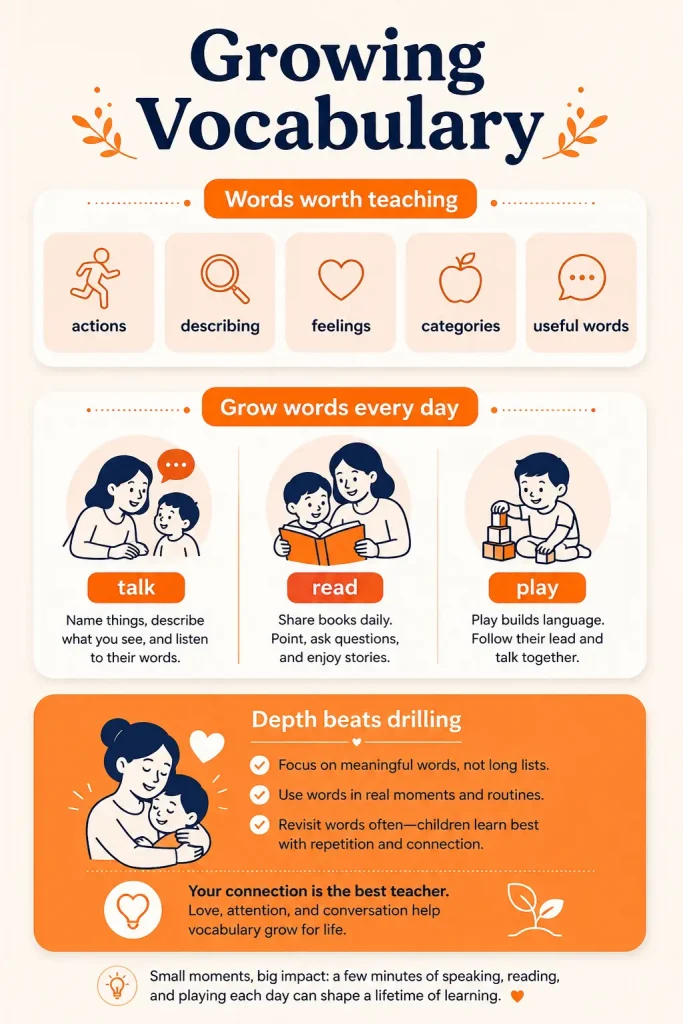
Everyday Ways to Grow Your Child’s Vocabulary
1. Talk About What Your Child Sees and Does
Use simple words during daily routines. You do not need to teach like a lesson.
During bath time, you can say, “water,” “wet,” “wash hands,” or “soap bubbles.”
During snack time, you can say, “banana,” “cut,” “more,” “finished,” or “yummy.”
Short, repeated words in real moments help your child connect words with meaning.
2. Follow Your Child’s Interest
Children learn words faster when the word is connected to something they already care about.
If your child loves cars, use car words: “go,” “stop,” “fast,” “slow,” “big car,” “red car.”
If your child loves animals, use animal words: “dog,” “jump,” “sleep,” “loud,” “soft.”
Start with what they enjoy. Then slowly add new words around it.
3. Read Together and Talk About the Pictures
Books are a simple way to introduce new words. You do not have to read every sentence.
Point to pictures and name what you see. Say things like, “The baby is sleeping,” “The dog is running,” or “Where is the ball?”
Pause and let your child point, look, gesture, or answer in their own way.
4. Add One More Word to What Your Child Says
When your child says one word, add one small idea.
If your child says “dog,” you can say, “big dog” or “dog running.”
If they say “car,” you can say, “red car” or “car go.”
This helps your child hear how words grow into short phrases.
5. Group Words Together
Help your child understand how words are connected.
You can sort toys into animals, vehicles, and food. You can also talk about opposites like big/little, hot/cold, open/closed, or fast/slow.
This helps your child build a stronger, more organized vocabulary.
6. Repeat New Words in Different Moments
Children usually need to hear a word many times before they fully understand and use it.
If you are teaching “open,” use it during snack time, playtime, dressing, and reading. Say “open the box,” “open the door,” “open your mouth,” or “open the book.”
The goal is not to test your child. The goal is to help them hear the word often in real life.
7. Keep Word Practice Playful, Not Forced
You don’t need flashcards or quizzes. Children learn words best through meaningful, repeated experiences — not by being tested. Keep it warm and playful, follow your child’s lead, and let vocabulary grow through genuine connection. If your child works with a speech therapist, these strategies sit alongside that guidance.
Common Worries About Vocabulary – and When to Seek Help
“They only use nouns — names of things.”
This is common. Nouns are easy to see, hold, and point to, so many children learn them first. To grow richer vocabulary, gently add action words and describing words during play: “car goes fast,” “dog is running,” “big ball,” “dirty hands.” Over time, these words help your child move from single labels to fuller language.
When to seek help: If your child uses very few words, is not adding new words over time, or mostly repeats labels without using words to request, comment, or connect, it may help to speak with a speech-language professional.
“They seem stuck at the same number of words.”
Vocabulary can grow in bursts. Some children stay at the same level for a while and then suddenly add many new words. Keep talking, reading, singing, and repeating useful words in daily routines. New interests can also open the door to new words.
When to seek help: If your child’s vocabulary has not grown for several months, if they seem frustrated because they cannot communicate, or if you notice they are losing words they once used, do not wait. Ask for a speech-language evaluation.
“They understand words but rarely say them.”
Many children understand more words than they can say. That understanding still matters. Keep naming, modelling, and giving your child time to respond. A word your child points to, signs, or selects on a communication device still shows meaningful vocabulary growth.
When to seek help: If the gap between understanding and speaking feels very wide, if your child struggles to follow simple directions, or if you are unsure whether they are hearing or understanding you clearly, speak with a professional. A hearing check may also be a sensible first step.
“They don’t seem interested when I teach new words.”
This often happens when the words are not connected to what the child cares about. Instead of teaching random words, start with your child’s interests. If they love animals, use animal sounds, actions, sizes, and feelings. If they love vehicles, use words like “go,” “stop,” “fast,” “slow,” “big,” and “noisy.”
When to seek help: If your child rarely responds to people, does not turn toward sounds, avoids interaction most of the time, or shows limited interest in communication across daily routines, it is worth getting guidance from a pediatrician or speech-language professional.
How the BASICS App Supports Vocabulary Practice at Home
Building vocabulary at home is easier when parents have a clear path to follow. It is common to repeat the same familiar nouns again and again, while missing action words, describing words, feeling words, and category words.
The BASICS app gives parents guided vocabulary activities for short, playful home practice. For families looking for a speech therapy app for kids or an autism app for kids, BASICS can support vocabulary learning through visuals, games, videos, and parent-led activities. It should be used as home support and does not replace professional speech-language assessment or therapy.
Guided Vocabulary Activities for Parents
Within the BASICS Communication module, the Vocabulary & Word Learning area helps parents practise words in an organised way. It includes categories, actions, describing words, concepts, and everyday words your child can use often.
Instead of giving parents a long list of random words, BASICS helps you focus on a few vocabulary goals and activities at a time. This makes home practice easier to follow, especially when you are not sure which words to teach next.
Vocabulary Valley: Word Games for Vocabulary Practice
Vocabulary Valley in BASICS is designed to make word practice more playful. Children can meet words through matching, choosing, naming, sorting, and visual activities. This kind of repeated practice helps children hear and understand words in different ways without turning learning into a drill.
For children with speech delay, autism-related communication needs, or early language difficulties, visual and repeated practice can be especially helpful when used along with parent interaction and professional guidance where needed.
Videos That Pair Words With Meaning
BASICS videos model words with pictures, actions, and simple language. This helps children connect a word with what it means. For example, a child may see an object, hear the word, and watch how the word is used.
This visual support can help children who learn better by seeing, pointing, choosing, or watching before they are ready to say the word clearly.
Printables for Hands-On Word Play
For screen-free practice, BASICS printables can help parents sort, match, name, and talk about words during simple table activities or daily routines.
You can use printables to practise categories, action words, describing words, and everyday vocabulary in a hands-on way.
Children Can Show Vocabulary in Different Ways
A child may show vocabulary by speaking, pointing, signing, choosing a picture, or using a communication device. These responses all matter.
BASICS supports parent-led practice where children can show what they understand in different ways. This makes it useful for families looking for an autism-friendly speech and language app for kids, especially when vocabulary practice needs to be visual, simple, and repeatable.
Explore Vocabulary Valley in BASICS
Use BASICS for short, guided vocabulary practice at home. Vocabulary Valley gives parents playful word-learning activities with visuals, games, videos, and printables.
For families looking for a speech therapy app for kids or an autism app for kids, BASICS can support daily speech and language practice alongside professional guidance when needed.
Try BASICS free for 7 days — no pressure, cancel anytime.
Final Thoughts on Growing Your Child’s Vocabulary
Every word your child learns is a new way to understand the world and connect with the people in it. You grow vocabulary not by testing, but by talking, reading, playing, and following your child’s curiosity — filling their days with rich, meaningful words. Keep it warm, keep it varied, and celebrate every new word, whatever form it takes. Little by little, a handful of words grows into a whole world of language.
Talk, read, play — every word opens a new door.
FAQs About Building Your Child’s Vocabulary
How can I grow my child’s vocabulary at home?
You can grow your child’s vocabulary by talking during daily routines, reading together, naming what your child sees, repeating useful words, and adding one extra word to what your child says. Keep it natural and playful. The goal is not to test your child, but to help them hear and understand words in real situations.
What words should I teach first?
Start with useful words your child can use often, such as “more,” “help,” “open,” “stop,” “eat,” “go,” and “wash.” Add action words, describing words, feeling words, and category words so your child’s vocabulary grows beyond object names.
Can a speech therapy app for autism help build vocabulary?
A speech therapy app for autism may help with vocabulary practice when it uses simple words, visuals, repetition, parent guidance, and playful activities. It should support home practice, not replace a speech-language evaluation or therapy plan when a child needs professional help.
Is BASICS an autism app for kids?
BASICS is designed to support children who need help with speech, language, communication, learning, and daily skill practice. Parents can use it as an autism app for kids when they need guided activities for vocabulary, first words, following directions, WH questions, and early communication practice.
Is an autism therapy app enough for speech delay?
No app should replace professional support when a child has speech delay, language delay, hearing concerns, regression, or ongoing difficulty communicating. An autism therapy app or speech therapy app can support home practice, but a speech-language professional can assess your child’s needs and guide the right plan.
Related Reading
- 10+ Simple Home Activities That Encourage Early Words
- Vocabulary Building Worksheets for Kids
- 15+ Vocabulary Flashcards for Kids
- How BASICS App Helps Kids Develop Speech and Language
Clinically Reviewed By
Reviewed by Anuradha Karanam, BASLP, Speech-Language Pathologist at Wellness Hub.
Anuradha supports children with speech, language, communication, and developmental needs. Her clinical work includes speech and language assessments, parent counselling, home training programs, speech sound concerns, fluency support, language comprehension and production, and communication support for children with autism and other developmental needs.
This article was reviewed for clinical accuracy, parent-friendly language, and safe home-practice guidance.
This content is for educational purposes only and does not replace professional assessment, diagnosis, or therapy.
View Anuradha Karanam’s Profile
References & Further Reading
The strategies above reflect widely used, evidence-based approaches described by the following authoritative sources.
- American Speech-Language-Hearing Association (ASHA). Activities to Encourage Speech and Language Development.
- https://www.asha.org/public/speech/development/activities-to-encourage-speech-and-language-development/
- American Speech-Language-Hearing Association (ASHA). Communication Milestones.
- https://www.asha.org/public/developmental-milestones/communication-milestones/
- National Institute on Deafness and Other Communication Disorders (NIDCD). Speech and Language Developmental Milestones.
- https://www.nidcd.nih.gov/health/speech-and-language
- Centers for Disease Control and Prevention (CDC). Developmental Milestones.
- https://www.cdc.gov/act-early/milestones/index.html
- American Academy of Pediatrics / HealthyChildren.org. Shared Reading Starting at Birth Offers Lifelong Benefits.
- https://www.healthychildren.org/English/news/Pages/beyond-literacy-shared-reading-starting-in-infancy-offers-lifelong-benefits.aspx
- Zero to Three. What Is Early Literacy?
- https://www.zerotothree.org/resource/literacy-skills-the-roots-of-reading-start-at-birth/
- Reading Rockets. Reading with Your Child.
- https://www.readingrockets.org/literacy-home/reading-your-child
- Rowe, M. L. A Longitudinal Investigation of the Role of Quantity and Quality of Child-Directed Speech in Vocabulary Development. Child Development.
- https://pmc.ncbi.nlm.nih.gov/articles/PMC3440540/
Book your Free Consultation Today
Parent/Caregiver Info:
Client’s Details:
* Error Message