Writing Skills
Enhance your child’s writing skills with our Home Therapy Resources. These tools improve handwriting, composition, and creativity, helping children express their thoughts clearly and effectively at any learning stage.

Explore the Best Writing Skills Resources for Kids
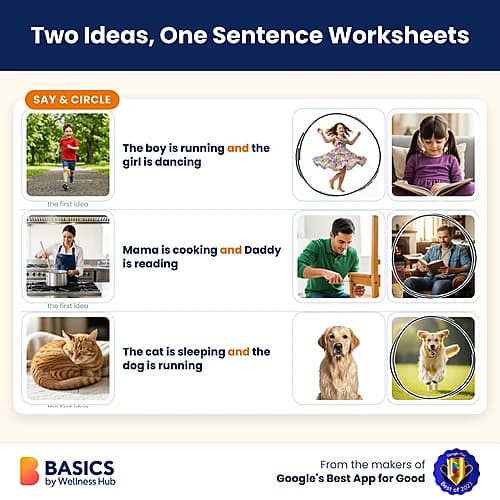
Two Ideas, One Sentence Worksheets
19 pencil worksheets for joining words — the choice always sits in the gap between two pictures — answers at the back.
₹80
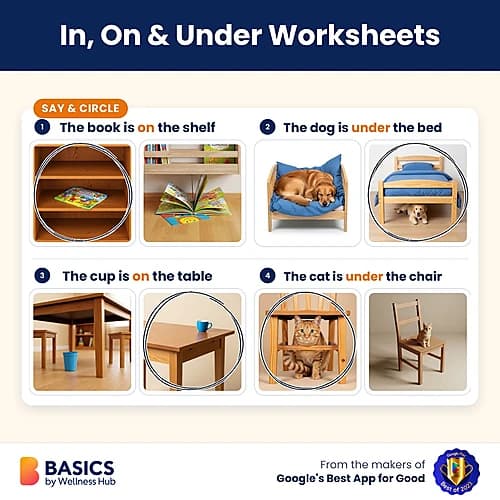
In, On & Under Worksheets
18 pencil worksheets for position words, with every answer at the back.
₹80
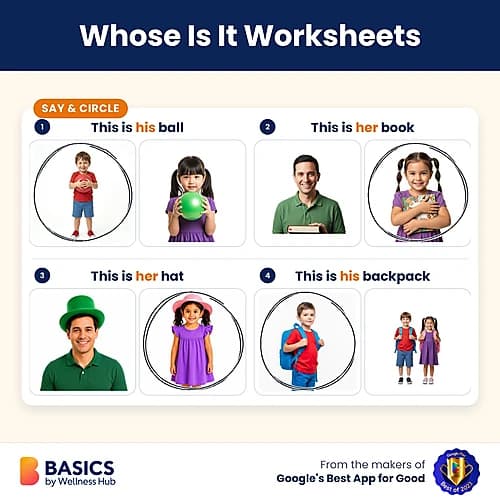
Whose Is It Worksheets
12 pencil worksheets for owner words, with every answer at the back.
₹80
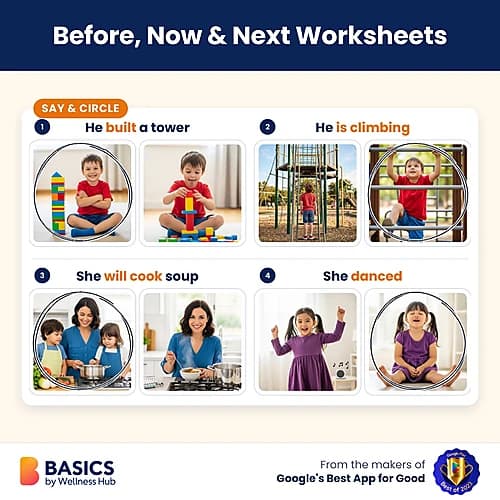
Before, Now & Next Worksheets
12 pencil worksheets for past, present and future, with every answer at the back.
₹80
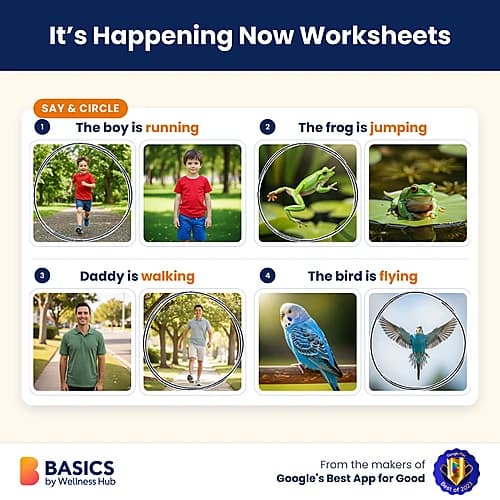
It's Happening Now Worksheets
18 pencil worksheets for -ing action words, with every answer at the back.
₹80
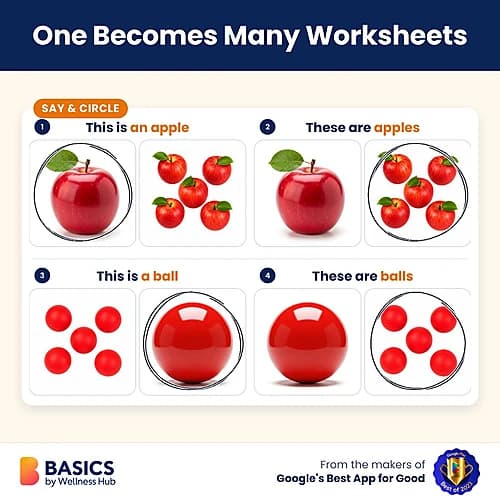
One Becomes Many Worksheets
18 pencil worksheets for plurals and counting words, with every answer at the back.
₹80
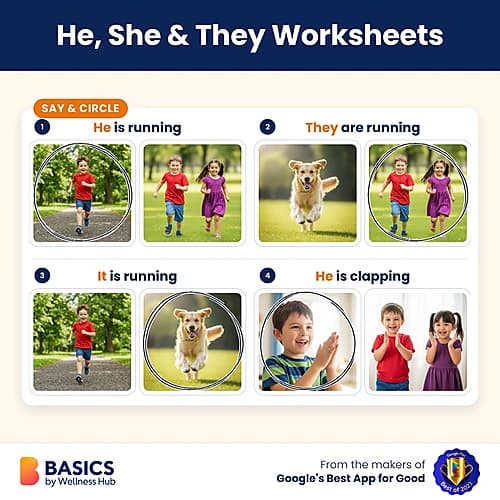
He, She & They Worksheets
18 pencil worksheets for pronouns — circle, match, finish and build, with answers at the back.
₹80
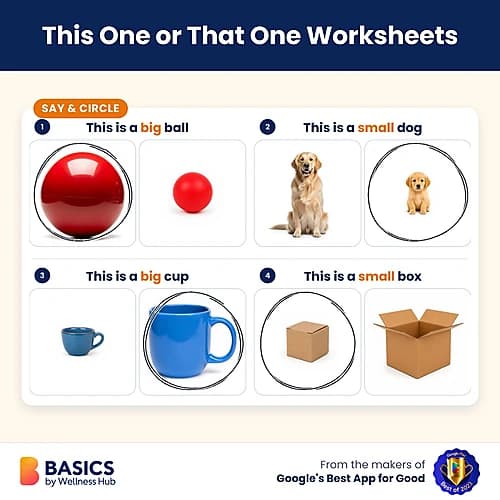
This One or That One Worksheets
18 pencil worksheets for describing words and opposites, with every answer at the back.
₹80
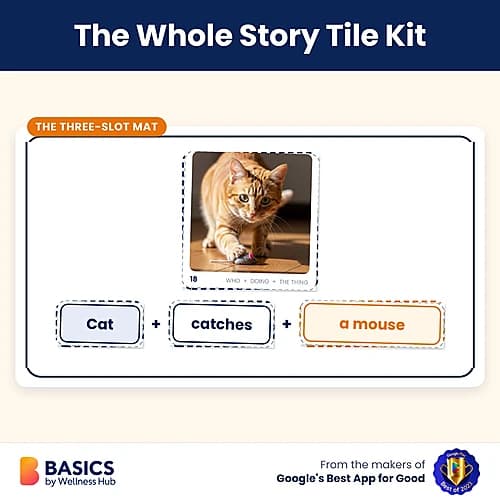
The Whole Story Tile Kit
A three-slot sentence mat with 120 word tiles — each slot a different shape, so a tile either fits or it's in the wrong place.
₹80
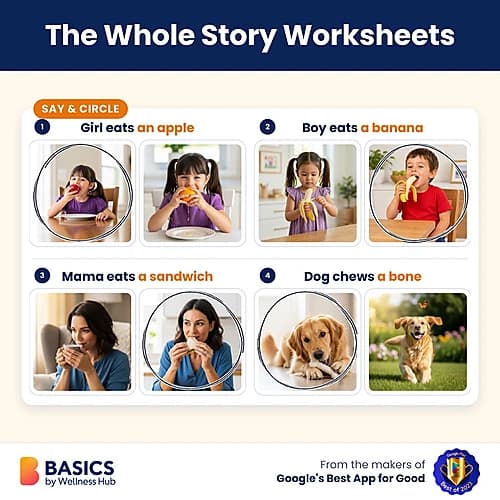
The Whole Story Worksheets
18 pencil worksheets for who + doing + what sentences, with every answer at the back.
₹80
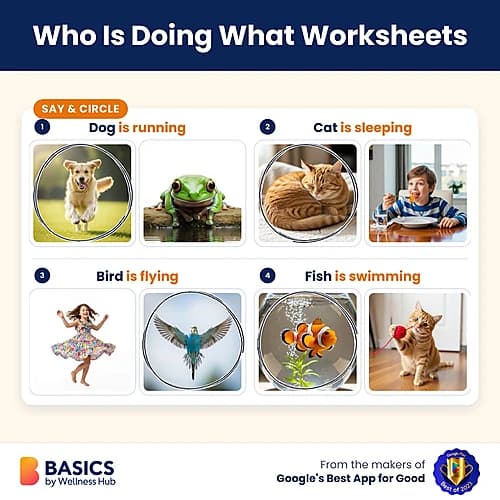
Who Is Doing What Worksheets
18 pencil worksheets for two-word sentences — circle, match, finish, cut and build — answers at the back.
₹80
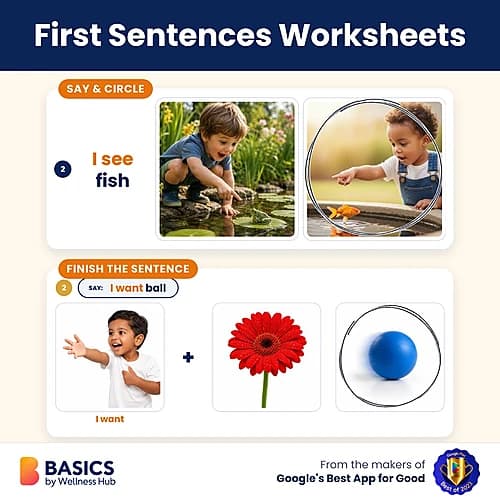
First Sentences Worksheets
18 printable worksheets to build three-word sentences on paper — starters matched, missing words found.
₹80

One or Many: Fill In
Fill in the singular or plural form from the picture.
₹80

Is or Will? Practice
Practise is and will across everyday actions.
₹80

Is or Will? Fill In
Fill in is or will — now or later.
₹80

Is or Are? Girl: Sentences
Write full sentences — the girl is, the girls are.
₹80

Is or Are? Colours: Sentence
Write colour sentences with is or are.
₹80

Is or Are? Boy: Sentences
Write full sentences — the boy is, the boys are.
₹80

Is or Are? Write Sentences
Choose and write the correct is/are sentence.
₹80

Plurals -ves: Fill In
Words that change f to -ves — leaf, leaves.
₹80

Plurals -oes: Fill In
Words that add -oes — tomato, tomatoes.
₹80

Plurals -ies: Fill In
Words that change y to -ies — baby, babies.
₹80

Plurals -es: Fill In
Words that add -es — bus, buses; box, boxes.
₹80

Opposites: Write Sentences
Write a sentence using the opposite shown in each picture.
₹80

Opposites: Write the Word
Write the opposite word under each picture.
₹80

I, You, We: Sentence
Write a sentence with I, you or we.
₹80

I, You, We: Worksheets
Learn I, you and we through everyday pictures.
₹80

He, She, They, It: Sentence
Write the full sentence with the right pronoun.
₹80

He, She, They, It: Write
Write the right pronoun under each picture.
₹80

These & Those: Sentence 2
A second set — write sentences with these or those.
₹80

These & Those: Tick 3
A third set — tick these or those for each picture.
₹80

These & Those: Sentence
Write the full sentence with these or those.
₹80

These & Those: Write Word
Write these or those under each picture.
₹80

This & That: Pick Sentence
Select and write the correct this/that sentence.
₹80

This & That: Write Word 2
Write the right pronoun — this or that.
₹80

This & That: Write Sentence
Write the full sentence with this or that.
₹80

This & That: Write Word
Write this or that under each picture.
₹80

That & Those: Write
Write sentences using that and those.
₹80

That & Those: Fill In
Fill in that or those in each sentence.
₹80

This & These: Build
Build a sentence with this or these.
₹80

This & These: Write
Write this or these under each picture.
₹80

In Front & Behind: Write
Write sentences using in front of and behind.
₹80

In Front & Behind: Circle
Circle in front or behind in each sentence.
₹80

On & Under: Write
Write on or under to complete each sentence.
₹80

Near & Far: Write
Write sentences using near and far.
₹80

Near & Far: Fill In
Fill in near or far in each sentence.
₹80

Inside & Outside: Write
Write sentences using inside and outside.
₹80

Inside & Outside: Worksheet
Mark inside or outside and say the sentence.
₹80

Colours: Spot & Write
Spot the colour, then write its name.
₹80

Colours: Name & Write
Name the colour and write it under each object.
₹80

Action Words: Fill In
Fill in the missing action word under each picture.
₹80
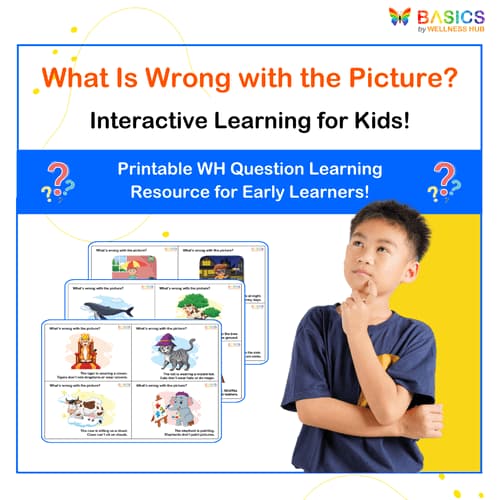
What's Wrong Here?
Spot what is wrong in each picture and say why.
₹80

What Do You Do There?
Say what you do at each place — at the park, at school.
₹80

What Do You Do With It?
Say what each object is for — a spoon is for eating.
₹80

What Are They Doing? Mixed
He, she, it and they — mixed what-doing questions.
₹80

What Are They Doing?
Answer what are they doing with group action pictures.
₹80

What Is It Doing?
Answer what is it doing with animal action pictures.
₹80

What Is She Doing?
Answer what is she doing with action pictures — builds verbs and sentences.
₹80

What Is He Doing?
Answer what is he doing with action pictures — builds verbs and sentences.
₹80

What Are These? Vegetables
Ask and answer what are these and those with vegetables.
FREE

What Are These? Toys
Ask and answer what are these and those with toys.
FREE

What Are These? School Things
Ask and answer what are these and those with school items.
FREE

What Are These? Home Things
Ask and answer what are these and those with household items.
FREE

What Are These? Animals
Ask and answer what are these and those with animals.
₹80

What Are These? Fruits
Ask and answer what are these and those with fruits.
₹80
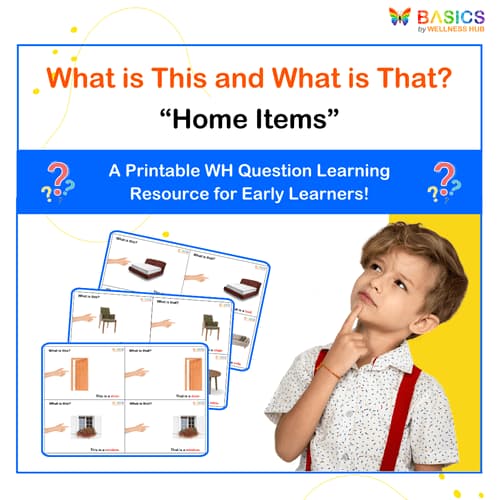
What Is This? Home Things
Ask and answer what is this and what is that with home items.
₹80

What Is This? School Things
Ask and answer what is this and what is that with school items.
₹80

What Is This? Fruits
Ask and answer what is this and what is that with fruits.
₹80

What Is This? Vegetables
Ask and answer what is this and what is that with vegetables.
FREE

What Is This? Toys
Ask and answer what is this and what is that with toys.
FREE

What Is This? Animals
Ask and answer what is this and what is that with animals.
₹80
Detailed Description
Introduction to Writing Skills Resources
Writing skills are essential for children’s literacy development, self-expression, and academic success. From learning how to form letters to composing sentences and creating stories, writing enables children to communicate ideas effectively. Our writing skills resources are designed to help children practice fine motor control, letter formation, sentence structure, and creative writing, supporting each step of their writing journey. With engaging, easy-to-use materials, these resources empower parents, educators, and therapists to support children’s development in a structured yet fun way.
How Our Resources Aid in Writing Skill Development
Our writing skills resources are carefully crafted to build foundational writing abilities in children. Activities such as tracing, letter formation, sentence building, and storytelling exercises foster fine motor skills, encourage creativity, and reinforce grammar and syntax. These resources provide guided practice that helps children learn to form letters, structure sentences, and express their thoughts in writing. Each tool is designed to make writing practice engaging and manageable, allowing children to build skills progressively and with confidence.
Types of Writing Skills Resources We Offer
Letter Formation and Tracing Cards: Our letter formation and tracing cards help children practice forming each letter of the alphabet. These cards guide children through the correct stroke order, making it easier to learn proper handwriting techniques. Practicing with tracing cards strengthens fine motor control, which is essential for writing fluency.
Sentence Building and Structure Cards: Sentence building cards introduce children to sentence structure and syntax. By arranging words to form sentences, children learn about grammar, word order, and punctuation. These activities help children understand how to construct sentences that convey complete thoughts, supporting language development and writing confidence.
Creative Writing Prompts: Creative writing prompts encourage children to use their imagination and express ideas freely. Each prompt provides a topic or scenario, inviting children to write sentences or short stories. This activity promotes self-expression, critical thinking, and creativity while helping children practice writing in a structured way.
Fine Motor Skill Development Activities: Creative writing prompts encourage children to use their imagination and express ideas freely. Each prompt provides a topic or scenario, inviting children to write sentences or short stories. This activity promotes self-expression, critical thinking, and creativity while helping children practice writing in a structured way.
Who Can Use These Resources?
Our writing skills resources are versatile and beneficial for a wide range of users:
Parents: Use these resources at home to help children practice writing in a relaxed, supportive setting.
Teachers: Incorporate writing exercises into the classroom to strengthen students’ writing skills and support literacy goals.
Therapists: Utilize these tools in therapy sessions for targeted practice, especially helpful for children with fine motor or writing challenges.
These resources are designed to be user-friendly and adaptable, providing effective tools for anyone working to support a child’s writing development.
Benefits of Writing Skills Activities at Home
Practicing writing skills activities at home allows children to build essential skills in a comfortable, familiar environment. These resources enable parents to reinforce school-based learning, focusing on fine motor control, letter formation, and creative expression. For children with specific needs, such as those with dysgraphia or fine motor delays, these activities offer structured, repetitive practice that strengthens handwriting fluency and confidence. By making writing practice part of daily routines, parents can help foster a positive attitude toward writing and academic growth.
Tips for Using Writing Skills Resources Effectively
Using our writing skills resources effectively can make learning to write enjoyable and successful for your child. Here are some practical tips:
Start with Letter Tracing: Begin with letter tracing activities to help children learn proper letter formation. This creates a solid foundation for handwriting and builds confidence.
Encourage Creativity with Writing Prompts: Allow children to use creative writing prompts to express their ideas. Encourage them to think freely and explore topics that interest them, which fosters a positive attitude toward writing.
Incorporate Fine Motor Practice: Writing requires fine motor control, so incorporate activities like threading or lacing to strengthen hand muscles. This extra practice makes handwriting feel easier and more natural.
Make Writing a Fun Routine: Incorporate short, daily writing sessions to create a routine. Gradual, consistent practice will build fluency over time without overwhelming your child.
Praise Effort and Progress: Celebrate each accomplishment, no matter how small. Positive reinforcement can help your child feel proud of their efforts and stay motivated to improve.
Real-Life Examples of Writing Skills Development with Our Resources
Our writing skills resources are designed to be practical and engaging, helping children build strong writing skills. Here are a few examples:
Developing Fine Motor Skills with Tracing Cards: A parent might use Letter Tracing Cards with their child to practice the alphabet. By following the stroke order, the child learns letter shapes and builds muscle memory, laying the groundwork for clear and fluent handwriting.
Building Sentences with Sentence Structure Cards: A teacher might use Sentence Building Cards in the classroom to teach sentence structure. By arranging words to form sentences, children learn grammar rules and gain confidence in creating complete sentences.
Fostering Creativity with Writing Prompts: A therapist could introduce Creative Writing Prompts to help a child with expressive language skills. By writing stories based on fun prompts, the child learns to organize thoughts and express ideas, which improves writing fluency and critical thinking.
Improving Hand Strength with Fine Motor Activities: For children struggling with writing control, parents can use fine motor activities like lacing and sorting. These exercises build the hand strength and dexterity needed for more precise handwriting.
These examples demonstrate how our resources can support different aspects of writing development, from forming letters to building sentences and nurturing creativity.
FAQs
Q1: How do I start using these resources with my child?
A1: Start with letter tracing cards to help your child learn proper letter formation. As they gain confidence, introduce sentence-building and creative writing prompts for more advanced practice.
Q2: Which resources are best for building sentence structure?
A2: Our Sentence Building and Structure Cards are perfect for teaching sentence formation. They guide children in arranging words to create complete sentences, supporting both grammar and fluency.
Q3: How often should I use these activities?
A3: Consistent practice is key. Short, daily sessions of 10–15 minutes work well for younger children. Gradually increase frequency and length based on your child’s comfort and progress.
Q4: Are these resources suitable for children with fine motor challenges?
A4: Yes, our resources include fine motor development activities that help strengthen hand muscles, making it easier for children with fine motor challenges to improve their writing control.
Related Topics and Further Learning for Parents
For parents interested in expanding their child’s writing skills, the BASICS app offers additional resources and courses that can support literacy development:
Letter Formation and Handwriting: A course that explores the unique communication styles of children with autism and offers strategies for building language and social skills.
Building Sentence Structure and Grammar Skills: Resources and activities focused on teaching grammar, punctuation, and the structure of sentences to support clear writing.
Fine Motor Skills for Writing: Guidance on fine motor activities that strengthen hand control, making handwriting easier and more enjoyable.
Creative Writing and Storytelling: A course designed to encourage children to explore their imagination and develop expressive writing skills.
These resources provide a comprehensive approach to writing development, equipping parents with tools to support their child’s literacy journey with confidence.
