


First Sentences Worksheets — 18 Printable Three-Word Sentence Worksheets for Early Talkers
₹80
₹160
You save ₹80
5 (33 ratings)
Grade Levels
Pre-K – Kindergarten (Ages 4–6)
Content Overview
Format: PDF | Pages: 24 | Features: 18 worksheets for three-word sentences, fine motor skills, and matching activities
Categories
Share


About the Product
Introduction
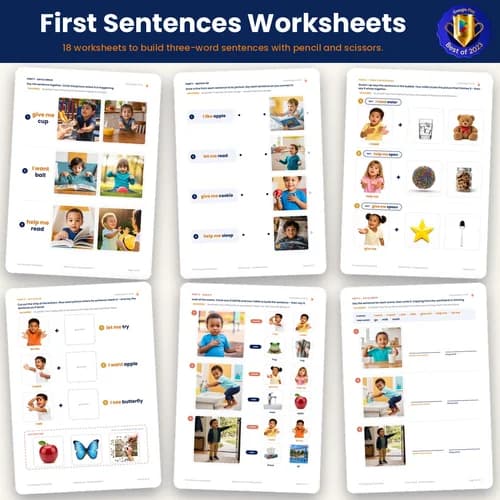
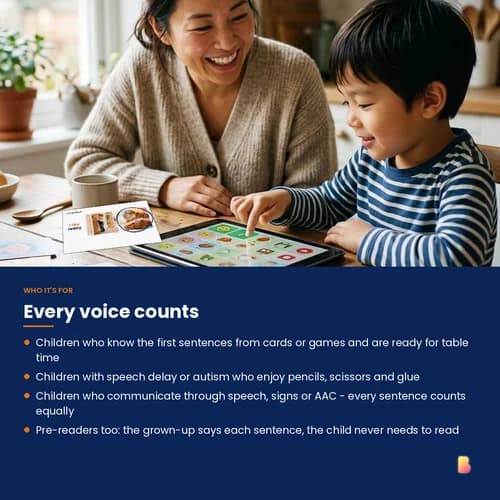
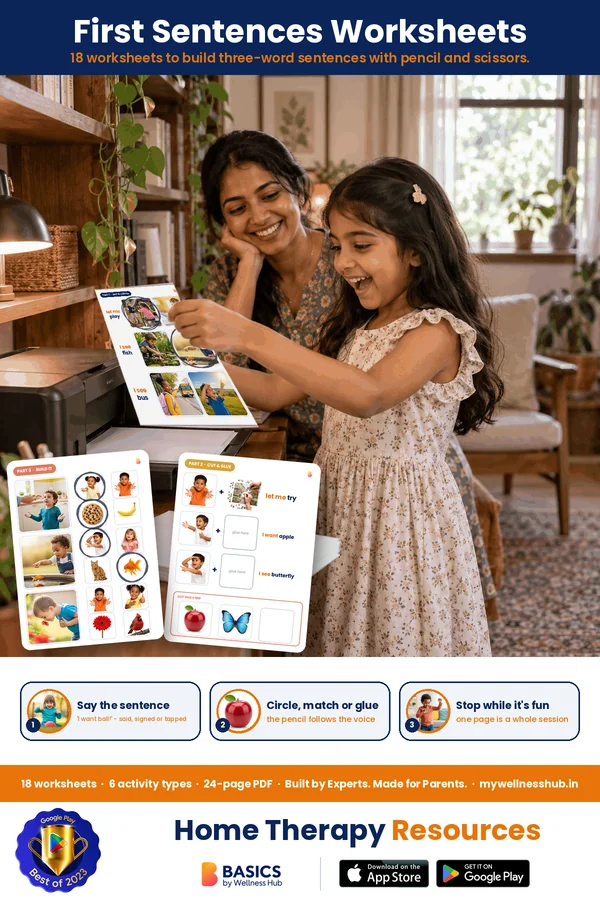
Three-word sentence worksheets are a practical and engaging way to help children strengthen their early communication skills. This 24-page printable and screen-friendly PDF is designed for young learners who are ready to move beyond simple phrases, including children with speech delay, autism, or those using AAC or sign language. With 18 worksheets and 54 sentence items, it offers structured table-time practice for building expressive language.
Children will develop sentence building skills by working with seven two-word sentence starters, such as I want, I need, and I see. Activities include saying a sentence while matching it to a picture, listening for a sentence and choosing the correct image, and building sentences from a starter and a thing word. These tasks support measurable progress in expressive language and sentence construction.
Parents, teachers, and therapists can use these worksheets in a variety of settings, including home, classroom, and therapy sessions. Each worksheet encourages participation and confidence, making it easy to adapt for individual or small group work. The resource also supports first sentence writing, making it a versatile tool for different learning environments.
Product Details
- Resource Name: Three-Word Sentence Worksheets for Early Communication
- Format: Printable and screen-ready PDF
- Total Pages: 24
- Grade Level: Pre-K, Kindergarten, Early Elementary
- Designed For: Children with speech delay, autism, AAC users, and early communicators
- Printing Notes: Optional—works on screen or printed
- Best Used In: Home, classroom, therapy
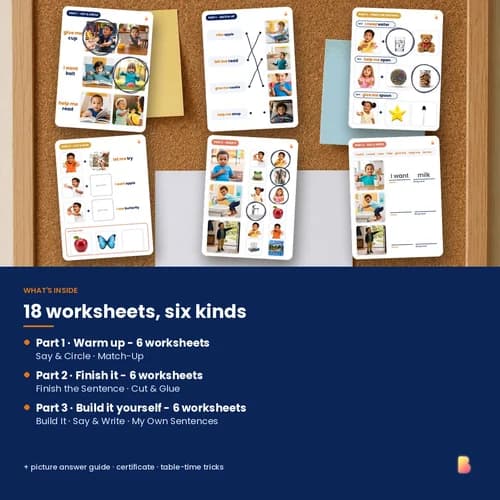
- Sets / Activities: 18 worksheets, 6 activity types, 54 sentence items
- Visuals / Illustrations: Child-friendly images for matching and sentence building
Educational Benefits
1. Expressive Language Expansion
- Children practice forming three-word sentences using familiar starters and objects.
- Activities support expressive language growth in a structured, visual format.
- Primary_keyword helps bridge the gap from single words to short phrases.
2. Sentence Building and Syntax Skills
- Learners build sentences by combining two-word starters with target nouns or verbs.
- This strengthens understanding of word order and basic grammar rules.
- Repetition across varied worksheet types reinforces sentence construction.
3. Listening and Comprehension Practice
- Tasks require children to listen for a spoken sentence and select the matching picture.
- This boosts auditory discrimination and receptive language abilities.
- Consistent practice improves following directions and understanding spoken cues.
4. Fine Motor and Early Writing Development
- Cutting, gluing, and tracing activities develop fine motor control.
- Children gain confidence in using scissors and pencils during table-time sessions.
- These skills support readiness for more advanced writing tasks.
5. AAC and Sign Language Parity
- All activities are accessible for AAC users and children who communicate by signs.
- Visual supports and clear instructions ensure full participation for diverse learners.
- Lsi_terms[4] is naturally integrated, supporting inclusive communication strategies.
Instructions for Use
Step 1: Gather and Prepare Materials
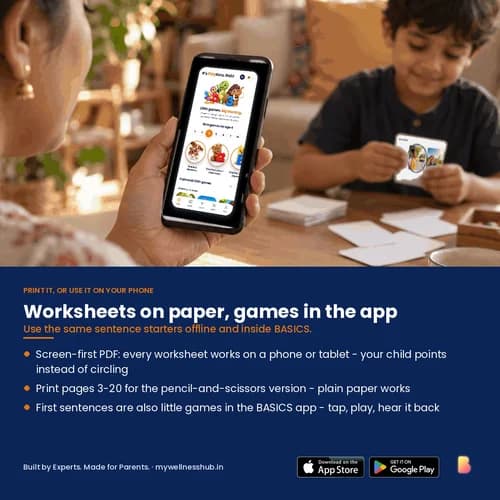
- Print selected worksheets or open the PDF on a tablet or computer.
- Choose one worksheet per session for focused practice.
- Laminate pages for repeated use if desired.
Step 2: Introduce the Sentence Starters
- Review the seven two-word starters with the child before beginning.
- Model examples such as "I want ball" or "I see fish."
- Lsi_terms[0] is introduced naturally during this step.
Step 3: Guide the Child Through the Activity
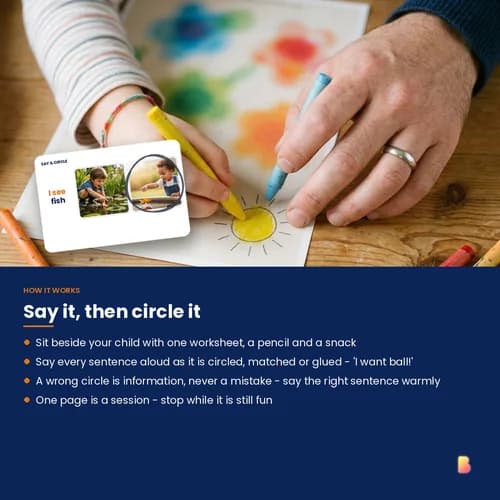
- Sit beside the child and read each instruction aloud.
- Encourage them to say the sentence as they circle, match, or glue.
- Offer prompts or choices as needed for support.
Step 4: Practice Listening and Matching
- Say a three-word sentence and have the child select the correct picture.
- Rotate between listening and speaking tasks for varied practice.
- Lsi_terms[2] is practiced through these matching activities.
Step 5: Support Cutting and Gluing Tasks
- Provide safety scissors and glue for cut-and-paste worksheets.
- Guide the child as they cut out and place sentence pieces correctly.
- Supervise closely to ensure safe and accurate work.
Step 6: Encourage Sentence Writing and Personalization
- Help the child use the word bank to write their own simple sentences.
- Celebrate their efforts with the included certificate or positive feedback.
- Revisit favorite worksheets for ongoing skill reinforcement.
Activities Using the Resource
1. Say and Circle Three-Word Sentences
Objective: To build confidence using three-word sentence starters and matching them to pictures.
How to Play:
- Present a worksheet with sentence options and related images.
- Read each three-word sentence aloud, such as "I want ball."
- Have the child circle the picture that matches the sentence.
Skill Development:
- Strengthens sentence-to-image association
- Improves expressive language with primary_keyword
- Builds attention to detail
2. Match-Up Sentence Starters and Objects
Objective: To reinforce understanding of sentence structure by connecting starters to correct items.
How to Play:
- Show a worksheet with two-word starters and a set of objects.
- Ask the child to draw lines from each starter (e.g., "I see") to the matching object (e.g., fish).
- Encourage the child to say each full three-word sentence aloud.
Skill Development:
- Enhances sentence building skills
- Promotes visual scanning and matching
- Supports comprehension of lsi_terms[0] patterns
3. Finish the Sentence Listening Game
Objective: To boost auditory comprehension and sentence completion using familiar language.
How to Play:
- Read a partial sentence, like "I need ___," and offer picture choices.
- The child listens and selects the image that completes the sentence.
- Have them repeat the full sentence after choosing.
Skill Development:
- Develops listening accuracy
- Practices primary_keyword in context
- Encourages turn-taking in communication
4. Cut and Glue Sentence Builder
Objective: To practice assembling sentences and improve fine motor skills.
How to Play:
- Provide a worksheet with cut-out words and blank sentence frames.
- The child cuts out the words and glues them in order to form a complete sentence.
- Read the finished sentence together, pointing to each word.
Skill Development:
- Builds sequencing and word order understanding
- Strengthens lsi_terms[2] manipulation
- Refines scissor and gluing skills
5. Build It with Word Bank
Objective: To support independent sentence construction using visual word prompts.
How to Play:
- Show a worksheet with a word bank and empty sentence starters.
- The child selects words to complete each starter, forming a full sentence.
- Encourage reading each new sentence aloud.
Skill Development:
- Fosters sentence creation from lsi_terms[4] options
- Increases vocabulary flexibility
- Encourages self-directed learning
6. Say and Write My Own Sentences
Objective: To encourage expressive language by writing and saying original three-word sentences.
How to Play:
- Offer a worksheet with blank lines and a visual word bank.
- Guide the child to choose words and write their own sentences.
- Have them say each sentence after writing.
Skill Development:
- Promotes early writing and spelling
- Strengthens expressive use of primary_keyword
- Builds confidence in independent communication
Frequently Asked Questions
Q1: What age group or developmental level are the Three-Word Sentence Worksheets for Early Communication designed for?
A1: These worksheets are ideal for children in Pre-K, Kindergarten, and early elementary grades who have mastered basic two- and three-word phrases. They are especially helpful for early communicators, including those with speech delay, autism, or using AAC. Children ready for short table-time activities and familiar with simple sentence starters will benefit most.
Q2: Can I use these worksheets in a classroom group setting?
A2: Yes, these worksheets are suitable for small group or classroom instruction. The structured activities allow for turn-taking, peer modeling, and collaborative practice with three-word sentence starters. For best results, assign one worksheet per child and encourage group discussion of answers.
Q3: Are these worksheets appropriate for speech therapy sessions?
A3: Absolutely, these worksheets are designed to support speech therapy goals. They target expressive language, sentence building, and the use of sentence starters, which are common objectives in speech therapy. Therapists can adapt the pace and support level based on each child's needs.
Q4: What is the best way to print and prepare these worksheets for repeated use?
A4: Print the worksheets on standard A4 or letter-size paper, and laminate them for durability if you plan to reuse them. Laminated sheets work well with dry-erase markers for repeated practice. You can also cut and store individual activity cards for easy access during sessions.
Q5: How do these worksheets support children with special needs or those requiring differentiation?
A5: The resource is fully accessible for children with speech delay, autism, or those using AAC or sign language. Visual supports, clear instructions, and multiple activity types ensure all learners can participate at their own level. You can provide extra modeling, choices, or physical prompts as needed.
Q6: Can these worksheets be used digitally without printing?
A6: Yes, every worksheet includes a tip for on-screen use, making them suitable for tablets, computers, or phones. Children can point, trace, or verbally respond to activities displayed on a screen. This flexibility is ideal for teletherapy or classrooms with limited printing resources.
Q7: What specific skills and learning goals do these worksheets target?
A7: The worksheets build expressive language, sentence construction, and early writing skills using three-word sentence starters and objects. They also strengthen listening comprehension, matching, and fine motor abilities through varied activity types. Consistent practice with these materials helps children generalize sentence patterns in daily communication.
Q8: What are the licensing and usage rights for these worksheets from Wellness Hub?
A8: When you purchase this resource, you receive a single-user license for personal, classroom, or therapy use. Sharing, reselling, or distributing the file to others is not permitted. For multi-user or school-wide licensing, please contact Wellness Hub directly.
Q9: How do I receive and download my Three-Word Sentence Worksheets after purchase?
A9: After purchase, you will receive an instant download link via email and in your Wellness Hub account. The PDF is ready for immediate use on any device or for printing. If you have trouble accessing your file, Wellness Hub's support team can assist promptly.
Q10: What is Wellness Hub's refund or exchange policy for digital resources?
A10: Wellness Hub does not offer refunds or exchanges on digital PDF resources once downloaded. This policy ensures the integrity of digital content and licensing. If you encounter a technical issue or receive the wrong file, contact support for a prompt resolution.
Usage Rights and Restrictions
Allowed Usage:
- Personal use by parents, teachers, and therapists.
- Printable for classroom, home, or therapy settings.
- Can be used in group or one-on-one learning sessions.
Not Allowed:
- Reselling, redistributing, or modifying the resource for commercial use.
- Sharing publicly (e.g., on blogs, social media, or websites) without permission.
- Uploading the file to public sharing platforms.
If you need a bulk license for schools or therapy centers, please contact us.
Conclusion
Three-Word Sentence Worksheets for Early Communication offer targeted support for children building foundational language skills, especially those with speech delay, autism, or who use AAC. These 24 pages of printable and digital activities are designed for parents, teachers, and therapists seeking structured, accessible practice for early communicators ready to move beyond simple phrases.
Children strengthen sentence building and expressive language as they work through engaging tasks at home, in classrooms, or during therapy. The resource nurtures confidence and independence by providing opportunities for first sentence writing and encouraging the use of a word bank.
Start using Three-Word Sentence Worksheets for Early Communication today to help your child or student develop clear, confident communication and essential language skills for lifelong learning.