

Whose Is It Worksheets — 12 Printable Possessives Worksheets (74 His, Her and Their Activities)
₹80
₹160
You save ₹80
4.9 (41 ratings)
Grade Levels
Pre-K – Kindergarten (Ages 4–7)
Content Overview
Format: PDF | Pages: 18 | Features: 12 worksheets for possessive pronouns, fine motor skills, sentence building
Categories
Share


About the Product
Introduction
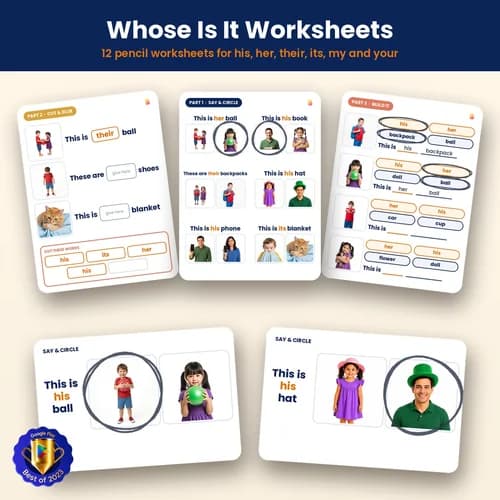
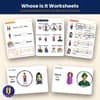
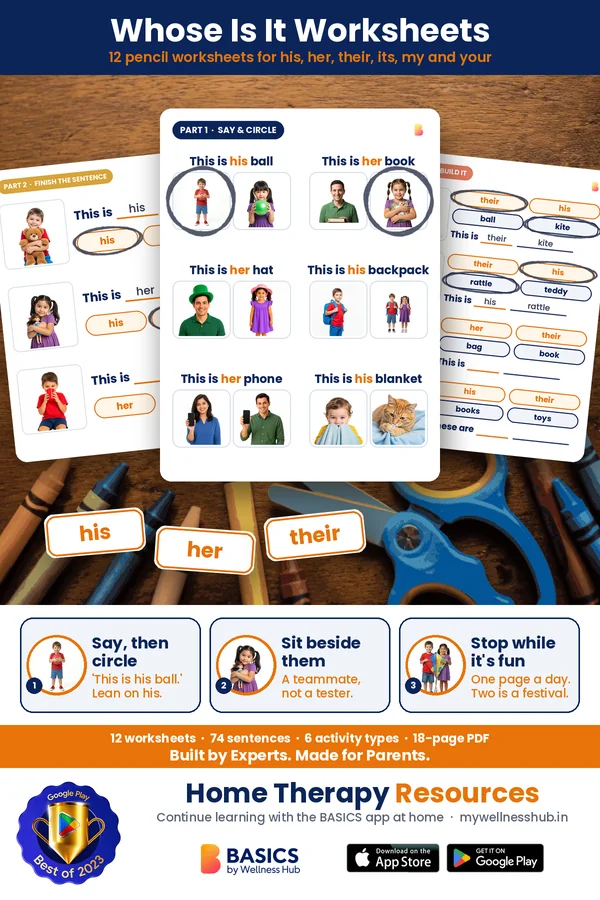
The Possessive Pronouns Worksheets: His, Her, Their, Its, My, Your PDF is a comprehensive digital resource designed for children building early grammar skills. This 18-page printable and screen-friendly set features 12 engaging pencil worksheets that help kids practice using owner words in real sentences. Created for young learners, including those with speech delay, autism, or who use AAC, these worksheets make learning possessive pronouns fun and accessible.
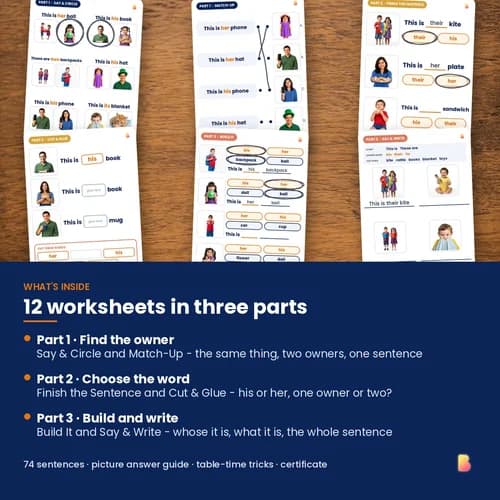
Children will develop strong skills in distinguishing his versus her and understanding one owner versus two by working through activities like Say & Circle, Match-Up, and Finish the Sentence. Each worksheet guides kids to recognize, say, and write sentences such as This is his ball or These are their backpacks, supporting measurable progress in language and early writing. The consistent structure and visual cues help learners gain confidence and independence with possessive pronouns.
Families, teachers, and therapists can use these worksheets during table time, in speech sessions, or at home for extra practice. The activities support early pencil and scissor work, making them ideal for a range of settings, including special education and inclusive classrooms. The resource also includes a picture answer guide, table-time tricks, and a Certificate of Sentence Power to celebrate each child's progress.
Product Details
- Resource Name: Possessive Pronouns Worksheets: His, Her, Their, Its, My, Your PDF
- Format: Printable and screen-ready PDF
- Total Pages: 18
- Grade Level: Pre-K, Kindergarten, Grade 1
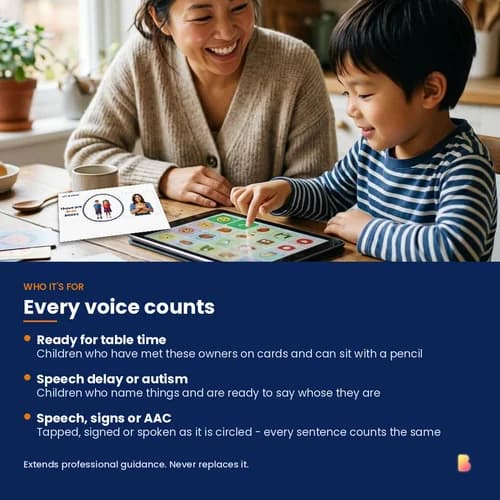
- Designed For: Early learners, speech delay, autism, AAC users
- Printing Notes: Color-coded owner words (orange) and text (navy); works on devices or printed
- Best Used In: Home, classroom, speech therapy, special education
- Sets / Flashcards / Activities: 12 worksheets, 6 worksheet types in 3 parts
- Visuals / Illustrations: Picture cues and answer guide included
Educational Benefits
1. Possessive Pronoun Mastery
- Children learn to identify and use possessive pronouns in context.
- Activities reinforce the difference between his, her, their, its, my, and your.
- Kids gain confidence in recognizing owner words within real sentences.
2. Sentence Construction Skills
- Learners build complete sentences using visual and written prompts.
- Practice with This is versus These are supports early grammar development.
- The primary_keyword supports structured language growth in every worksheet.
3. Visual Discrimination and Matching
- Students distinguish between similar objects by focusing on owner cues.
- Matching tasks help children spot subtle differences, boosting attention to detail.
- Visual cues and color coding make activities accessible for all learners.
4. Early Writing and Fine Motor Practice
- Cutting, circling, and writing exercises develop pencil control and scissor skills.
- Children copy sentences, supporting first writing experiences.
- These activities prepare kids for more advanced writing and classroom tasks.
5. AAC and Inclusive Communication Support
- Full AAC parity ensures every voice counts, including nonverbal communicators.
- The resource supports children who use signs or alternative communication devices.
- Instructions and visuals are accessible for a range of learning needs.
Instructions for Use
Step 1: Download and Print the Worksheets
- Access the PDF and print desired pages in color for best results.
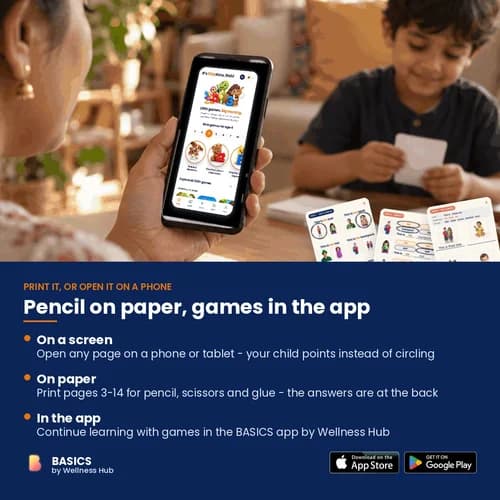
- Use standard paper or display on a tablet for screen-based work.
- Laminate pages for repeated use with dry-erase markers.
Step 2: Introduce the Owner Words
- Review the owner words (his, her, their, its, my, your) before starting.
- Show examples using the included picture cues.
- Emphasize possessive pronouns in each sample sentence.
Step 3: Guide Through Say & Circle Activities
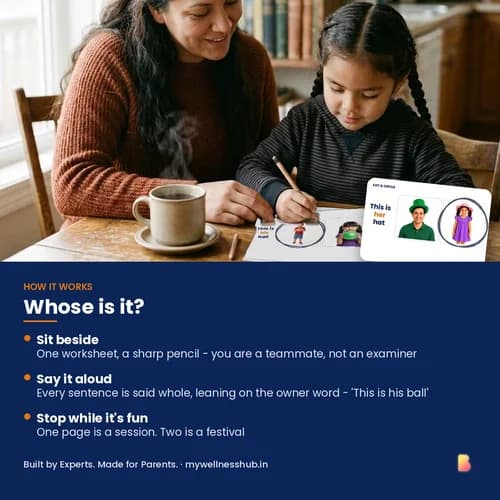
- Encourage the child to say each sentence aloud and circle the correct owner word.
- Support them in distinguishing between one owner and two.
- For screen use, have the child point instead of circling.
Step 4: Facilitate Cut & Glue and Writing Tasks
- Assist with cutting out owner words and gluing them into sentences.
- Prompt the child to copy or build sentences using the word bank.
- Early pencil and scissor work is practiced in this step.
Step 5: Use the Answer Guide and Table-Time Tricks
- Refer to the picture answer guide for quick checks and support.
- Apply table-time tricks like the warm-up lap or saying it wrong on purpose.
- Keep sessions short and positive to maintain engagement.
Step 6: Celebrate Progress and Next Steps
- Award the Certificate of Sentence Power when worksheets are complete.
- Discuss what comes next, such as moving to Whose Is It Flip Cards.
- Encourage continued practice with new sentence-building activities.
Activities Using the Resource
1. Owner Word Circle Game
Objective: To accurately identify and circle the correct owner word in sentences using possessive pronouns.
How to Play:
- Present a worksheet with sentences like "This is his ball" or "These are their backpacks."
- Ask the child to say each sentence and circle the owner word (his, her, their, its, my, your).
- Use color cues to help distinguish each owner word.
Skill Development:
- Builds possessive pronoun recognition in context.
- Strengthens visual discrimination between similar words.
- Supports early reading comprehension.
2. Picture-to-Sentence Match-Up
Objective: To connect visual cues with the correct possessive pronoun and sentence structure.
How to Play:
- Show two similar pictures (e.g., one boy's backpack, two children's backpacks).
- Have the child match each picture to its sentence, focusing on owner words like his and their.
- Encourage the child to explain their choice.
Skill Development:
- Enhances picture-to-text association.
- Promotes reasoning about one owner versus two.
- Develops language for describing ownership.
3. Finish the Sentence Cut & Glue
Objective: To complete sentences by choosing and attaching the correct owner word.
How to Play:
- Provide sentence frames with missing owner words and a set of cut-out options.
- The child selects, cuts, and glues the right word into each sentence (e.g., "This is ___ ball").
- Read the finished sentences together for reinforcement.
Skill Development:
- Practices fine motor skills with cutting and gluing.
- Reinforces sentence construction with possessive pronouns.
- Improves attention to sentence meaning.
4. Build and Write the Sentence
Objective: To construct and write full sentences using owner words and object names.
How to Play:
- Show a picture and a word bank including owner words and object names.
- The child circles whose it is, then what it is, and writes the complete sentence.
- Use prompts like "This is her pencil" or "These are their books."
Skill Development:
- Encourages independent sentence building.
- Supports spelling and handwriting practice.
- Develops understanding of matching owner and object.
5. My and Your Sentence Practice
Objective: To distinguish between my and your in personal and directed sentences.
How to Play:
- Present pairs of sentences: one about the child (my), one about the listener (your).
- Have the child copy or build each sentence using the word bank.
- Practice saying both sentences aloud, emphasizing the owner word.
Skill Development:
- Teaches first-person and second-person possessive use.
- Builds confidence in sentence copying and writing.
- Strengthens oral language for social interaction.
6. AAC & Sign Support Matching
Objective: To ensure all learners, including AAC users, can match owner words to pictures.
How to Play:
- Show a picture and give owner word choices (his, her, their, its, my, your).
- The child points, signs, or selects the correct owner word for each image.
- Celebrate every correct response, using the answer guide for support.
Skill Development:
- Promotes inclusive communication strategies.
- Reinforces owner word understanding across modalities.
- Encourages participation for nonverbal and verbal learners.
Frequently Asked Questions
Q1: What age group and learning level are these possessive pronoun worksheets designed for?
A1: These worksheets are designed for children ages 4–7, typically in Pre-K, Kindergarten, and Grade 1. The activities use simple sentences and clear visuals, making them accessible for early learners and those new to possessive pronouns. Children with speech delay, autism, or AAC needs also benefit from the structured approach.
Q2: Can I use these worksheets for small groups or classroom centers?
A2: Yes, these worksheets are suitable for small group instruction and classroom centers. Each activity is self-contained, allowing multiple children to work on different pages simultaneously. For group work, provide scissors and pencils for each student and encourage turn-taking during cut-and-glue tasks.
Q3: Are these worksheets effective for speech therapy sessions?
A3: These worksheets are highly effective for speech therapy targeting possessive pronouns and owner word discrimination. The resource supports structured practice, repetition, and visual cues, which are valuable in therapy. Therapists can model sentences, prompt responses, and use AAC or signs as needed.
Q4: What are the best practices for printing and laminating these worksheets?
A4: Print the worksheets in color to maintain the orange owner words and navy text for clarity. For repeated use, laminate pages and use dry-erase markers for circling or writing tasks. Laminated sheets are ideal for therapy rooms, classrooms, and home practice.
Q5: How do these worksheets support children with special needs or require differentiation?
A5: The resource offers full AAC parity and visual supports for nonverbal communicators and children with diverse learning needs. Activities can be adapted by focusing on one owner word at a time or using pointing/signing instead of writing. The included table-time tricks and answer guide help adults scaffold and differentiate instruction.
Q6: Can these worksheets be used on a tablet or computer without printing?
A6: Yes, every page is screen-ready and can be used on tablets or computers. Children can point, tap, or use a stylus to complete activities digitally. This flexibility supports remote learning and therapy sessions.
Q7: What specific skills and learning goals do these worksheets target?
A7: The primary_keyword builds mastery of possessive pronouns, focusing on his versus her and distinguishing one owner from two. Learners also develop early writing, sentence construction, and fine motor skills through circling, cutting, and copying. These activities help children generalize owner word use in real-life communication.
Q8: What are the licensing and usage rights for these worksheets?
A8: You may use these worksheets for personal, classroom, or therapy purposes. Redistribution, sharing, or commercial use beyond your direct students or clients is not permitted. For wider use or school licensing, please contact Wellness Hub for permission.
Q9: How do I access and download the PDF after purchase?
A9: After purchase, you will receive an instant download link via email. The PDF can be saved and printed or used directly on your device. If you encounter any issues, Wellness Hub's support team is available to assist.
Q10: What is Wellness Hub's refund or exchange policy for digital resources?
A10: Wellness Hub does not offer refunds or exchanges for digital PDF resources once downloaded. This policy ensures the integrity of digital content distribution. If you have questions or concerns about your purchase, contact Wellness Hub support for help.
Usage Rights and Restrictions
Allowed Usage:
- Personal use by parents, teachers, and therapists.
- Printable for classroom, home, or therapy settings.
- Can be used in group or one-on-one learning sessions.
Not Allowed:
- Reselling, redistributing, or modifying the resource for commercial use.
- Sharing publicly (e.g., on blogs, social media, or websites) without permission.
- Uploading the file to public sharing platforms.
If you need a bulk license for schools or therapy centers, please contact us.
Conclusion
Possessive Pronouns Worksheets: His, Her, Their, Its, My, Your PDF empowers young learners to master owner words through structured, engaging activities. Designed for children in Pre-K to Grade 1, including those with speech delay, autism, or who use AAC, it provides clear visuals and consistent routines that build confidence in using possessive pronouns.
Children strengthen their understanding of sentence structure and develop first writing skills as they practice distinguishing between his versus her and explore the concept of one owner versus two. The resource fits naturally into home, classroom, and therapy settings, supporting early literacy and communication milestones.
Start building language skills today—download Possessive Pronouns Worksheets: His, Her, Their, Its, My, Your PDF and help your child or students achieve success with owner words and early writing. Give every learner the opportunity to communicate clearly and confidently.