Where Questions for Kids: How to Teach Location Concepts With Visual Answers
By Wellness Hub
Last Updated: December 17, 2025
Understanding and answering where questions for kids is a key milestone in early language development. These questions help children talk about places, follow directions, and describe their surroundings clearly. While many toddlers and preschoolers learn where questions naturally, others need structured practice and visual support.
This guide explains what where questions are, why they matter, when children learn them, and how parents, caregivers, and speech therapists can teach them effectively using visual answers and printable worksheets.
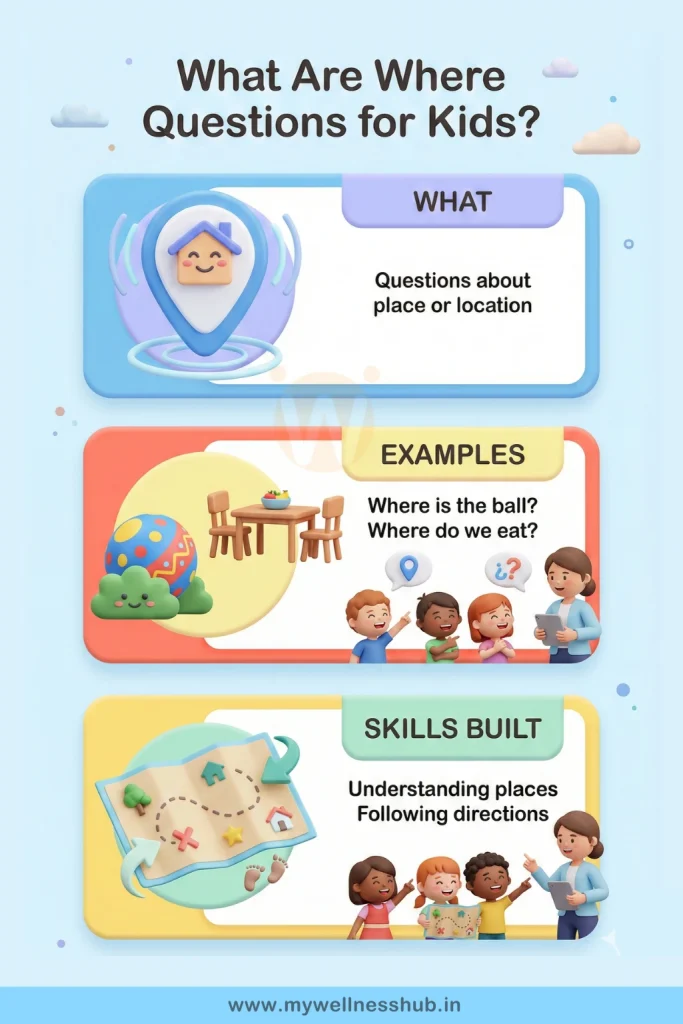
What Are Where Questions for Kids?
Where questions ask a child to identify location or place.
Examples include:
- Where is the ball?
- Where is the cat sleeping?
- Where do we eat dinner?
- Where are your shoes?
To answer correctly, a child must understand the word where, recognize the object or person, and connect it to a location. This makes where questions more complex than naming objects or answering yes/no questions.
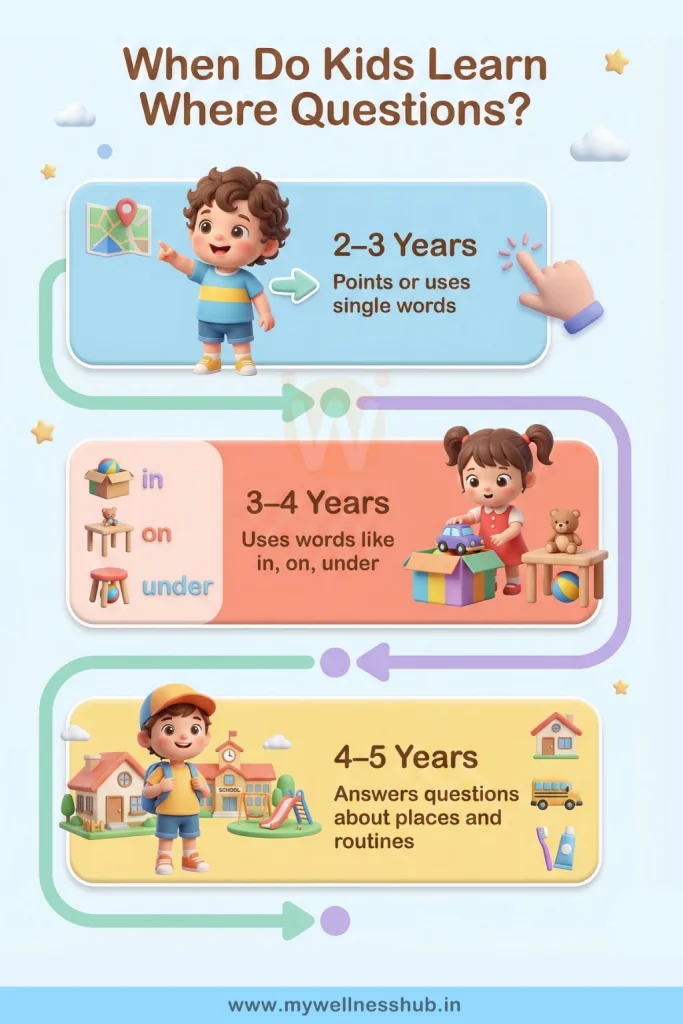
When Do Children Learn to Answer Where Questions?
Children develop these skills gradually.
- Around 2–3 years
Children begin to understand simple where questions, often responding by pointing or using single words. - Around 3–4 years
Children start using basic location words such as in, on, and under. - Around 4–5 years
Children answer more abstract where questions related to routines, places, and community settings.
Children with speech or language delays may need extra time, repetition, and visual support.
Why Are Where Questions Difficult for Some Children?
Many children struggle with where questions because they require multiple skills at once.
Common challenges include:
- Limited understanding of spatial concepts
- Difficulty processing spoken language
- Reduced attention or working memory
- Trouble forming verbal responses
Visual answers reduce this load by showing the location clearly instead of relying only on spoken language.
Types of Where Questions for Kids
Where questions help children understand location, people, places, and safety. These questions support early language development, listening skills, and real-life communication.
Where Questions to Teach Prepositions
These where questions for kids help children learn position words like on, under, behind, and in front. Understanding prepositions helps children follow directions at home and school.
Examples:
- Where is the ball?
- Where is the cat sitting?
- Where is the book kept?
Skills supported:
Spatial awareness, listening skills, classroom readiness
Where Questions About People
These questions help children identify who is where. They support the use of pronouns like he, she, and they, and help children form clear sentences.
Examples:
- Where is mom?
- Where is the boy standing?
- Where are the children sitting?
Skills supported:
Pronouns, sentence building, attention skills
Where Questions About Places
These questions teach children about common places they see every day, such as home, school, park, and hospital. They help children connect language to real life.
Examples:
- Where do we sleep?
- Where do we go to play?
- Where does the doctor work?
Skills supported:
Functional language, community awareness, vocabulary
Where Questions for Safety
These questions help children understand safe places and where to go in different situations. They are important for daily safety and independence.
Examples:
- Where do we cross the road?
- Where do you go if you feel lost?
- Where is a safe place to wait?
Skills supported:
Safety awareness, functional communication, real-life understanding
Why Where Questions Are Important
Practicing where questions helps children:
- Understand instructions
- Build meaningful sentences
- Improve daily communication
- Develop safety awareness
These skills are especially helpful for children with speech delay, autism, or language difficulties.
Where Questions for Kids With Visual Answers (Printable PDFs)
Visual-based where questions help children succeed by pairing each question with a clear picture. This approach improves comprehension, reduces frustration, and allows children to respond by pointing, choosing, or speaking.
Printable worksheets with visual answers are especially useful for:
- Speech therapy sessions
- Home practice with parents
- Preschool and special education classrooms
Where Question Worksheets and Focus Areas
| What Question Type | Focus Area | Resource Link |
|---|---|---|
| Where Is It? (Behind & In Front) | Prepositions – Spatial Concepts | Download PDF |
| Where Is It? (In Front) | Prepositions – In Front | Download PDF |
| Where Is It? (Behind) | Prepositions – Behind | Download PDF |
| Where Is It? (On & Under) | Prepositions – On and Under | Download PDF |
| Where Is It? (Under) | Prepositions – Under | Download PDF |
| Where Is It? (On) | Prepositions – On | Download PDF |
| Where Are They? | Plural Concepts and Visual Scanning | Download PDF |
| Where Is She? | Pronouns – Female (She) | Download PDF |
| Where Is He? | Pronouns – Male (He) | Download PDF |
| Where Do We Go? (Safety) | Safety Awareness and Emergency Places | Download PDF |
| Where Are These Places? (Landmarks) | Places and Landmarks Recognition | Download PDF |
| Where Do People Work? | Occupations and Workplaces | Download PDF |
| Where in Nature? | Nature and Animal Habitats | Download PDF |
| Where in the Community? | Community Places | Download PDF |
| Where at Home? | Home Locations and Daily Routines | Download PDF |
How to Teach Where Questions to Kids at Home
Use real-life situations throughout the day.
- Ask where questions during play and routines
- Model short answers
- Expand responses gently
Child: “Bed”
Adult: “Yes, on the bed”
Short, frequent practice is more effective than long sessions.
How Speech Therapists Use Where Question Worksheets
Speech therapists often use visual where question worksheets to:
- Control language complexity
- Track progress over time
- Support children with limited verbal skills
- Gradually move from pictures to spoken answers
This structured approach builds comprehension before expressive language.
Common Mistakes to Avoid When Teaching Where Questions
- Asking abstract questions too early
- Expecting full sentences immediately
- Correcting every response
- Skipping visual supports
Learning happens through repetition and modeling.
Conclusion
Teaching where questions for kids helps children describe their world, follow directions, and communicate more clearly. Visual answers and structured practice make learning easier and more confident, especially for children who need extra support.
Progress takes time. Start simple, use visuals, and build skills step by step.
Frequently Asked Questions:
1. What are where questions for kids?
Where questions for kids are questions that ask about place or location. Examples include “Where is the ball?” or “Where do we eat food?” These questions help children understand their surroundings and use language in daily life.
2. At what age do children learn where questions?
Most children start understanding where questions around 2 years of age. By preschool age, many children can answer where questions using simple words like in, on, or under. Some children may need more time and practice.
3. Why are where questions important for language development?
Where questions help children learn location words, follow instructions, and form longer sentences. They also support early thinking skills and everyday communication.
4. Why does my child struggle with where questions?
Some children find where questions hard because they involve listening, thinking, and speaking at the same time. Children with speech delay or language delay often need visual support and repeated practice.
5. How do I teach where questions to my child at home?
You can teach where questions during daily routines. Ask simple questions, show the answer, and use short phrases. Practice during play, meals, and bedtime to keep learning natural.
6. What are examples of simple where questions for toddlers?
Simple where questions for toddlers include:
- Where is the toy?
- Where is mama?
- Where is the dog?
These questions work best when you can show the answer.
7. Do visual pictures help children answer where questions?
Yes. Visual pictures help children understand where questions better. Pictures reduce confusion and make learning easier, especially for young children and children with speech delay.
8. Are where question worksheets useful for kids?
Where question worksheets are useful because they show clear pictures with each question. This helps children focus on the correct answer and practice without pressure.
9. How often should I practice where questions with my child?
Short daily practice works best. Even 5 to 10 minutes a day is enough. Repeat the same questions over a few days to help your child learn confidently.
10. When should I talk to a speech therapist about where questions?
If your child finds where questions very hard after age 3, or gets frustrated often, a speech therapist can help. Early support makes learning easier and less stressful for children.
About Wellness Hub
Wellness Hub is a trusted digital platform that empowers parents, caregivers, and professionals with science-backed tools for childhood development. From online speech therapy to home therapy resources, we offer a holistic ecosystem for children facing speech delays, autism, ADHD, and other developmental challenges.
Rooted in evidence-based practices and delivered by certified experts, Wellness Hub bridges the gap between accessibility and quality care. Whether you need at-home speech strategies, developmental checklists, or interactive mobile apps like BASICS, we make early intervention affordable and family-friendly.
Start your journey today with expert guidance tailored to your child’s unique communication and learning needs—anytime, anywhere.
Book your Free Consultation Today
Parent/Caregiver Info:
Client’s Details:
* Error Message