How to Encourage Consonant Sounds During Playtime Without Adding Extra Toys
By Wellness Hub
Last Updated: February 28, 2026
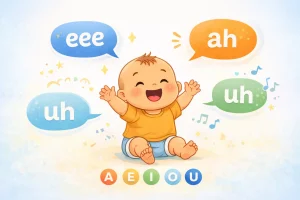
If you’ve ever listened to your child babble and thought, “I love hearing your voice… but I wish I heard a few more sounds,” you’re definitely not alone. Many parents looking to encourage consonant sounds notice that their child settles into a few favorite noises and sticks with them, even when they’re talkative and engaged.
It’s also easy to assume you need special toys, flashcards, or “speech tools” to help. The reassuring truth is that sound variety often grows best right in the middle of everyday play, when your child feels relaxed, curious, and already happy to interact with you.
This stage isn’t about getting your child to perform on demand. It’s about making room for playful sound exploration so new consonants can show up naturally over time, especially sounds like b, m, d, g, and p.
Also read: Common Mistakes That Can Shut Down Babbling (Even When You Mean Well
Why playtime helps encourage consonant sounds naturally
Play already has everything babbling needs: repetition, excitement, turn-taking, and shared attention. When something feels fun, children are more likely to use their voice. And when you’re face-to-face, responding warmly and taking turns, your child starts to learn that their sounds matter.
Exploring a wider range of sounds is part of how children begin to feel the “music” of speech, the rhythm, the timing, and the back-and-forth flow of communication. Those little sound experiments can turn into moments of connection between you and your child, not something to check off a list.
What more consonant sounds can look like and what still counts
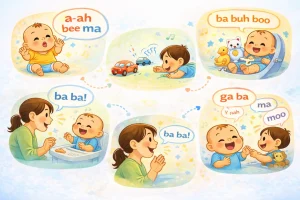
Parents sometimes imagine clear little “word-like” sounds, but early progress is often much smaller and sweeter than that. Expanding sound variety might look like your child adding a new sound once in a while, mixing sounds together differently, or playing with volume and pitch.
You might notice more m sounds during cuddly moments, more b sounds when something feels exciting, or a surprise g sound during silly play. Even if it isn’t consistent, those tiny “new” moments matter. The goal is a wider sound menu over time, not perfection.
Following your child’s lead, while gently widening the sound menu
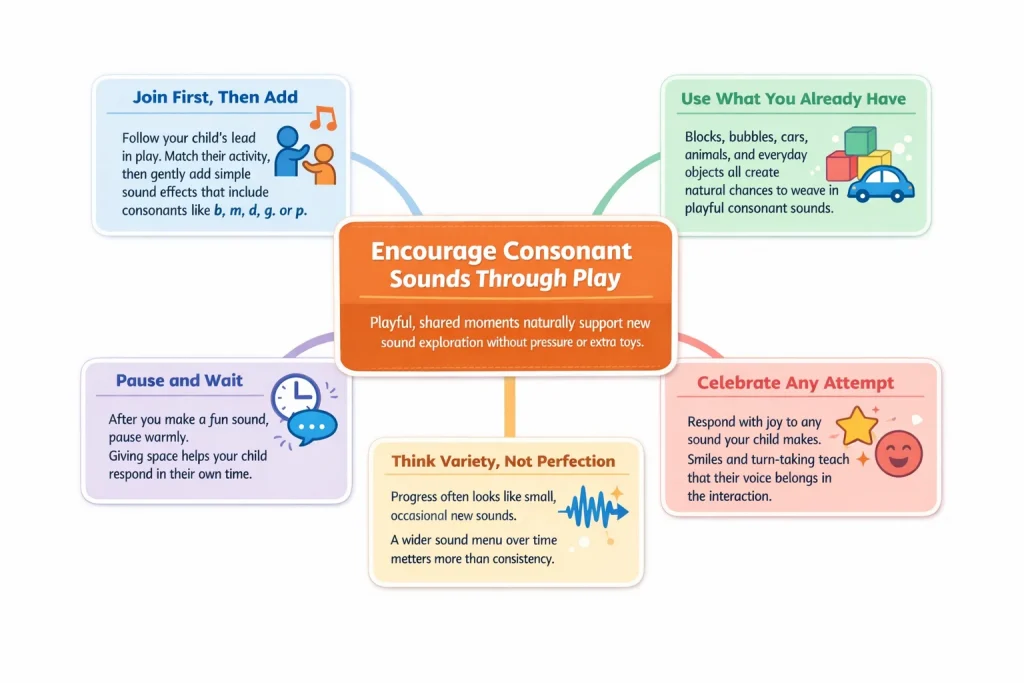
A helpful way to think about play is: join first, then add just a little more.
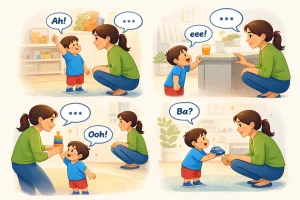
When your child is already doing something, stacking blocks, pushing a car, popping bubbles, you can match their energy and sprinkle in simple sound effects that naturally include consonants like b, m, d, g, and p. Think of it as offering ideas, not asking for answers.
If your child copies you, that’s wonderful. If they don’t, you’re still giving their brain a friendly sound sample in a moment that feels safe and fun. Many children need lots of low-pressure exposure before a new sound shows up in their own babbling.
Also read: What Progress Looks Like When Babbling Starts Expanding Small Signs to Notice
Play ideas using what you already have at home
You don’t need to buy anything new. The toys and objects you already use are usually enough to invite new sounds, especially when you add playful voice and turn-taking.
1. Blocks and stacking toys: easy “b” and “d” moments
Blocks naturally create anticipation: up, up, up… and then crash. That pause before the fall is often when children make a sound.
During stacking, many parents find themselves using simple sound effects like “ba,” “boo,” or “boom,” or a cheerful “da-da-da” as each block goes on. The exact sounds matter less than the feeling. You’re making sound part of the game. When your child makes any noise back, a squeal, a vowel, or a tiny “b,” your warm response tells them, “My voice belongs here.”
2. Bubbles: perfect for “p” and “b” without trying
Bubbles work beautifully because they’re exciting and repetitive. You blow, they watch, and you both react. That rhythm makes it easy to weave in sounds like “pop,” “puh-puh,” or “buh-buh” in a natural way.
Some children start making sounds right when a bubble pops, almost as if their voice is joining the action. If your child stays quiet, that’s okay too. Your playful sound effects are still helping them become familiar with those consonants.
3. Cars and trucks: “m,” “b,” and “g” can sneak in
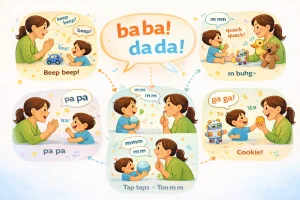
Vehicle play often comes with movement sounds like “mmmmm,” “beep,” “go,” or “brrrm.” These don’t feel like practice. They feel like fun.
If your child loves pushing a car back and forth, you can simply add sound to the moment: a low “mmmm” for the engine, a bright “beep beep,” or an excited “go!” If your child adds their own sound, even if it’s different, treat it like their turn in the conversation.
4. Animals and pretend play: consonants hide inside the fun
Animal play invites silly voices, and silly voices often lead to more varied babbling. Many animal sounds naturally include early consonants: “moo” (m), “baa” (b), “duck” (d), “goat” or “grr” (g).
If your child enjoys animals, keep it simple: one animal, one sound, then a pause and a warm look that says, “Your turn if you want.” Sometimes children respond with their own version. Sometimes they just watch and smile. Both are part of connection.
5. Everyday objects: you are allowed to be playful
You don’t even need a toy. A spoon can “tap tap” (d), a ball can “bounce bounce” (b), a door can “bang” (b), and a soft blanket can be “mmm” cozy (m). When you treat ordinary moments as worth talking about, your child gets more chances to hear and try new sounds.
The small interaction habits that make a big difference
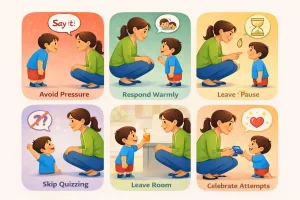
Sound variety grows best when play feels like a shared conversation, even before there are words. A few gentle habits make this easier without turning play into a lesson.
When you’re close enough for your child to see your face, they can watch how sounds are made. Exaggerated, playful mouth movements, without asking them to copy, can make consonants more interesting.
Warm pauses matter too. If you make a fun sound and then wait for a moment, you’re giving your child space to respond in their own way. Some children need that extra second before they jump in. And celebrating attempts is powerful. If your child offers any sound at all, new or familiar, your smile and responsive energy teach them that using their voice is worth it.
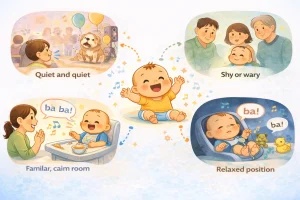
Also read: Why Your Baby Babble Changes in Some Rooms And Disappears in Others
What progress can feel like at home
Progress often feels like a slow widening. You may notice your child using more kinds of sounds during play, mixing them in new ways, or getting more animated about making noise. Sometimes a new sound appears once and then disappears for a while. That’s normal too. Sound exploration can be a bit like trying on outfits, children test what fits and come back to it later.
If you’re hearing more playful variety overall, you’re moving in the right direction.
When you might want extra support without assuming anything is wrong
Some parents simply want more ideas or feel unsure how to encourage consonant sounds without overdoing it. Getting guidance can be supportive, not a sign that something is wrong.
Tools like BASICS can help parents focus on goals like expanding sound variety through everyday routines and play, with simple examples that keep things relaxed and doable.
A calm reminder to end on
You don’t need extra toys to help your child explore more consonant sounds. You already have what matters: shared play, warm attention, and the willingness to be a little silly with sound.
Those “ba,” “mmm,” “duh,” “guh,” and “puh” moments aren’t just cute. They’re your child experimenting with communication in the safest way possible. And every time you respond with interest and joy, you’re showing them that their voice belongs in your relationship.
About the Author:
Shravanaveena Gajula
M.Sc ., Speech and Language Pathology (5+ years of experience)
Shravanaveena Gajula is a dedicated Speech-Language Pathologist with a BASLP and an M.Sc in Speech and Language Pathology. With experience spanning multiple settings, including Wellness Hub , Veena specializes in a wide range of disorders from developmental issues in children to speech and language assessments in adults. Her expertise includes parent counseling, managing speech sound and fluency disorders, and creating individualized therapy programs. Veena is also PROMPT certified and an author of several insightful blogs on speech and language pathology, aiming to educate and assist caregivers in supporting their loved ones.
Book your Free Consultation Today
Parent/Caregiver Info:
Client’s Details:
* Error Message