Why Your Baby Babble Changes in Some Rooms And Disappears in Others
Last Updated: February 28, 2026
You’re in the kitchen and your baby is happily chatting away, little “ba-ba” bursts, a few “mmm” sounds, maybe even a surprised squeal when something clatters. Then you step into another room, or visit a friend’s house, and suddenly… silence. The baby babble changes you notice at home seems to fade away.
If you’ve noticed this, you’re in very good company. Many parents see big changes in how much their baby vocalizes depending on the room, the people nearby, or whether the place feels familiar. Most of the time, this doesn’t mean anything is going backward. It usually means your baby’s sound play is closely tied to comfort, attention, and whatever is happening in that moment.
Babbling isn’t only practice for speech. It’s also a social play. Babies often use their sounds most freely where they feel safest and most connected.
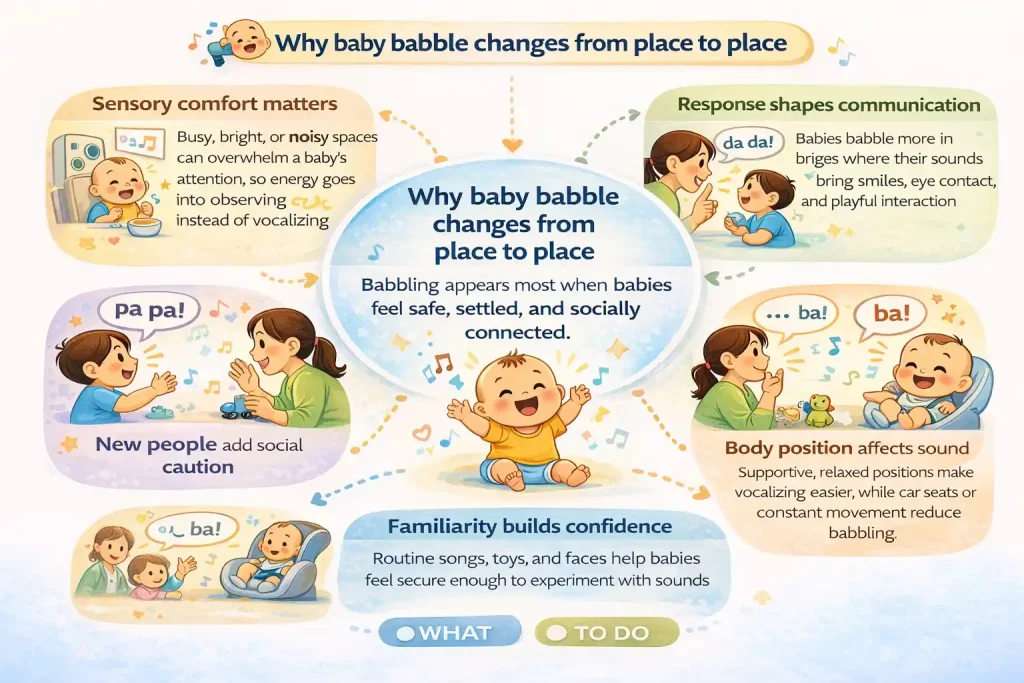
Baby babble changes are a comfort-and-connection skill, not a constant
When we think about development, it’s easy to imagine that once a baby learns a skill, they should use it everywhere and all the time. But early communication doesn’t work that way.
Babbling, especially the playful kind that includes consonant sounds like b, m, d, g, and p, tends to appear most when a baby feels settled. In familiar spaces, your baby already understands the “feel” of the room. They recognize the lighting, the echoes, the smells, the rhythm of the day, and your voice and face. That sense of predictability gives them space to experiment.
In a new place, your baby may be doing something different. They may be watching closely, taking everything in, and deciding what feels safe. Quiet doesn’t always mean nothing is happening. Sometimes it means your baby is concentrating.
Also read: How to Model New Sounds Without Feeling Like You’re “Drilling” Your Baby
Why your baby babbles more in some rooms than others
1) Some rooms feel “easier” on the senses
One room might be bright, echoing, or full of sudden noises. Another may feel softer and calmer. Babies often vocalize more when the environment feels manageable. If a space feels busy or overwhelming, your baby may pause their babbling simply because their energy is going into observing.
You might notice this in public places too. A grocery store, a family gathering, or a café can be exciting but also demanding. Even adults talk less when they’re busy taking everything in.
2) Your baby is tracking what gets a response
Babies are excellent pattern watchers. If babbling in the living room usually gets a smile, eye contact, or a playful sound back from you, that room becomes a comfortable stage for sound experiments. If another room is where you’re cooking, rushing, or on the phone, your baby may get fewer reactions there, and the babble naturally fades.
This isn’t because you’re doing anything wrong. It’s simply how communication grows. It’s shaped by attention and connection.
3) New people can change the “social pressure”
Even when everyone is kind and loving, unfamiliar faces can make a baby more cautious. Some babies babble more because they’re excited. Others grow quiet because they’re watching and warming up.
You may notice your baby holding back their playful sound combinations until they feel sure a new person is safe and predictable. That warming-up period is very normal.
4) Movement and body position matter more than we think
Babbling often comes out when babies feel comfortable in their bodies, supported, relaxed, and able to breathe easily. In a new place, your baby might be held differently, placed in a car seat, or passed from person to person. Their body may be busy adjusting, which can leave less energy for vocalizing.
Sometimes the “quiet room” isn’t really about the room at all. It’s about how your baby is positioned there.
Read more: Is It Normal If My Baby Mostly Makes Vowel Sounds When Babbling?
What “progress” can look like, even when babble is inconsistent
When the goal is to expand the variety of sounds in babbling, progress isn’t only about how often your baby babbles. It’s also about what you hear when they do.
You might notice that at home your baby is starting to add new consonants, more “b” and “m,” maybe a “d” or “g” here and there. You may hear playful sound mixes, changes in pitch, or little experiments with loud and soft sounds. Sometimes babies even look pleased with themselves, as if they’ve discovered something new.
If these moments are happening in any setting, that’s a good sign that sound exploration is growing. Using those sounds everywhere usually comes later, as confidence spreads.
How to invite babbling in new places without pushing it
Parents often ask, “Should I be doing something to get them to babble here too?” That question makes sense, especially when a baby is chatty at home but quiet in public.
In most cases, it helps to think in terms of inviting rather than prompting. Babbling tends to show up when a baby feels safe and unhurried. In new environments, keeping expectations gentle can make a big difference. If your baby is quiet, there’s no need to test them or pull sounds out of them. You can offer the same warm, playful communication you do at home and trust that they’ll join in when they’re ready.
Some parents find comfort in creating small moments of familiarity. A favorite song, a routine phrase, a well-loved toy sound, or a calm face-to-face moment can remind your baby, “This is still us, even in a new place.” And if your baby offers even the smallest sound, a tiny “mm” or a soft squeal, treat it as meaningful. A smile, a warm look, or a gentle echo back can keep the moment light and encouraging.
Read more: How to Model New Sounds Without Feeling Like You’re “Drilling” Your Baby
Why “minimal prompting” matters for real-life babbling
You may hear professionals talk about children using a variety of sounds “with minimal prompting” across different settings. In everyday terms, that simply means that over time, your baby begins to bring their sound play into more moments without you needing to work hard for it.
That’s a long-term skill. It grows from repeated experiences of safety, connection, and playful back-and-forth, not from pressure.
So if your baby babbles freely at home but becomes quiet elsewhere, you’re not falling behind. You’re seeing how the environment shapes communication and why baby babble changes across settings.
When you might want a little extra support (without assuming anything is wrong)
Some parents reach a point where they feel unsure. “I know my baby can make these sounds, but it’s only happening in one place,” or “I’m not sure how to create more chances without turning it into a task.”
That’s a natural place to want guidance. Some families like having a simple, parent-friendly tool that helps them understand communication goals, like expanding sound variety, and notice easy opportunities during daily routines.
If that sounds helpful to you, BASICS can be a supportive option. It offers short, everyday ideas that keep communication playful and low-pressure, especially when you’re hoping to build confidence across different settings where baby babble changes may appear.
A calm takeaway to hold onto
Babbling is not something your baby owes a room. It’s a form of play that appears most where your baby feels safe, connected, and ready.
If your baby’s babble changes from room to room or disappears in new places, try to see it as information rather than a warning sign. Your baby may be saying, “I’m taking this in,” or “I’m not settled yet,” or “I’m saving my energy for watching.” And when the babble returns, whether it’s a bold “ba-ba,” a soft “mmm,” or a brand-new sound you’ve never heard before, you’ll know what it really reflects: growing confidence, growing curiosity, and a communication journey unfolding in its own steady way.
About the Author:
Rajini Darugupally
M.Sc., Speech-Language Pathologist (9+ years of experience)
Rajini is a passionate and dedicated Speech-Language Pathologist with over 9+ years of experience, specializing in both developmental speech and language disorders in children and rehabilitation in adults. Driven by a desire to empower each individual to find their voice, Rajini brings a wealth of experience and a warm, genuine approach to therapy. Currently, at Wellness Hub, she thrives in a team environment that values innovation, compassion, and achieving results for their clients. Connect with Rajini to learn more about how she can help you or your loved one find their voice.
Book your Free Consultation Today
Parent/Caregiver Info:
Client’s Details:
* Error Message