2-Year-Old Developmental Milestones: What Parents Should Know
Last Updated: April 28, 2026
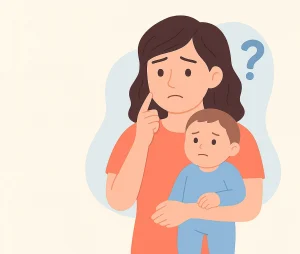
Wondering if your 2-year-old is on track? Age 2 is a big stage for speech, movement, play, emotions, and social development. Many toddlers begin using short phrases, following simple instructions, running, imitating adults, and showing more independence.
But milestones are not a strict exam. Every child develops at their own pace. This guide explains common 2-year-old developmental milestones, simple ways to support your toddler at home, and signs that may mean it is time to speak with a pediatrician, speech therapist, or child development specialist.
At age 2, parents usually watch five key areas: speech and language, movement, social interaction, emotional expression, and problem-solving. This guide will help you understand what many toddlers can do, what you can try at home, and when to ask for professional support.
Source note: This guide is informed by developmental milestone guidance from trusted child development sources, including CDC milestone guidance and pediatric developmental screening recommendations. Milestones are general guidelines, not a diagnosis. If you are worried about your child’s development, speak with your pediatrician or a qualified child development professional.
CDC lists 2-year language milestones such as saying at least two words together, pointing to body parts, pointing to pictures in books, and using more gestures than waving and pointing.
Read More: Home Based Speech Therapy Activities for 1-2 Years Kids
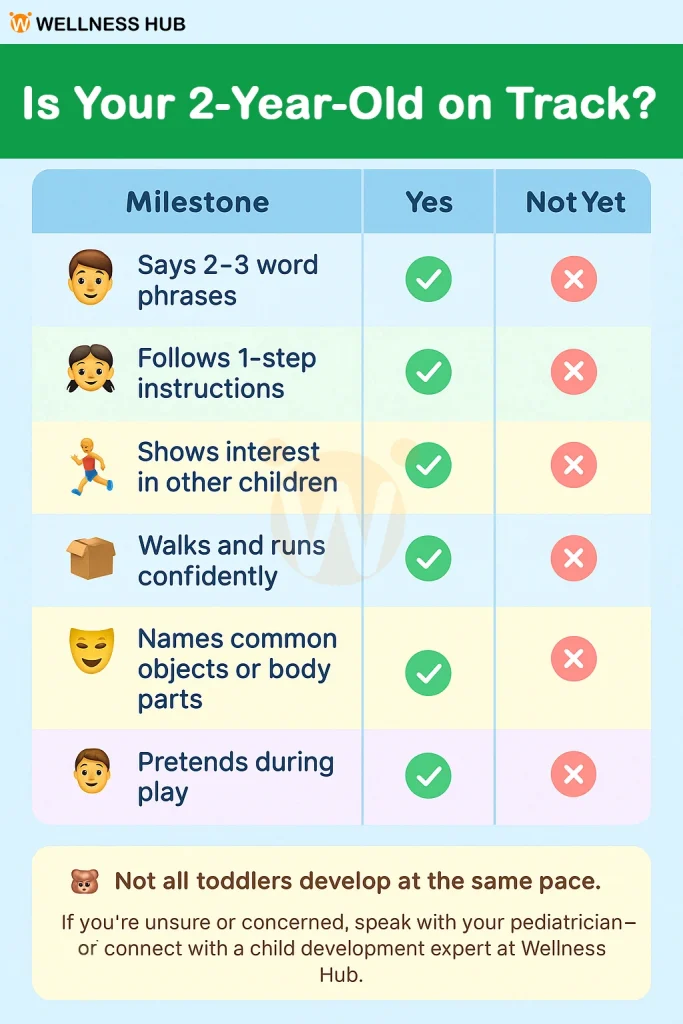
Quick 2-Year-Old Milestone Checklist for Parents
| Development Area | Many 2-Year-Olds May | Try This at Home | Ask for Help If… |
|---|---|---|---|
| Speech and Language | Use two-word phrases like “more milk” or “want toy” | Talk during daily routines and pause for your child to respond | Your child is not using words or two-word phrases |
| Understanding | Follow simple instructions like “bring your shoes” | Give one-step directions during play | Your child does not seem to understand simple instructions |
| Gestures | Point, nod, wave, show, or use gestures to communicate | Model gestures during songs, games, and routines | Your child rarely points, shows, waves, or uses gestures |
| Movement | Walk, run, climb, kick a ball, or move with better balance | Offer safe climbing, ball play, and outdoor movement | Your child has trouble walking, running, or using both sides of the body |
| Social Skills | Watch, copy, or play near other children | Arrange short play opportunities without pressure | Your child rarely responds to people or shows little interest in others |
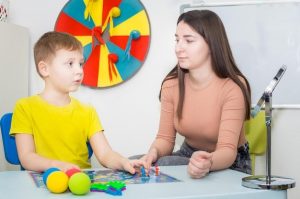
| Play & Thinking | Stack blocks, sort shapes, imitate actions, or solve simple problems | Use blocks, puzzles, pretend play, and everyday objects | Your child does not imitate, explore toys, or try simple play activities |
| Regression | Keep gaining new skills over time | Track new words, gestures, and play skills | Your child loses words, gestures, movement, or social skills they once had |
Why It’s Important to Track Milestones at Age 2
The toddler years are packed with changes—and age 2 is a major turning point. In just a short time, your child is learning how to talk, move with more confidence, interact with others, and express big emotions in little bodies. It’s amazing to watch, but it can also leave you wondering: “Is my 2-year-old on track?”
That’s where developmental milestones come in. These are common skills that most children reach around the same age, like saying two-word phrases or walking up stairs with help. Milestones offer a helpful roadmap, showing what’s typical and what might need more support.
Keeping an eye on these areas can help you:
- Understand your child’s strengths (Are they more verbal? More physical?)
- Spot potential delays early
- Get the right support at the right time
- Start helpful conversations with your pediatrician or therapist
You don’t need to track every tiny detail, but having a general sense of what’s expected at age 2 can really make a difference. That’s especially true when it comes to early intervention. Research shows that the earlier children receive support—whether for speech, motor skills, or social development—the better their long-term outcomes.
10 Common 2-Year-Old Developmental Milestones
Around age 2, many toddlers show progress in speech, movement, social interaction, emotions, play, and problem-solving. Your child does not need to master every skill on the same day or in the same way as another child. What matters most is steady progress over time.
1. Use Two-Word Phrases
Many 2-year-olds begin putting two words together to express simple needs, ideas, or actions. You may hear phrases like “more milk,” “go park,” “want toy,” or “mama come.”
What it looks like:
Your child may combine familiar words to ask for something, describe something, or call your attention. The words may not sound perfect yet, but the meaning is usually clear in context.
Try this at home:
Use short phrases during daily routines. Say “open door,” “wash hands,” “more rice,” or “big car.” Pause and give your child time to copy or respond.
When to ask for help:
Talk to a pediatrician or speech therapist if your 2-year-old is not using words, is not combining two words, or mostly communicates through crying, pulling, or gestures without trying words.
2. Follow Simple Instructions
Many 2-year-olds can understand and follow simple one-step directions, especially during familiar routines.
What it looks like:
Your child may respond when you say, “bring your shoes,” “give me the ball,” “sit down,” or “touch your nose.”
Try this at home:
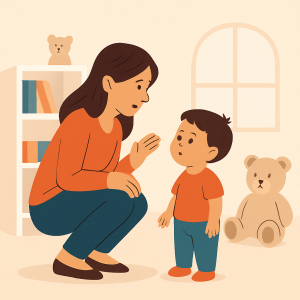
Give short, clear instructions during play and daily routines. Use gestures if needed. For example, point to the shoes and say, “Bring shoes.” Keep your tone warm and playful.
When to ask for help:
Ask for professional guidance if your child does not seem to understand simple instructions, does not respond to familiar words, or often seems unaware when you speak to them.
3. Walk, Run, Climb, and Move with More Confidence
Many 2-year-olds become more active. They may walk steadily, run with better balance, climb furniture, kick a ball, or try stairs with help.
What it looks like:
Your toddler may move quickly from one activity to another, climb onto chairs, run across the room, or enjoy outdoor play.
Try this at home:
Create safe movement opportunities. Let your child kick a soft ball, walk on different surfaces, climb safely under supervision, and dance to music.
When to ask for help:
Speak with your pediatrician if your child has trouble walking, falls often, avoids movement, seems very stiff or floppy, or uses one side of the body much more than the other. child development specialist. Wellness Hub also offers resources on toddler motor development.
4. Point to Objects or Pictures When Named
Many 2-year-olds can point to familiar objects, animals, body parts, or pictures when you name them.
What it looks like:
When you ask, “Where is the dog?” your child may point to the dog in a book. When you ask, “Where is your nose?” your child may point to their nose.
Try this at home:
Use picture books, family photos, toys, and real objects. Ask simple questions like “Where is the ball?” or “Show me the spoon.” Celebrate pointing, looking, or any attempt to respond.
When to ask for help:
Ask for support if your child does not point to named objects, does not look at pictures with you, or does not seem to connect words with familiar people, objects, or actions.
5. Show Interest in Other Children
Many 2-year-olds begin noticing other children. They may watch, copy, smile, move closer, or play beside another child. At this age, full sharing and cooperative play are still developing.
What it looks like:
Your child may play next to another child, copy clapping or jumping, watch other children closely, or become excited at the playground.
Try this at home:
Offer short, low-pressure play opportunities. Do not force sharing. Use simple phrases like “Look, Aarav is jumping” or “Your turn, my turn” during play.
When to ask for help:
Speak with a pediatrician or child development specialist if your child rarely notices people, does not respond to social games, avoids interaction most of the time, or shows very limited interest in people over time.
6. Express Needs and Emotions Clearly
Many 2-year-olds use a mix of words, gestures, facial expressions, and sounds to show what they want or how they feel.
What it looks like:
Your child may say “hungry,” point to a snack, shake their head for “no,” bring you a toy, cry when overwhelmed, or reach for comfort.
Try this at home:
Name feelings and needs during real moments. Say, “You are upset,” “You want help,” “You are tired,” or “You want more.” This helps your child connect words with emotions.
When to ask for help:
Ask for support if your child cannot communicate basic needs, rarely uses gestures or words, has frequent frustration because they cannot express themselves, or shows sudden loss of communication skills.
7. Stack Blocks, Sort Shapes, or Use Hands with More Control
Many 2-year-olds enjoy stacking blocks, putting objects in containers, turning pages, scribbling, or trying simple shape sorters.
What it looks like:
Your child may stack a few blocks, place rings on a stacker, put large puzzle pieces into place, or try to match simple shapes.
Try this at home:
Use blocks, nesting cups, large puzzles, crayons, shape sorters, and household containers. Let your child try, fail, and try again without correcting every move.
When to ask for help:
Speak with a specialist if your child avoids using their hands, cannot pick up or place objects, shows poor hand control, or seems unable to explore toys in simple ways.
8. Name or Point to Body Parts and Familiar Objects
Many 2-year-olds begin identifying body parts, familiar people, toys, foods, animals, and everyday objects.
What it looks like:
Your child may point to their nose, eyes, hands, or feet. They may also say or recognize words like ball, car, spoon, dog, banana, or mama.
Try this at home:
Use daily routines. During bath time, say, “Wash your hands,” “Where are your toes?” or “Let’s clean your nose.” During meals, name foods and utensils.
When to ask for help:
Ask for guidance if your child does not recognize familiar objects, does not point to body parts, or does not seem to understand common words used every day.
9. Imitate Adults and Older Children
Many 2-year-olds learn by copying. They may pretend to cook, talk on a toy phone, sweep the floor, feed a doll, clap, dance, or repeat simple actions.
What it looks like:
Your toddler may copy your facial expressions, household routines, gestures, or play actions. This is an important part of social learning and pretend play.
Try this at home:
Model simple actions during play. Pretend to drink from a cup, feed a teddy bear, brush a doll’s hair, or stir food in a toy bowl. Wait and see if your child copies.
When to ask for help:
Speak with a pediatrician or developmental specialist if your child rarely imitates actions, does not copy gestures, does not engage in simple pretend play, or seems disconnected from everyday routines.
10. Show Early Problem-Solving
Many 2-year-olds begin solving simple problems through trial and error. They may try different ways to open a container, fit a puzzle piece, reach a toy, or complete a familiar routine.
What it looks like:
Your child may try again when something does not work, move objects around, look for help, or use simple tools like a spoon, cup, or toy container.
Try this at home:
Offer simple problem-solving play. Use puzzles, containers with lids, stacking toys, shape sorters, and pretend play. Give your child time before stepping in.
When to ask for help:
Ask for support if your child does not explore toys, does not try simple problem-solving, becomes extremely frustrated with basic play, or does not seem curious about objects or routines.
When to Ask for Help: 2-Year-Old Developmental Red Flags
One missed milestone does not automatically mean something is wrong. But some signs deserve attention, especially when they continue over time or appear across more than one area of development.
| Area | Ask for Help If Your 2-Year-Old… |
|---|---|
| Speech & Language | Does not use words, does not combine two words, or rarely tries to communicate |
| Understanding | Does not follow simple instructions or does not seem to understand familiar words |
| Gestures | Does not point, wave, nod, show, reach, or use gestures to communicate |
| Social Interaction | Rarely responds to name, avoids interaction most of the time, or shows limited interest in people |
| Play | Does not imitate simple actions, does not explore toys, or does not try pretend play |
| Movement | Has trouble walking, running, climbing, or using both sides of the body |
| Regression | Loses words, gestures, movement skills, social interest, or play skills they once had |
If you notice several concerns, slow progress over time, or any loss of skills, do not wait and worry silently. Speak with your child’s pediatrician and ask whether developmental screening, speech therapy, occupational therapy, or early intervention support may be helpful.
What If My 2-Year-Old Is Not Doing All These Milestones Yet?
First, take a breath. Milestones are helpful guidelines, not a strict pass-or-fail test. Some toddlers talk early but take more time with movement. Others are physically active but slower with words. What matters most is steady progress over time.
Still, do not ignore your concern. If your child is missing several milestones, not making progress, or losing skills they once had, it is better to ask early than wait too long.
Here is what you can do:
- Write down what your child can do now
- Track words, gestures, play skills, and movement for 2–4 weeks
- Share your notes with your pediatrician
- Ask if developmental screening is needed
- Speak with a speech therapist if speech, language, or communication is a concern
- Ask about occupational therapy if motor, sensory, play, or daily routine skills are difficult
Early support does not label your child. It gives your child the right help at the right time.
Milestone Tracking vs Developmental Screening
Milestone tracking helps parents notice what their child is learning at home. Developmental screening is different. It uses structured tools to check whether a child may need further evaluation or support.
A screening does not automatically diagnose a child. It helps identify whether a pediatrician, speech therapist, occupational therapist, psychologist, or child development specialist should take a closer look.
If you are unsure, ask your pediatrician about developmental screening. It is better to ask early than wait and lose valuable support time.
Simple Tips to Support Your Toddler’s Development at Home
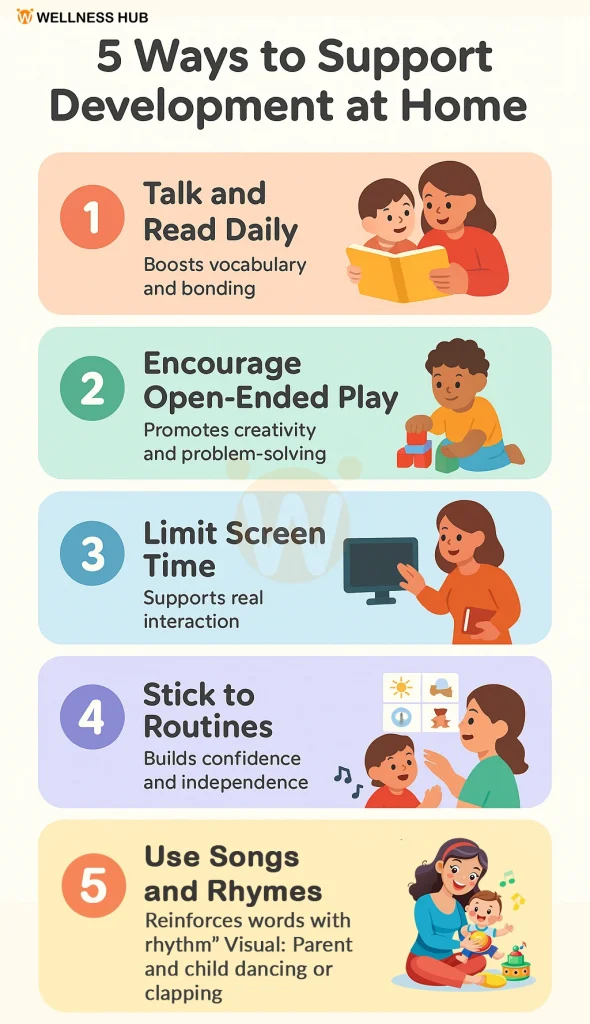
1. Talk and Read Together Every Day
Even if your child isn’t saying much yet, they’re absorbing everything. Hearing language regularly builds vocabulary, improves understanding, and supports early speech skills.
Try this:
- Describe what you’re doing: “I’m cutting the apple. Now we put it in the bowl.”
- Ask questions and wait: “Where’s the ball?” (even if they don’t answer, they’re learning!)
- Read the same picture book repeatedly—toddlers love repetition and it helps words stick.
2. Offer Open-Ended Play Opportunities
Let your child explore toys that don’t “do” much on their own. This encourages imagination, decision-making, and creativity.
Great open-ended toys include:
- Stacking cups or blocks
- Pretend kitchen items
- Playdough, crayons, or big puzzle pieces
Give them space to explore on their own and avoid correcting how they play. There’s no “wrong way” in toddler play!
3. Limit Screen Time and Encourage Real-Life Interaction
Screens can be tempting, but they don’t offer the same learning benefits as face-to-face play. The more your child engages with real people and objects, the more they learn.
Try:
- Short video chats with family instead of cartoons
- Music and dancing together instead of passive watching
- Sensory play like water bins or sand trays instead of digital games
4. Use Routines to Build Independence
Toddlers thrive on predictability. Routines help them feel safe—and give them chances to participate and learn.
Involve them in daily tasks like:
- Putting toys away after play
- Washing hands before meals
- Choosing between two outfits in the morning
Conclusion
Every 2-year-old develops in their own way, but milestones help parents notice progress and spot concerns early. Around this age, many toddlers begin using short phrases, following simple instructions, moving with more confidence, copying others, using gestures, and showing early problem-solving skills.
Do not panic if your child is not doing everything on a checklist. But do not ignore your instinct either. If your child is missing several milestones, not making steady progress, or losing skills they once had, speak with your pediatrician and ask about developmental screening or early intervention support.
Your child does not need pressure. Your child needs connection, play, routine, and the right help at the right time.
Frequently Asked Questions:
1. What should my 2-year-old be doing developmentally?
Many 2-year-olds use short phrases, follow simple instructions, point to named objects or pictures, run, climb, stack blocks, imitate adults, and show interest in other children. Every child develops at their own pace, so look for steady progress rather than perfection.
2. Is it normal for a 2-year-old not to talk yet?
Some toddlers talk later than others, but by age 2, many children are starting to use words and combine two words. If your child is not using words, not trying to communicate, or not combining words, speak with your pediatrician or a speech therapist.
3. How many words should a 2-year-old say?
Many 2-year-olds use a growing number of words and begin combining words like “more milk” or “want toy.” Word count can vary, but communication progress matters. Watch whether your child uses words, gestures, pointing, and sounds to communicate.
4. How can I help my 2-year-old learn to talk?
Talk during daily routines, read picture books, name objects, use short phrases, sing action songs, and pause to let your child respond. Avoid asking too many test-like questions. Model simple words naturally during play.
5. When should I worry about my toddler’s development?
Ask for help if your child is not using words, not combining two words, not following simple instructions, not using gestures, not showing interest in people, having trouble walking, or losing skills they once had.
6. What are signs of delayed development in a 2-year-old?
Possible signs include limited words, no two-word phrases, difficulty understanding simple directions, limited gestures, little imitation, limited play skills, movement difficulties, or loss of previously learned skills. One sign alone may not mean a delay, but a pattern of concerns should be discussed with a professional.
7. How can I support my toddler’s development at home?
Use daily routines for learning. Talk, read, sing, play, move, and give your child simple choices. Toddlers learn best through repetition, real interaction, and playful practice.
8. What social skills should a 2-year-old have?
Many 2-year-olds watch other children, play beside them, copy simple actions, show emotions, and look to caregivers for comfort or reassurance. Cooperative play develops later, so do not expect perfect sharing at this age.
9. Should my 2-year-old know shapes and colors?
Some 2-year-olds begin recognizing shapes or colors, but it is not required for every child. At this age, communication, play, movement, understanding, gestures, and social interaction are more important than formal learning.
10. Where can I get help if I’m worried about my toddler’s milestones?
Start with your child’s pediatrician. You can also speak with a speech therapist, occupational therapist, psychologist, or child development specialist depending on your concern. If you are worried about speech, language, gestures, play, or social interaction, early support can help.
About the Author:
Shravanaveena Gajula, M.Sc. in Speech and Language Pathology
Audiologist and Speech-Language Pathologist | 5+ Years of Experience
Shravanaveena Gajula is a dedicated Audiologist and Speech-Language Pathologist with a BASLP and an M.Sc in Speech and Language Pathology. With experience spanning multiple settings, including Wellness Hub and Ashray Akruti, Veena specializes in a wide range of disorders from developmental issues in children to speech and language assessments in adults. Her expertise includes parent counseling, managing speech sound and fluency disorders, and creating individualized therapy programs. Veena is also PROMPT certified and an author of several insightful blogs on speech and language pathology, aiming to educate and assist caregivers in supporting their loved ones.
Book your Free Consultation Today
Parent/Caregiver Info:
Client’s Details:
* Error Message