Best Speech Therapy Tools for Kids: Parent Guide to Safe Home Practice
Last Updated: April 28, 2026
Speech therapy tools can support a child’s communication practice, but they must be used for the right reason and in the right way. Some tools help children feel where their tongue, lips, or jaw should move for certain sounds. Others may support oral awareness, feeding skills, chewing, airflow, or sensory needs.
But no speech therapy tool works for every child. A tool that helps one child may be unnecessary or unsafe for another. That is why parents should use mouth-based tools only under the guidance of a qualified speech-language pathologist.
This guide explains common speech therapy tools, what they may help with, when parents should be careful, and how to choose the right support for a child’s speech, language, or oral-motor needs.
If your child struggles with specific sounds, first understand whether it may be related to speech sound disorders before choosing a tool.
Important Safety Note for Parents
Do not place any speech therapy tool inside your child’s mouth unless a qualified speech-language pathologist has shown you how to use it safely. Some tools are used for articulation practice, while others are used for oral awareness, feeding, chewing, jaw stability, or sensory support.
Stop using a tool and speak with a therapist if your child shows gagging, choking, distress, pain, refusal, increased drooling, or breathing difficulty during use.
Speech therapy tools should support a therapy plan. They should not replace professional assessment, speech practice, parent-child interaction, or therapist-led treatment.
Why Speech Therapy Tools Matter
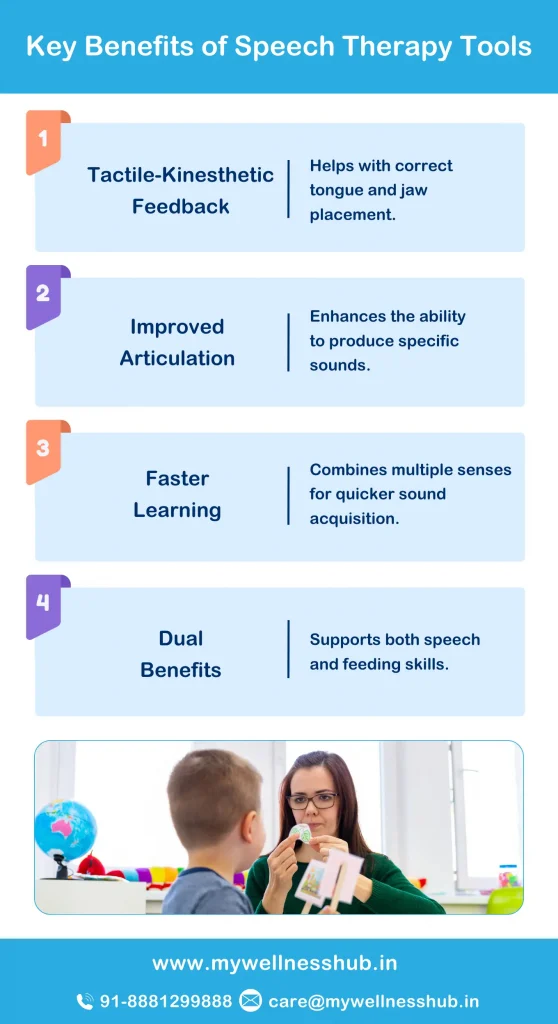
Speech therapy tools are important for helping people speak more clearly and effectively. These tools aren’t just about practicing, they’re about getting the movements just right. They guide the tongue, jaw, and other parts of the mouth to the correct positions needed for making sounds. For example, making the “r” sound can be tricky if you don’t know where your tongue should go. Tools like Speech Buddies provide exact feedback, making it easier to learn the correct placement.
One of the best things about using speech therapy tools is that they support learning through touch and movement. Unlike traditional methods that rely only on seeing and hearing, these tools let you feel the correct movements. This hands-on approach speeds up learning because it uses multiple senses—seeing, hearing, and feeling. For example, tools like Talktools Bilabial Shapes give specific touch cues for sounds like “m” and “p,” helping learners understand the right mouth movements more quickly.
Also read: How Speech Pathology Can Improve Communication
Common Speech Therapy Tools and When They May Help
Not every child needs a tool. Many children make progress through play-based speech practice, modeling, repetition, parent coaching, and direct sound practice. Tools may be useful when a speech therapist identifies a specific need, such as tongue placement, lip closure, jaw stability, oral awareness, airflow control, or sensory support.
Quick Guide: Speech Therapy Tools and Their Uses
| Tool | May Help With | Best For | Use Only With Therapist Guidance? | Parent Safety Note |
|---|---|---|---|---|
| Speech Buddies | Tongue placement for specific sounds | Articulation practice | Yes | Best used when the target sound is clearly identified |
| Bilabial Shapes | Lip closure for /m/, /p/, /b/ | Bilabial sound practice | Yes | Do not force lip movements |
| Tactile Tubes | Lip rounding and oral awareness | Vowel shaping or oral-motor support | Yes | Use carefully if child has sensory or feeding concerns |
| Apraxia Blocks | Jaw grading and stability | Motor planning or jaw control goals | Yes | Not a cure for childhood apraxia |
| Horn Kit | Airflow awareness | Specific therapist-led goals | Yes | Do not use as a general speech delay exercise |
| Straw Kit | Lip rounding, jaw grading, oral control | Feeding/oral-motor support | Yes | Avoid if choking or swallowing concerns exist |
| Chewy Tubes | Chewing, biting, oral sensory input | Oral sensory or feeding support | Yes | Always supervise; choose correct size and texture |
| Tongue Tip Tool | Tongue elevation and lateralization | Sounds like /t/, /d/, /n/, /l/ | Yes | Use only after therapist demonstration |
| Tongue Depressor | Oral awareness or placement cues | Therapist-led oral placement work | Yes | Never push deeply into the mouth |
| Nose Flute | Nasal airflow awareness | Specific nasal sound or airflow goals | Yes | Not suitable for all children |
Speech Buddies
Speech Buddies are specialized tools designed to help individuals master specific sounds, such as ‘l’, ‘r’, ‘s’, ‘sh’, and ‘ch’. They work by guiding the tongue to the correct position, making it easier to produce these sounds accurately. Suitable for a wide range of ages, Speech Buddies can be used by children as young as three with a therapist’s guidance, and older children can even use them independently. Their targeted approach makes them highly effective for those struggling with specific articulation issues.
For sound-specific practice, this guide on how to help your child pronounce the “ch” sound shows why targeted sound work matters.
Talktools Bilabial Shapes
Talktools Bilabial Shapes are particularly useful for producing bilabial sounds like ‘m’, ‘p’, and ‘b’. These tools come in different shapes and colors, with each shape—square, triangle, and circle—corresponding to a specific sound. This visual and tactile association helps learners understand and remember the correct lip movements needed for each sound, enhancing the overall learning experience.
Talktools Tactile Tubes
For vowel production, Talktools Tactile Tubes are a valuable tool. They aid in achieving the necessary lip rounding required for vowels such as ‘oo’, ‘oh’, and ‘ah’. These tubes are especially beneficial for children with apraxia of speech, oral sensory issues, or poor muscle tone, as they provide the tactile feedback needed to master these sounds. By using varying diameters, the tubes help in the gradual transition from one vowel sound to another, making speech production smoother.
Talktools Apraxia Blocks
Talktools Apraxia Blocks are designed to help with jaw stability, which is crucial for producing vowel sounds correctly. These color-coded bite blocks assist in stabilizing the jaw at different positions, which is particularly helpful for children with speech challenges like apraxia. By focusing on jaw stability, these blocks help create a strong foundation for clear and consistent vowel production.
Talktools Horn Kit
The Talktools Horn Kit includes a series of horns that help improve airflow, a key component in speech production. By practicing with these horns, individuals can work on increasing the airflow needed for specific speech sounds, prolonging speaking ability, and even reducing drooling. This tool is great for those who need to work on breath control and airflow regulation as part of their speech therapy.
Talktools Straw Kit
The Talktools Straw Kit consists of a series of straws used in a hierarchical manner to develop essential speech production skills. Practicing with these straws can improve lip protrusion, tongue retraction, and graded jaw opening, all of which are necessary for accurate sound production. This tool is not only simple to use but also highly effective in supporting speech development through everyday activities like drinking.
Chewy Tubes
Chewy Tubes serve a dual purpose in speech therapy—they help improve biting and chewing skills while also providing oral sensory stimulation. Available in various textures and colors, Chewy Tubes cater to different needs, from soft textures for younger children to firmer options for older users. They’re particularly useful for individuals who need to strengthen their jaw muscles or have sensory processing challenges, making them a versatile addition to any speech therapy toolkit.
If your therapist has recommended oral-motor support, read this guide on oral motor exercises for speech delay before trying tools at home.
Talktools Tongue Tip Elevation/Lateralization Tool
The Talktools Tongue Tip Elevation/Lateralization Tool is specifically designed to help with tongue movements essential for producing sounds like ‘t’, ‘d’, ‘n’, and ‘l’. By using this tool, individuals can practice moving their tongue tip to the correct position, either horizontally or vertically, which is key to articulating these sounds accurately.
Talktools Tongue Depressor
The Talktools Tongue Depressor is another versatile tool that aids in improving jaw stability and achieving proper lip closure. With added sensory features like textured surfaces and flavors, this tool makes practicing these skills more engaging and effective. It’s particularly useful for those who need to work on foundational speech skills that involve jaw and lip control.
Nose Flute
The Nose Flute is a unique tool used to address challenges with nasal sounds like ‘m’, ‘n’, and ‘ng’. It helps individuals practice volitional airflow through the nasal passage, which is essential for producing these sounds correctly. Additionally, it can be beneficial for children who tend to breathe through their mouths, as it encourages nasal breathing, contributing to better speech production overall.
Top Speech Therapy Tools and Their Uses
| Tool Name | Targeted Sounds/Skills | Best For | Recommended Age |
|---|---|---|---|
| Speech Buddies | ‘l’, ‘r’, ‘s’, ‘sh’, ‘ch’ | Articulation issues | Ages 3 and up |
| Talktools Bilabial Shapes | ‘m’, ‘p’, ‘b’ | Bilabial sounds | All ages |
| Talktools Tactile Tubes | Vowel production (‘oo’, ‘oh’, ‘ah’) | Apraxia, poor muscle tone | All ages |
| Talktools Apraxia Blocks | Jaw stability, vowel sounds | Children with apraxia | All ages |
| Talktools Horn Kit | Airflow improvement for speech | Prolonged speaking, drooling | All ages |
| Chewy Tubes | Biting, chewing skills, jaw strength | Oral sensory issues | Infants to adults |
| Talktools Tongue Tip Tool | Tongue elevation/lateralization (‘t’, ‘d’, ‘n’) | Articulation | All ages |
| Nose Flute | Nasal sounds (‘m’, ‘n’, ‘ng’) | Hypo-nasal speech | All ages |
Do Speech Therapy Tools Really Work?
Speech therapy tools can be helpful when they are matched to a specific therapy goal. For example, a therapist may use a tool to show where the tongue should go for a sound, help a child notice lip closure, or support oral awareness during a structured session.
But tools alone do not fix speech delay, unclear speech, or communication difficulties. A child also needs listening, imitation, sound practice, word practice, parent interaction, and real communication opportunities.
Some oral-motor tools are used for mouth movements that do not directly involve speech sounds. These should be used carefully. A speech therapist should decide whether the tool is actually connected to your child’s speech goal, feeding need, or sensory profile.
How to Choose the Right Speech Therapy Tool for Your Child

Choosing a speech therapy tool should not start with buying a product. It should start with understanding your child’s actual need.
Ask these questions first:
- Is my child struggling with a specific speech sound?
- Is the issue related to tongue placement, lip closure, jaw control, or airflow?
- Is my child having feeding, chewing, drooling, or sensory difficulties?
- Can my child follow simple instructions during practice?
- Has a speech therapist shown us how to use the tool safely?
- Are we practicing actual sounds and words, or only mouth movements?
If you cannot answer these questions clearly, do not guess. A speech therapist can assess your child and recommend whether a tool is needed at all.
If you are unsure which tool your child needs, an online speech assessment for kids can help identify the right therapy goal.
Do Speech Therapy Tools Really Work?
Speech therapy tools can be helpful when they are matched to a specific therapy goal. For example, a therapist may use a tool to show where the tongue should go for a sound, help a child notice lip closure, or support oral awareness during a structured session.
But tools alone do not fix speech delay, unclear speech, or communication difficulties. A child also needs listening, imitation, sound practice, word practice, parent interaction, and real communication opportunities.
Some oral-motor tools are used for mouth movements that do not directly involve speech sounds. These should be used carefully. A speech therapist should decide whether the tool is actually connected to your child’s speech goal, feeding need, or sensory profile.
For children who need structured support, online speech therapy for kids can help with speech sounds, language, fluency, and communication skills.
Tips for Using Speech Therapy Tools Safely at Home
Using speech therapy tools can greatly enhance communication skills, but how you use them is just as important as which tools you choose. Here are some practical tips to help you get the most out of your speech therapy tools:
1. Use Tools Only for a Clear Goal
Do not use a speech therapy tool just because it looks popular online. Every tool should have a clear purpose, such as helping with one sound, improving oral awareness, supporting chewing, or practicing airflow.
2. Keep Practice Short
Tool-based practice should usually be brief. Long sessions can frustrate the child or create resistance. Short, consistent practice is better than forcing long sessions.
3. Practice Sounds and Words After Tool Use
A tool should lead into real speech practice. After using a tool for tongue or lip placement, practice the target sound in syllables, words, and short phrases.
4. Watch for Discomfort
Stop immediately if your child gags, cries, bites too hard, turns away, coughs, chokes, or becomes distressed. These signs mean the tool may not be appropriate without professional guidance.
5. Track Progress
Write down what your child practiced, how they responded, and whether the target sound or skill improved. If there is no progress after consistent practice, speak with your therapist instead of adding more tools.
Conclusion
Speech therapy tools are a practical way to improve communication skills by offering hands-on guidance that helps with the correct placement of the tongue, lips, and jaw. These tools make it easier to master sounds and can be especially helpful for those with specific challenges like articulation issues or apraxia. Starting with simpler tools and progressing as skills improve, while ensuring consistent practice, can lead to significant improvements in speech clarity.
You can also book a free speech therapy consultation to understand whether your child needs a tool, therapy plan, or home practice support.
Exploring different tools is key to finding what works best for you or your child, as each person’s needs are unique. If you need more guidance, Wellness Hub provides access to qualified speech therapists and a range of tools to help you get started. With the right support and a bit of patience, you can make steady progress toward clearer, more confident communication. Remember, every small step forward is a win on this journey!
Sources Reviewed
This article is written for parent education and should not replace a personalized speech-language assessment. Speech therapy tools should be used based on a child’s specific communication, articulation, feeding, or oral-motor needs.
Sources reviewed include guidance and research discussions on speech sound disorders, therapist-led treatment planning, and the careful use of nonspeech oral-motor activities in speech therapy.
Frequently Asked Questions:
1. What are speech therapy tools?
Speech therapy tools are materials or devices that may support speech, language, oral awareness, articulation, feeding, chewing, airflow, or sensory goals. Some tools are used inside the mouth, while others are used during play, sound practice, or communication activities.
2. Are speech therapy tools safe for kids?
Some tools can be safe when used correctly, but mouth-based tools should only be used after guidance from a qualified speech-language pathologist. Parents should never force a tool into a child’s mouth or use it without knowing the exact goal.
3. Can speech therapy tools fix speech delay?
No tool can fix speech delay on its own. Children also need interaction, modeling, repetition, sound practice, language stimulation, and sometimes direct therapy. Tools may support a therapy plan, but they should not replace professional guidance.
4. Which speech therapy tool is best for my child?
The best tool depends on your child’s need. A child working on /r/ may need a different approach than a child with feeding difficulties, sensory needs, apraxia, or delayed language. A speech therapist can assess the concern and recommend the right tool, if one is needed.
5. Can I use speech therapy tools at home?
Yes, some tools can be used at home after a therapist demonstrates safe use. Parents should follow the therapist’s instructions, keep sessions short, supervise closely, and stop if the child shows discomfort, gagging, choking, or distress.
6. Do oral-motor tools help children speak clearly?
Oral-motor tools may help with certain goals, but they should be used carefully. Speech improvement usually requires actual speech practice, such as sounds, syllables, words, and sentences. Mouth movements alone may not improve speech clarity unless they are connected to a specific therapy goal.
7. Are chewy tubes speech therapy tools?
Chewy tubes are often used for chewing practice, oral sensory input, jaw strength, or feeding-related goals. They are not a general solution for speech delay. They should be selected and used under professional guidance.
8. How often should my child use speech therapy tools?
Frequency depends on the child’s goal, age, attention, and tolerance. Many children do better with short, consistent practice rather than long sessions. Follow your therapist’s plan instead of guessing.
9. What mistakes should parents avoid?
Avoid buying tools without assessment, using tools for too long, forcing practice, ignoring discomfort, or expecting tools to replace speech therapy. The biggest mistake is using a tool without knowing what speech or oral-motor skill it is supposed to support.
10. When should I speak to a speech therapist?
Speak to a speech therapist if your child is hard to understand, not using enough words, struggling with specific sounds, drooling, having feeding or chewing difficulties, showing oral sensory concerns, or not making progress with home practice.
About the Author:
Rajini Darugupally
M.Sc., Speech-Language Pathologist (9+ years of experience)
Rajini is a passionate and dedicated Speech-Language Pathologist with over 9+ years of experience, specializing in both developmental speech and language disorders in children and rehabilitation in adults. Driven by a desire to empower each individual to find their voice, Rajini brings a wealth of experience and a warm, genuine approach to therapy. Currently, at Wellness Hub, she thrives in a team environment that values innovation, compassion, and achieving results for their clients.
Book your Free Consultation Today
Parent/Caregiver Info:
Client’s Details:
* Error Message