Common Mistakes That Can Quiet a Child’s Sounds And What Helps Instead
Last Updated: February 28, 2026
You’re trying to support your child’s communication and purposeful sounds communication. So you do what most caring parents do. You lean in. You encourage the child. You prompt. You try to make things easier for them.
And then something puzzling happens.
The more you say, “Say it,” or repeat the word again and again, or rush to meet the need before the moment slips away… the quieter your child seems to become. Fewer sounds. Less trying. More looking away. More waiting, more silence.
If this sounds familiar, it doesn’t mean you’ve done anything wrong. Most often, it means your child is sensing pressure, even very gentle pressure, and responding in a very human way by pulling back.
The encouraging part is that early communication is surprisingly resilient. Small changes in how you respond can help bring back more playful, purposeful sounds, the kinds of sounds that let your child request, protest, comment, get your attention, and share excitement and feelings.
First, a reassuring truth: you haven’t “ruined” anything
Many parents quietly worry that they’ve somehow taught their child not to talk or not to make sounds. That’s not how this works.
Children don’t stop vocalizing because a parent tried too hard. They often get quieter when an interaction starts to feel like a performance, a test, or a moment where they might “get it wrong.” And that can happen even when you’re smiling and genuinely trying to help. Communication grows best in safety and connection. When the pressure softens, many children begin experimenting with sound again because it feels worth it.
What “purposeful sounds communication” really looks like and why it matters
Before words come easily, many children communicate through sounds that already carry meaning. A squeal when a favorite toy appears. A frustrated sound when something won’t open. A little “mm!” to pull your attention in. A burst of happy noise during play.
These are not just random noises. They are early communication.
When your child learns that their sounds can change what happens, get your attention, bring help, show excitement, or express dislike, they start to understand the power of communicating. That builds confidence. It also strengthens your bond, because your child feels noticed and understood.
Also read: What Progress Looks Like When Your Child Starts Using Sounds on Purpose
Common well-meaning habits that can accidentally quiet a child’s sounds
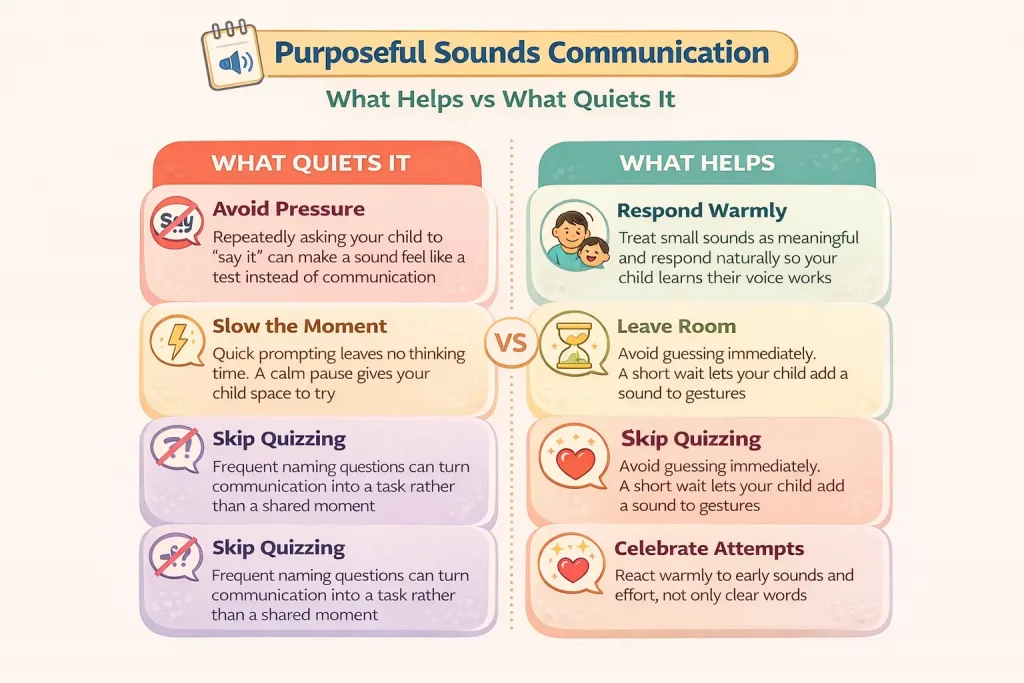
Asking for “one more” or “say it” in the moment
It’s natural to want to shape a sound into something clearer. Your child says “ba,” and your heart lifts. You respond, “Say ball. Ball. Can you say ball?”
But for a child who is still learning, that moment can suddenly feel heavy. Instead of “I made a sound and my parents understood,” it becomes “I made a sound and now I’m expected to do something harder.”
Many children react by going quiet, turning away, or switching to gestures just to escape the pressure. What helps instead is treating their sound as if it already counts. When you respond warmly, you teach the most important lesson first: “My voice works.”
Repeating prompts quickly (especially when you’re in a hurry)
Busy moments make everything speed up. “What do you want? Say juice. Juice. JUICE. Use your words.” The rhythm tightens, and your child feels it.
Even children who love making sounds can freeze when things move too fast. They need time to think, decide, and try. When every gap is filled with more words, there’s no space left for their sound to appear. What helps instead is slowing the moment just a little. A calm pause can feel like an open door rather than a demand.
Guessing too fast (because you know them so well)
This comes from love and experience. You know your child’s signals. The look that means snack. The face that means frustration. The reach that means “help me.”
But when we always jump in before a child can add a sound, the child learns something quietly: “I don’t need to try. They already know.”
Over time, some children become more passive communicators, not because they can’t communicate, but because the situation doesn’t invite them to. What helps instead is letting the moment linger just a tiny bit longer when it feels safe, especially during predictable routines like snacks, bath time, or favorite games. That small space gives your child a chance to add a sound to what they’re already showing you.
Read more: How to Tell If a Sound Is Meaningful Communication Or Just Noise
Turning sounds into a quiz
Sometimes we slip into teacher mode without noticing. “What’s this? Say car. What does the cow say? Can you say mama?”
It makes sense. Parents hear constantly that they should be “working on speech.” But frequent quizzing can turn communication into a task instead of a relationship.
Some children will perform for a while and then stop. Others resist right away.
What helps instead is joining what your child is already focused on and responding to their feelings and actions. Communication grows best when it connects to real wants and real emotions, wanting bubbles again, being annoyed when a tower falls, getting excited about a dog walking by.
Correcting the sound instead of celebrating the attempt
If your child says “guh” for “go,” it’s tempting to correct: “No, say go.” Even gentle correction can feel like “not quite right” to a child who is unsure.
When attempts feel judged, many children protect themselves by trying less.
What helps instead is letting the attempt succeed. You can model the clearer sound naturally without making them repeat it. The message becomes: “I understood you, and I’m also showing you more.”
Saving “big reactions” for perfect words
Children often make more sounds when they feel their sounds create connection. If the biggest smiles and excitement only appear for clear words, a child who isn’t there yet may stop trying.
What helps instead is giving your warmest attention to the earliest steps, the small noises, the effort, the look toward you, the sound paired with reaching or pointing. These moments are the roots of communication.
What supportive alternatives feel like in real life
Support doesn’t have to look like practice. It can look like everyday life, just with a little more listening.
It sounds like noticing a small sound and answering as if it mattered.
It looks like playful noises during routines, silly bath sounds, animal noises with toys, a shared “uh-oh” when something drops.
It feels like giving your child time to take a turn, even if that turn is a squeal, a hum, or one small consonant sound.
It also means welcoming protest sounds. A frustrated noise is still communication. When you respond with, “Oh, you didn’t like that,” or “You want help,” you show your child that sounds are useful for feelings too.
Over time, many parents notice more attempts, more variety, and more moments where their child uses sound to connect. Progress often looks like “trying more” before it looks like “speaking clearly.”
If you’re thinking, “But I need them to talk,” you’re not alone
Wanting words is completely human. Words make life smoother. They reduce guessing. They help with big emotions.
But words grow best when a child first learns that communicating is safe, effective, and enjoyable. Purposeful sounds communication is part of that path. When you protect the joy of communication now, you’re supporting what comes next.
When extra support feels comforting (not because something is wrong)
Sometimes parents just want clarity. What should I respond to? What really counts? How do I help without turning my home into a therapy session?
That’s where optional tools like BASICS can be useful. They guide parents toward simple, everyday ways to support communication goals, such as using sounds to express needs and feelings, through realistic examples that keep things gentle and doable.
A gentle closing thought
If your child has become quieter, it doesn’t mean you failed them. It often means they’re sensitive to the emotional tone of communication, which is actually a strength.
The most helpful shift is often the smallest one: less prompting, more pausing; less testing, more connecting; less rushing, more noticing. When your child learns, “My sounds are welcome here,” you may be surprised how quickly those sounds begin to return, one small moment of connection at a time.
About the Author:
Rajini Darugupally
M.Sc., Speech-Language Pathologist (9+ years of experience)
Rajini is a passionate and dedicated Speech-Language Pathologist with over 9+ years of experience, specializing in both developmental speech and language disorders in children and rehabilitation in adults. Driven by a desire to empower each individual to find their voice, Rajini brings a wealth of experience and a warm, genuine approach to therapy. Currently, at Wellness Hub, she thrives in a team environment that values innovation, compassion, and achieving results for their clients. Connect with Rajini to learn more about how she can help you or your loved one find their voice.
Book your Free Consultation Today
Parent/Caregiver Info:
Client’s Details:
* Error Message