Gross Motor Skills App for Kids: Guided Movement at Home
By Wellness Hub
Last Updated: August 5, 2026
See how brief demonstrations lead to active practice for balance, coordination, strength and everyday movement.
If your child avoids climbing games, falls more often than peers, tires during active play or simply needs more purposeful movement at home, you may be looking for a gross motor skills app for kids. An app cannot build strength or balance by itself. BASICS uses personalised goals, short demonstrations and parent guidance to start real movement practice; the child develops the skill by moving, not by watching the screen.
This guide explains what parents see in BASICS, how Animal Walks can be used safely and when movement concerns need professional advice. BASICS can organise home practice and support work between therapy sessions, but it cannot diagnose the cause of clumsiness, fatigue, fidgeting or movement avoidance.
Quick answer: How can an app support gross motor skills?
A gross motor app is useful when it gives the parent a clear goal, demonstrates a movement and then gets the device out of the way. This app demonstration videos, parent prompts and progress ratings. This makes the app a guide for active, mostly off-screen practice rather than a substitute for movement.
Gross motor skills are the large-body movements used for sitting, standing, walking, running, jumping, climbing, throwing and catching. Strength, balance and coordination can affect how a child participates in play and daily routines. They are not, however, a single explanation for attention, pencil fatigue or difficulty sitting still. Those concerns can have many causes and should not be diagnosed from one behaviour.
What gross motor skills include – and what they do not explain
Big-body movement is not one skill. It brings several abilities together, and the mix changes with the task, the environment and the child.
- Strength and endurance: producing enough force and continuing an activity without unusual fatigue.
- Balance and postural control: staying steady while still, changing position or moving across a surface.
- Coordination and timing: organising the arms, legs and trunk so a movement happens in the intended order.
- Body awareness and motor planning: knowing where the body is and working out how to start, sequence and adjust a movement.
- Task-specific practice: learning the particular demands of hopping, catching, climbing or another activity through appropriate opportunities to try.
Regular physical activity has broad health benefits. The CDC summary of benefits for children includes muscular fitness, endurance, bone health, attention and memory. That population-level evidence does not mean a short core exercise will fix an individual child’s focus or handwriting. A child may have adequate strength and still find a task difficult because of pain, vision, coordination, sensory needs, attention, motivation or the task itself.
Animal Walks in BASICS: Watch briefly, then move
The BASICS store listings confirm Animal Walks and name bear walks and frog jumps. They do not publicly confirm a fixed number of videos, so an evergreen article should not promise a library of exactly 16. Available movements may change with the app version.
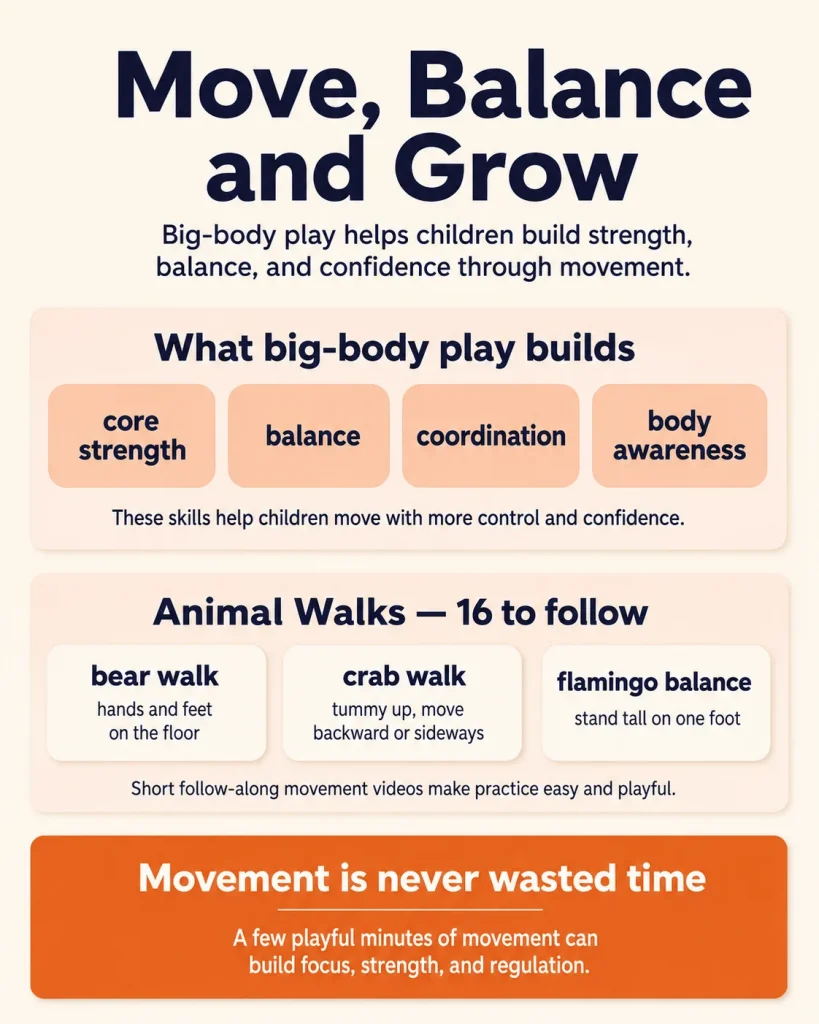
Use one video as a demonstration: watch the complete movement, place the device on a stable surface outside the movement path, clear enough floor space and let your child copy a short part. A bear walk asks the child to coordinate the trunk and limbs while taking weight through the hands and feet. A frog jump practices bending, pushing through both legs and landing. These movements can provide useful practice, but they do not guarantee a particular developmental outcome.
Children also respond differently to movement. An Animal Walk may help one child enjoy a transition or movement break, while another becomes more excited, tired or uncomfortable. Watch the child rather than assuming the activity is automatically calming. Skip a movement that causes wrist, shoulder or joint pain, and follow the child’s physiotherapist or occupational therapist when weight-bearing activity is restricted.
How BASICS guides gross motor practice at home
The verified BASICS workflow is straightforward. A parent answers questions, receives recommended developmental goals and sees three guided activities for the day. Each activity includes a demonstration video, simple steps, parent prompts and therapist tips. After practice, the parent can rate the activity and follow progress goal by goal.
That structure answers the practical questions that generic activity lists leave open: What are we working on? What should the movement look like? How can I support without taking over? How did my child respond? The exact gross-motor goals and activities in a child’s plan can vary by profile and app version, so the areas below describe ways to support the assigned activity rather than promise a fixed BASICS pathway.
Strength and trunk control
When an activity challenges whole-body strength, look for controlled participation rather than exhaustion. Can the child hold their body steady for a short movement? Can they breathe normally and stop safely? For an Animal Walk, a shorter distance or a few well-controlled steps may be more useful than racing across the room.
Make the task easier by reducing the distance, slowing the pace or using a more supported position. Increase the challenge only in a small, safe way after the child can complete the current version comfortably. Strength is one practice area; it is not the hidden cause of every attention, handwriting or coordination concern.
Balance and stability
Balance practice should begin with a stable surface and support within easy reach. If an assigned activity involves standing still, stepping along a path or changing direction, let the child look where they are going and avoid pushing for one-foot balance before they can participate safely in an easier version.
Reduce the challenge by widening the base of support, allowing a hand on a wall or chair, or shortening the task. Remove support only when the child is steady and willing. An adult should stay close enough to prevent a fall without holding the child in a position they cannot control.
Coordination and motor planning
A new movement may be difficult because the child has to understand the idea, plan the order and coordinate several body parts. Demonstrate once, use one short cue and allow time to try. If the sequence is confusing, practise one part before joining the parts together.
Avoid repeating several instructions while the child is moving. A simple cue such as “hands down, then feet” may be easier to follow than a long explanation. Improvement in one practised movement does not automatically transfer to every sport or playground task; children still need experience with the specific activity.
Adjusting practice for your child
Age, health, mobility, movement experience and confidence all affect what is appropriate. The CDC developmental milestone checklists provide broad age-based context, but they are monitoring tools rather than a test or diagnosis. Compare the child with their own recent participation and use the BASICS rating to record what happened, not to pressure them toward another child’s pace.
If an activity is too difficult, change one feature at a time: offer support, reduce the distance, slow the movement or return to one part of the sequence. If it is comfortable and easy, a small increase in distance or complexity may be appropriate. Progress ratings can help parents notice patterns, but they do not replace clinical judgement or an individual assessment.
Make gross motor practice part of an active day
A BASICS activity can fit into a routine without becoming the child’s entire physical-activity plan. Watch one demonstration, move the device out of the way, practise in a clear living-room space or garden, and rate the activity afterwards. If a movement break helps the child return to the next task, it can be used again; if it leaves the child uncomfortable or more dysregulated, choose a different time or activity.
Current CDC physical-activity guidance says children ages 3 to 5 should be active throughout the day and children ages 6 to 17 should receive at least 60 minutes of daily activity. A short guided BASICS task can complement outdoor play, walking, playground time and other enjoyable movement; it should not be presented as a replacement for them.
Set up movement practice safely
- Clear furniture, sharp objects, loose rugs and toys from the movement path.
- Use a dry, non-slip surface and keep enough distance from walls, screens and glass.
- Do not use unstable household furniture for climbing or balance practice.
- Supervise jumping, balancing and climbing, and give stable support when needed.
- Stop for pain, dizziness, unusual breathlessness, repeated falls or distress.
- Follow medical or therapy restrictions for weight-bearing, jumping or strenuous activity.
What BASICS adds to home movement practice
Parents can find many gross motor activities online. The harder part is choosing a relevant goal, seeing the movement clearly and tracking the child’s response without turning play into a test. Based on the current public app listings, BASICS adds five practical supports:
- A personalised goal plan: Parents answer questions and receive recommended developmental goals rather than a random activity feed.
- Three guided daily activities: The plan breaks home practice into a small set that can be carried into play and everyday routines.
- Watch, then do: Each activity includes a demonstration video, simple steps, parent prompts and therapist tips.
- Progress ratings without comparison: Parents rate activities and follow the child’s own goals; the app says it does not use streaks or comparisons.
- A broader occupational-therapy context: Gross motor coordination sits alongside motor planning, sensory processing, fine-motor and daily-living goals.
These are verified product features, not evidence that the app will make every child stronger, calmer or more coordinated. Results depend on the child’s needs, the selected goal, activity fit, health, opportunities to practise and the support available.
Explore guided movement activities in BASICS

Know What to Practise With Your Child Today


BASICS Premium is currently described on the Apple App Store as an auto-renewing monthly or yearly subscription with a seven-day free trial. It renews unless cancelled at least 24 hours before the current period ends. Prices, eligibility, renewal and cancellation terms can differ by platform or region, so review the current terms shown at checkout before subscribing.
Who BASICS may help – and when to seek advice
BASICS may help parents who want structured movement practice at home or between occupational-therapy or physiotherapy sessions, including families waiting for services. No app, Animal Walk or standard progression suits every child.
Seek advice from a pediatrician, physiotherapist or occupational therapist when movement difficulties limit play or daily activities, cause frequent falls or injuries, involve pain or unusual fatigue, affect one side much more than the other, or include loss of a previously used skill. The NHS overview of developmental coordination disorder emphasizes that coordination is complex and needs proper assessment. Appearing clumsy does not identify the cause.
Children with a recent injury, joint instability, mobility limits, heart or breathing conditions, or clinical restrictions may need individual adaptations before weight-bearing, jumping or strenuous movement. BASICS should support, not override, professional advice.
What to Remember about gross motor progress
Gross motor progress is not a race toward a perfect jump or balance time. It may look like joining a game, using support safely, coordinating one part of a sequence or moving with less discomfort. The relevant goal depends on the child and the task.
BASICS can organize home practice by showing parents what to try and how to help. The app provides the plan and demonstration; development happens through active practice, safe opportunities and responsive support.
Clinically Reviewed By
Reviewed by Shilpa Deshpande, Bsc(ASLP), Speech and Language Therapist at Wellness Hub.
Shilpa supports children and families with speech and language assessments, speech sound concerns, language and communication difficulties, autism-related communication needs, and caregiver guidance. This article was reviewed for clinical accuracy, parent-friendly language, and safe guidance on helping children move from short phrases to longer sentences.
This content is for educational purposes only and does not replace professional assessment, diagnosis, or therapy.
View Shilpa Deshpande’s Profile
Related reading on Wellness Hub
- 10 Fun Occupational Therapy Activities Kids Actually Enjoy
- 15 Easy OT Activities You Can Do at Home With Your Child
- How Occupational Therapy Helps Kids Build Life Skills
- Understanding Motor Developmental Difficulties in Autistic Children
- BASICS App Guide: Speech Therapy, Autism and Early Intervention Activities
References and further reading
Book your Free Consultation Today
Parent/Caregiver Info:
Client’s Details:
* Error Message