How to Help Your Child Combine Words into Phrases
Last Updated: July 15, 2026
Simple ways to help your child move from single words to two-word phrases, with examples, home practice, and guided support in the BASICS app.
Your child can say a few single words, but now you want to help them join words together — like “more milk,” “mama come,” or “big car.” This step is called combining words, and it usually grows through simple daily practice, not pressure or flashcards.
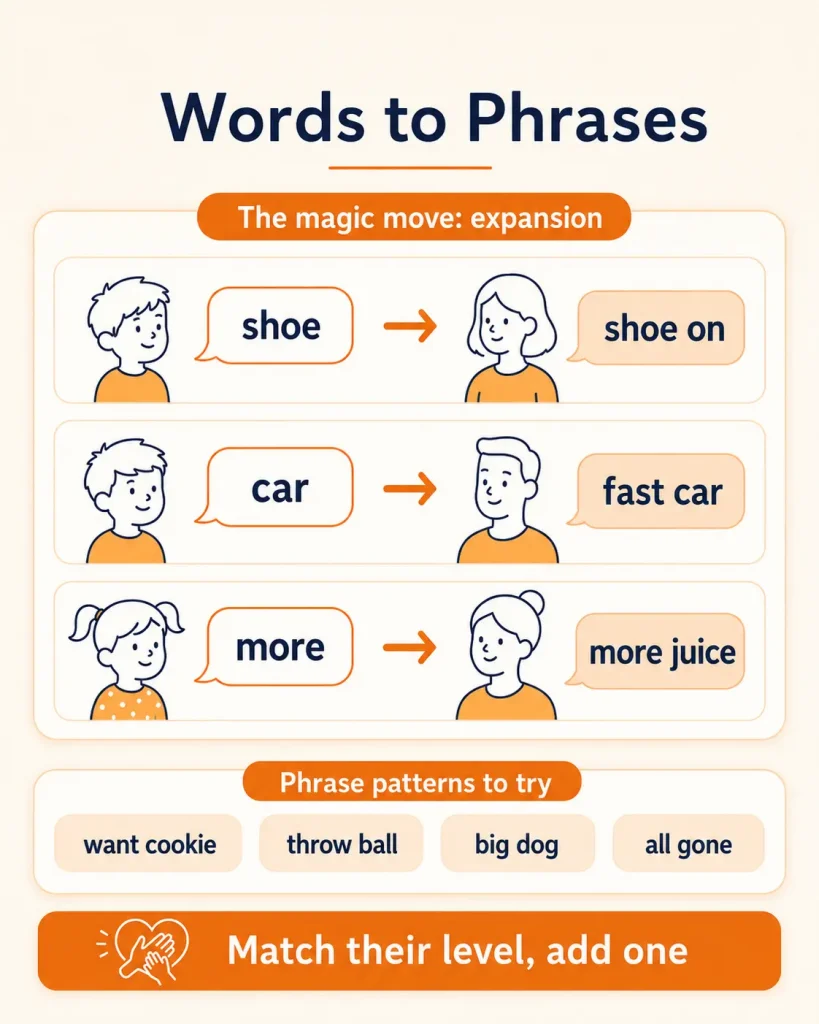
A good way to start is by adding one word to what your child already says. If your child says “shoe,” you can say “shoe on.” If they say “more,” you can say “more juice.” These small expansions help your child hear how two words work together.
In this guide, you’ll learn how to know when your child may be ready for two-word phrases, how to model simple combinations at home, and how the BASICS app can support phrase-building with guided activities, videos, games, and printables.
And remember: phrases do not have to be spoken to count. Two signs together, a word plus a point, or two symbols on a communication device are all meaningful ways of combining ideas. If you are concerned about your child’s speech, language, hearing, or development, speak with a qualified speech-language professional.
Is Your Child Ready to Combine Words?
There’s no exact age, but a useful signal is vocabulary size. Many children begin putting two words together once they have roughly 50 words they use regularly — often somewhere around 18 months to 2 years, though the range is wide and completely normal. Other signs your child may be ready:
- They use a good number of single words across the day, for different reasons.
- They understand simple two-word instructions (“kiss teddy,” “throw ball”).
- They combine a word with a gesture — saying “cup” while pointing, which is really “want cup.”
That word-plus-gesture moment is gold. It shows your child is already thinking in combinations — they just need a model for the second word. That’s exactly where you come in.
The Key Technique: Add One Word to What Your Child Says
If you learn one strategy for phrases, make it this: when your child says a single word, gently repeat it back with one word added. This is called expansion, and it’s the single most powerful thing you can do.
- Child: “Shoe.” You: “Shoe on!”
- Child: “Car.” You: “Fast car.”
- Child: “More.” You: “More juice.”
You’re not correcting them — you’re showing them the very next step, at exactly the moment they’re most tuned in. Keep your addition short and natural, and say it warmly. Over many small repetitions, your child begins to borrow that second word for themselves.
Expansion works because it’s perfectly timed and completely pressure-free. Your child has just told you what they’re thinking about; you simply hand back the same idea with a little more language attached. There’s no demand to repeat it, no quiz — just a warm, slightly fuller echo of their own message. Do this many times a day, across many different words, and you’re giving your child hundreds of gentle, well-timed models without a single lesson. It’s the closest thing early language has to a secret weapon, and it fits into moments you’re already having.
Two-Word Phrases You Can Model
Two-word phrases follow predictable patterns, and you can sprinkle these through the day. A few reliable types:
- Want + object: “want cookie,” “want up.”
- Action + object: “throw ball,” “eat apple,” “open door.”
- More/again + object: “more bubbles,” “more book.”
- Descriptor + object: “big dog,” “hot tea,” “dirty hands.”
- Possession: “my turn,” “mama shoe.”
- Location: “in box,” “up high.”
- Gone/finished: “all gone,” “bye car.”
More Ways to Encourage Phrases
1. Use a slight pause between words
Model the phrase clearly with a tiny gap: “big … ball.” This helps your child hear it as two separate words they can eventually produce on their own.
2.Offer Choices Using Two-Word Phrases
“Do you want big ball or small ball?” Choices naturally model two-word phrases — and give your child a reason to reach for one.
3. Build on Their Favorite Topics
Combinations come easiest around things your child loves. If they adore trucks, “big truck,” “truck go,” and “red truck” will land far better than phrases about things they don’t care about.
4. Create Small Reasons to Communicate
Give just one shoe, or a bowl with no spoon. These playful little gaps invite your child to tell you more — “other shoe,” “want spoon” — stretching them naturally toward two words.
Match Your Child’s Level, Then Add One Word
Match your models to your child’s level, then add one. If they use single words, model two-word phrases — not full sentences. Jumping too far ahead can overwhelm; one step up is the sweet spot where learning happens. If your child works with a speech therapist, these techniques sit alongside that guidance rather than replacing it.
Common Worries About Two-Word Phrases
“They leave out the little words.” Early phrases almost always drop words like “the,” “is” and “a” — “daddy go car” instead of “daddy is going in the car.” This is completely typical. Children carry the meaning first and fill in the small connecting words later. Keep modelling the fuller version gently, and those words arrive in their own time.
“The word order comes out jumbled.” Mix-ups like “up me” for “pick me up” are a normal part of experimenting with combinations. Rather than correcting, simply model it back the right way — “Up! Pick you up!” — and let repetition do the teaching.
“They use the same phrase for everything.” Many children latch onto one combination they’ve mastered and use it widely before branching out. That’s a sign the pattern has clicked — gently model new combinations around their favourite things to help them expand.
How the BASICS App Supports Phrase Building
Knowing the techniques is one thing; knowing which phrases to target, and finding enough moments to practise, is another. The BASICS app is built by speech therapists and child-development specialists to turn phrase-building into a clear, day-by-day routine, so you always know your next small step.
A Guided Path From Words to Phrases
Within the BASICS Communication module, the Phrases & Sentence Development area picks up right where first words leave off. It gives you a focused set of goals and a few daily activities at a time, each with clear steps, parent prompts, gentle progressions and therapist tips — so the leap from one word to two feels structured rather than daunting.
Phrase Park: Games Made for Combining Words
BASICS includes a dedicated set of phrase-building games in Phrase Park, designed specifically to help children join words together — pairing actions with objects, requests with items, and descriptors with things, in exactly the patterns above. Because they’re playful and repeatable, your child gets the many gentle repetitions phrases need, without it ever feeling like drill. And true to how BASICS is built, wrong answers gently teach rather than simply redirect.
Videos That Model Phrases Clearly
Building on the First Words video approach, BASICS models language in short, predictable clips your child can watch again and again — the calm, consistent format that many children learn combinations best from. You watch together, pause, and try, with no pressure and no testing.
Printables for Everyday Practice
For screen-free moments, BASICS printables give you simple, tactile ways to practise phrases at the table or on the go — turning car names, food, and favourite toys into natural two-word practice.
Signs, Gestures, and AAC Count Too
Signs, gestures and communication devices are treated as fully equal to speech throughout BASICS. A child who signs “more” and points to the bubbles is combining words — and BASICS is built to recognise, honour and grow that, whatever form it takes.
Build Phrases Step by Step With BASICS – Try free for 7 days — no pressure, cancel anytime.
Helping Single Words Grow Into Phrases
The jump from words to phrases can feel like it takes forever — and then one day your child surprises you with “more juice” as if they’d always known it. Keep expanding their words by one, keep the moments playful, and celebrate every combination, however it’s expressed. Little by little, single words grow into phrases, and phrases into the beginnings of real conversation.
One word, then two — you’re building conversations, one small step at a time.
Clinically Reviewed By
Reviewed by Anuradha Karanam, BASLP, Speech-Language Pathologist at Wellness Hub.
Anuradha supports children with speech, language, communication, and developmental needs, including speech-language assessments, parent guidance, and home training support. This article was reviewed for clinical accuracy, parent-friendly language, and safe guidance around helping children move from single words to phrases.
This content is for educational purposes only and does not replace professional assessment, diagnosis, or therapy.
View Anuradha Karanam’s Profile
Related reading
- How to Teach First Words at Home: A Parent’s Guide
- Support Speech Development at Home With BASICS App
- Speech Delay in Toddlers: Signs Every Parent Should Watch For
- Online Speech Assessment for Kids
References & Further reading
The strategies above reflect widely used, evidence-based early-language approaches described by the following authoritative sources.
- American Speech-Language-Hearing Association (ASHA). Communication Milestones: 19 to 24 Months
- Centers for Disease Control and Prevention (CDC). Milestones by 2 Years
- National Institute on Deafness and Other Communication Disorders (NIDCD). Speech and Language Developmental Milestones
- Mayo Clinic. Language Development: Speech Milestones for Babies
- The Hanen Centre. Combining Words Together: A Big Step in Language Development
- ASHA. Augmentative and Alternative Communication in Early Intervention
Frequently Asked Questions
1. When should my child start combining words?
Many children begin combining words around age 2, but the exact timing can vary. A child may start with simple two-word phrases like “more milk,” “mama come,” “big car,” or “want ball.” If your child is close to this stage, the best thing you can do is model short phrases during daily routines without forcing them to repeat.
2. What counts as a two-word phrase?
A two-word phrase means your child combines two ideas together. Examples include “more juice,” “daddy go,” “open door,” “big dog,” and “all gone.” Signs, gestures, picture symbols, or AAC choices can also count when your child is using two ideas together to communicate.
3. My toddler says single words but does not combine them. What should I do?
Start by adding one word to what your child already says. If your child says “car,” you can say “fast car” or “car go.” If they say “more,” you can say “more bubbles” or “more juice.” Keep it short, natural, and pressure-free.
4. Should I ask my child to repeat two-word phrases?
It is usually better to model the phrase instead of asking your child to repeat it again and again. For example, if your child says “shoe,” you can respond with “shoe on.” This gives your child the next step without turning communication into a test.
6. What if my child has 50 words but is not using phrases yet?
Some children need more time and more models before they begin combining words. Use simple expansion many times across the day: “want cookie,” “open box,” “more swing,” “mama help.” If your child is around 2 years old and not combining words, or if you are worried about their speech, hearing, or understanding, it is a good idea to speak with a speech-language professional.
7. Do signs, gestures, or AAC count as combining words?
Yes. Communication does not have to be spoken to count. If your child signs “more” and points to bubbles, chooses “want” plus “cookie” on a communication device, or uses a word with a gesture, they are learning to combine ideas. You can respond by modeling the same message in a simple phrase.
8. What are easy two-word phrases to teach first?
Start with phrases your child can use often. Good early examples include “more milk,” “want up,” “open door,” “throw ball,” “big truck,” “my turn,” “in box,” and “all gone.” Choose phrases that match your child’s real routines, favorite toys, foods, and daily needs.
9. When should I get help for my child’s speech?
Consider asking for a speech-language evaluation if your child is around 2 years old and is not combining words, uses very few words, does not seem to understand simple directions, has lost words they used before, or you have concerns about hearing, interaction, or communication. Getting support early does not mean something is wrong; it helps you understand what your child needs next.
Book your Free Consultation Today
Parent/Caregiver Info:
Client’s Details:
* Error Message