Simple Sentences for Kids: A Parent’s Guide to Early Sentence Building
By Wellness Hub
Last Updated: December 20, 2025
Helping young children move from single words to clear sentences is an important language milestone. Many parents ask when children should start using sentences and how to support this skill at home. This guide explains simple sentences for kids, why they matter, how they develop, and how you can practice them naturally with your child.
What Are Simple Sentences for Kids?
Simple sentences for kids are short, clear sentences that express one complete idea. They usually follow an easy structure:
Subject + Action (Verb)
or
Subject + Action + Object
Examples:
- I run.
- Dog eats.
- The boy jumps.
- She wants water.
These sentences use basic words and focus on meaning, not grammar rules. For young children, clarity matters more than perfection.
Why Simple Sentences Are Important for Children
Simple sentences help children:
- Express needs and feelings clearly
- Take part in back-and-forth conversation
- Build confidence while speaking
- Prepare for longer and more complex sentences later
- Strengthen listening and understanding skills
When children use short sentences, they are learning how words connect to form meaning.
When Do Children Start Using Simple Sentences?
Most children begin combining words between 18 months and 2.5 years. This timeline can vary.
General progression:
- 12–18 months: Single words (milk, mama, ball)
- 18–24 months: Two-word phrases (want toy, daddy go)
- 2–3 years: Simple sentences (I want toy, daddy is here)
- 3–4 years: Longer sentences with details
If your child understands language but speaks in short phrases, practicing simple sentences can help.
Examples of Simple Sentences for Kids
Below are age-appropriate examples parents can model during daily routines.
One-Word to Sentence Expansion
- Ball → Ball rolls
- Milk → I want milk
Daily Action Sentences
- I eat rice.
- She is sleeping.
- We go home.
Feeling-Based Sentences
- I am happy.
- He feels sad.
Play-Based Sentences
- Car goes fast.
- Baby is crying.
These examples work best when paired with real actions or pictures.
How to Teach Simple Sentences at Home
You do not need special training to help your child. Everyday moments are enough.
1. Model Simple Sentences Often
Speak in short, clear sentences during routines.
Instead of:
“Do you want to have some juice now?”
Say:
“You want juice.”
2. Expand What Your Child Says
If your child says:
“Dog.”
You can say:
“Dog is running.”
This shows how to turn words into sentences.
3. Use Daily Activities
Practice during:
- Mealtime: “I eat apple.”
- Bath time: “Water is warm.”
- Playtime: “The car goes.”
Repetition helps children learn faster.
4. Ask Easy Choice Questions
Instead of open questions, offer choices:
“Do you want apple or banana?”
Then model:
“I want apple.”
Simple Sentence Worksheets for Kids
Worksheets can support learning when used correctly. They work best when paired with talking and interaction.
Common worksheet activities include:
- Matching pictures to sentences
- Filling in missing words
- Choosing the correct sentence
- Tracing and reading short sentences
For preschoolers, worksheets should:
- Use pictures with one clear action
- Have short sentences only
- Avoid complex grammar
Worksheets are tools, not replacements for conversation.
Simple Sentences Worksheets for Kids
| Worksheet Set Name | Focus Area | Resource Link |
|---|---|---|
| Simple Sentences (Full Set) | Complete action sentence practice | Download PDF |
| Simple Sentences (Plural Set) | Plural nouns in simple sentences | Download PDF |
| Simple Sentences (Boy/Girl Set) | Gender-based sentence practice | Download PDF |
| Sentences: She + Action + Object | Pronoun “She” sentence building | Download PDF |
| Sentences: He + Action + Object | Pronoun “He” sentence building | Download PDF |
| Sentences: Animals + Action + Object | Animal-based action sentences | Download PDF |
| Sentences: Woman + Action + Object | Adult female action sentences | Download PDF |
| Sentences: Man + Action + Object | Adult male action sentences | Download PDF |
| Sentences: Boy + Action + Object | Boy-focused sentence practice | Download PDF |
Simple Sentences for Speech and Language Development
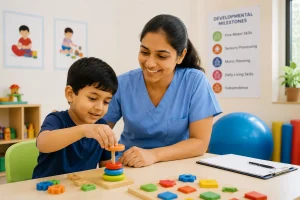
Speech therapists often start with simple sentences because they reduce pressure on the child. Short sentences allow children to focus on meaning and clarity.
Simple sentences help with:
- Late talking
- Limited sentence length
- Difficulty combining words
- Building confidence in speaking
Parents can support therapy goals by practicing the same sentence patterns at home.
Common Mistakes to Avoid
- Correcting every sentence your child says
- Forcing repetition again and again
- Using long or complex sentences too early
- Expecting grammar accuracy at the start
Focus on communication, not correctness.
Signs Your Child May Need Extra Support
Consider professional guidance if your child:
- Rarely combines words after age 2.5
- Uses only gestures instead of words
- Gets frustrated when trying to speak
- Has limited understanding of simple directions
Early support makes learning easier and more effective.
Simple Ways to Practice Every Day
You can practice simple sentences by:
- Reading picture books and describing images
- Talking during walks or errands
- Singing action songs
- Playing pretend games
Short, repeated exposure works better than long practice sessions.
Conclusion
Simple sentences are the foundation of communication. Children learn them best through everyday interaction, repetition, and patience. Focus on connection, not perfection. When children feel understood, their language grows naturally.
If you would like, I can also help you create:
- An SEO-friendly worksheet section
- A comparison table of sentence activities
- Downloadable practice ideas for parents
- Infographic text for sentence-building stage
Frequently Asked Questions:
1. What are simple sentences for kids?
Simple sentences for kids are short sentences that share one clear idea. They usually include a subject and an action, such as “I eat food” or “The dog is running.” These sentences help children express their thoughts without feeling overwhelmed by long or complex language.
2. At what age should kids start using simple sentences?
Many children begin using simple sentences between 2 and 3 years of age. Some children may start earlier, while others may take a little longer. Development can vary, and understanding language often comes before speaking in full sentences.
3. How can I teach simple sentences at home?
You can teach simple sentences by speaking slowly and using short, clear sentences during daily routines. Expand on what your child says, repeat sentences often, and talk during play, meals, and everyday activities. Natural conversation is the best practice.
4. Are worksheets helpful for learning sentences?
Yes, simple sentence worksheets can help when they are used along with talking and play. Worksheets work best when they include pictures and short sentences and when parents talk about the sentences instead of focusing only on writing.
5. My child uses only two words. Is that okay?
Yes, this is common in early language development. Two-word phrases like “want milk” or “mommy come” are an important step before full sentences. With regular modeling and patience, children usually begin adding more words over time.
6. Should I correct my child’s grammar?
No. Correcting grammar directly can make children feel unsure or hesitant to speak. Instead, repeat what your child says using the correct sentence. This helps them hear the right structure without pressure.
7. Can late talkers learn sentences later?
Yes. Many late talkers learn to form sentences with consistent support and practice. Using simple sentences often, encouraging communication, and seeking guidance when needed can make a big difference.
8. How many words are in a simple sentence?
For young children, a simple sentence usually has two to five words. Short sentences are easier to understand and say, and they help children focus on meaning rather than length.
9. Do pictures help with sentence learning?
Yes. Pictures help children connect words with actions and objects. Visual support makes it easier for children to understand sentence meaning and encourages them to try speaking.
10. When should I talk to a speech therapist?
If your child is not combining words, seems frustrated while trying to communicate, or is difficult to understand for their age, it may help to speak with a speech therapist. Early guidance can support language growth and confidence.
Book your Free Consultation Today
Parent/Caregiver Info:
Client’s Details:
* Error Message