When to Get Extra Help With Early Communication: If Gestures and Sounds Aren’t Connecting Yet
By Wellness Hub
Last Updated: January 28, 2026
You notice your child reaching for something, or looking at a favorite toy, or wanting to be picked up. You can see the intention so clearly. But the “connection” piece, the pointing, the showing, the little sounds that go with it, doesn’t seem to be coming together yet.
If you’ve been watching for pointing, reaching, showing, or vocalizing to start working as a team and it still feels scattered, it’s completely understandable to wonder what to do next. Many parents would wonder, feeling that gentle tug of, “Should I ask someone about this?”
This article is here to offer calm guidance, what this early skill really is, what patterns are worth noticing over time, and what it can look like to get extra support in a way that feels proactive and positive.
What “gestures + sounds” really means and why it matters
Early communication isn’t only about words. Long before children talk in full words, they often communicate with their bodies, reaching, pointing, holding something up for you to see, or offering an object. When those gestures start pairing with sounds, an “ah!”, a squeal, a little “mm,” or an early proto-word, it’s a powerful shift.
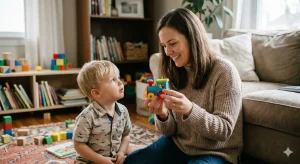
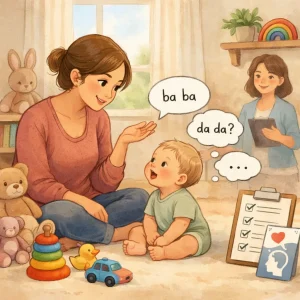
This goal is often described as “combining gestures with sounds to communicate intent”. It can look like point + sound, reach + vocalize, show an object + “ah!”, or using early proto-words alongside gestures during everyday interactions.
What matters most isn’t the exact sound. It’s the message, “I want that,” “Look at this,” “Help,” “More,” “I’m sharing this with you.” These moments tend to create more back-and-forth connection, more shared excitement, and more confidence for your child, because they feel understood.
Also read: Common Mistakes That Can Shut Down Gesture + Sound Communication And What to Do Instead
If it’s not happening yet, does that mean something is wrong?
Not necessarily.
This skill often develops gradually and unevenly. Some children gesture a lot but stay quiet. Others make plenty of sounds but don’t naturally point or show. Many children do a bit of both, but not in a way that feels clearly “connected” yet. And sometimes, life itself makes it harder to notice progress. Busy days, older siblings, daycare transitions, travel, illness, or simply a child with a very focused play style can make communication look quieter for a while.
It’s also normal for parents to feel unsure because early communication can be subtle. A small reach paired with a tiny sound might happen quickly and be easy to miss, especially if you’re juggling snacks, shoes, and the rest of the day. So if you’re wondering, it doesn’t mean you’ve missed something or done something wrong. It means you’re paying attention.
Read more: Progress Signs: Small Wins to Look for When Gestures Start Pairing With Sounds
What progress often looks like when gestures and sounds start connecting
When this skill begins to emerge, it usually shows up as small, everyday moments rather than a big “aha” milestone.
You might start noticing things like your child pointing or reaching while making a sound, showing you an object and adding a vocalization like “ah!”, or using simple proto-words alongside gestures. Often, parents also notice more shared excitement, those little “Did you see that?” moments, because their child is pulling them into the experience more often.
Over time, engagement in play and routines may increase too. Not because you’re doing anything fancy, but because your child is discovering that communication works. Thinking like, “When I gesture and add a sound, people understand me.”
When it may be time to consider extra support
A helpful way to think about this is not “Should I worry?” but “Would support make this easier for us?”
Extra help can be a good next step when you notice patterns like seeing gestures or sounds, but they don’t seem to come together over time, and progress feels stalled. Or your child often wants things but doesn’t consistently point, reach, or show you in a way that clearly invites you in. Some parents also notice that communication feels more like guessing than sharing, like you’re working hard to interpret needs, but there aren’t many clear signals to build on.
Another common reason families reach out is simply that they feel unsure what’s typical or what to focus on. That uncertainty can be exhausting. Getting a professional perspective can replace that mental loop of “Am I overthinking this?” with a calmer plan. Seeking help can also make sense if you’re noticing frustration, either in your child or in the flow of daily routines, because communication isn’t feeling smooth yet. Support isn’t about labeling anything. It’s about making everyday connections easier.
What to track before you reach out without turning life into a test
If you decide to ask for guidance, it can help to bring a few simple observations. Not perfect notes, not a spreadsheet, just a clearer picture of what you’re seeing.
Think about whether your child is more likely to communicate during certain routines (snack, getting dressed, bath) or with certain people. Notice what kinds of gestures show up most (reaching, giving, showing, pointing) and whether any sounds tend to appear in the same moments. You might also reflect on how your child lets you know they need help, want more, or want you to look at something. Even a couple of real-life examples can be useful, like: “When she wants a snack, she pulls me to the pantry but doesn’t point,” or “He reaches for bubbles and makes a sound, but doesn’t look at me,” or “She shows me toys sometimes, but it’s quiet, no sound with it.”
These kinds of details help a professional understand your child’s current communication style and what support might be most helpful.
Questions you can bring to a professional so you feel supported, too
Usually parents sometimes worry they’ll be dismissed or overwhelmed with information. It’s okay to come in with questions that keep things grounded and practical. You might ask what they’re noticing about how your child expresses needs and interests right now, and what “next steps” typically look like for children at a similar stage. You can also ask what would count as meaningful progress over the next few months, and how you can support communication in daily life without pressure.
Many parents find it reassuring to ask how to respond in the moment when their child reaches, points, shows, or vocalizes, so those attempts feel successful and motivating. Support often comes down to helping you recognize and build on what’s already there.
What extra support usually looks like and what it doesn’t
Extra help for early communication is often much gentler than parents imagine. It typically looks like someone getting to know your child through play and routines, noticing what your child already does to communicate, and helping you strengthen those moments of connection. The focus is usually on making communication feel easier and more rewarding, so gestures and sounds become a natural way your child shares needs and interests.
It does not have to look like drilling, pressure, or constant “say this” moments. In fact, many families find it feels like a relief with fewer guesses, more clarity, and a calmer sense of direction. Professionals also often use simple ways to track progress over time. For example, one common measure of mastery for this goal is whether a child is consistently using gestures with sounds across interactions, not perfectly, but more often and more reliably.
If you’re worried it’s “your fault,” please hear this
When parents consider extra help, a quiet guilt sometimes shows up. You may feel like, “Did I miss something? Did I not talk enough? Did I do something wrong?”
Early communication development is not a parenting scorecard. Children grow in different patterns, and many factors shape how and when skills emerge. Seeking support is not an admission of failure, it’s a thoughtful, loving choice to meet your child where they are. Though your child’s gestures and sounds aren’t connecting yet, it’s good to support them and pay attention with care.
A gentle option if you want guidance at home
Some families like having a simple structure to lean on between appointments or while deciding what to do next. Speech and Autism therapy App like BASICS can help parents understand communication goals (like combining gestures with sounds) and see how support can fit naturally into everyday routines—without turning your day into “therapy time.”
It’s not the only route, and it’s not required. It’s just one way to feel less alone and more confident about what you’re noticing.
The bottom line: help can be a proactive step, not a scary one
If gestures and sounds aren’t connecting yet, it’s okay to pause and wonder. It’s also okay to reach out and ask for another set of eyes.
The goal isn’t to rush your child or compare them to anyone else. It’s to support those small, meaningful moments—point + sound, reach + vocalize, show + “ah!”—that build connection, confidence, and joyful back-and-forth over time.
And if you decide to get extra help, let it be for the simplest reason of all: you want communication to feel easier for your child, and you want to feel supported as their parent.
Book your Free Consultation Today
Parent/Caregiver Info:
Client’s Details:
* Error Message