How to Build from Single Gestures to Simple 2-Step Action Sequences Like Clap + Wave
Last Updated: March 7, 2026
You finally get a wave. Or a clap. Or that tiny, proud high-five that makes your whole day.
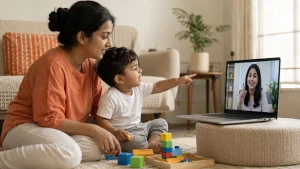
And then a new question appears: “How do we go from one gesture to two?” Many parents exploring gesture sequences for toddlers wonder how to help their child link actions like clap then wave or high-five then clap without turning play into a test.
If this sounds familiar, you’re in good company. Many parents feel unsure about when to introduce simple sequences and how to do it in a way that still feels light, connected, and fun. The reassuring truth is that gesture sequences do not need to be rushed. They usually grow naturally from warm, repeated interactions—especially when the goal is shared joy, not perfect performance.
Also read: Teaching High-Fives and Waves Without Turning It Into a Power Struggle
Why linking two gestures is a meaningful next step
Imitating simple actions and gestures, such as clapping, waving, giving a high-five, or shaking the head, helps your child connect with you. It is one of the earliest ways children take part in back-and-forth interaction before words become steady.
When a child begins linking two actions together, something new is happening. They are noticing a pattern and holding it in mind long enough to try it. A two-step sequence is still small, but it represents a big step in coordination, attention, and social understanding. It also often brings more smiles, more laughter, and more “we did that together” moments, which is really the heart of this goal.
When is a child ready for simple 2-step action sequences?
Readiness usually looks less like a specific age and more like gentle signs that appear in everyday play.
Your child may be ready to explore short action chains if they are beginning to imitate at least one gesture some of the time, especially during familiar routines. You might notice them watching you closely before trying something, as if checking your hands or your face for clues. Some children pause and then copy; others jump in quickly when they feel excited. Both can show that imitation is developing.
Enjoyment is another helpful sign. If your child lights up during social games—peekaboo, action songs, or silly “copy me” moments in the mirror, that joy can be a strong foundation for adding one more small step. Most importantly, readiness does not mean your child can do this consistently. It simply means they are interested, engaged, and beginning to understand the idea of “you do it, then I do it.”
Why two steps can feel surprisingly hard even when one step is easy
This is where many parents feel surprised. A child might clap easily, but “clap + wave” suddenly feels out of reach. That does not mean they lost the skill or stopped paying attention.
Two-step sequences ask for more than imitation alone. Your child must notice the first action, do it, then shift to the second action without getting stuck, distracted, or overwhelmed. Some children also need extra time to process what they saw before their body can respond. This is why it helps to think of gesture sequences for toddlers as something children grow into—through repetition, predictability, and playful timing—rather than something they are expected to perform on demand.
Keeping sequences playful and predictable without overwhelming your child
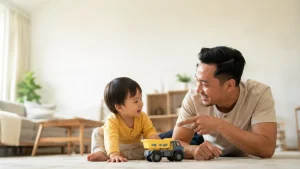
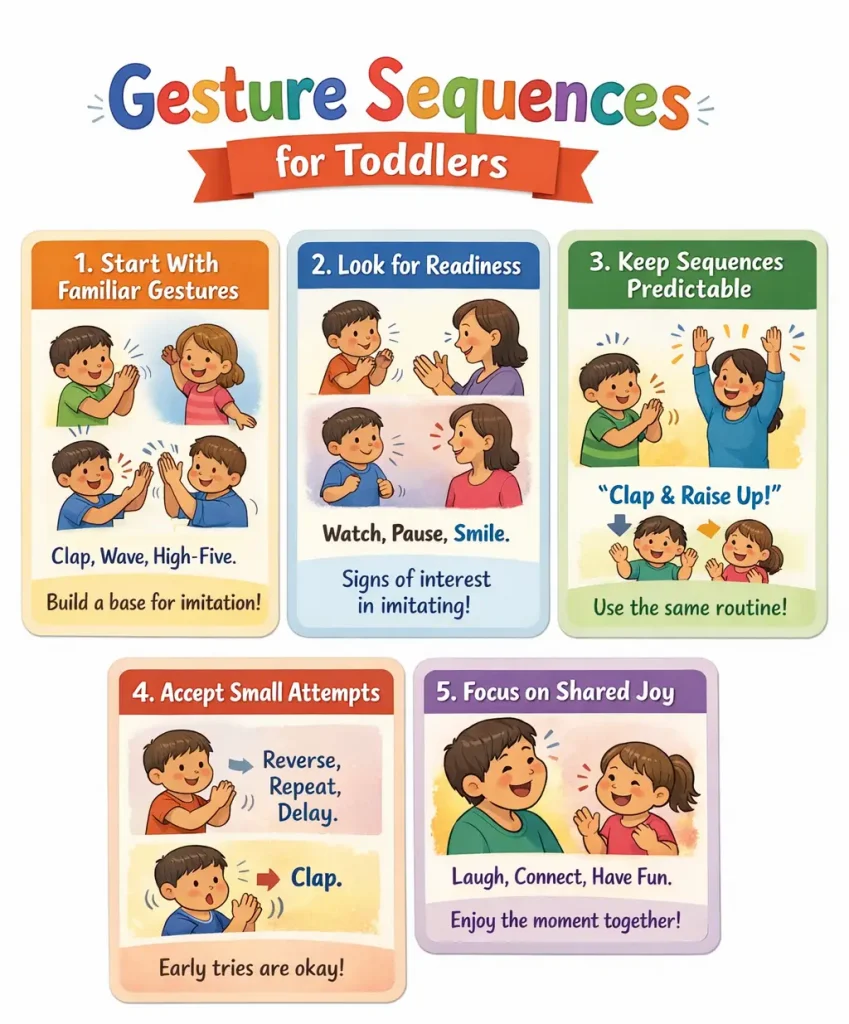
Two-step sequences feel easiest when they grow out of moments your child already understands. Many families naturally use gestures in routines: waving goodbye at the door, clapping when a tower falls, giving a high-five after washing hands. These familiar moments can become gentle anchors for adding one more action.
Predictability also helps. When the same small sequence appears in the same types of moments, your child does not have to guess what will happen next. It becomes a shared script. For example, a consistent “yay!” after something fun may naturally invite a clap, followed by a wave to move on to the next activity. Over time, gesture sequences for toddlers become part of the story of your day.
Keeping the mood relaxed matters too. Children are more likely to imitate when they feel safe and unhurried, not watched closely for a “right answer.” If your child tries only the first step, that is still meaningful participation. You can treat it as success and keep the interaction warm.
Also read: Why Your Child Imitates Sometimes but Not Other Times
What progress can look like and what still counts
Progress with gesture sequences is often quiet and uneven. It may not look like a clean “clap, then wave” at first. Instead, you may notice small changes that show your child is moving closer.
Your child might do the first gesture and then look at you, as if asking, “What’s next?” You might see a delayed second step, clap now, wave a few seconds later. Some children reverse the order at first, or repeat one gesture twice because they are excited. All of this can be part of learning.
You may also notice more anticipation. Your child might smile before you even begin, lift their hands as if they know what is coming, or become more engaged in games with motions. They may start seeking you out for the familiar routine. These moments matter because the goal is not perfection. The goal is connection, your child learning that copying you is a fun way to be together.
Choosing the right sequences: simple, social, and familiar
The most helpful early sequences usually use gestures your child already recognizes and sees often. Clap + wave is a great example because both actions are common, visible, and naturally celebrated.
Some families find that high-five + clap fits well after a shared success, or wave + blow a kiss works naturally in goodbye routines. Even a playful head shake “no” followed by a wave can make sense in moments like “no no… bye-bye!” The best sequence is one that fits your child’s world and feels natural in your family.
If a sequence seems to require constant prompting or your child consistently turns away, it may simply be too much right now. That is not a setback—it is useful information. Often, the most supportive choice is to return to single gestures for a while and try again later when your child feels more regulated and interested.
A common worry: Am I pushing too hard?
Many thoughtful parents worry about this, especially when they are encouraged to “work on skills” at home. A helpful guideline is to watch your child’s cues.
If your child is smiling, staying near you, making eye contact, or re-engaging after a pause, the interaction likely feels okay. If they are pulling away, becoming frustrated, or clearly done, it is completely fine to drop the sequence and enjoy whatever connection is available in that moment.
You are not missing a window. You are building trust. And trust is what allows imitation to grow.
Also read: 10+ Simple Home Activities to Encourage Clapping, Waving, and High-Fives
When extra support can feel helpful
Sometimes parents want fresh ideas or reassurance that they are noticing the right kinds of progress. If you would like a bit of structure without turning your day into “practice time,” tools like BASICS can offer simple guidance and short videos that fit naturally into routines and play, with an emphasis on connection and everyday moments.
If you have ongoing concerns about your child’s communication or imitation skills, speaking with a speech-language pathologist or your pediatrician can be a helpful first step.
A gentle takeaway
Moving from single gestures to simple two-step sequences is a lovely next step, but it does not have to be a big project. Gesture sequences for toddlers often grow from what you are already doing: familiar routines, playful repetition, and warm pauses that give your child time to join in.
If your child claps but does not wave yet, or waves but forgets the clap, you are still on the path. Each attempt, each glance to you for cues, each shared laugh, each moment of “we’re doing this together”, is real progress. And if today is a one-gesture day, that is okay too. Connection comes first. The sequences will follow.
About the Author:
Shravanaveena Gajula
M.Sc ., Speech and Language Pathology (5+ years of experience)
Shravanaveena Gajula is a dedicated Speech-Language Pathologist with a BASLP and an M.Sc in Speech and Language Pathology. With experience spanning multiple settings, including Wellness Hub , Veena specializes in a wide range of disorders from developmental issues in children to speech and language assessments in adults. Her expertise includes parent counseling, managing speech sound and fluency disorders, and creating individualized therapy programs. Veena is also PROMPT certified and an author of several insightful blogs on speech and language pathology, aiming to educate and assist caregivers in supporting their loved ones.
Book your Free Consultation Today
Parent/Caregiver Info:
Client’s Details:
* Error Message