How to Teach Self-Regulation to Children: 8 Practical Strategies
By Wellness Hub
Last Updated: August 3, 2026
A safety-first parent guide to big feelings, co-regulation, tantrums, sensory overload, calm-time practice, and optional support from the BASICS app.
Short answer: To teach self-regulation to children, help them notice what is happening in their body, give them accessible ways to communicate, and practise one coping option at a time when they are calm. During intense distress, focus first on safety, lower demands and stimulation, and offer connection or space without forcing either. A strategy that helps one child may upset another, so watch the child’s response and adjust.
Self-regulation is the ability to manage attention, energy, emotions, and behaviour well enough to take part in daily life. For a young child, that may mean asking for a break, moving away from noise, accepting help after disappointment, or recovering after a hard transition. It does not mean staying calm all the time, obeying without protest, or hiding distress.
Children build these skills gradually. Support from a caregiver can help, but a child’s regulation is also influenced by communication, sensory needs, sleep, hunger, pain, temperament, neurodevelopment, past experiences, and the environment. The aim is to understand what the child may need and expand their options – not to blame the child or the parent for a difficult moment.
What is Self-Regulation in Children?
Self-regulation includes several related abilities:
- Noticing: recognising body signals such as a tight jaw, fast breathing, tiredness, hunger, restlessness, or the urge to escape.
- Communicating: using speech, gestures, signs, pictures, or augmentative and alternative communication (AAC) to ask for help, a break, more time, or for something to stop.
- Choosing support: trying a movement, sensory, breathing, quiet, connection, or problem-solving strategy that fits the situation.
- Holding a boundary: expressing anger or disappointment without hurting another person or damaging property.
- Recovering: returning to an activity, reconnecting, resting, or repairing after the body has settled.
Emotional regulation focuses specifically on emotions. Self-regulation is broader and also includes attention, arousal, impulses, and behaviour. In daily parenting, the terms often overlap. The useful question is not which label is perfect, but what support the child needs in this situation.
Co-Regulation Helps, but Parents Are Not the Sole Cause
Co-regulation is the support a caring adult provides through a responsive relationship, a manageable environment, and coaching that fits the child’s developmental level. The Administration for Children and Families describes co-regulation as a process that fosters self-regulation; it does not mean that a parent must make every feeling disappear.
A calmer adult may make a hard moment safer and more predictable. But an adult can do everything thoughtfully and still have a child who needs time, distance, a quieter space, medical care, communication support, or professional assessment. If your first approach is not helping, change the approach instead of assuming that either of you has failed.
Before Choosing a Strategy, Ask What May Be Driving the Distress
Crying, yelling, dropping to the floor, running away, freezing, hitting, or becoming silent can have more than one explanation. The same child may need different support on different days.
| What you notice | Possible factors to consider | First response |
| Distress after a limit, a lost turn, or an unmet want | Frustration, disappointment, fatigue, hunger, difficulty waiting, or testing whether the boundary will change | Stay nearby, keep the boundary clear, reduce talking, and allow time to recover |
| Distress around noise, light, crowds, touch, clothing, or busy transitions | Sensory overload, pain, anxiety, unpredictability, or communication difficulty | Reduce stimulation and demands, move to a safer space if possible, and offer the child’s usual communication or sensory supports |
| Fear, freezing, rapid breathing, clinging, or repeated reassurance-seeking | Anxiety, panic, an unfamiliar situation, pain, or a previous frightening experience | Slow down, use simple reassurance, reduce pressure, and seek professional advice if episodes recur or interfere with daily life |
| Hitting, biting, throwing, self-injury, or running toward danger | Overwhelm, impulsivity, pain, communication breakdown, a learned pattern, or another unmet need | Prevent harm first, move dangerous items, use few words, and get additional help when safety is difficult to maintain |
| A sudden change from the child’s usual behaviour | Illness, pain, sleep loss, medication effects, injury, stress, or another health or environmental change | Check basic needs and health first; contact the child’s doctor when the change is significant, unexplained, or persistent |
These are possibilities, not diagnoses. NICE recommends assessing physical health, mental health, communication, and environmental triggers when an autistic child develops behaviour that challenges. The same habit of checking for multiple causes is useful for any child.
For a more focused comparison, read Autism Meltdowns vs Tantrums: What Parents Need to Know. Do not rely on the label alone: respond to what is happening now and what keeps everyone safe.
What Should You Do During a Big Feeling?
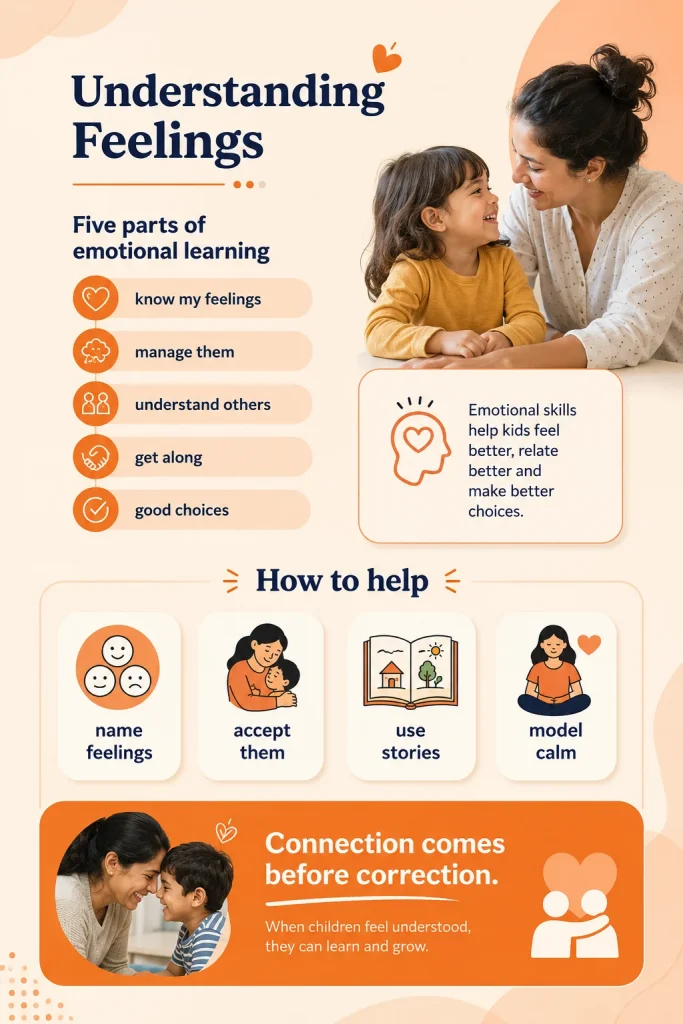
At the peak of distress, a child may have limited capacity to process explanations, answer questions, or use a newly taught technique. This is usually the time to reduce pressure, not teach a lesson.
1. Make the Situation Safe
Block hitting or biting as calmly as you can, move breakable or dangerous objects, and stop the child from running into danger. Use short language:
- “I will not let you hit.”
- “You are safe. I am moving this.”
- “We are going somewhere quieter.”
Safety is not punishment. The American Academy of Pediatrics advises adults to set clear limits around hitting, biting, and other aggressive behaviour.
2. Reduce Demands and Stimulation
Pause non-essential instructions. Lower noise and light if they appear to be adding to distress. Move other people back, stop repeated questions, and give the child time to process. If leaving the setting is safer, use the simplest available route.
3. Steady Your Own Pace
Take one breath, lower your voice, and slow your movements if you can. This may help the interaction feel less threatening, but it is not a guarantee that the child will calm immediately. If you are becoming overwhelmed, another trusted adult can take over while you step away briefly, provided the child remains safe.
4. Offer Connection or Space
Some children want a cuddle, hand, or familiar adult nearby. Others need less talking, no touch, or more distance. Ask or observe:
- “Do you want me close or over here?”
- “Cuddle or space?”
- “I am here when you want help.”
Do not force eye contact, touch, deep breathing, or a verbal explanation. A child moving away, covering their ears, pushing away a hand, or saying “stop” is communication.
5. Keep Necessary Boundaries Simple
Comfort and boundaries can exist together. You can acknowledge disappointment without giving the unsafe or unavailable item:
“You wanted more screen time. It is finished. You can be upset. I will stay nearby.”
Avoid bargaining, lecturing, or repeatedly changing the answer in the middle of the episode. Discuss what happened after recovery, when the child can take in more information.
How to Teach Self-Regulation to Children
The following eight self-regulation strategies for children work best as short experiments. Start with one recurring situation and one skill. Keep what helps and discard what adds pressure.
1. Track Patterns Before and After the Behaviour
For one week, write down:
- What happened just before the distress
- What the child may have been communicating
- Sleep, hunger, pain, illness, noise, crowds, transitions, or demands
- What adults did
- What reduced or increased the distress
How long recovery took
Look for patterns rather than judging one episode. You may discover that the problem is most likely before meals, after poor sleep, during a noisy transition, when the child’s AAC is unavailable, or after an instruction with too many steps.
Use the pattern to prevent some difficulties: offer a snack, prepare for a change, simplify the instruction, bring headphones, schedule movement, or make the communication system easier to reach.
2. Model Regulation Without Pretending to Be Perfect
Let your child see a brief, real example:
- “I am frustrated. I am going to pause before I answer.”
- “This room is noisy for me. I am moving somewhere quieter.”
- “I made a mistake and raised my voice. I am sorry. I will try again.”
Model the action more than the speech. A long explanation about your emotions can place extra demand on a young or distressed child. The point is to show that adults notice, choose support, hold boundaries, and repair mistakes.
3. Build Body and Emotion Awareness When the Child Is Calm
Use everyday moments, books, pictures, or play to connect body clues with possible feelings:
- “Your hands are tight. Something might feel hard.”
- “You are covering your ears. Is it too loud?”
- “Your body is moving fast. Do you need movement?”
- “You might be disappointed. Am I close?”
Use tentative language. A facial expression or body movement is a clue, not proof of an emotion. Accept “no,” a correction, a gesture, or no answer.
For a child who does not yet use emotion words, begin with practical messages such as “help,” “stop,” “break,” “too loud,” “hurt,” “finished,” and “more time.” Functional communication can reduce guessing and protect the child’s boundaries.
4. Practise One Calming Option at a Time
Choose one tool and practise for less than a minute during a neutral part of the day. Options may include:
- Slow exhaling, such as pretending to cool hot food
- Pushing hands against a wall
- Carrying or moving a safe object
- Stretching, walking, jumping, or an animal walk
- Listening to familiar music
- Squeezing and releasing hands
- Drawing, humming, or using a repetitive movement
- Asking for a quiet break or a trusted person
Do not assume that deep breathing, counting, or sitting still is calming for every child. Stop if the exercise increases frustration, dizziness, breath-holding, panic, or resistance. The child is not failing the strategy; the strategy may be a poor fit.
5. Create an Optional Calm Space
A calm space can be a corner, tent, chair, room, or outdoor spot with lower stimulation. Invite the child to help choose what belongs there. Depending on safety and sensory preferences, that might include a familiar blanket, books, drawing materials, headphones, a water bottle, or access to AAC.
Teach the space when the child is calm. It should not be a place where the child is sent away for having feelings. Keep exits clear, supervise according to the child’s age and safety needs, and remove items that could cause harm.
Children who are sensitive to sound, light, touch, or clutter may also benefit from broader environmental adjustments. See Making Your Home Autism-Friendly: A Sensory-Safe Space Guide for practical ideas, then individualise them rather than assuming one sensory tool suits every child.
6. Prepare for Transitions, Limits, and Waiting
Many episodes become harder when the child does not know what will happen or how long something will last. Before a predictable challenge:
- Give a short warning that the child understands
- Show “first-then” with words, pictures, or objects
- Offer two acceptable choices
- Make the end point visible
- Keep a preferred communication option available
- Plan a break before the child is exhausted
For example: “First shoes, then outside. Red shoes or blue shoes?” A visual timer helps some children, but others fixate on it or become more anxious. Test it during calm situations before depending on it.
7. Review the Moment After Recovery
Wait until the child is settled and able to engage. Keep the review short:
- “That was hard.”
- “The blender was too loud.”
- “You showed me ‘stop.'”
- “Next time, we can move away or use headphones.”
Ask “What helped?” only if the child can answer without pressure. You can also offer two options or simply record your own observation. Avoid demanding an apology or explanation while the child is still recovering.
If you raised your voice or responded in a way you regret, repair it directly: “I shouted. That was not okay. I am sorry. I will work on using a quieter voice.” Repair does not remove the boundary; it restores safety and trust after a mistake.
8. Notice Communication and Recovery, Not Emotional Compliance
Praise the useful action, not the absence of emotion:
- “You told me it was too loud.”
- “You moved away before hitting.”
- “You asked for more time.”
- “You came back when you were ready.”
Avoid “Good calm boy/girl” or praise that teaches the child to hide discomfort. A child can use a helpful strategy and still cry, move, refuse, or need adult support.
What If a Calming Strategy Does Not Work?
“Nothing calms my child” often means that the current support does not fit the cause, timing, or sensory need. During peak distress, stop adding instructions. Check whether words, touch, proximity, breathing prompts, screens, or the environment are increasing pressure. Try less input, a familiar support, or more recovery time.
Do not promise yourself that a strategy is “working in the brain” when the child’s response says otherwise. Record what happened and change one variable next time. Persistent difficulty is information that may justify professional assessment.
Should You Ignore a Tantrum?
Do not ignore danger, aggression, pain, a child seeking help, or distress that needs support. Do not abandon the child.
For safe protest after a clear limit, it may be appropriate to stay nearby without arguing, bargaining, or giving intensive attention to the behaviour. Keep the limit consistent and reconnect when the child is ready. This is different from ignoring the child or withholding comfort.
What If Breathing, Counting, or a Calm Corner Makes Things Worse?
Stop using that strategy in the moment. It may feel controlling, require too much language, increase body awareness in an uncomfortable way, or simply be the wrong sensory fit. Try a different category: movement instead of stillness, quiet instead of talking, space instead of touch, or communication support instead of a calming demand.
How Can BASICS Support Calm-Time Practice?
BASICS can provide structured, parent-guided practice, but it should not become the automatic response every time a child is upset. The American Academy of Pediatrics advises against using a device whenever a toddler or preschooler is upset or bored. Practise with the app during a regular, calm part of the day, then use the same idea away from the screen.
The current BASICS App verifies:
- Social Skills & Feelings content involving emotions, staying calm, turn-taking, and handling big feelings
- Feelings & Friendships games involving naming emotions, finding calm, and understanding others
- Occupational therapy activities related to sensory processing
- Video models, including animal walks that may help calm the body
- Parent prompts, demonstration videos, step-by-step guidance, and therapist tips
A multidisciplinary content team including speech therapists, occupational therapists, behavioural therapists, special educators, and child psychologists
Use alongside a child’s therapist rather than as a replacement
This supports describing BASICS as an emotional regulation app for kids or a parent-guided home-practice app. It does not support claiming that the app can identify the cause of a meltdown, automatically calm a child, recognise every response, or replace individual mental-health, developmental, communication, or occupational therapy assessment.
A Five-Step BASICS-to-Real-Life Routine
- Choose one skill while the child is calm. For example, naming “angry,” asking for a break, or trying an animal walk.
- Watch or play together. Pause, model, and accept the child’s usual communication method.
- Practise the same idea away from the screen. Use a toy, picture, movement, or real routine for less than a minute.
- Use one neutral cue before a predictable challenge. Say “break or help?” rather than opening the app during every episode.
- Observe the result. Keep the strategy only if it improves access, communication, safety, or recovery without adding distress.
When Should You Seek Professional Support?
Speak with your child’s paediatrician or another qualified child-development professional if emotional or behavioural episodes are frequent, intense, hard to recover from, or affecting sleep, eating, learning, relationships, family routines, or safety.
Ask for help sooner if your child:
- Has lost communication, play, movement, self-care, or other skills they previously used
- Has a sudden or unexplained change in behaviour
- Frequently hurts themselves or others, destroys property, or runs into danger
- Appears to be in pain, unwell, extremely tired, or affected by sleep or medication changes
- Has limited ways to communicate pain, refusal, help, or a break
- Shows strong fear or panic that interferes with daily activities
- Is regularly distressed by sound, light, touch, movement, clothing, food, or other sensory input
- Causes you ongoing concern, even if you cannot identify one clear reason
The CDC advises parents to act early when a child has lost previously used skills or when development causes concern. Depending on the pattern, support may involve a paediatrician, child psychologist, occupational therapist, speech-language professional, audiologist, school team, or another relevant clinician.
Seek urgent medical help when a child has a serious injury, breathing difficulty, is unresponsive, or there is an immediate danger that you cannot safely manage.
BASICS cannot diagnose why a child is dysregulated and does not replace individual assessment, mental-health care, occupational therapy, speech-language therapy, or emergency help.
Try BASICS for Parent-Guided Calm-Time Practice
BASICS includes therapist-created activities, Feelings & Friendships games, Social Skills & Feelings content, sensory-processing activities, demonstration videos, and parent guidance. Use it during calm, planned practice and carry one useful strategy into daily life.
Download BASICS on Google Play
Download BASICS on the Apple App Store
BASICS Premium currently includes a seven-day free trial. On Apple, the monthly or yearly subscription renews automatically unless it is cancelled at least 24 hours before the end of the current period. Prices, availability, renewal terms, and cancellation steps can vary by store and region, so check the current listing before subscribing.
Start with one recurring situation, one observation, and one strategy. If the strategy adds pressure or does not fit the cause, change it. The goal is not a child who never has big feelings; it is a child with safer, more accessible ways to communicate needs, receive support, and recover.
Written by Lasya Vooturi
Clinical Psychologist (A) and Behavioral Therapist
Lasya Vooturi is a Clinical Psychologist (A) and Behavioral Therapist at Wellness Hub. She holds a Professional Diploma in Clinical Psychology from Amity University and has experience supporting children and families with behavioral, emotional-regulation, social and developmental concerns.
Related Reading
- Autism Meltdowns vs Tantrums: What Parents Need to Know
- 7 Activities to Boost Emotional Regulation in Young Children
- Making Your Home Autism-Friendly: A Sensory-Safe Space Guide
- How the BASICS App Builds Social and Emotional Skills
References and Further Reading
- Administration for Children and Families: Promoting Self-Regulation in the First Five Years
- American Academy of Pediatrics: What’s the Best Way to Discipline My Child?
- American Academy of Pediatrics: Kids and Screen Time – 5 Cs for Toddlers and Preschoolers
- NICE: Assessing Possible Triggers for Behaviour That Challenges
- CDC: Developmental Milestones
Book your Free Consultation Today
Parent/Caregiver Info:
Client’s Details:
* Error Message