Storytelling Activities for Kids: Build Narrative Language at Home
Last Updated: July 18, 2026
Every child has a story worth sharing. Help your child build sequencing, narrative language, and confidence through simple storytelling activities at home—with guided practice from BASICS.
Your child’s first story may be two words, a gesture, or three pictures placed in order—and every version deserves to be heard. With warm attention and simple storytelling activities, you can help your child turn everyday moments into stories while building language, confidence, and connection.
Storytelling activities for kids help children organize events, use sequence words, describe people and places, explain feelings, and connect ideas. At home, the easiest starting points are real experiences, family photos, familiar books, and pretend play. The BASICS app can support the vocabulary, sentences, WH questions, emotions, and conversation skills that children draw on when telling stories.
What Are Storytelling and Narrative Language Skills?
Narrative language is the ability to understand, organize, and share connected events. A narrative may describe something that happened, retell a familiar book, explain a routine, or create an imaginary adventure. It can be spoken, signed, written, acted out, or built with pictures and augmentative and alternative communication, or AAC.
Storytelling brings several language skills together. A child needs words or symbols for the people and actions, a way to place events in order, and enough information for a listener to follow. More detailed stories may also include a setting, a problem, a solution, feelings, motives, and cause-and-effect language.
These skills support conversation and early literacy. Story retelling has been studied as a strategy for strengthening story comprehension, expressive vocabulary, receptive language, and early literacy. Review the Reading Rockets research summary on children’s story retelling.
Storytelling is also personal. It gives children a way to share what they noticed, imagined, enjoyed, or found difficult. The goal is not a perfectly performed story. It is helping a child communicate an experience in a form that feels possible and meaningful.
5 Building Blocks Children Use in Stories
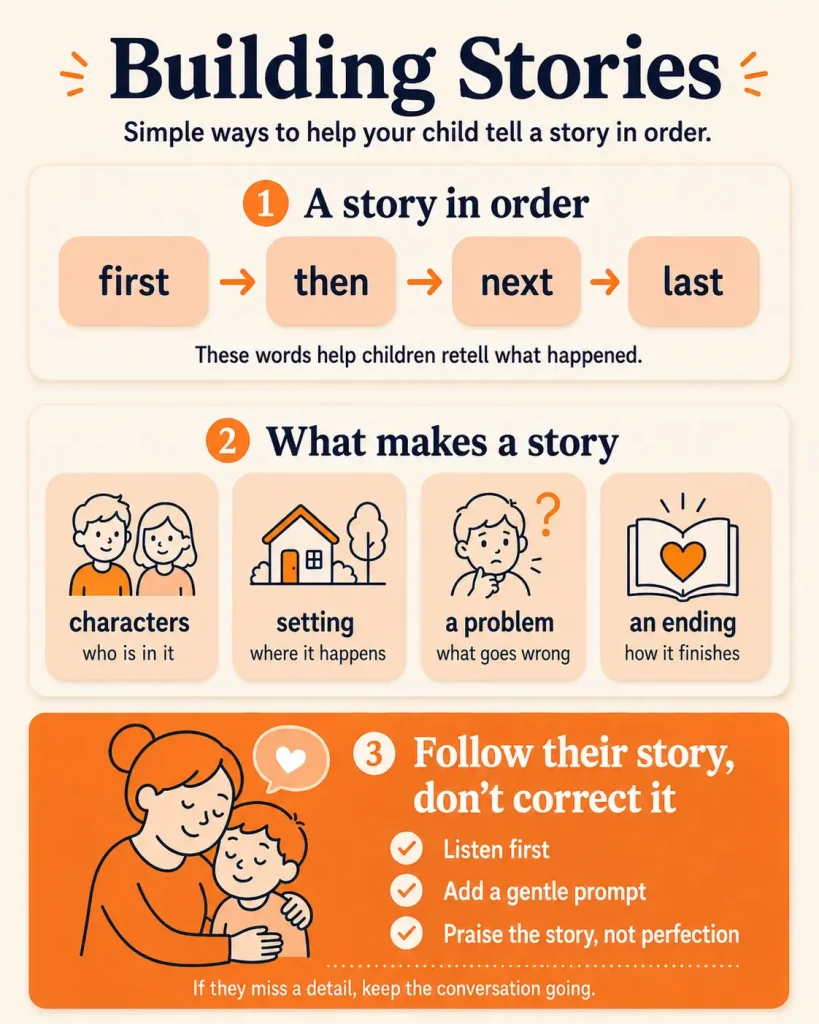
Many stories contain the following elements, but children do not need to include every one. Families and cultures also tell stories in different ways, so treat this as a flexible framework rather than a checklist.
Sequence: Events have an order, often supported by words such as *first*, *then*, *next*, *after*, and *last*.
Characters and setting: The listener learns who was involved and where the event happened.
An important event or problem: Something happens that gives the story a focus. In a simple personal story, this might be “The ice cream fell.”
Actions, feelings, and reasons: The storyteller explains what people did, how they felt, or why something happened.
An outcome: The story shows what happened next or how the event ended. More advanced stories may include a clear solution.
A story with only two or three connected events is still a real story. “We went to the park. I climbed the steps. Then I went down the slide” already shows a meaningful sequence. Details and explanations can grow over time.
How Narrative Skills May Develop in Young Children
Narrative skills usually become more detailed as children gain language and experience, but there is no single timetable. Development can be influenced by a child’s communication method, languages, culture, interests, learning profile, and opportunities to share stories.
Around 2 to 3 years: Some children begin referring to recent events with short phrases or sentences. They may name a person or action, connect two events loosely, or rely on an adult to fill in missing information.
Around 3 to 4 years: Children may talk about activities that happened away from home, answer simple questions about an event, and place a few familiar actions in order with prompts or pictures.
Around 4 to 5 years: Many children can tell a short, connected story that stays mostly on topic and includes more detail. They may begin adding characters, actions, feelings, and words that explain time or cause.
Toward school age: Stories often become longer and clearer. Children may consider what the listener does not already know, connect events through cause and effect, and use narrative skills in reading and writing.
These are broad signposts, not a scorecard or diagnostic test. ASHA’s communication milestones by age range can help families understand general language development, while ZERO TO THREE describes how the earliest forms of storytelling emerge during the first three years.
Consider all the languages and communication systems your child uses. A multilingual child may know different story words in different languages. A child who uses AAC may need time to find and combine symbols. Both are valid parts of narrative development.
6 Storytelling Activities to Try at Home
1. Retell a Real Event Together
Begin with something your child just experienced: feeding a pet, going to the shop, visiting the park, or making a snack. Real events are easier to recall because the people, actions, and feelings are familiar.
Model a short version: “First we put on our shoes. Then we walked to the park. Last, we played on the swings.” Pause after each part and invite your child to add a word, gesture, picture, or detail. If they contribute only “dog,” you can respond, “Yes, we saw a big dog at the park.”
2. Put Family Photos in Order
Choose three or four photos from one event. Ask your child to arrange them in the order they happened. Talk about each picture using *first*, *next*, and *last*.
Photos reduce the memory load because the child can see the people, place, and actions. They also make it easier to share the story with another family member later, giving the child a real reason to retell it.
3. Retell a Familiar Book
After reading a favorite book, look back at three important pictures or close the book and remember the story together. Begin with broad prompts: “Who was in the story?” “What happened first?” “How did it end?”
If your child is unsure, offer a choice or model one part instead of turning the activity into a test. Acting out the story with toys can make characters’ actions and feelings easier to understand. The Hanen Centre offers additional ideas for bringing books to life through play and acting.
4. Create Stories During Pretend Play
Pretend play is storytelling in action. A toy animal can get lost, a doll can prepare for a trip, or a block tower can need repair. Follow your child’s idea before adding a small problem or next event.
Try a simple structure: “Teddy wanted a picnic. Oh no—the basket was empty. What could Teddy do?” Accept practical, funny, or unexpected ideas. The purpose is to connect events, not steer every story toward an adult’s preferred answer.
5. Ask Open, Wondering Questions
Questions such as “What happened next?”, “How did she feel?”, and “Why did he do that?” can invite richer language. Ask one question at a time and give your child time to respond.
Balance questions with comments and models. Too many questions can make storytelling feel like an interview. If “why” is difficult, offer two possibilities: “Was he hiding because he felt scared, or because he was playing?” For more support, see this parent guide to helping children answer WH questions.
6. Build a Simple Story Map
Draw three boxes labeled *first*, *next*, and *last*, or use pictures and symbols. Place one event in each box and tell the story from left to right. When your child is ready, add prompts for *who*, *where*, *what happened*, *feelings*, and *the ending*.
Story maps make an invisible language structure visible. Begin with the simplest format and add detail only when it helps. Reading Rockets explains story sequencing and offers more advanced story-map ideas for children who are ready.
Follow Your Child’s Story Without Overcorrecting
When a child shares a story, respond to the meaning before fixing grammar, order, or facts. Your interest tells them that their message matters. You can then model a clearer version without requiring them to repeat it.
If your child says, “Dog bark, then park,” you might answer, “The dog barked, and then we went into the park.” If an event is missing, use a gentle prompt: “You fell in the puddle—what happened after that?”
Avoid correcting every speech sound or sentence. Frequent interruption can make a child focus on being right instead of sharing an idea. Choose one small language model and keep the conversation moving.
Storytelling belongs to speaking and nonspeaking children alike. A child can select pictures, sign key actions, act out events, type words, or use a speech-generating device. Keep the communication system available and give enough time to find the required words or symbols. Do not withhold attention until the child speaks.
A Simple 10-Minute Storytelling Routine
Use this short routine after an outing, book, meal, or play activity:
- Choose one familiar event. Pick something your child recently experienced or knows well.
- Find three visual reminders. Use photos, objects, drawings, or AAC symbols for the main events.
- Model a short sequence. Tell it once using *first*, *next*, and *last*.
- Invite your child’s version. Accept words, gestures, signs, pictures, acting, or AAC.
- Add one useful detail. Model a character, place, feeling, or reason without rebuilding the entire story.
- Share it with someone else. Retell the story to another family member so the skill has a genuine purpose.
Stop while the interaction is still enjoyable. A short story shared willingly is more useful than a long story produced under pressure.
How BASICS Supports Skills Used in Storytelling
Storytelling draws on many smaller language abilities, and it can be hard for parents to know which one to support first. BASICS is created by a multidisciplinary team and gives parents a plan based on their child’s current skills, with three therapist-created activities each day.
Personalized Daily Language Practice
The Communication and Speech Therapy area supports first words, vocabulary, phrases, sentences, WH questions, and conversation. These are the building blocks children combine when they describe an event or tell a story. Each activity includes a demonstration video, step-by-step guidance, parent prompts, and therapist tips.
Use the suggested goal as a starting point rather than expecting a complete narrative immediately. A child may first need words for actions, support answering “who” and “where,” or practice joining two ideas. Small skills can later be used together during real storytelling.
Games for Language, Feelings, and Social Understanding
BASICS includes more than 250 learning games across Speech and Language, Academics, and Feelings and Friendships. Relevant games practice vocabulary, phrases, sentences, WH questions, emotions, calming, and understanding other people.
After a game, connect the skill to life. If your child identifies “sad,” talk about how a character in a familiar book felt. If they answer “where” questions, use the same question while retelling a family outing. Families can also explore receptive language activities at home to strengthen understanding before expecting a detailed retell.
Video Models as Conversation Prompts
The BASICS Show Me How area uses real videos to demonstrate first words, everyday tasks, social moments, and movement activities. Parents can use a familiar clip as a conversation prompt: “What did she do first?” “What happened next?” or “How did it end?” This turns watching into shared language practice rather than passive screen time.
AAC-Friendly Participation and Goal-by-Goal Progress
BASICS activities are designed for speaking and nonspeaking children. Children can take part through speech, gestures, signs, pictures, or AAC. Parents can rate activities and follow progress goal by goal without public comparisons or streak pressure.
Progress in narrative language may look like adding one event, needing fewer prompts, using a sequence word, explaining a feeling, or retelling the story to a new listener. Record the support your child needed, not only whether the answer was correct.
BASICS supports practice at home and between therapy sessions; it does not replace an individual evaluation or professional therapy. Current program areas and subscription details are available on the official BASICS listings for the Apple App Store and Google Play.
When to Speak With a Speech-Language Professional
Children develop narrative skills at different rates. Consider speaking with your child’s pediatrician or a qualified speech-language pathologist if your child loses language or communication skills, has difficulty understanding familiar questions, cannot reliably communicate needs, or becomes frequently frustrated when trying to share experiences. Concerns about hearing also deserve assessment.
A professional can look beyond storytelling to understand receptive language, expressive language, speech, hearing, social communication, memory, and AAC access. If your child already receives therapy, ask which narrative skill to practice and which prompts match their current plan.
Help Your Child Become a Storyteller
Stories are how children share where they have been, what they noticed, and what they imagine. Each time you retell a family moment, wonder about a book character, or follow an adventurous toy across the floor, you are creating a reason to connect ideas.
Keep the experience warm and collaborative. Celebrate the message before the grammar. Accept every communication method. Begin with two or three events and let detail grow gradually. First, next, and last can become the beginning of a story your child is proud to share.
Parents who want guided home practice can download BASICS from the Apple App Store or Google Play. The app currently offers a seven-day free trial; review the subscription terms shown in your store before confirming a purchase.
Clinically Reviewed By
Reviewed by Anuradha Karanam, BASLP, Speech-Language Pathologist at Wellness Hub.
Anuradha supports children with speech, language, communication, and developmental needs, including speech-language assessments, parent guidance, and home training support. This article was reviewed for clinical accuracy, parent-friendly language, and safe guidance around helping children move from single words to phrases.
This content is for educational purposes only and does not replace professional assessment, diagnosis, or therapy.
View Anuradha Karanam’s Profile
Related Reading
1 Grow Your Child’s Vocabulary at Home
2 How to Help Your Child Combine Words into Phrases
3 How to Help Your Child Speak in Full Sentences
4 How to Use the BASICS App to Teach Phrases and Sentences
References and Further Reading
- ASHA: Communication Milestones by Age Range
- Narrative Intervention: Principles to Practice
- Reading Rockets: Children’s Story Retelling as a Literacy and Language Strategy
- Reading Rockets: Story Sequence
- Hanen Centre: Bringing Books to Life
- ZERO TO THREE: Storytelling in the First Three Years
- ZERO TO THREE: Early Literacy and Language Development
Book your Free Consultation Today
Parent/Caregiver Info:
Client’s Details:
* Error Message