How to Encourage Imitation by Pausing Instead of Repeating the Gesture
By Wellness Hub
Last Updated: March 3, 2026
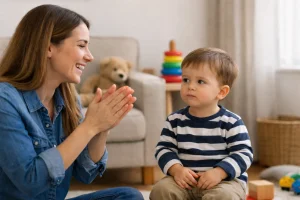
You clap your hands or hold up a hand for a high-five. Your child looks straight at you—maybe even leans in, eyes focused, yet nothing happens. So you try again. And again. Each time, the gesture becomes a little bigger, a little closer, a little more obvious.
And still… they watch, but they don’t copy.
If this feels familiar, you are far from alone. Many parents notice this same pattern and wonder, “My child clearly sees what I’m doing. Why won’t they try it too?” It can be confusing, especially when your child seems interested and connected.
Here is the reassuring truth: watching closely is not “nothing.” Watching is often part of learning. And one small shift in interaction can make it easier to encourage imitation at the moment—pausing.
Also read: 10+ Simple Home Activities to Encourage Clapping, Waving, and High-Fives
Why a child might watch but not copy right away
Imitating simple actions and gestures, like clapping, waving, giving a high-five, shaking the head, or copying a short sequence like clap then wave, looks easy from the outside. For a child, however, it involves many tiny steps happening very quickly.
In just a few seconds, your child is noticing you, understanding that your movement is meant to be shared, figuring out what the movement is, planning how to move their own body, and then trying to carry it out. That is a lot to organize, especially when they are still learning what “copying” means in social play.
So when your child watches closely but does not imitate, it often means they are processing. They may be interested, but not yet ready to respond at the same pace you are offering.
The hidden power of a pause
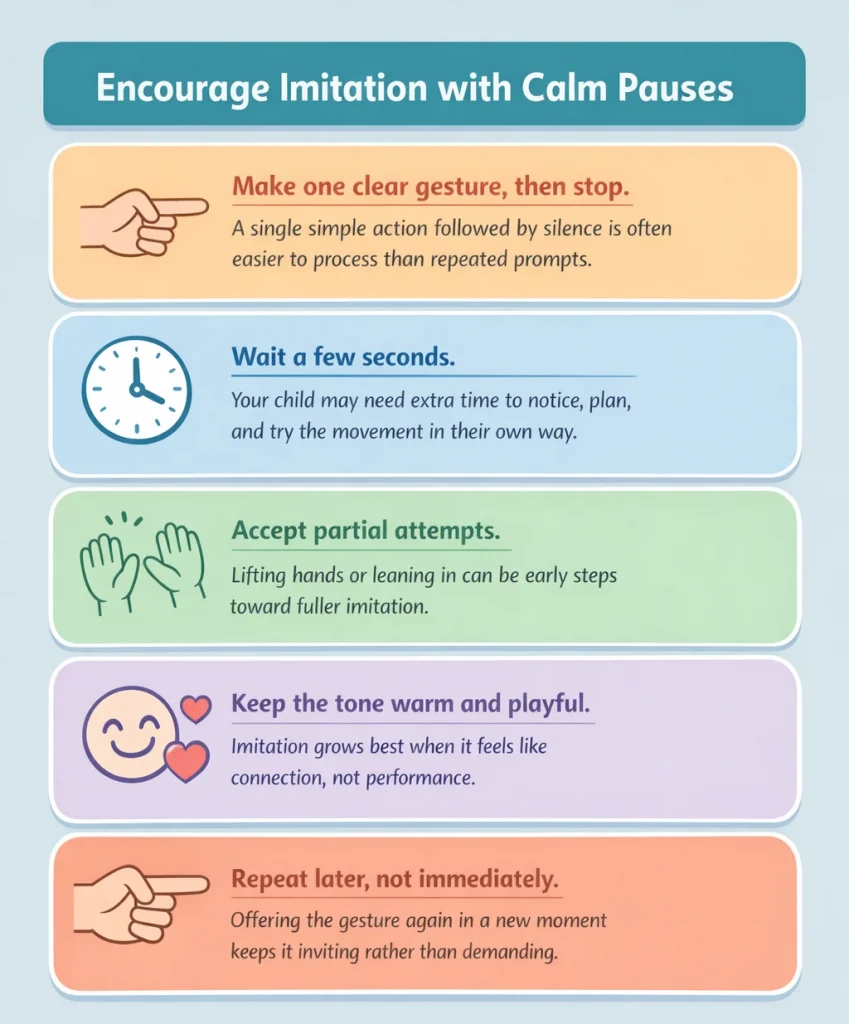
A pause is one of the most helpful tools when you want to encourage imitation because it does not require you to do more. It simply asks you to do less, for a moment.
When you make a gesture and then pause, you give your child time to:
- take in what they saw
- decide whether they want to join
- plan the movement
- try it in their own way
That “in their own way” is important. Early imitation rarely looks exact. A child might lift their hands without clapping, touch your palm gently instead of giving a big high-five, or wave with a small finger movement. These are meaningful attempts. A pause gives those attempts room to show up.
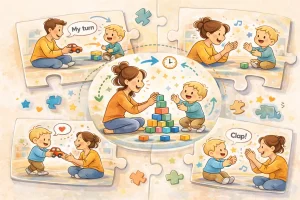
In everyday interaction, pauses also create a shared rhythm rather than a performance. You act, you wait, and your child gets a turn. That back-and-forth is part of the connection you are building.
Also read: What Counts as Imitation Even If It Doesn’t Look Perfect Yet
Why repeating too quickly can accidentally make it harder
When you repeat a gesture right away, especially several times in a row, it usually comes from a loving place. You are trying to help. You may think, “Maybe they didn’t see it,” or “Maybe they need another example.”
But quick repetition can sometimes create unexpected challenges.
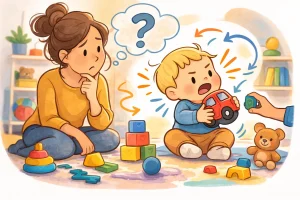
First, it can speed the moment up. Your child may still be working on how to copy the first gesture when the second or third one appears. Instead of feeling like it is their turn, the interaction may start to feel like it is moving on without them.
Second, it can change the emotional tone. Even when you sound cheerful, repeated prompting can begin to feel like pressure. Some children respond by freezing, looking away, or focusing on an object instead of the interaction—not because they cannot imitate, but because the moment feels too fast or demanding.
Third, repetition can blur the message. If each repeat looks slightly different—bigger, closer, or faster—your child has to keep figuring out what they are supposed to copy. A single clear gesture followed by a calm pause is often easier to understand.
Pausing does not mean giving up. It means giving your child space to participate and helps encourage imitation without pressure.
What success can look like and it may be smaller than you expect
Parents often imagine imitation as a perfect match: you clap, they clap. You wave, they wave. Sometimes that happens. But early progress is often quieter.
You might notice your child:
- looking at your hands after you clap
- leaning toward you when you offer a high-five
- lifting their hands slightly, even without completing the clap
- smiling or laughing as if they understand the game
- trying the gesture a few seconds later
- looking to you for cues before they attempt something
All of these are signs that your child is engaging with the idea of copying and learning the rhythm of interaction. Imitation often grows from attention, to interest, to partial attempts, and then to more consistent copying over time.
A calmer way to invite imitation during real life moments
Imitation tends to appear most easily when it is part of something your child already enjoys—small celebrations, greetings, silly moments, songs, or play routines. It can be as simple as clapping when a block tower stands, waving goodbye to a favorite toy, or offering a high-five after washing hands.
In these moments, the gesture is not a test. It is a shared experience. You are offering a way to connect and then leaving space for your child to respond.
Often, the most supportive thing a parent can do when they want to encourage imitation is hold the moment gently. Make the gesture, let your face show that it is safe and fun, and then wait. If your child joins in, that is wonderful. If they do not, the interaction can still remain warm and positive—and you have shown them what the gesture means without pressure.
Over time, these relaxed opportunities add up. Your child learns, “This is something we do together.”
If your child only imitates sometimes, that can be part of the process
Many children imitate inconsistently at first. They may wave one day and not the next, high-five at home but not with relatives, or clap during songs but not during play.
This does not mean the skill has disappeared. It usually means it is still settling in. New environments, excitement, tiredness, hunger, or deep focus on play can all affect whether a child imitates in the moment. A pause helps here too, because it respects your child’s timing. It keeps the interaction open without turning it into a demand.
When it helps to get extra support without assuming anything is wrong
Sometimes parents simply want more ideas for encouraging imitation in ways that feel natural—especially if their child mostly watches and rarely tries, or if play feels one-sided and it is hard to invite more back-and-forth.
That is a common reason families seek gentle guidance. Some parents like having a clear goal, such as imitating simple actions and gestures, along with examples of how this can fit into everyday routines.
Tools like BASICS can be helpful here. It is designed to support parents with simple, everyday ways to encourage imitation and connection through play, without making home life feel like “practice.”
A steady reminder for parents
If your child watches your gestures closely but does not copy right away, it does not mean they are not learning. It often means they are taking it in, organizing it, and building the confidence to try.
Pausing is a quiet way of saying, “There is room for you here.” And for many children, that small change, less repeating and more waiting, can help encourage imitation more naturally.
Those shared claps, waves, and high-fives are not just sweet moments (though they truly are). They are small bridges to connection. And each time you offer one calmly, you give your child another chance to meet you there.
About the Author:
Shravanaveena Gajula
M.Sc ., Speech and Language Pathology (5+ years of experience)
Shravanaveena Gajula is a dedicated Speech-Language Pathologist with a BASLP and an M.Sc in Speech and Language Pathology. With experience spanning multiple settings, including Wellness Hub , Veena specializes in a wide range of disorders from developmental issues in children to speech and language assessments in adults. Her expertise includes parent counseling, managing speech sound and fluency disorders, and creating individualized therapy programs. Veena is also PROMPT certified and an author of several insightful blogs on speech and language pathology, aiming to educate and assist caregivers in supporting their loved ones.
Book your Free Consultation Today
Parent/Caregiver Info:
Client’s Details:
* Error Message