The Best Times of Day to Try Playful Noises Bath, Meals, Diaper Changes, and More
Last Updated: March 2, 2026
Playful sound imitation means helping a child copy or respond to simple sounds during everyday routines like bath time, meals, dressing, or diaper changes. It matters because sound play builds turn-taking, vocal confidence, listening, and early speech. For example, a toddler may copy “pop” when bubbles burst.
What you will learn in this article
- What sound imitation looks like
- Why it supports early speech
- Age-wise red flags to watch
- Routines that encourage sounds
- When speech therapy may help
Your child is in the bath. You squeeze a sponge and say, “squish.” Your child watches your mouth, smiles, and makes a small “shh” sound. It is not perfect. It may not even sound like your word. But in our clinic, we would treat that as an important communication moment.
Parents often think imitation means the child must copy exactly: “moo,” “pop,” “ba,” or “mama.” That is too strict. Early sound imitation often begins as looking, smiling, changing pitch, making a similar sound, or taking a vocal turn.
The goal is not to run speech practice all day. The goal is to notice small routine moments where your child is relaxed, connected, and ready to play with sound.
What playful sound imitation looks like in children
Playful sound imitation looks like a child watching, listening, and trying to copy or respond to a sound during a shared moment. It may be exact copying, a similar sound, a vocal turn, a laugh, a squeal, or a repeated sound game.
In our clinic, we do not expect toddlers to copy like adults. A child may hear “pop” and say “pa.” They may hear “moo” and hum. They may hear “beep beep” and laugh first, then copy it three days later. That still tells us the child is listening, engaging, and experimenting with voice.
Micro-example one: during bubbles, you say “pop” and your child says “buh.” That is a strong attempt. Micro-example two: during car play, you say “vroom,” and your child moves their lips silently while watching your mouth. That may be a pre-imitation sign.
| What you may see | What it may mean clinically |
|---|---|
| Watches your mouth | Child is attending to sound and movement |
| Smiles after your silly sound | Sound play feels socially rewarding |
| Copies the rhythm, not the sound | Auditory pattern imitation is emerging |
| Makes a similar sound | Early vocal imitation is developing |
| Takes a vocal turn | Back-and-forth communication is growing |
| Copies days later | Delayed imitation may still be learning |
| Uses sound effects in play | Sound is becoming meaningful |
| Starts the sound game | Initiation and confidence are improving |
ASHA lists “tries to copy sounds that you make” in the 10–12 month range, along with pointing, waving, showing or giving objects, and imitating social gestures. This means sound imitation should be viewed as part of the wider early communication system, not as an isolated trick.
What I tell families is simple: do not chase perfect sounds. Chase connection, turn-taking, and comfortable voice use.
Why playful sound imitation matters for speech and communication
Playful sound imitation matters because children learn speech through repeated listening, social turn-taking, mouth movement practice, and meaningful sound use. Before clear words, children often practise with coos, squeals, babbles, animal sounds, vehicle sounds, exclamations, and simple syllables.
In our clinic, sound imitation gives us a window into several skills at once. Is the child listening? Are they interested in people? Can they take turns? Can they use their voice for fun? Can they try a new sound without pressure?
Micro-example one: a child who copies “uh-oh” when a block falls is learning that sounds can carry meaning. Micro-example two: a child who says “mmm” when eating mango is linking sound, feeling, food, and shared attention.
Sound imitation supports:
- Vocal confidence
- Babbling variety
- Turn-taking
- Listening and attention
- Mouth movement practice
- Joint attention
- Play-based language
- First words
- Social engagement
- Imitation of actions and gestures
- Early conversation rhythm
NIDCD explains that children follow a natural progression in speech and language development, and milestone checklists help professionals decide whether a child may be on track or may need extra help.
Here is the clinical point parents often miss: a child does not need to copy every sound on command. But if a child rarely makes sounds, rarely copies actions, does not respond to name, does not use gestures, or loses sounds they once had, that pattern needs attention.
Also read: Why Your Child Copies Sounds One Day and Not the Next
At what age does playful sound imitation develop
Playful sound imitation develops gradually from early vocal play in infancy to clearer copying of sounds, words, and playful exclamations in toddlerhood. Most children move from cooing and babbling toward intentional sound imitation across the first two years.
Age ranges are guides, not exam marks. The concern grows when a child has few sounds, no imitation, no gestures, poor response to sound, or communication regression.
| Age Range | What to expect | Red flag if missing |
|---|---|---|
| 0–3 months | Cries differently, calms to voice, begins cooing | No response to sound or very limited vocal response |
| 4–6 months | Laughs, squeals, makes vowel-like sounds, plays with voice | Very quiet baby or no vocal play |
| 6–9 months | Babbles, uses repeated sounds, reacts to familiar voices | No babbling or limited response to voices |
| 9–12 months | Tries to copy sounds, uses gestures, enjoys peekaboo-like games | No babbling, no sound imitation, no gestures |
| 12–18 months | Uses exclamations, early words, sound effects, gestures | No meaningful sounds, words, pointing, or imitation |
| 18–24 months | Copies simple words/sounds, uses sound effects in play | Very limited speech sounds or no functional words |
| 2–3 years | Uses words, phrases, pretend play sounds, simple songs | Speech very limited or child cannot imitate actions/sounds |
| Any age | Vocal skills steadily increase | Loss of sounds, words, gestures, or social interest |
CDC states that developmental screening is recommended at 9, 18, and 30 months, and autism screening at 18 and 24 months, with additional screening whenever concerns appear. AAP gives the same general developmental and autism screening schedule.
Micro-example one: a 10-month-old who watches your face, babbles, and tries “ba” after you say “bye-bye” is showing emerging imitation. Micro-example two: an 18-month-old with no babbling history, no pointing, no words, and no sound imitation needs professional review, not more waiting.
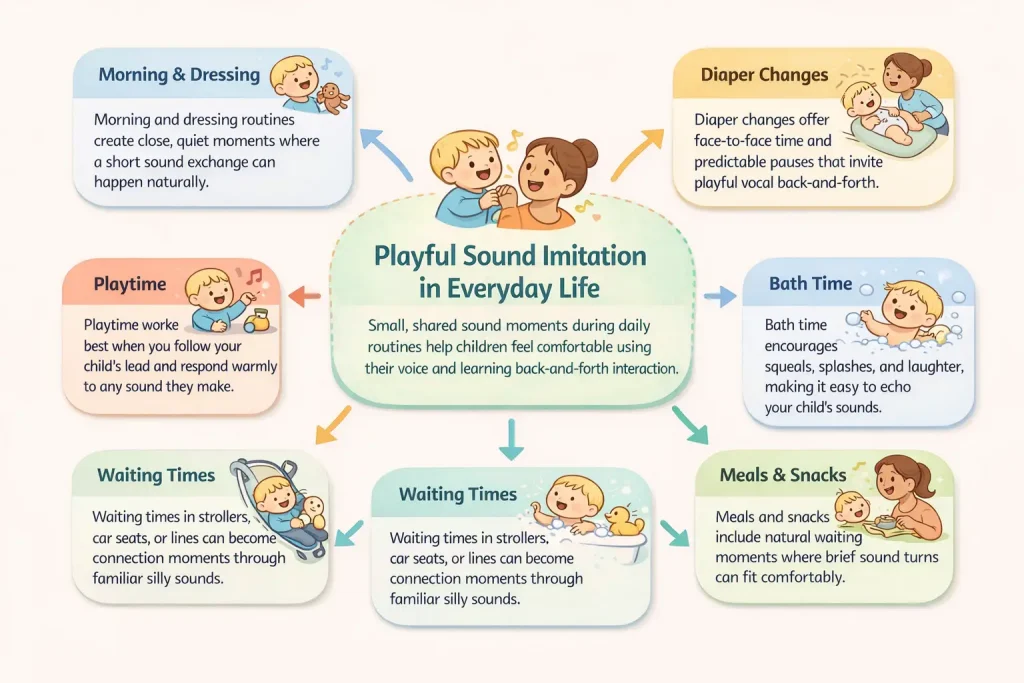
During bath time: use water sounds, bubbles, and surprise
Bath time is one of the easiest routines for sound imitation because water naturally creates sounds, movement, anticipation, and shared fun. The best bath routine uses one short sound, one pause, and one warm response.
In our clinic, bath time often works well because the child is close to the parent and the routine repeats daily. Water pouring, bubbles popping, sponge squeezing, and splashing all create natural sound effects without needing toys or flashcards.
Micro-example one: you pour water slowly and say “shhhh.” Your child watches the water and makes a soft sound. You smile and repeat “shhhh” once. Micro-example two: bubbles pop and you say “pop-pop.” Your child laughs and says “pa.” That counts.
| Bath moment | Sound to model | What to watch for |
|---|---|---|
| Pouring water | “shhh,” “wee,” “pour” | Looks, smiles, vocal turn |
| Bubbles | “pop,” “buh,” “wow” | Attempts similar sound |
| Splashing | “splash,” “pa-pa” | Laughs, copies rhythm |
| Sponge squeeze | “squish,” “mmm” | Watches mouth or tries sound |
| Washing toes | “tickle,” “tee-tee” | Anticipation or giggle |
| Duck toy | “quack,” “wak-wak” | Animal-like imitation |
| Water stops | “all done” | Sound, gesture, or look |
Use sound effects before real words if your child finds words hard. “Pop,” “mmm,” “uh-oh,” “wow,” and “beep” are often easier than long words because they are playful and emotionally meaningful.
Do not keep repeating the sound until your child performs. Try this rhythm instead: sound → pause → watch → respond → move on. If your child joins, celebrate softly. If they do not, keep the routine pleasant.
If your child dislikes bath time, do not force sound practice there. A child who is sensory-overloaded is less available for imitation. Choose a calmer routine.
During meals and snacks: use tiny sound moments, not pressure
Meals and snacks can support sound imitation when the parent keeps it short, playful, and low-pressure. The goal is not to make eating into a speech lesson; the goal is to add small sound turns inside a routine your child already understands.
In our clinic, we often use snacks because they create natural pauses. A container opens, a spoon waits, food falls, a cracker crunches, or water pours. These moments invite sound without forcing the child to repeat.
Micro-example one: you open a snack box and say “pop.” Your child looks at the box and makes “ba.” You say, “Yes, pop,” and hand over the snack. Micro-example two: your child eats mango and says “mmm.” You copy “mmm” and smile. That is imitation in both directions.
| Mealtime moment | Sound to model | Parent action |
|---|---|---|
| Opening a box | “pop,” “open” | Say once, pause |
| Crunchy food | “crunch,” “krr” | Copy child’s sound |
| Tasty bite | “mmm” | Smile and model |
| Food falls | “uh-oh” | Use natural surprise |
| More food | “more,” “ma” | Pair sound with gesture |
| Drinking | “aaah” | Keep it playful |
| Wiping hands | “wipe-wipe” | Use rhythm |
If your child is focused on eating, do not interrupt every bite. Pick one or two moments. Children learn better from a few successful turns than from constant prompting.
This is also where parents must stop over-testing. “Say apple. Say apple. Say apple.” is not playful imitation. It is pressure. Try “mmm apple” and wait.
For children with feeding difficulties, texture sensitivity, gagging, choking, or high mealtime distress, speech practice should not be the priority. Feeding safety and comfort come first.
During diaper changes, dressing, and care routines: use face-to-face pauses
Diaper changes, dressing, and care routines support sound imitation because they naturally place parent and child close together. These moments work best when the child is comfortable, regulated, and not rushed.
In our clinic, we use these routines because they have predictable steps. Shirt over head, socks on feet, wipes open, diaper tabs, lotion, comb, shoes. Each step can carry one small sound.
Micro-example one: while pulling a shirt over your child’s head, you say “peekaboo” or “boo.” Your child smiles and says “oo.” Micro-example two: while putting socks on, you say “push-push,” and your child copies the rhythm with “puh-puh.”
| Routine moment | Sound to model | Skill supported |
|---|---|---|
| Shirt over head | “boo,” “up” | Anticipation and imitation |
| Socks on | “push-push” | Rhythm copying |
| Zip closing | “zzzip” | Sound effect imitation |
| Diaper tab | “stick,” “tap-tap” | Repetition |
| Lotion | “mmm,” “rub-rub” | Calm vocal play |
| Comb hair | “shhh,” “brush” | Routine language |
| Shoes | “stomp,” “tap” | Body-sound connection |
Use sound plus action. Toddlers often imitate actions before sounds, so pairing both helps. If the child taps their foot after you say “tap tap,” that is still imitation and should be valued.
If your child dislikes dressing, nail cutting, toothbrushing, or diaper changes, do not turn those moments into speech demands. Occupational therapy may help if sensory discomfort is blocking routine participation.
What progress looks like
Progress in playful sound imitation means your child becomes more comfortable using their voice, taking vocal turns, copying sounds, and starting sound games. It does not mean every sound becomes clear immediately.
In our clinic, progress often appears as small changes before words increase. A child may watch your face more, laugh after your sound, vocalize during a pause, copy a rhythm, or repeat a sound later in the day.
| Sign of progress | What it means clinically |
|---|---|
| Watches your mouth during sounds | Auditory-visual attention is improving |
| Smiles or laughs after sounds | Sound play feels socially rewarding |
| Makes any sound after you pause | Vocal turn-taking is emerging |
| Copies rhythm, not exact sound | Early imitation pattern is developing |
| Uses more varied babble | Speech-sound exploration is increasing |
| Repeats a sound effect in play | Sound is becoming meaningful |
| Starts a sound game | Initiation is growing |
| Copies animal or vehicle sounds | Play-based imitation is improving |
| Uses sound with gesture | Communication is becoming intentional |
| Tries sound in more than one routine | Generalisation is beginning |
Micro-example one: last week your child only watched bubbles. This week they say “pa” after you say “pop.” That is progress. Micro-example two: your child does not copy “moo” during play, but later says “mmm” while holding the cow. That still matters.
Track progress over two to four weeks. One quiet day after poor sleep is not a setback. But if your child rarely makes sounds across all routines, does not respond to sound, or has lost vocal play, do not keep waiting.
What not to do
Do not turn sound imitation into a performance test. Children copy more when they feel connected, safe, interested, and unpressured.
The biggest mistake is repeating “say it” until the child shuts down. If the child hears every fun moment turn into a demand, they may stop trying. Sound play should feel like a game, not an exam.
Avoid these common mistakes:
| What not to do | Better option |
|---|---|
| Say “copy me” repeatedly | Make one sound and pause |
| Demand perfect pronunciation | Accept similar sounds |
| Practise when child is upset | Choose regulated moments |
| Ask too many questions | Use sound effects and comments |
| Ignore child’s own sounds | Copy them back warmly |
| Use only flashcards | Use real routines and play |
| Force eye contact | Face the child naturally and wait |
| Panic over inconsistency | Track patterns across weeks |
| Use screen sounds as the main practice | Prioritise live human interaction |
Micro-example one: instead of “Say pop, say pop, say pop,” say “pop,” pause, and smile if your child tries anything. Micro-example two: instead of correcting “ba” to “pop,” say “Yes, pop!” and keep the game going.
Do not compare your child to cousins, siblings, or Instagram milestone clips. Compare your child’s communication today to their own communication last month.
When to seek professional help
Seek professional help when your child rarely makes sounds, does not babble, does not respond to sound or name, does not try to copy sounds or gestures, has no words by the expected age range, or loses sounds, words, gestures, or social interest. A speech-language pathologist can assess whether sound imitation is part of a broader communication delay.
In our clinic, we recommend help when the concern appears across routines, not just during one tired or busy moment. If your child is quiet during bath, meals, play, songs, and social games, that pattern deserves review.
| Warning sign | Recommended action |
|---|---|
| No cooing or very limited sound by 4–6 months | Discuss with paediatrician |
| No babbling by 9–10 months | Hearing check and SLP review |
| Does not respond to sounds or name | Audiology and developmental review |
| Does not try to copy sounds by 10–12 months | Monitor closely; seek SLP if other signs are present |
| No gestures like pointing, waving, showing by 12 months | Speech-language assessment |
| No meaningful words by 16–18 months | SLP and developmental screening |
| No two-word phrases by 24 months | Speech-language evaluation |
| Sound play disappears or words are lost | Prompt medical/developmental review |
| Child uses crying only to communicate | SLP support for functional communication |
| Parent feels unsure despite trying routines | Book professional consultation |
CDC states that children should receive developmental screening at 9, 18, and 30 months, autism screening at 18 and 24 months, and additional screening whenever concerns appear. CDC also notes that autism can sometimes be detected at 18 months or younger, and by age 2 a diagnosis by an experienced professional can be considered reliable.
Here is the blunt clinical line: if your child is not babbling, not copying sounds, not using gestures, and not responding socially, do not keep collecting reels and hoping. Get the child’s hearing and communication checked.
How speech therapy or occupational therapy works on playful sound imitation
Speech therapy works on playful sound imitation by helping the child listen, watch, take turns, use their voice, copy sounds, imitate actions, and connect sounds to meaning. Occupational therapy helps when sensory regulation, body control, feeding, or routine distress blocks participation.
In speech therapy, we may use bubbles, songs, animal toys, cars, books, snack routines, movement games, and parent coaching. The goal is not to force a child to repeat sounds. The goal is to make vocal communication easier and more rewarding.
Micro-example one: if a child watches bubbles silently, the therapist may blow once, say “pop,” pause, and accept a look, reach, sound, or smile as a communication turn. Micro-example two: if a child makes only one sound, the therapist may copy that sound and slowly add a new one nearby.
Occupational therapy may help if the child cannot stay regulated enough for sound play. A child who covers ears, avoids bath time, resists dressing, or melts down during transitions may need sensory support before imitation can grow.
Helpful approaches may include:
- Hanen-style parent coaching
- NDBI
- ESDM
- JASPER
- PROMPT, when motor-speech planning is a concern
- AAC for children with limited reliable speech
- PECS for structured picture communication
- Functional Communication Training
- DIR/Floortime
ASHA describes AAC as multimodal and including gestures, signs, pictures, symbols, and speech-generating systems. AAC can support communication while speech is developing; it should not be treated as a last resort.
A strong therapy plan should train parents in real routines. If a child only imitates in a clinic room but not at home, the plan needs better carryover.
Comparing therapy approaches
Different therapy approaches support different reasons a child may not imitate sounds. The right plan depends on hearing, attention, social engagement, motor planning, sensory regulation, language level, and parent-child interaction.
| Approach | What it focuses on | Best for |
|---|---|---|
| Speech-Language Therapy | Sound play, imitation, gestures, words, understanding | Children with speech/language delay |
| Hanen-style Parent Coaching | Responsive interaction in daily routines | Parents needing practical home strategies |
| NDBI | Natural routines, communication, play, developmental learning | Toddlers with developmental delays |
| ESDM | Social engagement, imitation, play, communication | Toddlers/preschoolers with autism signs |
| JASPER | Joint attention, symbolic play, engagement, regulation | Children with weak shared attention/play |
| PROMPT | Motor planning for speech movements | Children with suspected motor-speech difficulty |
| AAC | Gestures, signs, pictures, devices | Children with limited or unreliable speech |
| PECS | Picture exchange for communication | Children needing structured communication support |
| Functional Communication Training | Replacing crying/grabbing with clear messages | Children using behaviour to communicate |
| Occupational Therapy | Sensory regulation and participation | Children too dysregulated for imitation routines |
| Audiology | Hearing assessment | Any child with poor response to sound or delayed speech |
In our clinic, we rarely choose one approach blindly. A toddler may need speech therapy for sound imitation, parent coaching for daily routines, hearing screening to rule out access issues, and OT if sensory distress blocks engagement.
The wrong question is, “How do I make my child repeat sounds?” The better question is, “What is stopping my child from listening, joining, and using their voice comfortably?”
Questions Parents Ask
1. My toddler watches my mouth but does not copy sounds. Is that progress?
Yes, watching your mouth can be an early sign that your child is paying attention to sound and movement. Some children observe first and copy later, especially when the sound is new. Keep the moment playful by making one sound, pausing, and responding warmly to any attempt. If your child rarely makes sounds across routines, seek speech-language guidance.
2. Should I keep saying the same sound until my child repeats it?
No. Repeating the same sound too many times can turn play into pressure. Say the sound once or twice, pause, and give your child time to respond. If they do not copy, move on without disappointment. Children imitate more when sound play feels safe and enjoyable.
3. What sounds are easiest for toddlers to copy?
Playful sounds are often easier than formal words. Try “mmm,” “uh-oh,” “wow,” “pop,” “ba,” “boo,” “beep,” “wee,” “moo,” and “shh.” Choose sounds linked to real actions, such as “pop” for bubbles or “beep” for cars. Meaningful sounds are easier to learn than random drills.
4. What if my child makes sounds but never copies me?
Spontaneous sounds are useful, but imitation adds another layer of communication. If your child makes sounds alone but does not copy sounds, actions, gestures, or social routines, look at the wider pattern. They may need support with attention, imitation, joint engagement, or motor planning. A speech-language pathologist can assess what is blocking imitation.
5. Does no sound imitation mean autism?
No sound imitation alone does not mean autism. We look at the whole profile: response to name, gestures, pointing, shared attention, imitation, play, sensory responses, and whether skills are progressing. CDC and AAP recommend autism screening at 18 and 24 months, and earlier discussion is appropriate if concerns appear. If sound imitation is missing along with social communication red flags, seek developmental screening.
6. Can speech therapy help before my child says words?
Yes. Speech therapy can help before clear words appear. Early sessions often focus on sound play, gestures, imitation, turn-taking, joint attention, AAC, parent coaching, and everyday routines. The goal is to build communication now, not wait for perfect speech. Early support can reduce frustration and give parents clearer strategies.
Playful sound imitation should feel like connection, not homework. Start with one routine today: bath, snack, dressing, or play. Make one simple sound, pause, and warmly respond to any look, smile, sound, gesture, or attempt. If your child rarely babbles, copies sounds, responds to name, uses gestures, or communicates clearly, book a speech-language consultation and check hearing instead of waiting.
Citations used in the article
- American Speech-Language-Hearing Association. “Communication Milestones: Birth to 1 Year.” ASHA. URL: https://www.asha.org/public/developmental-milestones/communication-milestones-birth-to-1-year/
- National Institute on Deafness and Other Communication Disorders. “Speech and Language Developmental Milestones.” NIDCD, 2022. URL: https://www.nidcd.nih.gov/health/speech-and-language
- Centers for Disease Control and Prevention. “Developmental Monitoring and Screening.” CDC, 2026. URL: https://www.cdc.gov/act-early/about/developmental-monitoring-and-screening.html
- American Academy of Pediatrics. “Developmental Surveillance and Screening Patient Care.” AAP, 2025. URL: https://www.aap.org/en/patient-care/developmental-surveillance-and-screening-patient-care/
- Centers for Disease Control and Prevention. “Screening for Autism Spectrum Disorder.” CDC, 2025. URL: https://www.cdc.gov/autism/diagnosis/index.html
- American Speech-Language-Hearing Association. “Augmentative and Alternative Communication.” ASHA Practice Portal. URL: https://www.asha.org/practice-portal/professional-issues/augmentative-and-alternative-communication/
Book your Free Consultation Today
Parent/Caregiver Info:
Client’s Details:
* Error Message