What Counts as Combining a Gesture and a Sound? Real-Life Examples Parents Recognize
By Wellness Hub
Last Updated: January 27, 2026
If you’ve ever found yourself thinking, “Does that little ‘uh!’ count?”, you got this!
Many parents picture “communication” as a clear word paired with a clear point—something obvious enough that anyone would recognize it. But early communication rarely shows up that neatly. More often, it looks like a reach with a small grunt, a point with a squeal, or your child holding something up with a breathy “ah!” that seems to mean, “Look!”
Those moments can absolutely be meaningful. And when a gesture and a sound happen together, especially when they’re aimed at you, it often signals a growing ability to share needs, interests, and excitement. This is one of those quiet, everyday signs of progress that can be easy to miss if you’re only looking for “real words.”
What does combining actually mean in real life?
In simple terms, combining a gesture with a sound means your child uses their body (a gesture like reaching, pointing, showing, giving) and their voice (any vocal sound) at the same time or in the same moment to communicate an intention.
It doesn’t have to be a clear word. It doesn’t have to be perfectly timed. And it doesn’t have to sound like what adults say. What matters most is the message behind it: your child is trying to connect with you—either to get something, share something, or keep an interaction going. You might notice this most during everyday routines: snacks, getting dressed, playtime, book reading, or those little “help me” moments that pop up all day long.
“But it’s not a word…”—does it still count?
Yes. A sound can be a squeal, a hum, an “mm,” a breathy “ah,” a frustrated yell, or a tiny “uh!” It can even be an early attempt at a word that only you recognize.
Early communication often starts with “I have something to say” before it becomes “I can say it clearly.” When your child pairs a gesture with a vocal sound, they’re practicing the idea that communication is shared, something that happens between two people. That’s why these moments often lead to more engagement, more back-and-forth, and more shared excitement over time. They’re small, but they’re powerful.
Also read: My Child Makes Sounds but Doesn’t Point, How Can I Encourage Both Together?
Real-life examples parents recognize and wonder about
Sometimes it helps to see what this looks like in the wild, like your living room, your kitchen, the grocery store aisle.
Reach + sound: “I want that”
This is one of the most common early combinations, and it can look very subtle.
Your child reaches toward a snack on the counter and makes a small “uh!” or “mm!” They might open and close their hand, lean their body forward, and add a little vocal push, almost like they’re trying to send the message out louder.
Even if the sound is more of a grunt than a “word,” the combination often carries a clear intention: “Help me get that,” or “Give me that.”
Point + sound: “Look!” or “That one!”
Pointing is a big deal on its own, and when a sound comes with it, it often becomes even more social.
You might see your child point at a dog outside and squeal, or point at the bubbles and shout something like “Ah!” or “Eh!” Sometimes the sound is excitement; sometimes it’s urgency. Either way, they’re using their voice to pull you into what they’re noticing. And if you’ve ever had your child point at two choices, two snacks or two toys and make a sound while looking back and forth, that can be their early version of “That one.”
Show + “ah!”: “See what I have”
This is a favorite for many families because it feels so relational.
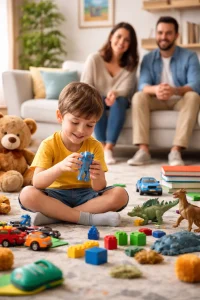
Your child picks up a toy, turns toward you, holds it up, and adds a little “ah!” or “eh!” They might not be asking for help or requesting anything—they’re sharing. It’s their way of saying, “I have something important,” or “I want you to be part of this.”
These moments often come with eye contact, a smile, or a pause that seems to wait for your reaction. That “waiting” is part of the communication, too.
Give + sound: “Here” / “Your turn”
Some children communicate by handing things to you long before they can say “here you go.”
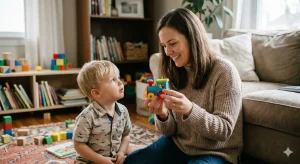
They might place a block in your hand with a small sound, or push a book toward you with a vocalization that sounds like a request: “Read,” “Do it,” “Help,” even if it doesn’t come out that way.
This kind of gesture-plus-sound often shows up in simple back-and-forth play, and it can be a sweet sign that your child is learning how interactions work: my turn, your turn, together.
Gesture + early “proto-words”: “ba,” “up,” “muh”
Sometimes parents hesitate to “count” early word attempts because they don’t sound perfect. But early proto-words paired with gestures are very much part of this goal.
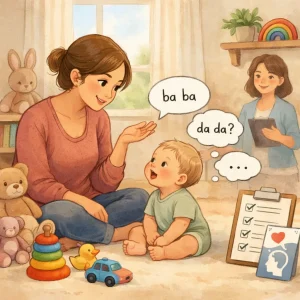
A child might reach up with “uh!” that sounds like “up.” They might point to a ball and say “ba.” They might tug at your sleeve and say “muh!” while looking toward the milk. If the sound is consistent and tied to a clear moment, it’s meaningful—even if it isn’t crisp or adult-like yet.
Gesture + sound to request help: “I can’t do this”
This combination often shows up when something is stuck, tricky, or just out of reach.
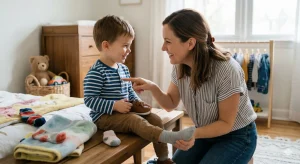
Your child might hold out a container they can’t open and vocalize, or pull at their shoe while making a frustrated sound. They might look at you, gesture, and add a vocal “eh!” that clearly means, “Help.”
These moments can feel intense (because frustration is real), but they’re also communication. Your child is learning that you can be part of solving the problem.
Read more: My Child Points but Doesn’t Make Sounds Is That Okay?
Does it have to happen at the exact same time?
Not necessarily.
Some children gesture first and then add the sound a second later. Others vocalize first and then reach or point. Many do a “cluster” of communication—gesture, sound, look, gesture again—especially when they really want to be understood.
If it’s all part of one message in one moment, it generally fits the spirit of “combining.”
What if my child only does it sometimes?
That’s common. These skills are not all-or-nothing.
You might notice your child combines gestures and sounds more during calm routines, with familiar people, or when they’re especially motivated (favorite snack, favorite toy, bubbles, going outside). In other moments, they may be quiet, tired, or deeply focused on play.
Inconsistency doesn’t cancel out progress. It usually means the skill is still emerging—and that your child is practicing it in the situations that feel easiest or most rewarding.
How you’ll know it’s working without overthinking it
Many parents describe a shift that feels less like “my child learned a new trick” and more like “we’re connecting more.”
You may notice more shared excitement—your child points and vocalizes, then looks at you to see your reaction. You may notice your child engages longer in play because they can communicate what they want. You may find yourself understanding them more quickly, even before words are clear.
Those are meaningful changes. Communication isn’t only about vocabulary; it’s also about the back-and-forth rhythm of being with someone.
A gentle way to respond when you see it
You don’t need to correct, quiz, or ask for “say it.” In most families, the most supportive response is simply treating the attempt like it matters.
When your child reaches and vocalizes, you might naturally respond with warmth—“You want that!”—and let your face and voice show that you understood. When they point and squeal, you might share their excitement—“Yes, the dog!” When they show you something with an “ah,” you might join in—“Oh wow, you found it!”
This kind of response doesn’t pressure your child to perform. It just reinforces the idea that communicating with you works—and that you’re a safe, interested partner.
If you want extra clarity, you’re not alone
Some parents feel confident spotting these moments right away. Others second-guess themselves constantly: “Was that intentional?” “Did I imagine it?” “Does it count if it’s just a sound?”
If you’d like a little more support recognizing early communication and knowing what to look for next, to Speech and Autism therapy app like BASICS can help parents make sense of goals like combining gestures with sounds through short, everyday examples, without turning your home into a therapy space.
A calm takeaway to hold onto
If your child reaches with a little “uh,” points with a squeal, or holds something up with an “ah,” you’re likely seeing real communication in its early form.
Words will come in their own time. For now, these gesture-plus-sound moments are often your child’s way of saying, “I’m here. I want you to know something. I want to share this with you.” And when you notice and respond to those moments, you’re already building a joyful, trusting connection where communication can grow.
Book your Free Consultation Today
Parent/Caregiver Info:
Client’s Details:
* Error Message