How to Build Joint Attention During Everyday Routines Meals, Bath, Getting Dressed
By Wellness Hub
Last Updated: January 22, 2026
If you’ve ever tried to “work on a skill” with your child and immediately felt the day get heavier, you’re not alone. Many parents want to support connection and communication, but they don’t want playtime to feel like a lesson or to add one more thing to an already full schedule.
That’s where everyday routines can be surprisingly powerful. Meals, bath time, and getting dressed already happen. They’re predictable, they repeat, and they naturally create little moments where you and your child can notice the same thing at the same time. Those moments are the heart of joint attention and they don’t need to be forced or formal.
What joint attention really looks like in real life
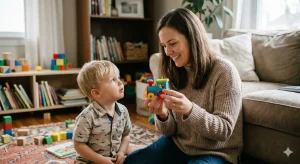
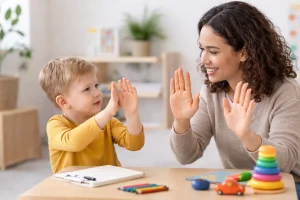
Joint attention is a shared focus between you and your child. It can look like your child following your gaze, looking where you point, or shifting their attention between you and an object or event. It’s the we’re noticing this together feeling.
In day-to-day life, joint attention often shows up in small, easy-to-miss ways: your child glances up when you react to something, watches your hand as you point, looks at the bubbles you’re looking at, or checks your face after something surprising happens. These are not “tests” your child passes or fails. They’re tiny connection points that tend to grow with time, repetition, and comfort. And most importantly, joint attention isn’t about getting your child to perform on cue. It’s about helping your child experience you as a partner, in noticing the world.
Read More: What Joint Attention Looks Like at Home Small Signs You Might Be Missing
Why routines are a natural place for joint attention
Routines work well because they’re familiar. When your child can predict what’s coming next, they often have more space to look up, take you in, and share attention—without feeling rushed or overwhelmed.
Routines also come with built-in “interesting moments.” A spoon clinks. Water splashes. A sock disappears inside a pant leg. A towel becomes a cape. These everyday details are naturally attention-grabbing, and they give you opportunities to share a look, a point, a smile, or a little moment of surprise together. For many families, routines feel easier than play because there’s less pressure to “do it right.” You’re already doing the thing. Joint attention can simply ride along.
1. Meals: shared focus without extra effort
Mealtimes are full of natural reasons to look, point, and share interest—without needing to turn the table into an activity.
You might notice joint attention happening when you pause to look at something on the plate and your child follows your gaze, or when you point out something small and your child checks it out, then looks back at you. Even a quick back-and-forth glance—child looks at the snack, then at you, then back—counts as meaningful practice.
Meals also offer lots of “shared excitement” moments. A favorite food appears. Something is crunchy. A cup tips. A berry rolls away. When you naturally react with a warm face or an interested tone, you’re giving your child a reason to tune in and share the moment with you.
If mealtimes are stressful right now, that’s okay. Joint attention doesn’t require a calm, perfectly seated dinner. Sometimes the best moments happen during a snack at the counter, a picnic on the floor, or while you’re unloading groceries and your child is nearby. What matters most is that your child has chances to notice what you notice—without pressure.
2. Bath time: built-in “wow” moments
Bath time is one of the easiest routines for joint attention because it’s full of movement, sound, and visual surprises. Water pours, bubbles form, toys float, and faces get splashed. These are naturally engaging events that invite shared attention.
Often, the most powerful joint attention moments in the bath are the ones that happen when you and your child react together. You look at the bubbles. Your child looks too. Your child watches the water swirl, then checks your face. You both smile. That “we’re in this together” feeling is exactly what you’re nurturing.
Bath time can also be a gentle place for gaze-following and pointing to happen naturally. When you look toward the faucet, the drain, the towel, or a toy, your child may begin to track where your attention goes—especially when the routine repeats day after day. And if bath time is not your child’s favorite, that doesn’t cancel the opportunity. Even brief moments—one shared look at the running water, one quick glance toward a toy you’re holding—can be enough. Joint attention grows through many small experiences, not one perfect routine.
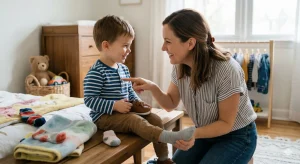
3. Getting dressed: connection in the in-between moments
Getting dressed can feel like a race, especially on busy mornings. But it’s also full of tiny “pause points” where joint attention can slip in—often when you least expect it.
There are natural moments when your child may look at what you’re holding, notice where you’re looking, or shift attention between you and the clothing item. A shirt with a picture, a sock with a pattern, a zipper that gets stuck for a second—these everyday details can become shared moments rather than obstacles to push through.
Sometimes joint attention during dressing looks like your child watching your hands, then looking up at your face. Sometimes it’s your child noticing what you’re noticing—like the hookup of a button or the “peek-a-boo” moment when a shirt goes over their head. These are simple, relationship-based moments that build familiarity with shared focus.
If dressing is a struggle right now, it may help to remember that joint attention doesn’t require cooperation. Even if your child wiggles away or protests, you can still have brief moments of shared attention when things slow down for a second—when you catch each other’s eyes, when you both notice the same object, when your child checks your face.
Read More: Why Does My Child Follow My Eyes Sometimes but Not Other Times
What progress tends to look like and what counts
Parents often expect joint attention to look obvious: “I point, my child looks, and we share a moment.” Sometimes it does look like that. But often, progress is quieter.
You might notice your child looking where you point more often, even if not every time. You may see more shifting between you and an object—those quick check-ins that say, “Are you seeing this too?” You might catch more shared smiles during routines, or notice your child showing interest in what you’re looking at or talking about.
All of that counts. Joint attention isn’t about perfection. It’s about increasing moments of shared focus across everyday life.
Keeping it relaxed: the mindset that helps most
Many parents accidentally turn joint attention into a “quiz,” especially when they’re worried or eager to help. It’s understandable. But joint attention tends to grow best when it feels safe and enjoyable.
A calm, helpful mindset is: I’m inviting, not testing. You’re offering something interesting, giving your child time to notice, and warmly responding when they do. Even a small glance can be met with a smile or a gentle comment—because the goal is connection, not performance.
It also helps to remember that children vary in how quickly they shift attention, how long they look, and how they show interest. Some children are quick and subtle. Others need more time. Your steady, warm presence is what makes the difference over time.
When you want a little extra support without adding pressure
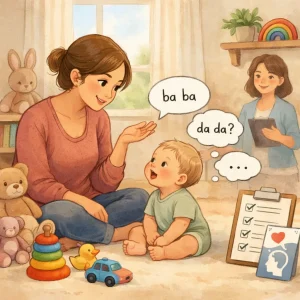
Sometimes it helps to have simple guidance on what to look for and how to make the most of routines—especially if you’re not sure whether you’re “doing enough.” Speech and autism like BASICS can support parents by breaking communication goals into everyday moments, so you can feel more confident without turning your day into a program.
Support is not about doing more. It’s about making what you already do feel clearer and more connected.
A gentle takeaway
Joint attention is one of the sweetest building blocks of connection: you and your child sharing focus on something in the world, together. And the good news is you don’t have to create extra time to support it.
Meals, baths, and getting dressed already offer dozens of natural chances for shared looks, shared surprise, and shared interest. When you notice those moments—and respond with warmth—you’re helping your child learn that your attention is meaningful, safe, and worth sharing.
And that is more than enough for today.
Book your Free Consultation Today
Parent/Caregiver Info:
Client’s Details:
* Error Message