My Baby Isn’t Imitating Sounds Yet, Is That Normal?
Last Updated: March 5, 2026
You make a silly “ba-ba-ba,” a tiny squeal, or a playful raspberry, and your baby just looks at you. Maybe they smile. Maybe they kick their legs. Maybe they return their attention to the ceiling fan like it’s the most fascinating thing in the world.
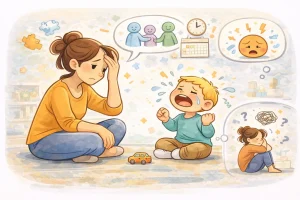
If you’ve been waiting for the moment when your baby “copies you back,” it can feel confusing when it doesn’t happen—especially when you’re hearing coos and squeals but not clear imitation. Many parents quietly wonder, Should this be happening by now? Am I missing something?
This is a very common concern. And for most families, the reassuring truth is this: baby sound imitation usually starts small, appears inconsistently, and can be easy to overlook in the beginning.
What baby sound imitation really means in early communication
When parents think of imitation, they often picture a neat little echo you say “ah,” your baby says “ah” right back.
But early imitation is rarely that simple.
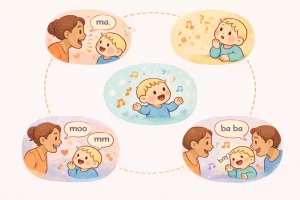
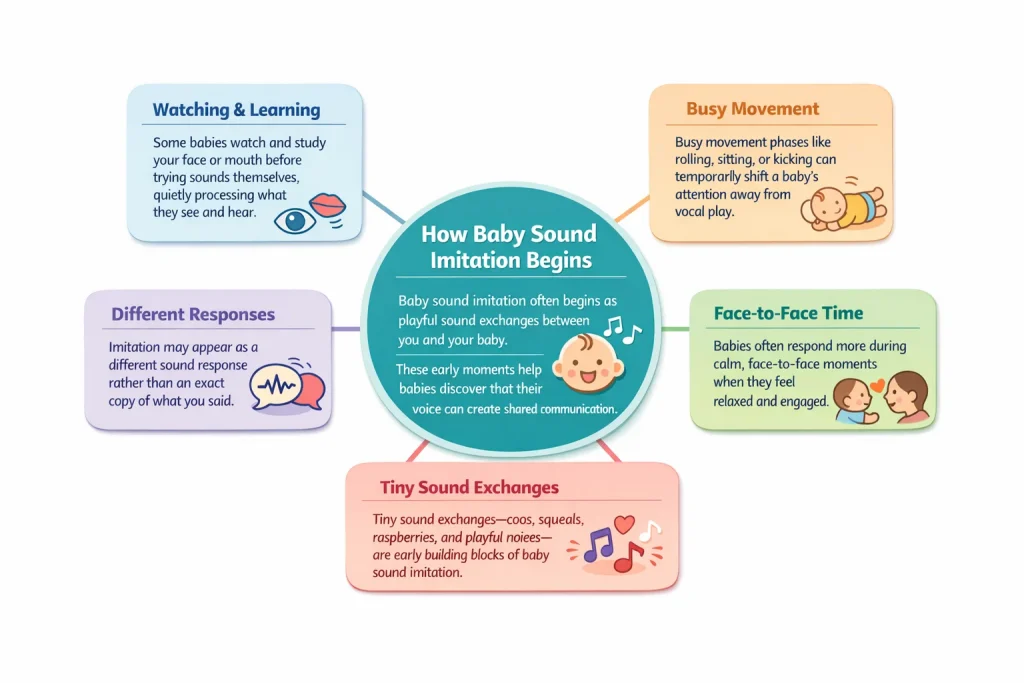
In the beginning, “imitating sounds” often means your baby is joining the feeling of the interaction rather than matching the exact sound. It may show up as coos, squeals, raspberries, or little excited noises during playful back-and-forth. Sometimes it’s less about copying the sound itself and more about copying the rhythm: you make a sound, and they answer with a sound.
These early sound exchanges are a joyful form of communication. They help your baby get comfortable using their voice and begin to learn something important communication happens between two people.
Why your baby might not “copy you back” yet even if everything is going well
Even babies who are developing communication skills beautifully may not imitate sounds consistently at first. There are many ordinary reasons this can happen.
Sometimes your baby is busy watching and learning. A baby who studies your face, your mouth, or your eyes may be doing a lot of quiet processing before trying anything themselves.
Sometimes your baby is busy moving. When babies are working hard on physical skills—rolling, sitting, bouncing, grabbing, kicking—vocal play can fade in and out. You may notice more sounds during calm moments and fewer during active ones.
Sometimes the timing just doesn’t match. You might offer a playful sound when your baby is hungry, tired, or simply not in a “chatty” mood. Babies don’t perform on cue, even when they are fully capable of making the sound later.
And sometimes imitation is happening in subtle ways. Your baby might not repeat the exact sound, but instead respond with a different coo, a small squeal, or a breathy noise that says, “I’m with you.”
What early imitation can look like so you know what to notice
It helps to widen the idea of what “copying” looks like. Early baby sound imitation often appears in tiny moments scattered throughout the day.
You might notice your baby making a sound that feels similar to yours during play, even if it is not an exact match. You may hear them experimenting with playful noises coos, squeals, raspberries especially when they are excited or engaged with you. Some babies pause and look at you after they make a sound, as if waiting to see what you will do next. Over time, you may notice more little sound “conversations,” paired with shared smiles and a sense of turn-taking.
All of this counts. Early progress is often quiet, imperfect, and still meaningful.
Why sound imitation matters without making it a “test”
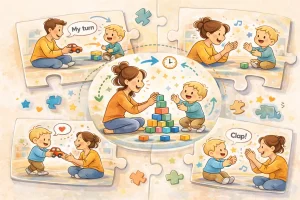
Sound imitation is more than a cute trick. It is one of the ways babies learn that communication is shared. When you make a playful noise and your baby responds, they are practicing the rhythm of conversation: you go, I go, you go, I go.
These moments also build confidence. Each time your baby experiments with their voice and receives a warm response from you, they learn, My sounds matter here. That feeling of being heard and enjoyed supports communication in a natural, gentle way.
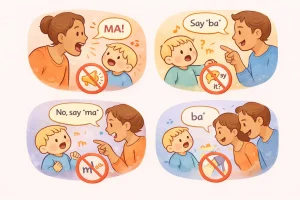
And it’s important to say clearly: this is not something you need to drill or train. Babies learn vocal play best when it stays light, responsive, and pressure-free.
Keeping it playful when you’re not seeing imitation yet
If you’re feeling stuck, it can help to shift the goal from “I want them to copy this sound” to “I want us to enjoy a sound moment together.”
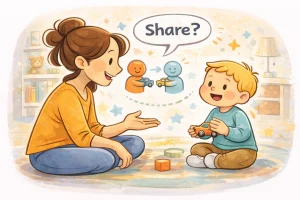
In everyday life, that may look like leaning into face-to-face moments when your baby is calm and interested, making simple playful noises, and giving them space to respond in their own way. Many babies respond best to exaggerated, friendly sounds coos, squeals, raspberries, or silly animal-like noises because they are easier to notice and more fun to try.
Pauses matter too. Babies often need an extra moment to process what they hear and decide whether to try something back. When the interaction feels unhurried, baby sound imitation is more likely to emerge as babies experiment with their voices.
And when your baby makes any sound whether it matches yours or not your warm response matters. A smile, a playful face, or a gentle laugh can keep the exchange going. The message you are sending is: I hear you. This is fun.
Realistic expectations: why progress can be uneven
One week your baby may seem full of noises, and the next week things feel quieter. This up-and-down pattern is very common.
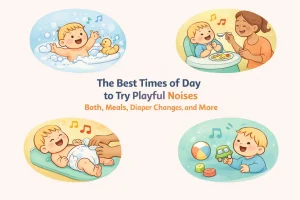
Babies often move through phases where they focus on different skills. Sometimes they are deeply into watching. Sometimes into moving. Sometimes into vocal play. Even within a single day, you may notice more sounds in the morning and fewer later in the afternoon, or more during bath time and fewer while running errands.
Instead of looking for constant imitation, it can be more reassuring to look for a gentle trend over time: more shared sound moments, more interest in your voice, and more little attempts when your baby feels relaxed and engaged.
When it might help to get extra support without assuming anything is wrong
Sometimes, even with reassurance, you may still feel uncertain—especially if you are not sure what to look for or how to interpret what you’re seeing.
Extra support can be helpful if you notice very few sound exchanges over time, if vocal play is not increasing, or if you simply feel worried and want a clearer picture of what is typical for your baby. Seeking guidance does not mean something is wrong. It often means you want support that feels calm and tailored to your child.
Some families find speech and Autism therapy apps like BASICS helpful for understanding early communication goals (such as playful baby sound imitation) and discovering simple ways to encourage connection through everyday routines without turning it into a practice session.
A gentle reminder for parents
If your baby is not imitating sounds yet, it does not mean you are doing something wrong, and it does not mean your baby is not communicating. Many babies begin with watching, smiling, moving, and making their own sounds before they start echoing yours more clearly.
Baby sound imitation often begins as a tiny, inconsistent spark one little coo after your coo, one surprised squeal during a silly moment, one raspberry that seems to appear out of nowhere. Those small moments add up.
Keep it light. Keep it warm. Keep noticing the ways your baby is already engaging with you. You do not need a perfect copy to have a real conversation. You are building it together, one playful sound at a time.
About the Author:
Shravanaveena Gajula
M.Sc ., Speech and Language Pathology (5+ years of experience)
Shravanaveena Gajula is a dedicated Speech-Language Pathologist with a BASLP and an M.Sc in Speech and Language Pathology. With experience spanning multiple settings, including Wellness Hub , Veena specializes in a wide range of disorders from developmental issues in children to speech and language assessments in adults. Her expertise includes parent counseling, managing speech sound and fluency disorders, and creating individualized therapy programs. Veena is also PROMPT certified and an author of several insightful blogs on speech and language pathology, aiming to educate and assist caregivers in supporting their loved ones.
Book your Free Consultation Today
Parent/Caregiver Info:
Client’s Details:
* Error Message