Toilet Training a Child Who Needs More Time with the BASICS App
By Wellness Hub
Last Updated: August 28, 2026
A flexible, low-pressure path to toileting—with step-by-step parent guidance in the BASICS app.
Toilet training can bring worry, comparison and pressure, especially when a child needs more time or support. Progress is not a test of intelligence, parenting or effort. Some children become independent quickly, while others need a longer period of teaching, environmental changes, communication supports or ongoing assistance.
Short answer: If your child needs more time with toilet training, begin by checking for pain or constipation, make the toilet physically secure, observe their natural bladder and bowel patterns and teach one manageable part of the routine at a time. Keep accidents neutral, accept speech, gestures, pictures or AAC, and seek medical guidance when difficulties persist or appear suddenly.
The BASICS app can help parents organise step-by-step toilet-training practice at home. It cannot determine why a child is having accidents, diagnose constipation or bladder problems, or guarantee independent toileting. Medical concerns should be discussed with your child’s paediatrician, GP or continence service.
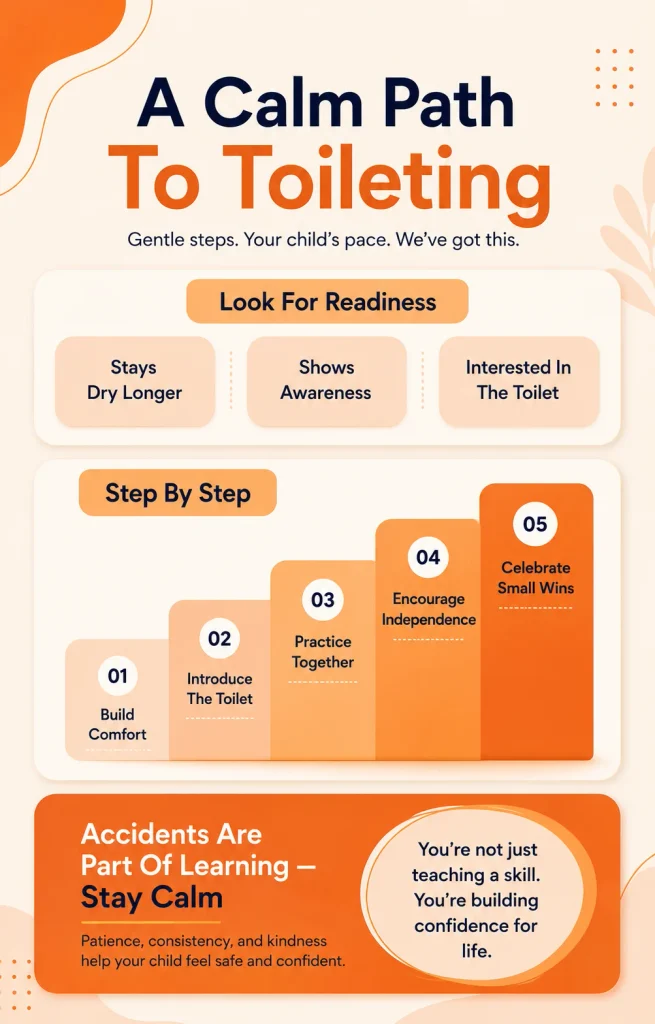
Readiness signs can help you decide how to begin, but they are not a pass-or-fail checklist. A child may understand the routine without communicating before every toilet visit. Another may need scheduled opportunities because they do not yet notice or respond to internal body signals. The goal is to find the support that makes toileting safer, more comfortable and more understandable for your child.
Signs Your Child May Be Ready
Look for a combination of practical signs while remembering that children with developmental, motor, communication or sensory differences may show them in less obvious ways:
- Staying dry for longer periods or having a somewhat predictable time for urination or bowel movements.
- Pausing, hiding, fidgeting, holding their body or otherwise changing behaviour before or during elimination.
- Noticing a wet or soiled nappy, asking to be changed or helping with the changing routine.
- Showing interest in the bathroom, potty, toilet or another person’s routine.
- Sitting safely for a brief period with appropriate support.
- Understanding a simple routine through spoken words, demonstration, pictures, gestures or another communication method.
- Participating in clothing management with whatever help is currently needed.
Not every sign must be present. Spoken language, independent dressing and advance notice are not prerequisites for beginning toilet-learning preparation. A child may communicate through a word, gesture, sign, picture, device or behaviour that a familiar adult has learned to recognise.
Readiness also has several parts. The child’s body needs to pass urine and stool without untreated pain or significant constipation. The environment needs to be accessible and secure. The routine must be understandable, and the adult must have enough time to stay consistent without forcing the process.
Do not simply wait indefinitely for every readiness sign. If your child is well beyond the stage when you expected progress, has never developed awareness of wetting or soiling, or has motor, sensory or communication needs affecting toileting, ask a health or child-development professional for individual guidance. The purpose is not to rush the child; it is to identify barriers and choose appropriate support.
Setting Up for Success
A small amount of preparation can remove avoidable difficulty:
- Check comfort first: Notice hard or painful stools, stool withholding, soiling, abdominal discomfort, pain when urinating or a sudden change in wetting. Discuss concerning signs with your child’s doctor before increasing training demands.
- Choose stable equipment: Use a potty or a securely fitted child seat. If your child uses a toilet, provide a stable step so their feet are supported rather than dangling.
- Make access easy: Choose clothing with manageable fastenings and keep the route to the bathroom clear. Independence is not required; provide the help your child needs.
- Reduce specific environmental barriers: Consider lighting, fan noise, flushing sounds, smells, temperature, visual clutter and the feel of the seat. Change only what appears to be a real barrier for your child.
- Use understandable cues: A short verbal instruction, object cue, picture sequence, gesture or AAC symbol may be more useful than repeated questions.
- Coordinate caregivers: Agree on the same basic words, communication cue, equipment and response to accidents across home, nursery or school where possible.
- Choose a manageable period: Avoid starting an intensive change during illness, travel or a major disruption when practical. Preparation and familiarisation can still happen gradually.
Focus first on daytime toileting. Night-time dryness is a separate developmental process involving sleep, bladder capacity and hormone production, and it may develop much later. A child who uses the toilet reliably during the day may still need protection at night.
Protect dignity and safety throughout. Never shame, punish or restrain a child on the potty or toilet. Do not force prolonged sitting or restrict drinks to prevent accidents unless a qualified medical professional has given specific instructions. Respect privacy, provide adult help with wiping and handwashing where needed, and supervise equipment for stability.
A Gentle, Step-by-Step Approach
Toileting includes several connected skills: entering the bathroom, managing clothing, sitting securely, releasing urine or stool, communicating, wiping, flushing and washing hands. Breaking the routine into observable steps helps you identify what the child can already do and where support is needed.
The following framework is flexible. Children do not have to master every step in this exact order, and several skills may develop together. Practise one useful target at a time while continuing to assist with the rest of the routine.
1. Get Comfortable With the Bathroom and Potty
Begin with safe, neutral exposure. Let your child see the potty or toilet, learn the words or symbols your family will use and enter the bathroom without being required to perform. They might sit briefly while clothed, place a toy near the potty or look at a simple picture sequence.
Do not repeatedly flush or expose a child to a feared sound in the hope that they will “get used to it.” If flushing is distressing, let them leave before another person flushes, reduce the sound where possible or introduce it gradually at a tolerable distance.
2. Build a Brief Sitting Routine
Offer the potty or toilet at times that match the child’s observed pattern, such as after waking or shortly after a meal. Keep the sit brief, supervised and physically comfortable. A book, song or simple visual timer may help some children; it may distract or create pressure for others.
Praise participation rather than demanding urine or stool: “You came to the bathroom and sat for a moment.” End the sit if the child is distressed, in pain or trying to leave. Toileting should never become a restraint exercise.
3. Connect Body Signals With the Toilet
Notice possible signals such as becoming quiet, fidgeting, hiding, crossing the legs, holding the genital area or moving to a familiar place. Describe what you observe without certainty or shame: “Your body might need the toilet. Let’s go and check.”
Some children have reduced awareness of internal sensations or notice the signal only at the last moment. Scheduled toilet opportunities may therefore be more practical than waiting for the child to request. Keep a simple record of timing for a few days if it helps reveal a pattern; do not turn the record into a scorecard.
4. Build Awareness and Communication
Teach one consistent way to communicate “toilet,” “wet,” “poo,” “help” or “finished.” Accept speech, gestures, signs, pointing, pictures or AAC. Keep the symbol or device accessible rather than expecting the child to find it after the urge becomes urgent.
Do not withhold access until the child asks correctly. If you recognise a body signal, respond and model the communication at the same time: “Toilet,” while showing the word, picture or sign. Communication can grow alongside successful toileting rather than having to come first.
5. Grow Participation and Independence Gradually
Choose one part the child can practise while you support the remaining steps. They might push trousers down after you loosen them, tear off toilet paper, flush after leaving the seat or complete one part of handwashing.
Some children learn well when the adult completes most of the routine and leaves the final manageable action for the child. Others do better starting with the first step. Use the least intrusive prompt that keeps the routine safe, and reduce help only when the child can succeed without distress.
Complete independence is not the only valid outcome. Reliable participation, communicating discomfort, accepting help, using adaptive equipment or completing the routine with reminders can all be meaningful progress.
Accidents Are Part of Learning—Respond Neutrally
An accident is information, not misbehaviour. Keep the response brief and matter-of-fact: “Your clothes are wet. Let’s get clean and changed.” Protect the child’s privacy, involve them only in cleanup steps that are safe and reasonable, and avoid lectures or visible disappointment.
Frequent accidents may mean the schedule does not match the child’s pattern, the clothing is difficult, the communication cue is inaccessible, the child needs more help or a medical issue is interfering. Do not assume the answer is simply more reminders.
If Progress Stalls
A pause in progress can occur, but persistent or sudden difficulty deserves investigation rather than automatic reassurance. Constipation is especially important: hard or painful stool can lead to withholding, toilet refusal, soiling and urinary accidents. A child may still pass small amounts of stool and nevertheless be constipated.
Contact your child’s paediatrician or GP if you notice:
- Hard, painful or infrequent stools, stool withholding or repeated soiling.
- Pain or burning with urination, unusually frequent urination, blood in urine or stool, fever or a strong change in urine smell.
- New daytime accidents after a period of dryness.
- Excessive thirst together with increased urination.
- Ongoing distress, refusal or accidents that are affecting participation at home or school.
- Loss of a toileting or communication skill the child previously used.
Seek prompt medical care when the child appears acutely unwell, cannot pass urine, has severe abdominal pain or swelling, persistent vomiting, significant bleeding or signs of dehydration.
If medical causes and access barriers have been considered and the process has become a repeated struggle, reducing demands or taking a planned break may help. Keep the bathroom familiar, continue ordinary hygiene routines and decide with the child’s care team when and how to restart. A break is not failure, but it should not replace evaluation when pain, constipation, regression or illness is possible.
A paediatric continence service can help with bladder and bowel patterns. An occupational therapist may help with seating, clothing, motor planning, environmental access or sensory barriers. The appropriate professional depends on the reason the routine is difficult.
Common Worries, and What They May Mean
“Everyone Else’s Child Is Trained—Mine Isn’t.”
Comparison does not explain what your child needs. Later toileting is not a measure of intelligence, character or parenting. It can, however, affect comfort, school participation and family routines, so concerns should not be dismissed with “they will do it eventually.”
Focus on the next functional barrier: pain, body awareness, bathroom access, communication, sitting stability, clothing, routine or fear. If you cannot identify the barrier, ask for professional guidance rather than increasing pressure.
“They Were Doing Well, Then Started Having Accidents Again.”
Changes in routine, illness or emotional stress can affect toileting, but constipation, painful bowel movements, urinary infection and other physical problems must also be considered. A sudden regression should not automatically be labelled behavioural.
Respond calmly, note when and where accidents occur and contact the child’s doctor when the change persists, is frequent or comes with pain, withholding, soiling, urinary symptoms, excessive thirst or loss of another skill. Once medical concerns are addressed, rebuild the familiar routine with the level of support the child currently needs.
“They Refuse to Sit on the Potty or Toilet.”
Refusal may reflect pain, constipation, fear of falling, an unstable seat, a loud flush, an uncomfortable posture, an unclear expectation, loss of control or another experience. Do not assume it is defiance or sensory avoidance.
First check for physical discomfort and equipment safety. Then reduce the demand: entering the bathroom, standing near the toilet or sitting clothed for a moment may be the current step. Never hold the child on the toilet. Persistent refusal warrants support from the child’s doctor and, depending on the barrier, a continence or occupational-therapy professional.
How the BASICS App Helps With Toilet Training

Speech and Autism Learning App for Kids Ages 2–8


A Step-by-Step Toilet-Training Programme
BASICS can give parents a clearer next activity instead of presenting toileting as one large goal. Review the suggested activity, watch the demonstration where provided and adapt the practice to the child’s current participation level.
The programme should not be described as one mandatory linear sequence for every child. A child may need a different starting point, additional repetition, an environmental change or professional input before continuing. An activity rating records how practice went; it is not a continence assessment or proof of mastery.
Support for Routines, Access and Participation
Use BASICS prompts to help make a routine predictable, then practise in the real bathroom with the child’s actual seat, clothing, communication method and caregiver support. Notice whether positioning, instructions, sound, lighting or the number of steps affects participation.
The app cannot determine whether a difficulty is caused by constipation, a urinary problem, pain, reduced body awareness, motor access, anxiety or another factor. Do not use continued app practice as a substitute for investigating a persistent problem.
Calm, Consistent Home Practice
Consistency means using a familiar cue and response—not forcing the same demand regardless of the child’s condition. A short, understood practice opportunity can be more useful than completing an activity while the child is uncomfortable or distressed.
BASICS may help families structure practice, but it cannot guarantee a calm process, prevent accidents or make every child independent. Use it as one part of a plan that respects the child’s privacy, communication, body signals and need for assistance.
A Gentle Last Word
When a child needs more time with toileting, the useful question is not “Why aren’t they trained yet?” It is “What is making this part difficult, and what support would make it safer or easier?” Check comfort and bowel health, make the equipment secure, teach one manageable part of the routine and respond to accidents without shame.
Progress may mean independent toileting. It may also mean recognising a body signal, entering the bathroom without fear, communicating “help,” sitting securely or completing the routine with prompts and adaptations. Those outcomes are not failures.
Use BASICS when a structured home activity is helpful, and involve medical, continence or occupational-therapy professionals when the barrier requires their expertise. The aim is not speed. It is safe, dignified participation with the right level of support.
At your child’s pace, with comfort, dignity and the support they need.
Related Reading
- Effective Autism Toilet Training Tips for Parents
- BASICS Daily Living Skills App for Kids: Guided Routine Practice at Home
References and Further Reading
The guidance above draws on the following paediatric, continence and product resources:
- American Academy of Pediatrics: Potty Training
- American Academy of Pediatrics: Potty Training Children With Special Needs
- American Academy of Pediatrics: Potty Training Regression
- NHS: Constipation in Children
- NHS: Soiling in Children
- Cambridgeshire and Peterborough Children’s Health Services: A Guide to Toileting
Book your Free Consultation Today
Parent/Caregiver Info:
Client’s Details:
* Error Message