BASICS Language Games for Kids: First Words, Vocabulary, Phrases, Sentences and Questions
By Wellness Hub
Last Updated: August 13, 2026
A parent guide to what children practise in the BASICS Speech & Language games, how to connect one screen response to everyday communication, and when to seek professional guidance.
Short answer: BASICS includes Speech & Language games for first words, vocabulary, phrases, sentences and WH questions. These games can provide structured practice with a specific task, but completing a game does not show that a child can use the same language spontaneously in daily life. Use the games as an additional practice area within the broader parent-guided BASICS plan, not as a language assessment or a replacement for speech-language therapy.
Speech is how sounds and spoken words are produced. Language is how a child understands and expresses meaning. Communication is broader: it can include speech, gestures, signs, pictures, writing and augmentative and alternative communication (AAC). This guide focuses mainly on language and communication practice. Speech-sound or articulation concerns may need different activities and professional assessment.
How BASICS Speech & Language Games Fit Into the App
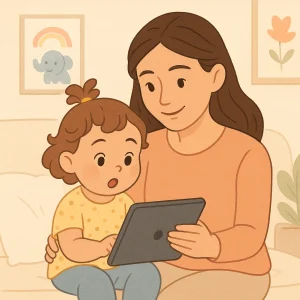
BASICS is more than a child-facing game library. In the current app workflow, a parent answers questions about observable skills, reviews suggested goals and receives three guided activities. Activities include demonstrations, steps and parent prompts, and the parent records a practice rating. The games sit alongside that parent-guided plan as an additional way to revisit selected ideas.
The BASCIS App describes more than 250 learning games across three worlds: Speech & Language, Academics, and Feelings & Friendships. Within Speech & Language, it names first words, vocabulary, phrases, sentences and WH questions. The listing also says BASICS content is created by a multidisciplinary team that includes speech therapists.
Therapist-created content can make a practice goal clearer, but it is not the same as an individual assessment or therapy plan. For each game, focus on two practical questions: What does this task let my child practise? Can we use the same idea during everyday communication?
What Children Practise in the Speech & Language Games
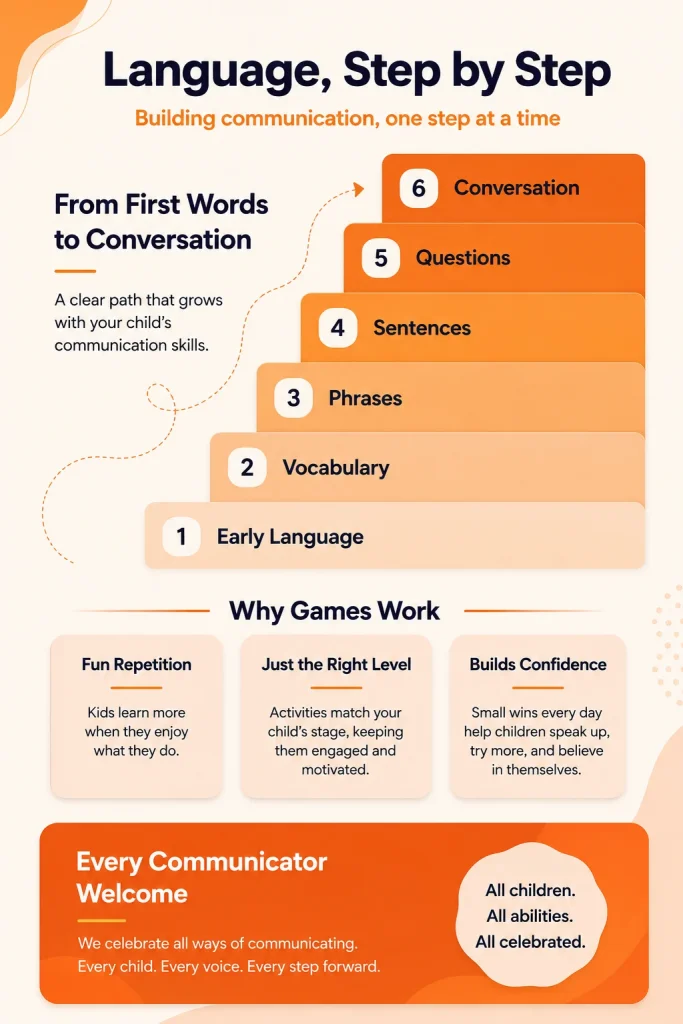
Language development does not follow one identical ladder for every child. Understanding, vocabulary, grammar, speech, social communication and AAC use may develop at different rates. BASICS can organise practice by task type and complexity; it cannot determine a child’s complete language profile from game performance. A child may benefit from tasks in more than one area at the same time.
First-Word and Early-Language Tasks
- In a game: A first-word task may ask a child to find a familiar picture after hearing its name. If the prompt is “Find cup,” choosing the cup can practise attending to the spoken word and linking it with that picture.
- Try it offline: At snack time, place the cup within reach, name it once and pause. Accept a look, reach, point, gesture, sign, picture choice, AAC selection or spoken word as communication. Respond to the message instead of requiring imitation.
- Important limit: Selecting one familiar picture does not show that the child understands the word across different cups or can use it to request, comment or answer a question.
Vocabulary Tasks
- In a game: Vocabulary tasks may involve familiar objects, actions, describing words or everyday concepts. For example, choosing a picture of someone running after hearing “running” can practise a word-to-picture association for an action.
- Try it offline: Use the word during real movement: “You are running” or “The dog is running.” Then contrast it with walking or stopping. Keep the language connected to what the child can see and do.
- Important limit: Recognition in one picture does not prove that the child understands the word with new people, actions or settings, or that they will use it independently.
Phrase-Building Tasks
- In a game: A phrase task may combine two ideas, such as an action and an object, a descriptor and an object, or a request and an item. A child might select or arrange words or symbols for a combination such as “big ball” or “more bubbles.”
- Try it offline: Build on the child’s message by adding one useful word. If they say, sign or select “ball,” model “big ball” or “ball go.” Do not turn every model into a demand to repeat.
- Important limit: Completing a prompted combination does not show that the child can create the same phrase for a new purpose or with a different communication partner.
Sentence-Building Tasks
- In a game: A sentence task may ask a child to choose a sentence that matches a picture or place words in an expected order. This can practise noticing who is doing what and how words are organised in that example.
- Try it offline: During play or a picture book, repeat the child’s message and add a little information. If the child communicates “dog run,” you might model, “The dog is running.” A short, natural model is more useful than repeatedly correcting grammar.
- Important limit: Sentence length is not the same as speech clarity, and arranging words on a screen does not prove that the child can produce a grammatical sentence in conversation.
WH-Question Tasks
- In a game: WH questions do not all require the same kind of thinking. “What is this?” may ask for a label, “Where is it?” asks for a location, “Who is eating?” asks for a person, and “Why?” may require an explanation. A visual choice can make the expected answer type clearer.
- Try it offline: Ask one question connected to the moment, then wait. If needed, point, offer two meaningful choices or model the answer. Accept a response through speech, gesture, sign, a picture or AAC where appropriate.
- Important limit: Answering a familiar picture question does not prove that the child can understand the same question word in conversation, especially when the answer is not visible.
Connecting a Game Response to Shared Interaction
Conversation is not simply the final level after words and sentences. It involves another person’s timing, attention, knowledge, communication style and changing response. A screen can present a prompt, but it cannot reproduce the full back-and-forth of a real interaction.
- After a game response: Use one idea in a shared activity. If the game involved “open,” pause at a box, door or snack container and model “open” in the communication form available to the child. Wait, respond and continue the activity. The goal is participation, not a perfect spoken answer.
- Important limit: A greeting, turn-taking or social-choice task may help a child discuss an idea in a calm setting. It cannot guarantee that the child will use it during a fast, unpredictable interaction or that it will lead to friendship.
What Feedback and Game Results Can Show
BASICS does not use streaks or comparisons with other children. During a game, treat a correction sound, animation or highlighted answer as a prompt – not proof that the child has learned the skill. The more useful question is what happens next: Does the child correct the response, recognise a new example or use the idea away from the screen?
A useful observation ladder moves from the screen toward everyday communication:
- The child responds to the same item again.
- The child responds to a new example of the same task.
- The child uses the idea with a real object or activity when an adult supports them.
- The child uses the idea spontaneously with a different person, object or setting.
These are different observations, not interchangeable proof of progress. A parent-recorded BASICS rating can help track practice, but it is not a standardised language score or diagnosis. Random tapping, memorising a screen position or waiting for a visual cue may produce a correct answer without showing understanding.
Why Repetition Alone Is Not Enough
Repetition can make a task more familiar, but repeated exposure does not guarantee that a child understands the target or can use it elsewhere. Useful practice includes attention to the prompt, a purposeful response, varied examples and a reason to communicate outside the game.
A systematic review of educational apps published in Pediatrics found emerging evidence for some early academic learning, especially mathematics, but wide variation across studies and apps. It did not establish that children’s apps broadly improve spontaneous social communication. BASICS should therefore be described as offering practice opportunities, not guaranteed developmental results.
Engagement also needs careful interpretation. Bright pictures, sounds or rewards may keep a child on the screen even when they are tapping without understanding, becoming overstimulated or no longer attending to the language target. Look for purposeful choices and comfort, not just time spent in the game.
How to Use Language Games With Your Child
There is no BASICS-specific evidence that a fixed number of minutes or a daily game streak produces better language. Choose brief, optional use that fits the child, the activity and your family’s media plan. The quality of the shared interaction matters more than finishing a level.
- Choose one target. Pick one word, phrase pattern or question type rather than testing several skills at once.
- Model once, then wait. Show the game rule or give a short language model. Leave enough time for the child to respond.
- Accept different communication methods. A look, reach, gesture, sign, picture, AAC selection or spoken response may all be meaningful, depending on the task.
- Comment more than you test. Describe what is happening instead of asking a rapid series of questions or requiring repeated imitation.
- Connect one example to real life. Use the target with a toy, book, person, action or routine while it is relevant.
- Stop when participation drops. Pause if the child looks away repeatedly, taps randomly, becomes distressed, needs movement or no longer wants to continue.
The American Academy of Pediatrics encourages families to consider the child, the content, how media is used for calming, what it may crowd out and ongoing communication. Its 5 Cs of media guidance and family media plan can help parents place app use alongside sleep, movement, play, books and face-to-face interaction.
What Makes BASICS Language Games Different
The main difference is that the games sit inside a broader parent-guided app. BASICS combines child-facing practice with suggested goals, three guided activities, demonstration videos, parent prompts and parent-recorded ratings. This helps families connect a game target with practice during everyday routines.
- A broad game library. More than 250 learning games are organised across Speech & Language, Academics, and Feelings & Friendships.
- Clear language practice areas. The Speech & Language catalogue covers first words, vocabulary, phrases, sentences and WH questions.
- Multidisciplinary input. The store listings say BASICS content is created by a team that includes speech therapists and other child-development professionals.
- No streaks or comparisons. Practice is not tied to maintaining a streak or competing with another child.
- More than spoken answers. The broader communication activities recognise speech, gestures and AAC as ways to communicate.
BASICS is designed to work alongside professional support. The game library can help organise practice at home, while a speech-language professional remains the right person to assess persistent speech or language concerns and tailor goals to the individual child.
Explore BASICS Premium
If the Speech & Language catalogue matches the kind of practice you want, review the current trial and subscription terms before starting. BASICS Premium is offered as a monthly or yearly auto-renewing subscription with a seven-day free trial. Prices and terms can vary by store or region, so check the details shown at checkout.
On Apple devices, payment is charged to the Apple ID at confirmation and the subscription renews unless it is cancelled at least 24 hours before the current period ends. Android billing and cancellation follow the terms shown in Google Play. You can review BASICS on the Apple App Store or Google Play. The trial provides access to practice content; it does not guarantee a language, speech or communication result.
Who May Find These Games Useful
The games may be useful for parents who want a structured way to revisit first words, vocabulary, word combinations, sentences or WH questions. They may also provide extra practice between speech-language sessions or while a family is waiting for services. Usefulness depends on whether the task is understandable, accessible, relevant and comfortable for the individual child.
A child described as a “late talker” may have different needs related to hearing, understanding language, speech production, motor planning, development or access to communication. An app cannot identify the reason or decide whether an assessment is needed.
Ask a paediatrician or qualified speech-language professional for guidance if your child:
loses words, signs, gestures or other communication they previously used;
- rarely responds to sounds or you have concerns about hearing;
- has difficulty understanding familiar words or directions;
- does not have a reliable way to communicate important needs;
- experiences frequent distress or frustration related to communication; or
- has feeding, swallowing, speech-motor or other developmental concerns.
The National Institute on Deafness and Other Communication Disorders explains that children vary in how speech and language develop, while the American Academy of Pediatrics advises parents to seek evaluation when they are concerned rather than waiting for an app to answer the question.
A Practical Takeaway for Parents
Treat a correct tap as a starting point. Notice whether your child can respond to a new example, use the idea with a real object when you support them, and eventually communicate it in a different setting or with another person. Those steps may happen unevenly, and a child can communicate meaningfully without using spoken words.
After a game, ask one useful question: Can my child use this idea in a comfortable communication form during a real activity? If not, make the example simpler, model it without pressure or ask a speech-language professional how to adapt the target. BASICS can organise practice; the child’s everyday communication remains the more important measure.
Clinically Reviewed By
Reviewed by Shravanaveena Gajula, BASLP, M.Sc. Speech and Language Pathology, Audiologist and Speech-Language Pathologist at Wellness Hub.
Shravanaveena supports children and families with speech, language, and communication needs. Her clinical work includes speech-language assessments, receptive and expressive language development, speech-sound concerns, autism-related communication needs, parent counselling, and home-practice guidance.
This article was reviewed for clinical accuracy, parent-friendly language, and safe guidance on helping children move from single words to phrases and sentences.
This content is for educational purposes only and does not replace professional assessment, diagnosis, or speech-language therapy.
View Shravanaveena Gajula’s Profile
Related Reading and Sources
- BASICS Learning Games for Kids: Speech, Academics and Social-Emotional Play
- BASICS Speech Therapy App for Kids: First Words to Sentences
- How to Teach First Words at Home: A Parent’s Guide
- How to Help Your Child Combine Words Into Phrases
- An App to Teach WH Questions: How BASICS Supports Practice
References and further reading
- BASICS: Autism, Speech Therapy – Apple App Store
- NIDCD: Speech and Language Developmental Milestones
- ASHA: Augmentative and Alternative Communication in Early Intervention
- American Academy of Pediatrics: Language Delays in Toddlers
- American Academy of Pediatrics: Kids and Screen Time – The 5 Cs
- Griffith et al.: Apps as Learning Tools – A Systematic Review
Book your Free Consultation Today
Parent/Caregiver Info:
Client’s Details:
* Error Message