Helping Your Child Pause, Think and Make Good Choices
By Wellness Hub
Last Updated: July 27, 2026
Building impulse control and thoughtful choices — with the Pausing & Choosing games in the BASICS app.
Impulse control is the ability to pause long enough to stop, wait, ask, or choose a safer action. If you are wondering how to teach impulse control to children, start with short stopping and waiting games when your child is calm, use simple cues in daily routines, make waits manageable, and step in immediately when safety is at risk. Games are useful impulse control activities for kids, but they work best as repeated practice — not as a test of obedience.
Grabbing a toy, calling out, leaving a queue, or running towards something interesting can happen because the urge arrives before a child can use what they know. Impulsive behaviour is common in childhood, especially in the preschool years. It is not a character flaw. It can also be affected by excitement, communication needs, sensory overload, anxiety, tiredness, hunger, pain, attention differences, or an expectation that is too difficult in that moment. The aim is to understand the pattern, protect safety and other people’s boundaries, and teach an action the child can actually use.
Why Self-Control Takes So Long to Develop
Pausing before acting draws on several executive function skills. A child may need to notice an urge, remember a rule, stop an automatic response, shift to another action, and cope with not getting what they want immediately. These abilities develop gradually through childhood and adolescence. The prefrontal cortex, which supports planning and decision-making, continues maturing into early adulthood, but brain development alone cannot explain why a particular behaviour happened.
Knowing a rule and using it in a fast, exciting, frustrating, or overwhelming moment are different tasks. A child may be able to say, “I wait for my turn,” and still grab the toy when it appears. That gap does not automatically mean the child is being defiant. First check whether the child understood the expectation, had a usable way to respond, and was regulated enough to use it.
Self-control is not a fixed trait that a child either has or lacks. It is a group of developing skills influenced by maturity, practice, communication, health, neurodevelopment, relationships, and the environment. Practice can create more chances to pause and choose, but progress will not be identical for every child or transfer automatically from a game to daily life.
The Building Blocks of Good Choices
- “Making good choices” is easier to teach when adults describe the separate skills involved:
- Pausing – creating a brief gap between an urge and an action.
- Waiting – coping with a short delay while knowing what will happen next.
- Thinking ahead – noticing a likely result, especially when safety is involved.
- Weighing options – seeing two or more possible actions and selecting one.
- Considering others – recognizing another person’s space, turn, belongings, or feelings.
Impulse control is one part of broader self-regulation. Thinking ahead, comparing options, and considering other people also involve language, memory, attention, social understanding, and problem-solving. A child may need support in more than one of these areas.
Start with short pauses and waits because they are concrete and easy to practise. Use an action the child can see or do: stop feet, hands to self, wait for the timer, point to “my turn,” or ask with speech, a gesture, a picture, sign language, or augmentative and alternative communication (AAC). “Make a good choice” is too abstract unless the child already knows exactly what the available choices are.
Gentle Ways to Build Self-Control
Play waiting and stopping games
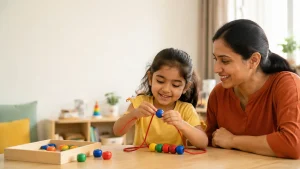
Use games such as “Red Light, Green Light,” freeze dance, “Simon Says,” rolling a ball back and forth, or taking turns adding blocks to a tower. These activities give children low-pressure practice with stopping their body, listening for a cue, waiting briefly, and starting again.
Begin at a level where your child can succeed. For a younger child, use one- or two-second pauses and make the stop signal obvious. Stand close, demonstrate the action, and play for only a few turns. As it becomes easier, vary the length of the pause or let your child give the signal. If the game causes distress or repeated failure, shorten it, simplify the rule, or choose a different activity.
Do not use the game as proof that a child should now be able to stop near traffic or during intense distress. Instead, carry over one familiar cue in a safe setting. For example, after playing “Red Light, Green Light,” practise stopping at the front door with an adult beside the child. For more play ideas, see Fun Turn-Taking Games for Kids.
Name the pause
Help your child notice the exact moment between wanting something and acting. Keep the language brief and descriptive: “You want the car. Pause. Ask for a turn.” If another child’s toy is being grabbed, calmly block or return the toy first, then model an accessible alternative such as “turn please,” a pointing gesture, a picture card, or an AAC button.
Avoid long explanations during the incident. When everyone is calm, replay the situation with toys: “Bear wants the train. Bear can stop, point to ‘turn,’ and wait.” This lets the child rehearse the replacement action without shame.
Naming the pause does not mean narrating every mistake. Choose one recurring situation and use the same short words each time. Notice genuine effort: “You stopped your hand,” or “You waited while I counted to three.” Praise the observable action rather than calling the child “good” or “bad.”
Teach a simple stop-and-think cue
Choose one cue that tells the child what to do, not only what to avoid. Examples include “stop feet,” “hands with your body,” “wait, then go,” or a small stop picture. Pair the words with a gesture or visual if that helps. Practise the cue during play and predictable routines before expecting the child to use it in a difficult moment.
A breath, hand on the tummy, or counting may help some children slow down, but it will not suit everyone. Never force touch or breathing exercises. Offer options and watch the child’s response. Children who use AAC should have quick access to messages such as “stop,” “break,” “help,” “my turn,” and “all done.”
During high arousal, a child may not be able to use a cue independently. Reduce language, lower unnecessary demands, and provide the support needed to keep people safe. Teaching and problem-solving can wait until the child is calmer.
Talk through choices and consequences
Discuss choices when the child is calm enough to listen and the situation is safe. Use one concrete question at a time: “The ball rolled near the road. Do we run after it, or ask an adult?” Pictures, dolls, toy cars, and short role-play can make the options easier to understand than a verbal lecture.
Near traffic, water, heights, or another immediate danger, do not wait for a young child to reason through consequences. Secure safety first. Use a direct instruction such as “Stop. Hold my hand,” provide close supervision, and practise the routine later in a safe place. If running away happens repeatedly, look for patterns such as curiosity, escape, distress, sensory overload, or difficulty understanding the routine, and seek professional support when needed.
Use consequences that are immediate, related, and calm. If a hard toy is thrown, move the toy out of reach and offer a safe throwing option. If a game piece is grabbed, return it and show whose turn comes next. Shame, threats, or distant punishments do not teach the missing action.
Offer real choices
Offer two manageable options when either answer is genuinely acceptable: “Red cup or blue cup?” “Shoes first or jacket first?” “Wait beside me or hold my hand?” This supports autonomy and gives the child a low-pressure chance to pause, compare, communicate, and decide.
Keep the options visible and the language short. For a child who does not answer with speech, let them point, look, gesture, sign, or use AAC. Allow enough time to respond. If neither option is acceptable to the child, check whether the task, sensory demand, or timing is the real problem.
Choices do not replace adult boundaries. Safety limits remain clear: “We are staying beside the car. You can hold my hand or hold the trolley.” Offering choices also does not, by itself, train impulse control. It is one way to practise decision-making while respecting the child’s agency.
Meet their stage, and keep expectations realistic
Young children usually need shorter waits, more adult support, clearer visual cues, and many repetitions. Start with a delay your child can manage — sometimes only one or two seconds — and make the endpoint visible with a short count, a “first…then…” statement, a turn card, or a visual timer. Increase the wait gradually only when the child is coping.
Match the strategy to the child’s communication and developmental level rather than relying on age alone. A child who understands one-step directions may need a demonstration instead of a discussion about future consequences. A child who becomes overwhelmed by sound or crowds may need a quieter environment before any self-control cue can work. A child with motor or sensory differences may need a different action than “keep your body still.”
Look for patterns across situations. Note what happened before the behaviour, what the child may have been communicating, what helped, and whether the expectation was realistic. The BASICS app can support parent-guided practice, but it cannot assess, diagnose, or explain an individual child’s behaviour.
Speak with your child’s pediatrician or another qualified professional if impulsive behaviour is severe, persistent, clearly different from same-age peers, affects learning or relationships, occurs across settings, or creates repeated safety risks. Seek medical advice for a sudden behaviour change, possible pain, major sleep disruption, or loss of skills. Depending on the concern, the care team may involve a child psychologist, developmental professional, occupational therapist, or speech-language professional.
Common Worries – and What They Often Mean
“They grab things instead of asking or waiting.” Grabbing may involve an urge that is hard to stop, but it can also reflect difficulty communicating, uncertainty about whose turn it is, intense interest, limited access to AAC, or a wait that is too long. Protect the other person’s boundary first: block the grab calmly and return the item. Then model one usable alternative — ask, point to a turn card, offer a swap, or wait for a clearly shown turn. Practise the same action with familiar toys when the child is calm.
“They know the rule but do it anyway.” Repeating a rule does not prove that a child can remember and use it under pressure. Check whether the rule is concrete, whether the cue comes early enough, and what may be competing with it: excitement, fatigue, distress, sensory input, language load, or the need to escape. State the action you need — “walk beside me” — and help the child do it. Avoid assuming either deliberate defiance or a single developmental cause without looking at the pattern.
“They can’t wait even a minute.” A minute can be a long and unclear delay for a young child. Reduce it to a few seconds, show what the child is waiting for, and give them something specific to do while waiting. Say, “First I pour the water, then your turn,” while pointing to the steps. Build the delay slowly. If waiting remains unusually difficult across daily routines or leads to unsafe behaviour, discuss the pattern with a qualified professional rather than trying to stretch the wait indefinitely.
How the BASICS App Helps You Build Self-Control
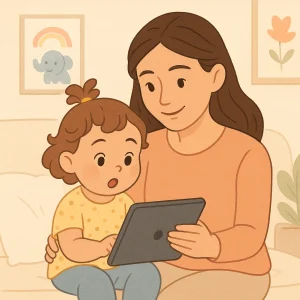
Impulse control is difficult to teach through explanations alone. BASICS offers parent-guided games and activities that can be used for short practice when a child is calm. Its current public listings describe Social Skills & Feelings activities, Feelings & Friendships games, turn-taking, parent prompts, therapist tips, and support from a multidisciplinary team that includes child psychologists.
Use the app as one part of a wider routine: practise one simple idea on screen, name the same idea during play, and support the child in a real situation. An app can provide repetition and shared language, but it cannot guarantee that a skill will transfer or replace supervision, individual assessment, or professional care.
Pausing & Choosing games
The Pausing & Choosing games give children a concrete way to practice stopping briefly, looking at simple options, and selecting a response. Play when your child is comfortable and available for learning. Keep the session short, join the activity, and accept speech, gestures, signs, pointing, or AAC as valid ways to answer.
After a game, choose one phrase or visual to carry into the day, such as “stop, wait, ask.” Use it in one predictable routine rather than testing the child in every situation. If the child becomes frustrated, pause the activity and return later or choose a simpler example.
A guided, gentle progression
Begin with the simplest skill represented in the activity, such as stopping for a moment or choosing between two visible options. Use the step-by-step guidance, parent prompts, and therapist tips in BASICS to understand the activity before asking your child to respond.
Progress means the child is beginning to use a supported skill more comfortably — not that every answer is correct or that the skill appears everywhere. Repeat an activity when it remains useful, change the support when it does not, and avoid moving ahead simply to finish a level.
Skills that connect across development
Pausing and waiting connect with turn-taking, communication, emotional regulation, safety routines, and social problem-solving. BASICS also includes Social Skills & Feelings content and Feelings & Friendships games that address emotions, calming, turn-taking, and understanding others.
Make the connection explicit after play: “In the game, we stopped and looked. At snack, we can stop and point to the one you want.” Keep the real-life step small and observable. The goal is not perfect self-control; it is giving the child more safe, accessible ways to respond.
Explore Pausing & Choosing games in BASICS
Explore BASICS on Google Play and the Apple App Store.
BASICS Premium currently offers a seven-day free trial. On the Apple App Store, it is an auto-renewing monthly or yearly subscription unless cancelled at least 24 hours before the end of the current period. Prices and terms may vary by platform or region, so review the store listing before subscribing. BASICS is designed to work alongside — not replace — your child’s therapy or professional care.
A Gentle Last Word
Helping a child pause, think, and choose is not about demanding adult self-control from a developing child. Start with one situation, one concrete cue, and a wait the child can manage. Practise when calm, protect safety and other people’s boundaries in the moment, and treat communication, sensory needs, health, and the environment as part of the picture.
Progress may look small: a hand stops for one second, a child points instead of grabbing, or they accept help after running towards something unsafe. Those moments show which support is becoming usable. If impulsivity continues to disrupt daily life or create danger, seek individual guidance rather than relying on more practice alone.
Stop, wait, choose — one supported pause at a time.
About the Author
Rajini Darugupally is a Speech-Language Pathologist at Wellness Hub with an M.Sc. in Speech-Language Pathology and more than 11 years of experience. Her work includes child speech and language development, social communication, receptive and expressive language, play skills, caregiver coaching, and home-based communication strategies.
Related reading
- How to Teach Self-Regulation to Children: 8 Practical Strategies
- Fun Turn Taking Games for Kids: Build Social Skills at Home
- How to Teach Social Skills to Kids at Home: 10 Practical Ways
- 10+ Think It or Say It Activities for Kids
- How the BASICS App Builds Social and Emotional Skills
References & further reading
- The developmental and practical guidance in this article was checked against the following sources:
- Center on the Developing Child at Harvard University. A Guide to Executive Function.
- National Institute of Mental Health. The Teen Brain: 7 Things to Know.
- CASEL. What Is SEL? — Self-Management.
- ZERO TO THREE. Toddlers and Self-Control: A Survival Guide for Parents.
- American Academy of Pediatrics. Early Signs of ADHD in Children; Nemours KidsHealth. Teaching Your Child Self-Control.
Book your Free Consultation Today
Parent/Caregiver Info:
Client’s Details:
* Error Message