How to Use a Speech Therapy App for Home Practice
Last Updated: August 3, 2026
A practical parent guide to turning therapist-created activities into short, useful communication practice during play, meals, books, and everyday routines, with support from BASICS.
A speech therapy app for home practice can make the next step clearer: what skill to work on, how to model it, and how to repeat it during daily life. BASICS gives parents a personalized developmental plan, three activities a day, demonstration videos, step-by-step guidance, parent prompts, therapist tips, and goal-by-goal progress tracking. It can support practice at home and between therapy sessions, but it cannot diagnose a communication difficulty or replace an evaluation and individualized care from a speech-language professional.
The screen is not the real practice space. Your child’s life is. The useful part of an app is not completing more activities; it is helping you take one communication goal into moments that already matter, asking for a snack, choosing a toy, following a direction, greeting someone, or telling you what happened.
What is a Speech Therapy App for Home Practice?
A speech therapy app for home practice is a digital tool that guides parents and children through activities related to speech, language, communication, or social interaction. The strongest apps do more than show flashcards or reward taps. They explain the goal, demonstrate what the adult should do, allow different ways to respond, and help families carry the skill into everyday situations.
It also helps to separate three terms that are often treated as the same:
- Speech is how a person produces sounds and how clearly those sounds are understood.
- Language is how a person understands and expresses ideas using words, sentences, signs, symbols, or an augmentative and alternative communication (AAC) system.
- Communication is broader. It includes speech and language, as well as eye gaze, facial expression, body movement, gestures, pictures, and communication devices.
An app may support one or several of these areas, but it should not be assumed to provide individualized speech therapy simply because “speech therapy” appears in its name. A speech-language pathologist assesses the child’s specific needs, considers hearing and development, selects appropriate goals, and adjusts treatment based on the child’s response. An app is a practice tool, not a clinician.
Why Home Practice Needs Structure, Not More Pressure
Parents are often told to “work on speech at home” without being shown what that means. The result can be predictable: too many goals, repeated requests to “say it,” and practice that feels like a test.
Research provides a more precise message. A meta-analysis of parent-implemented language interventions found positive effects on children’s receptive and expressive language skills. However, the parents in these interventions were taught specific strategies; the result should not be reduced to “more practice always works” or “an app produces therapy outcomes.” The quality of the strategy, the match to the child, and professional guidance still matter.

Home practice is more useful when it is:
- Focused on one clear goal at a time
- Short enough for the child to remain comfortable and engaged
- Connected to an activity the child already understands or enjoys
- Responsive rather than based on repeated testing
- Open to speech, gestures, signs, pictures, and AAC
- Adjusted when the child shows fatigue, distress, or disinterest
Consistency does not mean forcing a fixed session every day. It means returning to a useful strategy across real situations. Five calm minutes can be more productive than a longer activity that becomes a struggle.
How BASICS Supports Speech and Language Practice at Home
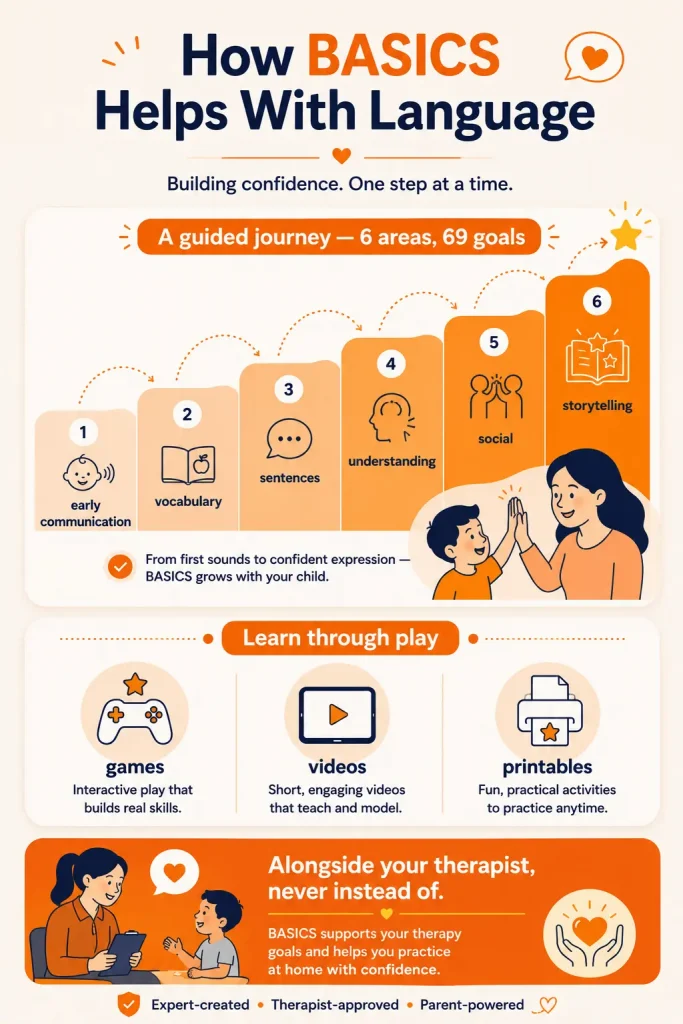
BASICS is a therapist-created app for speech, occupational therapy, social skills, oral motor skills, daily living skills, and other areas of early development. For communication, the official listings describe support from first words through vocabulary, two-word phrases, sentences, WH questions, and conversation. Activities are designed to include speaking children and children who communicate through gestures or AAC.
The app uses a simple parent workflow:
- Answer questions about your child’s current skills.
- Receive a plan with selected developmental goals.
- Complete three suggested activities a day.
- Watch a demonstration and follow the steps, prompts, and therapist tips.
- Rate the activity and follow progress goal by goal.
This structure can reduce guessing, but the plan is still based on the information entered in the app. If a goal appears too easy, too difficult, or unrelated to the concern that brought you here, do not push through it merely because it is on the screen. Discuss the goal with your child’s speech-language pathologist when possible, or seek an evaluation if concerns persist.
How to Use the BASICS Speech Therapy App at Home
The most effective use of BASICS is active and shared: the parent watches, models, waits, responds, and then takes the idea away from the screen. Use the following process for each activity.
1. Start With One Functional Goal
Choose a goal that would help your child communicate more easily in daily life. “Use more words” is too broad. “Ask for more during snack or play,” “combine an action with an object,” or “follow one familiar direction” gives you something observable to practice.
If your child works with a speech-language pathologist, use the app to reinforce a goal already in the therapy plan. Ask which words, sentence forms, speech sounds, or communication strategies should be practiced at home. Alignment prevents the app, parent, and therapist from pulling in different directions.
2. Watch the Demonstration Before Asking Your Child to Try
BASICS activities include a demonstration video, simple steps, parent prompts, and therapist tips. Watch the model first. Notice what the adult says, how much help is offered, and how the activity is kept manageable.
Then prepare the materials and remove unnecessary distractions. This is not about creating a perfect therapy room. It is about making the interaction easy to follow. A few toys on the floor or two choices at snack time may be enough.
3. Model the Skill Without Turning It Into a Test
A model shows the child what communication could look like. If the goal is “more bubbles,” you might say “more bubbles” as you point to the bubbles or select the words on the child’s AAC system. Then pause.
Avoid asking “What do you say?” again and again. That question tests the child but does not necessarily teach the response. Model the word, phrase, sign, or symbol; leave time to respond; and acknowledge the child’s attempt. If they reach, look, point, vocalize, sign, or use AAC, treat it as communication and build from there.
4. Keep the Child’s Response Easy to Give
Communication practice should not depend on speech alone. A child may answer by speaking, pointing, choosing a picture, signing, gesturing, or using a communication device. BASICS describes its communication activities as AAC-friendly, and parents should keep that inclusivity in the real-world practice that follows.
Do not withhold a basic need until a child says a word. Create an opportunity to communicate, but respond to the child’s available form of communication. AAC does not need to be saved for a last resort. Evidence summarized by the American Speech-Language-Hearing Association indicates that AAC does not hinder speech development and may support communication and speech production for some people with developmental disabilities.
5. Repeat the Goal in a Real Routine
After the app activity, use the same strategy once or twice in a familiar part of the day. The goal is carryover: helping the skill appear beyond the activity in which it was introduced.
For example:
- If the app goal involves requesting, practice during snack, bubbles, or a favorite toy.
- If the goal involves action words, model “car goes,” “baby sleeps,” or “water pours” during play and routines.
- If the goal involves following directions, use one meaningful direction while getting dressed or putting toys away.
- If the goal involves WH questions, ask about a familiar photo or something that just happened instead of quizzing the child on unrelated facts.
- If the goal involves conversation, practice one turn at a time around a topic the child already enjoys.
This is where an app activity becomes useful communication. Completion inside the app is not the endpoint.
6. Record What Happened, Not Just Whether It Was Finished
BASICS lets parents rate activities and view progress by goal. Use that record honestly. A completed activity is not the same as an independent skill.
Notice details such as:
- Did your child respond independently, after a model, or with more support?
- Did they use the skill only in the activity or later in the day as well?
- Which form of communication did they use?
- Did they stay regulated and willing to participate?
- Was the task consistently too easy or too hard?
These observations are more informative than a streak. They can also give a speech-language pathologist useful context when reviewing home practice.
A Flexible 10-Minute Home Practice Routine
Ten minutes is a planning example, not a clinical rule. Some children will enjoy a longer interaction; others will do better with two or three minutes embedded in several routines. Stop earlier if your child becomes distressed, fatigued, or disengaged.
Minutes 1–2: Preview
Open the selected BASICS activity, read the goal, and watch the demonstration. Gather only what you need. Decide which communication response you will accept: speech, gesture, sign, picture, or AAC.
Minutes 3–6: Practice Together
Follow the activity steps. Model more than you test. Pause long enough for your child to respond, and keep your language at a level they can process. If the child gives a shorter response, acknowledge it before modeling a slightly fuller version.
For example, if the child says or selects “car,” you might respond, “Yes, red car,” rather than insisting that they repeat the entire phrase.
Minutes 7–9: Move Into Real Life
Use the same goal in play, a book, a family photo, or a routine. If the activity practiced “more,” try it with one enjoyable action. If it practiced a one-step direction, use the direction while tidying up.
Minute 10: Reflect and Stop
Rate the activity in BASICS and note one concrete observation. End while the interaction still feels manageable. You do not need to repeat the task until the child performs it perfectly.
Match Practice to Your Child’s Current Communication
The same activity will not suit every child. Choose a starting point based on what your child does now, not what you think they should be doing.
If Your Child Communicates Without Spoken Words
Focus on connection, shared attention, choice-making, requesting, protesting, turn-taking, gestures, signs, pictures, and AAC. These are communication skills, not placeholders that count only until speech arrives.
During play, pause before an expected action and notice how your child asks for it to continue. Model an accessible response without demanding imitation. If your child uses AAC, keep the system available and model on it as you speak.
If Your Child Is Beginning to Use Words or Symbols
Choose useful words that can work across the day: actions, people, favorite objects, social words, and words such as “more,” “help,” “stop,” or “open.” Teach them in situations where they have an immediate purpose.
For more examples, see Grow Your Child’s Vocabulary at Home.
If Your Child Uses Single Words
Model short combinations that add one piece of meaning: “more water,” “blue car,” “mama come,” or “dog running.” Do not make every attempt depend on repeating after you. Expansion works by responding to the child’s message and showing a slightly fuller form.
Use How to Help Your Child Combine Words Into Phrases for a more detailed parent routine.
If Your Child Uses Phrases or Sentences
Work on clearer sentence structure, describing, answering and asking questions, explaining reasons, retelling events, and taking conversational turns. Keep the topic meaningful. A conversation about a favorite animal or a recent outing gives the child more reason to communicate than a disconnected drill.
You may also find How to Help Your Child Speak in Full Sentences and How to Help Your Child Answer WH Questions useful.
If Your Main Concern Is Speech Clarity
Language activities and speech-sound practice are not interchangeable. A child who knows what they want to say but is hard to understand may need an assessment of speech-sound production. The correct target depends on the pattern of errors and other factors; random mouth exercises or repeated correction may not address the cause.
Ask a speech-language pathologist which sound to target, how to cue it, and whether home practice is appropriate. Use the app only in a way that fits that plan.
Make Home Practice Easier for Your Child
Follow Interests Without Letting the Goal Disappear
If your child loves vehicles, animals, water, music, or letters, use that interest to create communication opportunities. Keep the goal specific. “Play with cars” becomes language practice when you intentionally model action words, offer choices, take turns, or build short phrases.
Use the Languages Your Family Speaks Comfortably
Parents do not need to avoid their home language to support communication. ASHA advises families to communicate in the languages they are most comfortable using. A familiar, natural interaction gives the child meaningful language and connection.
Reduce Prompts When the Child Can Do More Independently
Help should make success possible, not become a permanent part of the response. If your child begins using the word, sign, or symbol without a model, pause before helping. Give them space to initiate.
Stop Before Practice Becomes a Battle
Watch for turning away, pushing materials aside, crying, shutting down, or increasing agitation. These behaviors are information. Shorten the activity, change the setting, offer a break, or stop. A child does not need to tolerate distress to prove that practice “worked.”
What BASICS Can and Cannot Do
BASICS can organize home practice by providing selected developmental goals, three daily activities, demonstration videos, instructions, parent prompts, therapist tips, and progress tracking. Its current store descriptions also include communication, occupational therapy, social-emotional learning, oral motor and articulation activities, toilet training, early literacy, learning games, and Show Me How video modeling.
That breadth is useful only if parents remain selective. More content is not automatically better. Start with the concern that matters most, and avoid switching among unrelated goals simply because the activities are available.
BASICS cannot:
- Diagnose a speech, language, hearing, developmental, or feeding condition
- Determine why a child is having difficulty communicating
- Replace a hearing assessment or speech-language evaluation
- Guarantee progress or predict how quickly a child will learn a skill
- Fully individualize support in the way a clinician can during ongoing assessment and treatment
The app should work alongside professional care when care is recommended or already in place. It can help parents remember strategies, repeat agreed goals, and bring observations back to the therapist.
When an App Is Not Enough
Do not wait for an app to solve a concern that needs professional assessment. ASHA advises families to seek help when a child is missing several communication skills, is not learning new skills, or has lost skills they previously used. A single milestone is not a diagnosis, and children develop at different rates, but a pattern of concern deserves attention.
Speak with a pediatrician, audiologist, or speech-language pathologist if:
- Your child has lost words, gestures, social responses, or other communication skills
- Your child is not gaining new communication skills over time
- They often do not seem to hear or understand spoken language
- Their speech is difficult for familiar people to understand and is not becoming clearer
- Communication frequently leads to significant frustration or withdrawal
- You are concerned about stuttering, voice, feeding, or swallowing
- You simply feel that something is not right
An evaluation does not automatically mean your child will need therapy. It can clarify strengths, identify needs, check whether hearing or another factor should be considered, and help you choose an appropriate plan.
How to Evaluate Any Speech Therapy App
Before paying for a subscription or building an app into your child’s routine, ask harder questions than “Is it fun?”
- Who created the activities? Look for named, relevant professionals and a clear explanation of their role.
- Does it explain the parent strategy? A child-facing game alone may not teach you how to support communication outside the app.
- Can goals match the child’s current level? Personalization should be based on skills and needs, not only age.
- Does it accept different forms of communication? Speech should not be the only response treated as meaningful.
- Can you connect it to everyday life? The app should help practice move into routines and relationships.
- Does it avoid guarantees? No responsible app can promise that every child will speak, catch up, or improve within a fixed time.
- Are pricing, cancellation, and trial terms clear? Check the store listing before subscribing because terms can change.
- What happens to your data? Review the current privacy information, permissions, deletion options, and any data collected.
- Can a professional review the goals? The ability to coordinate with a speech-language pathologist is more important than the number of games.
This neutral check matters because “therapist-created” is not the same as individualized therapy, and a large activity library is not proof of effectiveness for your child.
Build a Small, Repeatable Home Practice Plan
The best home plan is not the most ambitious one. Choose one functional goal, one BASICS activity that supports it, and one routine where you can use the same strategy. Repeat that pattern long enough to notice whether the skill is becoming easier or appearing in a new situation.
For example:
Goal: Request help in any available communication form
- BASICS activity: Complete the suggested communication activity and watch the parent demonstration
- Real routine: Pause at a container the child cannot open, model “help,” and respond to speech, sign, gesture, picture, or AAC
- Observation: Note whether the child initiated, copied a model, or needed more support
- Therapist discussion: Share what worked, what caused frustration, and whether the goal appeared outside practice
That is a more defensible measure of progress than minutes spent in the app. The purpose is not to make your child perform for the screen. It is to make communication more available in daily life.
Try BASICS for Guided Home Practice
BASICS offers therapist-created plans, three daily activities, demonstrations, parent guidance, AAC-friendly communication activities, and goal-by-goal progress tracking. A seven-day free trial is currently listed; review the latest terms in your device’s app store before subscribing.
Download BASICS on Google Play
Download BASICS on the Apple App Store
Use BASICS to make home practice clearer, then carry the strategy into the moments where your child actually communicates. If your child has a therapist, align the app goal with the therapy plan. If you have ongoing concerns and no professional guidance, arrange an evaluation rather than relying on the app alone.
Related Reading
- Grow Your Child’s Vocabulary at Home
- How to Help Your Child Combine Words Into Phrases
- How to Help Your Child Speak in Full Sentences
- How to Use BASICS to Teach Phrases and Sentences
Clinical Review
Prepared for clinical review by Shilpa Deshpande, BSc (ASLP), Speech and Language Therapist.
After she approves the final article, change this line to “Clinically reviewed by Shilpa Deshpande, BSc (ASLP), Speech and Language Therapist.” Clinical review confirms the educational accuracy and safety of the published article. It does not create an individual therapist-client relationship or replace an assessment.
References and Further Reading
- American Speech-Language-Hearing Association: What to Expect—Your Child’s Communication Development
- American Speech-Language-Hearing Association: Late Language Emergence
- Roberts and Kaiser: The Effectiveness of Parent-Implemented Language Interventions—A Meta-Analysis
- American Speech-Language-Hearing Association Evidence Map: AAC and Speech Production
- BASICS on Google Play
- BASICS on the Apple App Store
Book your Free Consultation Today
Parent/Caregiver Info:
Client’s Details:
* Error Message