How to Help Your Child Answer WH Questions
Last Updated: July 8, 2026
A parent’s guide to WH questions — and how Inquiry Island in the BASICS app builds them one step at a time.
You ask, “What are you doing?” and your child gives you a blank look. You ask, “Where is your shoe?” and they walk away. If your child cannot answer WH questions yet, it does not always mean they are ignoring you or not trying. They may still be learning what each question word means and how to give the right kind of answer.
WH questions are questions that begin with who, what, where, when, why, and how. Each one asks for a different type of answer, so children often need step-by-step practice before they can respond clearly. Most children find concrete questions like “what” and “where” easier before harder questions like “when” and “why.”
The best way to help is to start with simple, visible answers, model the response, offer choices, and practise during daily routines. An answer does not have to be spoken to count. If your child answers with a gesture, sign, picture, pointing, or a communication device, that is still a real answer.
This guide explains why WH questions can be hard, which questions to teach first, how to practise them at home, and how Inquiry Island in the BASICS app can support simple, parent-guided practice.
Why WH Questions Are Hard for Some Children
“WH questions” are the ones starting with who, what, where, when, why — plus how. They’re trickier than they look, because each one asks for a completely different kind of information: a person, a thing, a place, a time, a reason. Before a child can answer, they have to recognise which type of answer the question is fishing for — and that’s a big cognitive step.
Think about how much has to happen in the split second after you ask “why is the baby crying?” Your child has to notice it’s a “why” question, understand that “why” wants a reason, look for clues, work out a likely cause, and then find the words to say it. That’s a remarkable amount of thinking packed into one small question — which is exactly why some question types take much longer than others, and why patience matters so much.
It also helps to know that answering questions has two sides. First, your child has to understand the question (receptive language); then they have to find and say the answer (expressive language). A child might understand “where’s the ball?” perfectly and simply not have the words to answer yet — or have plenty of words but not yet grasp what “where” is asking. Knowing which side your child finds harder helps you pitch your help just right.
Which WH Questions Should You Teach First?
WH questions do not need to be taught all at once. Many children find concrete questions easier first because the answer can be seen, pointed to, or shown.
Start with what and where questions because they usually connect to objects and places your child can see:
- “What is this?”
- “Where is teddy?”
Then practise who questions with familiar people:
- “Who is this?”
- “Who is at the door?”
Questions like when and why can take longer because they ask your child to think about time, reasons, causes, and events that may not be right in front of them.
This order is a guide, not a strict rule. Some children may answer “who” questions before “where.” Others may understand a question but still need help finding the words, signs, pictures, or gestures to answer. Start with the question type your child can answer with the most support, then build slowly from there.
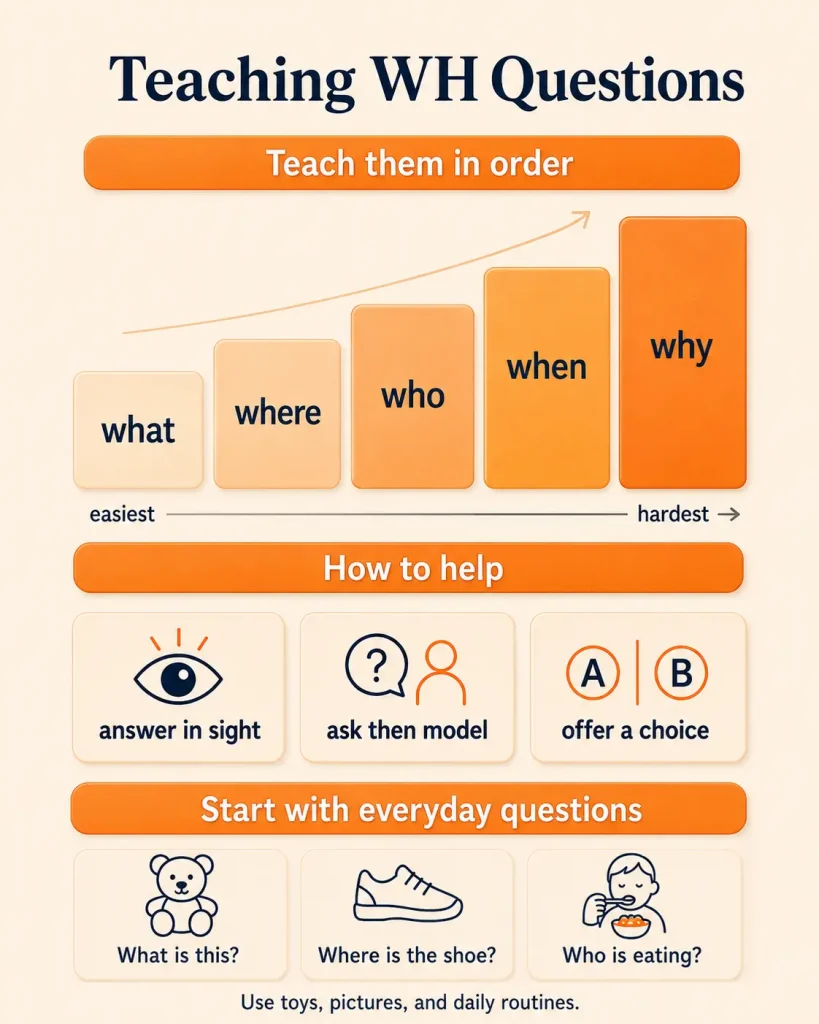
How to Teach WH Questions at Home
Start With Answers Your Child Can See
Begin with questions where the answer is right in front of you. Point to a cup and ask “What’s this?” Hold teddy and ask “Who’s this?” When the answer is visible, your child can connect the question word to the kind of answer it wants, without having to remember or imagine anything.
Ask, Pause, and Model the Answer
Ask the question, wait a few seconds, and if no answer comes, simply model it: “Where’s the dog? There’s the dog — under the chair!” You’re teaching both the answer and the pattern. Over time, pause a little longer and let your child fill in more.
Give Two Choices When Open Questions Are Too Hard
If an open question is too hard, tuck the answer into a choice: “Is teddy under the table or on the bed?” Choices give your child a way in and a model of what a right answer sounds like, before they have to generate one alone.
Use Books, Photos, and Picture Scenes
Picture books and family photos are perfect question practice. “What is the boy eating?” “Where is the cat?” “Who came to the party?” The picture holds the answer steady while your child works out what’s being asked.
Practise WH Questions in Daily Routines
Ask real questions with real answers throughout the day: “Where do your shoes go?” “What do we need for the bath?” “Who’s at the door?” Questions tied to genuine moments are far more meaningful — and better remembered — than quiz-style drilling.
Keep It Playful, Not Like a Quiz
Try not to fire off question after question — it can feel like an interrogation and make children shut down. Sprinkle questions naturally, keep your tone playful, and always model the answer warmly when it doesn’t come. The goal is a child who enjoys the back-and-forth, not one who dreads being tested. If your child works with a speech therapist, these strategies sit alongside that professional guidance.
Common Reasons Children Struggle to Answer WH Questions
“They repeat the question back to me.” Some children echo a question instead of answering it. For example, you may ask, “What do you want?” and your child says, “What do you want?” back to you.
This can happen when the question is too hard, too open-ended, or your child is still learning what kind of answer is expected. Try making the question easier. Offer a choice, show the answer, or model the answer for them: “Do you want water or milk?” or “You want milk.”
Echoing does not mean your child is being difficult. It may be their way of holding onto the words while they work out what to say. If echoing happens often, your child struggles to answer simple questions, or you are worried about their communication, it is a good idea to speak with a speech-language professional.
When to Speak With a Speech-Language Professional
Some children need more time and practice with WH questions. But it is a good idea to speak with a speech-language professional if your child:
- does not seem to understand simple questions, even with gestures or visual clues
- loses words, skills, or communication abilities they used before
- often does not respond to sounds, their name, or everyday speech
- struggles to follow simple directions
- repeats questions often but does not seem to understand how to answer
- has very limited words, gestures, or ways to communicate
- is not making progress even after regular practice at home
You do not need to wait until the problem feels serious. A speech-language professional can help you understand whether your child is having difficulty with understanding questions, finding the words to answer, hearing clearly, social communication, or a mix of these skills.
If you are also worried about hearing, development, or regression, speak with your child’s pediatrician or a qualified professional. Early guidance can help you choose the right support without guessing.
How the BASICS App Supports WH Question Practice
Teaching questions well means knowing the right order, matching the right level, and finding enough natural practice — which is a lot to hold in your head. The BASICS app is built by speech therapists and child-development specialists to make it simple, turning WH questions into a clear, step-by-step routine you can follow a few minutes at a time.
Within the BASICS Communication module, the Understanding & Comprehension area builds exactly these skills — following the natural progression from concrete questions to more abstract ones. It gives you a focused set of goals and a few daily activities at a time, each with clear steps, ready-to-use parent prompts, gentle progressions and therapist tips, so you always know which question type to work on next.
Inquiry Island for Who, What, Where, When, Why, and How Questions
BASICS includes a rich set of question-focused games in Inquiry Island, designed specifically to teach who, what, where, when, why and how — along with the reasoning skills, like cause-and-effect and sequencing, that harder questions depend on. Because they’re playful and repeatable, your child gets the many gentle repetitions questions need to click, without it ever feeling like a test. And true to how BASICS is built, wrong answers gently teach rather than simply redirect — so a wrong tap becomes a moment of learning, not failure.
Videos and Visuals That Make Questions Easier to Understand
BASICS models language in short, predictable clips and clear visuals your child can return to again and again — exactly the kind of concrete, low-pressure support that makes abstract question words easier to grasp. You watch together, pause, and try, with no rush and no testing.
Printables for Screen-Free WH Question Practice
For screen-free moments, BASICS printables give you simple, tactile ways to practise questions at the table or on the go — picture scenes to ask about, sorting activities, and prompts that turn everyday play into question practice.
Signs, Gestures, Pictures, and AAC Responses Count
Signs, gestures, pictures and communication devices are treated as fully equal to spoken answers throughout BASICS. A child who points to the right picture or signs their answer is answering the question — and BASICS is built to recognise, honour and grow that, whatever form it takes.
Practise WH Questions With Guided Activities
Help your child practise who, what, where, when, why, and how questions through simple games, videos, and printable activities in the BASICS app.
Helping Your Child Answer Questions One Step at a Time
If your child can’t answer questions yet, it isn’t a wall — it’s a skill still being built, one question word at a time. Start with what’s easy, keep it warm and playful, model the answers freely, and celebrate every attempt however it’s expressed. Little by little, blank looks turn into answers, and answers turn into the back-and-forth of real conversation. And if progress feels stuck, or you’re ever worried, a friendly chat with a speech-language professional is always a good next step.
One question word at a time — you’re opening the door to conversation.
Clinically Reviewed By
Reviewed by Rajini Darugupally, M.Sc. Speech Language Pathology, Speech Language Pathologist at Wellness Hub.
Rajini supports children with speech and language delays, receptive and expressive language difficulties, social communication needs, autism, ADHD, and parent-guided home practice. This article was reviewed for clinical accuracy, parent-friendly language, and safe guidance.
This content is for educational purposes only and does not replace professional assessment, diagnosis, or therapy.
View Rajini Darugupally’s Profile
Related reading
- Why Isn’t My Toddler Talking Yet? Signs & Next Steps
- How to Teach First Words at Home: Parent Guide
- How to Help Your Child Combine Words into Phrases
- How to Help Your Child Speak in Full Sentences
- Is My Child Talking Late? Expressive vs. Receptive Delays
References & further reading
The strategies above reflect widely used, evidence-based language approaches described by the following authoritative sources.
- American Speech-Language-Hearing Association. Communication Milestones.
- American Speech-Language-Hearing Association. Activities to Encourage Speech and Language Development.
- National Institute on Deafness and Other Communication Disorders. Speech and Language Developmental Milestones.
- American Speech-Language-Hearing Association. Augmentative and Alternative Communication.
- The Hanen Centre. Common Questions About Questions.
- American Speech-Language-Hearing Association. Communication Milestones: 4 to 5 Years.
Book your Free Consultation Today
Parent/Caregiver Info:
Client’s Details:
* Error Message