When to Get Extra Support for Gesture Imitation – A Calm, Practical Guide
Last Updated: March 10, 2026
You clap after your child does something sweet, wave goodbye, hold up your hand for a high-five. And… nothing. Or maybe you get a quick glance, but no copy. Over time, this can start to feel confusing and even a little lonely, especially when you are trying so hard to make play feel connected.
If gesture imitation support is something you are starting to think about, and gesture imitation is not showing up yet, you deserve clarity without falling into worry. Imitating simple actions and gestures, such as clapping, waving, giving a high-five, shaking the head “no,” or copying a short sequence like clap then wave; is one of the earliest ways children learn, “We’re doing this together.” It is less about performing a trick and more about building the rhythm of back-and-forth connection.
This guide will help you think through when it may be helpful to seek an extra perspective, what information is useful to notice, and what questions to ask, while still respecting your child’s individual pace.
Also read: How to Build from Single Gestures to Simple 2-Step Action Sequences Like Clap + Wave
What gesture imitation really is and what it isn’t
Gesture imitation means your child notices what you do and attempts to do something similar. Early on, this can look small and imperfect: a partial clap, a lifted hand that does not quite become a wave, or a moment of focused watching before trying. Some children imitate best when they are calm, face-to-face, and when the interaction feels playful rather than expected.
It is also important to remember what gesture imitation is not, or not a measure of your bond with your child. It is not proof of how much effort you are putting in. And it does not follow a neat timeline for every child. Many children need repeated, low-pressure exposure before they decide, in their own way and in their own time, “I want to try that.”
What progress can look like when imitation is starting to emerge
Parents often imagine imitation as an immediate and obvious copy. In reality, early progress is usually quieter.
You may notice your child watching your hands more closely, leaning in, smiling, or pausing as if considering whether to join. Some children “practice” later, clapping on their own after you have stopped, or waving at a different moment than when you modeled it. Others may imitate objects first, such as copying an action with a toy, before copying body gestures like waving or high-fives.
Another encouraging sign is when your child begins to look to you for cues, checking your face or hands during familiar moments as if asking, “What happens next?” These small check-ins are part of the same connection that imitation grows from.
Why gesture imitation might not be showing up yet
There are many everyday, non-alarming reasons imitation can take time to appear.
Some children are deeply focused players and find it hard to shift attention to what someone else is doing. Some need more time to warm up socially, especially in new environments or with unfamiliar people. Others are more motivated by movement, music, or objects than by social gestures at first. Some children also prefer to lead rather than follow, meaning they engage best when you copy them before asking them to copy you.
Context matters as well. A child may be more likely to imitate a calm, predictable routine, such as a goodbye wave at the door, than during busy play when there is a lot happening at once. None of this means you have done something wrong. It usually means your child is still discovering the purpose of copying, and that understanding develops gradually.
Also read: Teaching High-Fives and Waves Without Turning It Into a Power Struggle
When it may be worth getting extra support
Seeking support does not have to be a big or alarming decision. Often, it simply means inviting someone else to observe what you are seeing and help you make sense of it. Many parents explore gesture imitation support when they want reassurance or guidance.
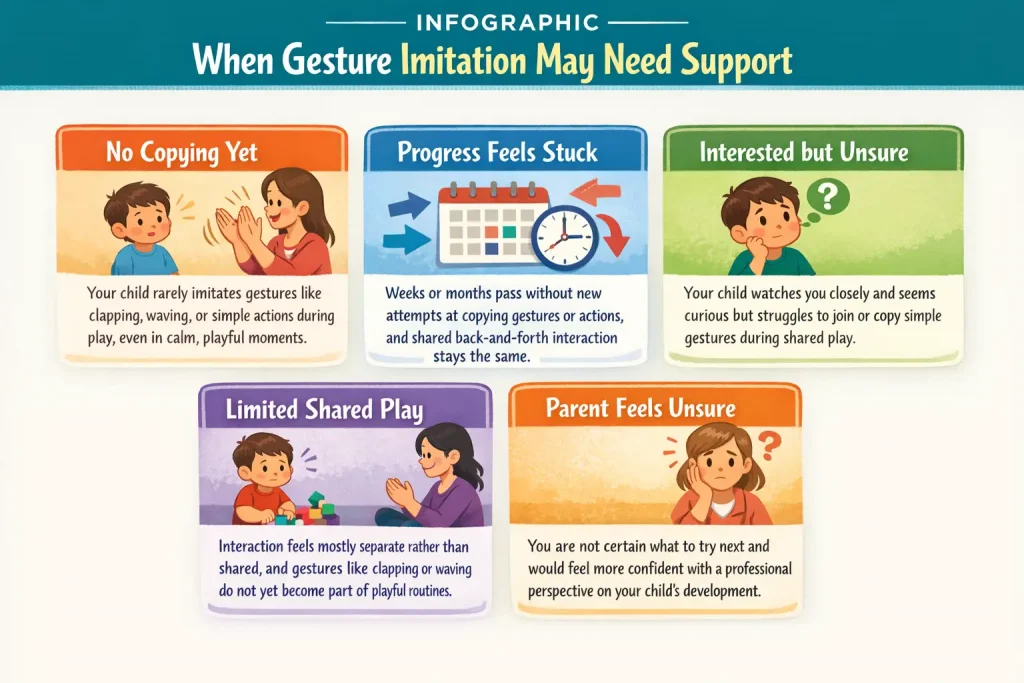
It may be helpful to seek another perspective if you notice several of the following patterns over time:
If imitation is rarely happening in any form, even during playful moments. This includes not copying simple gestures such as clapping or waving, and also not copying basic actions during play, like tapping, banging, or simple “do what I do” movements.
If progress feels stalled; meaning weeks or months pass without new attempts, new interest, or more shared back-and-forth: it can be useful to ask for guidance. You are not looking for perfection, only for signs of movement forward.
If your child seems interested in you but does not know how to join in, support can help identify a more comfortable entry point. Some children want connection but need the interaction shaped in a way that feels manageable for them.
If everyday interactions feel consistently difficult, such as limited shared attention or play that stays mostly separate: an outside perspective can be grounding. Because gesture imitation grows from warm, shared moments, supporting interaction itself is often just as important as supporting the gesture.
And finally, if you feel unsure what to try next, that alone is a valid reason to reach out. Parenting is not meant to be done alone. Sometimes the most helpful step is having someone reflect what your child is already doing well and suggest what might support the next step.
What to notice before you reach out so the conversation is more helpful
You do not need perfect data. A few simple observations can make a support conversation clearer and more productive.
Notice when your child feels most connected. Is it during songs, meals, bath time, book time, rough play, or greetings at the door? Many children show their best readiness for imitation in predictable routines.
Pay attention to what your child does copy, even if it is not gestures yet. Do they copy actions with toys? or copy sounds? Do they copy steps in a routine? These all matter because they show your child can learn through watching: just perhaps through a different doorway.
Also notice what seems to make imitation harder. Is it busy environments, tiredness, pressure to “do it,” or fast-moving gestures? These patterns can guide the kind of gesture imitation support that truly fits your child.
Also read: Why Your Child Imitates Sometimes but Not Other Times
Questions you can ask a professional without turning it into a test
When you speak with someone, whether an early childhood specialist, speech-language therapist, occupational therapist, or your child’s doctor, you deserve a conversation that feels respectful and practical.
You might ask what they notice about your child’s attention and engagement during play, since imitation grows from these foundations. You can ask which gestures make sense to focus on right now: clapping, waving, high-fives, head shakes, or whether starting with simple action copying is a better fit.
It can also help to ask what short-term progress should look like. Many parents feel calmer when they know what small signs to watch for, such as more watching, more attempts, or more shared smiles and pauses. And you can ask how to keep everything playful. The goal is not to drill gestures, but to create more moments where your child feels, “I can join this.”
What support can look like and how to keep it aligned with your child
Support does not have to mean intensive therapy or rigid plans. Sometimes gesture imitation support is simply a few sessions to understand what helps your child engage and what gets in the way. Often it focuses on everyday routines: hellos, goodbyes, celebrations, songs, and shared games, because these moments naturally include gestures like waving, clapping, and high-fives.
Some families also appreciate having a simple structure for choosing goals and staying consistent without overthinking. speech therapy app like BASICS can be a gentle option, offering short guidance and everyday activity ideas that keep the focus on connection rather than performance. It is not necessary for everyone, but it can feel reassuring if you want a clearer path.
Whatever support you choose, the best fit is one that respects your child’s temperament and keeps your relationship at the center.
A reassuring note to end on
Gesture imitation is a bridge to communication, and it is built one small moment at a time. If your child is not clapping or waving yet, it does not mean they will not. And it does not mean you are missing something obvious. Often, the skill is still organizing itself, through attention, trust, playfulness, and many low-pressure chances to join in.
If you are feeling uncertain, reaching out for gesture imitation support can be a calm and thoughtful step, not a sign that something is wrong. You are simply giving yourself and your child more understanding, so those shared smiles, high-fives, and “you do it, I do it” moments have room to grow.
About the Author:
Shravanaveena Gajula
M.Sc ., Speech and Language Pathology (5+ years of experience)
Shravanaveena Gajula is a dedicated Speech-Language Pathologist with a BASLP and an M.Sc in Speech and Language Pathology. With experience spanning multiple settings, including Wellness Hub , Veena specializes in a wide range of disorders from developmental issues in children to speech and language assessments in adults. Her expertise includes parent counseling, managing speech sound and fluency disorders, and creating individualized therapy programs. Veena is also PROMPT certified and an author of several insightful blogs on speech and language pathology, aiming to educate and assist caregivers in supporting their loved ones.
Book your Free Consultation Today
Parent/Caregiver Info:
Client’s Details:
* Error Message