When to Get Extra Support for Limited Babbling Variety: A Gentle Parent Guide
Last Updated: March 7, 2026
You hear other babies making a whole little “sound salad” of babbles, ba, ma, da, goo, while your own child seems to stick with just one or two familiar sounds. If you’ve been wondering whether limited babbling variety is just a phase or something worth getting extra support for, you’re not alone at all.
Babbling variety can be surprisingly hard to judge when you’re living it every day. You’re with your child constantly, you’re listening closely, and you’re trying to figure out what “progress” is supposed to sound like. This guide is meant to bring clarity without creating worry, helping you understand what this skill really includes, what gentle progress can look like, and when it might feel helpful to bring in another caring set of eyes and ears.
Also read: How to Encourage Consonant Sounds During Playtime Without Adding Extra Toys
What babbling variety really means in everyday terms
When people talk about expanding the babbling variety, they usually mean that a child is beginning to explore more kinds of sounds during play and interaction. That can include using more consonants like b, m, d, g, and p, trying out new sound combinations, and playing with their vocal range through different pitches, volumes, or sing-song patterns.
This isn’t about saying words on cue. It’s more like sound play. Your child is experimenting, noticing what their mouth can do, and enjoying the feeling of going back and forth with you. These moments may seem small, but they matter. They’re part of how children discover the rhythm and melody of speech and learn that their voice can bring connection.
Why some children stick to a small set of sounds for a while
There are many very ordinary reasons a child might use only a few sounds for a period of time. Some children are watchers first. They take everything in quietly before they show what they know. Some become attached to a favorite sound and repeat it because it works, it feels fun, or it always gets a smile from you. Others are so busy moving, exploring, and playing that sound experiments happen in short bursts rather than steadily.
It’s also common for progress to look uneven. A child might try a new sound one day and then not use it again for a week. That doesn’t mean it didn’t count. Early communication skills often appear in little pop-up moments before they settle in for good.
Also read: Common Mistakes That Can Shut Down Babbling (Even When You Mean Well
What progress can look like even if it’s subtle
Many parents expect progress to sound obvious, like suddenly hearing lots of new consonants every single day. But early changes are often quieter than that.
You might notice your child sprinkling in a new sound now and then, or their babbling becoming more playful and varied even if it still leans on a few familiar consonants. You may hear them experiment with new combinations, change their pitch, or look delighted when a new sound slips out.
If your child is curious about their voice, trying, repeating, and reacting to you, that’s a meaningful sign that sound exploration is happening, even if the variety is still limited.
When it may be helpful to seek extra support for limited babbling variety
Many families choose to wait and see for a little while, and that can be completely reasonable. At the same time, you don’t need to wait until you feel truly worried to ask for guidance. Extra support for limited babbling variety can simply mean getting reassurance, a clearer plan, and another perspective on what you’re seeing.
It may be helpful to reach out if you notice one or more of these patterns:
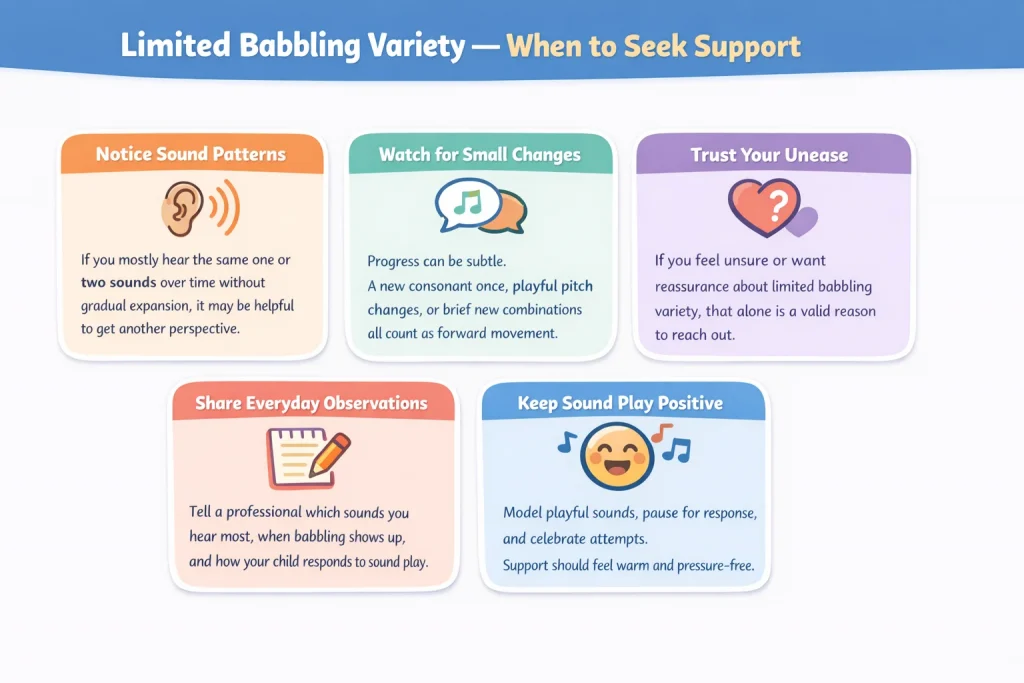
You’re hearing the same one or two sounds most of the time and they don’t seem to be slowly expanding. Or your child is very vocal, but the babbling stays in a similar pattern day after day. Often, the biggest signal is that you’re not seeing small forward movement over time.
Support can also be useful if you feel unsure how to encourage sound play without turning it into testing. Many thoughtful parents land here. You want to help, but you don’t want to create pressure. A good support person can help you keep things playful and natural while still guiding progress.
And sometimes the reason to reach out is simple. You’d feel calmer hearing a professional perspective. That alone is a valid reason. Seeking support for limited babbling variety doesn’t mean something is wrong. It means you’re paying attention and wanting to feel confident about what comes next.
What to share if you do reach out so you get clearer answers
If you decide to contact a professional or a program, it helps to bring everyday observations instead of trying to make your child “show” the skill on the spot. You don’t need detailed notes, just the kinds of things you already notice as a parent.
You might mention which sounds you hear most often, maybe lots of “m” sounds and not many others. And can share whether your child uses different sounds during certain routines like bath time, meals, or car rides, and whether babbling shows up more when they’re excited, relaxed, or playing with you.
It’s also helpful to describe how your child responds when you play with sounds. Do they watch your mouth? and they smile and try to copy? Do they prefer making sounds on their own rather than in back-and-forth play? None of these are good or bad. They’re simply clues that help someone understand your child’s current style.
If you can record a short video of everyday play where your child is vocal, even 30 to 60 seconds, that can be very useful. Real-life moments often say more than a “show me your babbling” situation in a new place.
Also read: What Progress Looks Like When Babbling Starts Expanding Small Signs to Notice
What extra support can look like and what it shouldn’t feel like
The best kind of support for early sound variety usually feels encouraging and relationship-based. It should help you notice what your child is already doing, choose a next small step, and keep sound play fun and pressure-free.
You deserve support that respects both your child and you. It shouldn’t feel like drilling sounds or trying to get everything right. For most children, babbling variety grows best when adults model playful sounds during daily routines and respond warmly to every attempt, big or small.
Some families prefer in-person help, while others like something more flexible. Tools like BASICS can be an optional way to get guidance on communication goals and see simple examples of how to support them during everyday moments, without turning your day into a checklist. The right choice is the one that helps you feel calmer and more confident.
How to keep things positive at home while you decide
If you’re in that in-between place of watching, wondering, and deciding about limited babbling variety, a few gentle mindsets can help keep your home feeling good.
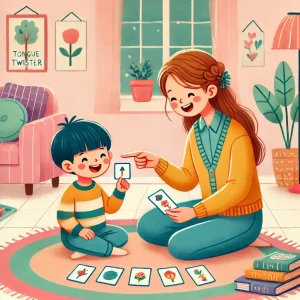
First, treat sounds as shared play rather than performance. When you model fun sounds during routines, like “yum yum,” “ba-ba,” or silly toy noises, and then pause, you’re creating space for your child to join in if they want. If they don’t, nothing has gone wrong. You’ve still shared a moment.
Second, count attempts as progress. A new consonant once, a playful squeal, a change in pitch, or an excited repeat all show that your child is exploring their voice.
Third, keep expectations human. Even adults don’t feel like talking all day. Children have quiet days, busy days, and days focused more on movement or problem-solving than on sound. Variety usually grows through many small, ordinary moments over time.
A gentle closing note for parents
If your child’s limited babbling variety doesn’t have much range right now, it doesn’t mean you missed a window or that you should be doing more. It simply means you’re noticing where your child is today, and that awareness is a strength.
You’re allowed to ask for extra support early, just to feel steadier. You’re also allowed to take a breath and watch for a little longer. Either way, you can keep your home warm and playful, where sounds are welcomed and celebrated without pressure. And if you do reach out, you’re not making it a big deal. You’re doing what caring parents do, gathering information, staying connected, and taking the next step with calm confidence.
About the Author:
Shravanaveena Gajula
M.Sc ., Speech and Language Pathology (5+ years of experience)
Shravanaveena Gajula is a dedicated Speech-Language Pathologist with a BASLP and an M.Sc in Speech and Language Pathology. With experience spanning multiple settings, including Wellness Hub , Veena specializes in a wide range of disorders from developmental issues in children to speech and language assessments in adults. Her expertise includes parent counseling, managing speech sound and fluency disorders, and creating individualized therapy programs. Veena is also PROMPT certified and an author of several insightful blogs on speech and language pathology, aiming to educate and assist caregivers in supporting their loved ones.
Book your Free Consultation Today
Parent/Caregiver Info:
Client’s Details:
* Error Message