What Progress Looks Like When Your Child Starts Using Sounds on Purpose
By Wellness Hub
Last Updated: February 28, 2026
What Progress Looks Like With Purposeful Sounds
It can be a strange kind of uncertainty when you’re watching your child closely and still thinking, Is anything actually changing?
Maybe words aren’t there yet, or they appear and disappear. Maybe your child makes plenty of sounds, but you can’t tell if they’re purposeful sounds or if they’re just part of play. And when you’re around other children who seem to be “talking so much,” it’s hard not to compare, even when you know every child is different.
Here’s the reassuring part: purposeful communication often shows up before clear words do. And most of the time, it shows up in small, everyday ways that are easy to overlook unless you know what to notice.
This article will help you recognize what progress can look like when your child begins using sounds to communicate needs and feelings, whether they’re requesting, protesting, getting your attention, commenting, or sharing excitement. No pressure. No testing. Just real-life signs that connection is growing.
What purposeful sounds mean
Using sounds purposefully simply means your child is vocalizing with intention. They’re not just making noise. They’re trying to make something happen.
That “something” might be, “I want that,” “I don’t like that,” “Look at me,” “Do it again,” or “This is fun!” The sound itself may not resemble a real word, and that’s okay. What matters is the reason behind it and the back-and-forth it creates between you.
When children realize their sounds can change what happens next, when you look at them, respond, come closer, help, or share the moment, they begin to feel the power of communication. That’s a big step, even if it happens quietly.
Progress often looks small because it’s happening in real time
Many parents expect progress to look obvious. No sounds… then words. Babbling… then talking.
But for most children, it’s much more gradual. The sounds may seem the same at first, but something else changes. The timing changes. The expression on their face changes. The way they look at you changes. The sound starts appearing in the same situation again and again, almost like your child is saying, This is how I tell you.
Those little patterns matter. They’re often the earliest signs that communication is becoming intentional.
Everyday signs your child is using purposeful sounds to communicate
You start hearing sounds at “useful” moments
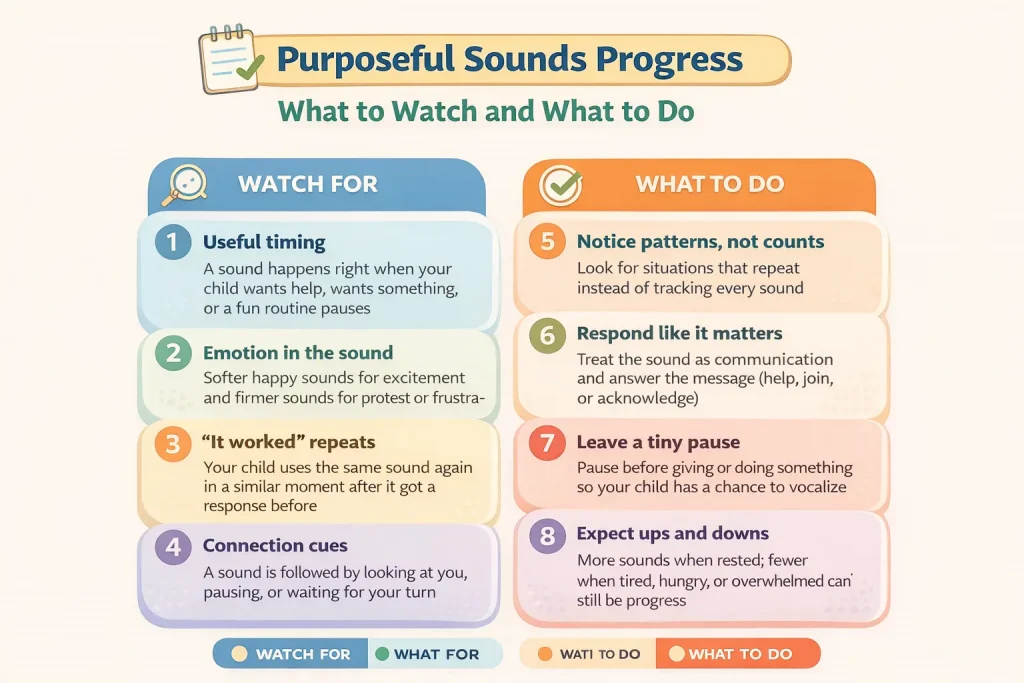
One of the clearest signs of purposeful sound use is when your child vocalizes at moments that make sense, right when something is about to happen, when they need help, or when they want your attention.
For instance, your child may make a sound when you pause before giving a snack, when a favorite toy is just out of reach, or when a game suddenly stops. Even if the sound is simple, the timing shows they are part of the moment, not just making background noise.
The sound seems connected to a feeling
Purposeful sounds often come with emotion. You might hear a lighter, happier sound when your child is excited, or a stronger, sharper sound when something isn’t going their way.
It could be a squeal when bubbles appear, a small “mm!” when a favorite song starts, or a louder protest when you take away something unsafe. These are early ways of expressing feelings, and they absolutely count as communication.
Your child repeats a sound because it worked
A powerful sign of growth is when your child uses the same sound again in a similar situation, especially if it got a response before.
Maybe they made a sound once and you looked right away. Later, they make that sound again and glance at you as if to check, Did you hear me? That’s not random. That’s learning.
This is why progress can feel sudden. Often your child isn’t suddenly more capable, they’ve simply realized their voice has an effect.
You notice more looking, pausing, or waiting
Purposeful communication is rarely just sound by itself. It usually includes a moment of connection.
You might see your child make a sound and then look at you, pause, or wait, almost like they’re giving you a turn. That small pause can be a big developmental shift. It shows your child is starting to understand communication as something shared, not something they do alone.
Sounds become more varied over time
Progress can also show up as variety. Not necessarily clearer words, but more kinds of sounds.
Your child might begin with one familiar sound for many situations and then slowly add others. You may hear different tones for different needs, one for excitement, another for protest, another for getting your attention.
Even subtle changes, like new consonant-like sounds, different pitch, or longer strings of sound, can be signs that your child is experimenting and growing.
Your child uses sounds to pull you into play
Some children start using sounds to invite you into what they’re doing. They may vocalize while holding up a toy, during a silly routine, or when they want you to keep something going.
It can feel like they’re saying, Join me, or Do that again, without using words. These moments are important because they’re not only about getting needs met. They’re about sharing joy, which is a beautiful foundation for communication.
Progress doesn’t have to be consistent to be real
A very common worry is, “They did it yesterday. Why not today?”
With purposeful sounds, it’s normal to see purposeful sounds come and go depending on the day.
In early communication, ups and downs are normal. Children often vocalize more when they’re rested and comfortable, and less when they’re tired, hungry, overwhelmed, or deeply focused on something else. They might talk more at home than in new places. They might be chatty in the bath but quiet at the park.
That doesn’t mean the skill disappeared. It usually means your child is still learning how to use it across different situations.
The comparison trap: why your child’s “small wins” are still wins
It’s hard not to compare when other children’s progress looks louder or more obvious. But purposeful sound use is one of those skills that can be easy to miss from the outside.
A child who uses one sound to request, protest, and connect is doing important work, even if it doesn’t sound like speech yet. Those early attempts are how children practice the rhythm of communication: I signal, you respond, we connect. If you’re noticing more moments where your child seems to be trying to tell you something, that’s not nothing. That’s the beginning of something.
What you can pay attention to (without turning life into a checklist)
If it helps to have something gentle to notice, try looking for patterns instead of counting behaviors.
You might start wondering: Are sounds happening more often during play and routines? Do they show up when my child wants something, needs help, or feels strongly? Do I see more moments where my child looks at me after vocalizing? Are the sounds becoming a little more varied? These aren’t tests. They’re simply ways to notice growth that can easily get lost in the busyness of everyday life.
When extra support feels helpful
Sometimes parents want reassurance that they’re reading the signs correctly. Sometimes they just want ideas for how to make space for more communication without creating pressure.
That’s where gentle, parent-friendly support can be useful. Tools like BASICS can help you choose a goal, such as using sounds purposefully, recognize what progress looks like, and feel more confident about what to watch for during normal days, without turning your home into a therapy room.
Seeking support doesn’t mean something is wrong. Often it just means you want a clearer path and a steadier sense of, Yes, we’re moving forward.
A calm reminder to hold onto
When your child starts using sounds on purpose, they’re doing something deeply human. They’re reaching for connection.
It may not sound like words yet. It may come and go. It may be easy to miss when you’re tired or distracted. But those small moments, an excited squeal, a frustrated protest sound, a little vocal “hey” to get you to look, are meaningful steps toward being understood.
And the fact that you’re noticing, wondering, and caring this much? That’s already part of what helps communication grow.
About the Author:
Rajini Darugupally
M.Sc., Speech-Language Pathologist (9+ years of experience)
Rajini is a passionate and dedicated Speech-Language Pathologist with over 9+ years of experience, specializing in both developmental speech and language disorders in children and rehabilitation in adults. Driven by a desire to empower each individual to find their voice, Rajini brings a wealth of experience and a warm, genuine approach to therapy. Currently, at Wellness Hub, she thrives in a team environment that values innovation, compassion, and achieving results for their clients. Connect with Rajini to learn more about how she can help you or your loved one find their voice.
Book your Free Consultation Today
Parent/Caregiver Info:
Client’s Details:
* Error Message