Helping Without Taking Over: How to Respond When Your Child Brings You a Toy
By Wellness Hub
Last Updated: February 14, 2026
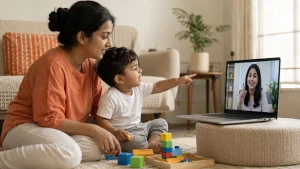
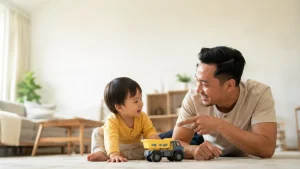
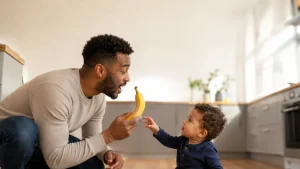
When a child brings you a toy, they may be showing, requesting help, inviting play, or trying to share attention with you. This matters because bringing and showing objects can support early communication, gestures, joint attention, and social connection. For example, a toddler who brings a car and looks at you may be saying, “Look with me.”
What you will learn in this article
- What toy-bringing means
- How to respond without taking over
- Age-wise red flags to watch
- When showing becomes communication
- When therapy support may help
Your child walks across the room holding a toy car. They place it in your hand, look briefly at your face, and then look back at the car. You freeze for a second. Should you name it? Play with it? Ask, “What colour is it?” Make the car move? Wait?
In our clinic, parents often describe this small moment with surprising anxiety. They want to respond well because these moments may feel rare, quick, or fragile. But the goal is not to deliver the perfect therapy-style response.
The goal is simpler: notice what your child is trying to do, respond warmly, and leave space for the child to continue.
Also read: Joint Attention Routines for Children: Meals, Bath and Dressing
What bringing a toy to a parent looks like in children
Bringing a toy to a parent can mean showing, requesting help, asking for play, seeking comfort, or starting a shared interaction. The meaning depends on what the child does before, during, and after the handoff.
In speech-language therapy, we do not treat every toy handoff the same way. A child who brings a closed box and pushes it into your hand may be asking for help, a child who brings a spinning car wheel and looks at your face may be sharing interest, child who brings the same toy again and again may be building a predictable routine.
Micro-example one: a 15-month-old brings a ball, looks at you, and smiles. That may be an invitation to roll it back. Micro-example two: a 2-year-old brings a broken truck, puts it in your hand, and waits. That may mean, “Help me fix this.”
| What the child does | What it may mean | Parent response |
|---|---|---|
| Brings toy and looks at you | “Look with me” | Comment: “You brought the car.” |
| Brings toy and pushes it into your hand | “Help me” | Say: “Help car?” |
| Brings toy, waits, then smiles | “Play with me” | Join briefly, then pause |
| Brings toy and walks away | Quick check-in or unfinished interaction | Comment and stay available |
| Brings same toy repeatedly | Predictable social routine | Repeat simple words/actions |
| Brings toy without looking | May be requesting, organising, or sharing indirectly | Watch for other cues |
| Brings toy during distress | Seeking help, comfort, or repair | Label feeling and help |
| Brings toy to show sibling/parent | Social sharing | Respond with interest, not testing |
NIH/NICHD states that joint attention includes shared attention skills such as pointing, showing, and coordinating looks between a person and an object. That is why a child bringing or showing a toy can be clinically meaningful, especially when it includes looking, pausing, or waiting for your reaction.
What I tell families is direct: do not rush to teach. First decode the child’s message.
Why bringing toys matters for speech and communication
Bringing toys matters because it can be an early way for a child to initiate communication before they have many words. It shows that the child is reaching out, creating a shared moment, or using an object to connect with another person.
Parents often focus on speech alone: “Did my child say car?” But before children use words consistently, they often communicate through actions. Bringing, showing, giving, pointing, reaching, looking, smiling, and waiting all support the foundation for later language.
Micro-example one: your child brings you a toy animal and says nothing. You say, “Cow,” and pause. Your child smiles and brings another animal. That is a communication loop. Micro-example two: your child brings a puzzle piece, looks at the puzzle board, and then looks at your hand. That is a request for help and shared problem-solving.
Toy-bringing can support:
- Initiating interaction
- Joint attention
- Requesting help
- Turn-taking
- Early pretend play
- Imitation
- Social confidence
- Vocabulary learning
- Shared emotional reactions
- Back-and-forth communication
ASHA’s communication milestones for 13–18 months include pointing to request, comment, or get information, and following directions such as “Give me the ball.” These skills connect closely with early showing, giving, and shared play.
Great Ormond Street Hospital notes that during 12–24 months, children begin using voice, gestures, pushing away, pointing, and familiar objects to communicate needs and understand routines. It also describes children bringing familiar objects when asked, which shows how objects become part of early communication.
In our clinic, we treat bringing a toy as a doorway. If the parent steps through gently, the child may learn: “When I show something, people respond.”
At what age does bringing and showing develop
Bringing and showing develop gradually from late infancy into toddlerhood. By the second year, many children begin using objects, gestures, looks, and sounds to request, show, share, or invite interaction.
Age matters, but the pattern matters more. A 12-month-old may simply give or drop objects. A 15- to 18-month-old may bring a toy to request help or share interest. A 2-year-old may bring a toy, name it, ask for help, or start pretend play.
| Age Range | What to expect | Red flag if missing |
|---|---|---|
| 6–9 months | Reaches, holds, explores, drops, looks between people and objects | Rarely looks at people or reacts to shared play |
| 9–12 months | Gives, shows, reaches, responds to simple social games | No gestures like giving, showing, waving, or reaching |
| 12–15 months | Brings objects for help or attention; starts clearer showing | Does not bring, show, point, or seek help |
| 13–18 months | Points to request/comment, gives objects, follows simple directions | No pointing, showing, giving, or meaningful gestures |
| 18–24 months | Brings toys to play, request help, share interest, or start routines | Brings objects only for needs and rarely shares interest |
| 2–3 years | Uses words with showing, pretend play, and simple peer/parent interaction | Rarely initiates play or shares objects with people |
| Any age | Interaction becomes more intentional and flexible | Loss of gestures, words, play, or social interest |
HealthyChildren, from the American Academy of Pediatrics, explains that by 12 months most children look where a parent points, by 15 months many point to wanted objects, and by 18 months many point to interesting objects while looking back and forth to check that the parent is tuned in.
The CDC notes that autism symptoms can appear in the first 12 months for some children, and in others may appear by 24 months or later; some children gain skills until around 18–24 months and then stop gaining or lose skills.
What I tell parents: one behaviour alone does not diagnose anything. But if a child rarely shows, brings, points, imitates, responds to name, or shares interest by 18–24 months, do not wait and hope.
When your child brings a toy: respond without taking over
When your child brings a toy, your first response should be warm, simple, and low-pressure. The best response usually follows the child’s lead before adding your own teaching.
In our clinic, we often see parents accidentally turn a beautiful initiation into a mini-exam. The child brings a car, and the parent immediately asks, “What colour? What sound? How many wheels? Say car.” The child walks away because the moment became work.
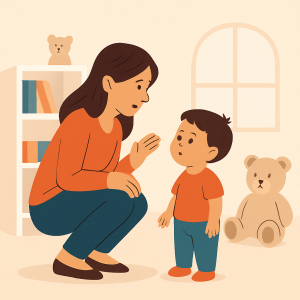
Micro-example one: your child brings a teddy. You say, “You brought teddy,” smile, and wait. Micro-example two: your child brings a car and watches your hand. You roll it once and pause, giving the child a chance to continue.
| Parent step | What to do | Example |
|---|---|---|
| Notice | Show that you saw the child’s action | “You brought the truck.” |
| Match | Respond to the child’s energy | Quiet child → quiet comment |
| Join briefly | Add one small action | Roll car once |
| Pause | Wait for child’s next move | Count silently to five |
| Expand gently | Add one word or action | “Fast car!” |
| Stop before taking over | Leave control with child | Hand toy back |
Use fewer questions. More comments. More waiting.
A Hanen-style responsive interaction approach fits this situation well: observe what the child is doing, wait for the child’s signal, and respond in a way that keeps communication going. This is especially helpful for children who initiate rarely or lose interest quickly.
Do not demand eye contact. Joint attention is not about forcing the child to stare at your face. It is about shared meaning between the child, the adult, and the object.
During play routines: turn toy-bringing into back-and-forth interaction
Toy-bringing becomes more powerful when it turns into a short back-and-forth routine. The goal is not a long therapy session; the goal is two or three shared turns.
In our clinic, we often build communication through predictable routines because children learn faster when they know what comes next. If the child brings a ball, roll it once and wait, if the child brings bubbles, blow once and wait. If the child brings a car, make it go once and wait.
Micro-example one: your child brings a ball. You say, “Ball,” roll it gently, then pause with open hands. If your child pushes it back, that is turn-taking. Micro-example two: your child brings a toy animal. You make it jump once and say, “Jump.” If your child smiles or gives it back, the routine has started.
| Toy brought | Simple parent routine | Communication target |
|---|---|---|
| Ball | Roll, pause, wait | Turn-taking |
| Car | Push once, pause | Requesting “again” |
| Puzzle piece | Help one piece, wait | Asking for help |
| Animal | Make sound once, wait | Imitation |
| Book | Open one page, pause | Shared attention |
| Blocks | Add one block, wait | Joint play |
| Bubbles | Blow once, close lid | Requesting continuation |
JASPER stands for Joint Attention, Symbolic Play, Engagement, and Regulation. A systematic review of JASPER found that most included studies reported greater improvements in at least one outcome related to joint attention, joint engagement, play skills, or language skills.
NDBI-informed routines also fit this work because they teach communication inside natural play. Instead of drilling a child at a table, the adult uses the child’s interest to build shared attention, imitation, and communication.
The mistake is doing too much. If the child brings a toy and you create a 20-minute adult-led activity, the child may stop bringing toys. Keep it small enough that the child wants to return.
During daily routines: notice showing outside toy play
Children do not only show communication through toys. They may bring shoes, cups, books, clothes, snacks, broken objects, or household items to communicate needs, interests, or routines.
In our clinic, we ask parents to watch the whole day, not just playtime. A child bringing shoes may mean “outside,” a child bringing a spoon may mean “food.” A child bringing a broken crayon may mean “help.” These are practical communication moments.
Micro-example one: your child brings a water bottle and puts it in your lap. Instead of only opening it, say, “Water. Help open?” Micro-example two: your child brings shoes and stands near the door. Say, “Shoes. Outside?” and wait for a look, sound, reach, or smile.
Use routine-based responses:
| Object child brings | Possible meaning | Parent language |
|---|---|---|
| Shoes | Wants to go out | “Shoes. Outside?” |
| Cup | Thirsty or wants help | “Water? Help?” |
| Book | Wants reading or sharing | “Book. Read?” |
| Broken toy | Needs help | “Broken. Help fix?” |
| Spoon | Hungry or routine cue | “Eat?” |
| Blanket | Tired or needs comfort | “Sleepy? Blanket.” |
| Remote | Wants screen or routine | “TV? Not now. Later.” |
Do not ignore these moments because they are not “play.” Many children communicate more clearly during routines than during planned activities.
If your child brings objects only to get needs met but never to share enjoyment, that is still useful communication, but it may need expansion. A therapist may help the child move from requesting to showing, commenting, and shared play.
What progress looks like
Progress means your child’s toy-bringing becomes clearer, more intentional, more social, and more flexible over time. It does not mean your child must speak every time they bring something.
In our clinic, we track small changes. Does the child bring objects more often? Do they look at the parent more, do they wait for a response, Do they bring different objects, Do they share excitement, not only request help?
| Sign of progress | What it means clinically |
|---|---|
| Brings toy more often | Initiation is increasing |
| Looks at parent after bringing | Shared attention is emerging |
| Waits for parent response | Interaction is becoming intentional |
| Brings toy to show, not only request | Commenting/social sharing is growing |
| Repeats a play routine | Predictable back-and-forth is developing |
| Uses sound or word with toy | Speech is linking with communication |
| Points to object after bringing | Gesture use is expanding |
| Brings toy to different people | Skill is generalising |
| Plays longer after handoff | Joint engagement is improving |
| Accepts parent joining briefly | Social play tolerance is improving |
Micro-example one: last month your child brought a toy and left immediately. This week they bring it, watch your hand, and smile when you move it. That is progress. Micro-example two: your child still does not say the toy name, but now brings it to you and waits. That waiting matters.
Track progress across two to four weeks. One day can mislead you because tiredness, hunger, illness, screen time, and sensory overload can change how a child interacts.
Do not reduce progress to “more words.” A child who brings, looks, waits, smiles, gestures, or repeats a shared routine is building communication.
What not to do
Do not turn every toy handoff into a test. Testing can reduce initiation, especially in children who already find communication effortful.
The most common parent mistake is over-prompting. The child brings a toy, and the adult immediately says, “Say car. Say red car. What sound does it make?” That may be too much language pressure for the moment.
Avoid these mistakes:
| What not to do | Better option |
|---|---|
| Ask rapid questions | Make one comment and wait |
| Force eye contact | Watch for natural looks and gestures |
| Take over the play | Join briefly, then return control |
| Ignore quiet initiations | Treat small handoffs as communication |
| Correct the child’s play immediately | Follow first, shape later |
| Demand speech every time | Accept gesture, sound, look, or action |
| Turn it into teaching colours/numbers | Focus on connection first |
| Panic if child walks away | Stay available and try again later |
Micro-example one: instead of “What is it? Say truck,” say, “Truck. You brought truck,” then pause. Micro-example two: instead of building the whole tower yourself, place one block and wait for the child’s next move.
Also do not assume every object-focused child is “not social.” Some children connect through objects first. Your job is to use the object as the bridge, not fight the object for attention.
The clinical balance is simple: respond warmly, add a little language, and leave enough space for the child to lead.
when-to-seek-professional-help
Seek professional help when your child rarely brings, shows, points, gives, imitates, responds to name, or shares interest with others, especially after 18 months. A speech-language pathologist can assess whether your child’s object use reflects typical communication, delayed gestures, autism-related social communication differences, or another developmental need.
In our clinic, we recommend support when parents notice a pattern across routines, not just one isolated behaviour. If your child brings objects only to get help but rarely looks, points, shows, or shares enjoyment, that pattern deserves attention.
| Warning sign | Recommended action |
|---|---|
| No showing, giving, pointing, or waving by 12–15 months | Discuss with paediatrician or SLP |
| No pointing to request/comment by 13–18 months | Speech-language assessment recommended |
| Does not look where you point by 12 months | Developmental screening advised |
| Does not point to interesting objects by 18 months | Ask about autism/developmental screening |
| Brings objects but never looks, waits, or shares | Assess joint attention and social communication |
| Uses adult’s hand as a tool without shared attention | Developmental evaluation recommended |
| Rarely responds to name | Hearing check and developmental review |
| Loss of words, gestures, or social interest | Prompt medical/developmental review |
| Repetitive object play blocks interaction | SLP/OT/autism-informed assessment |
| Parent feels unsure despite trying strategies | Book a consultation for guided coaching |
HealthyChildren states that the AAP recommends autism screening at 18- and 24-month well-child checkups, alongside routine developmental surveillance. It also advises parents to speak with a paediatrician if they have concerns about how their child plays, learns, speaks, acts, or moves.
The CDC says families should contact the child’s doctor if they have concerns about the child’s development, and that early services can help children and families get support sooner.
Here is the blunt clinical line: if your child does not use objects to connect, show, request, imitate, or share by the toddler years, do not keep guessing. Get the communication profile assessed.
How speech therapy or occupational therapy works on toy-bringing and showing
Speech therapy works on toy-bringing by helping the child turn object interest into communication. Occupational therapy helps when sensory regulation, play skills, motor planning, or attention affects how the child uses toys and interacts with people.
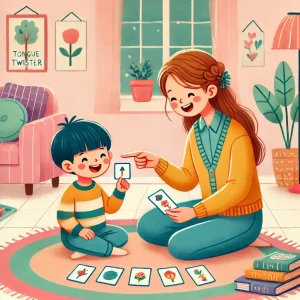
In speech therapy, we may teach the child to bring, show, give, point, request help, ask for “again,” comment, imitate sounds, and take turns. We build these skills during play and routines, not only through flashcards.
Micro-example one: if a child brings a closed container, the therapist models “help open” and waits for the child to reach, look, sign, or vocalise. Micro-example two: if a child brings a car and watches the wheel, the therapist joins that interest by saying “spin,” pausing, and building a shared routine.
Occupational therapy may help when the child is very object-focused because of sensory interests, difficulty with play flexibility, or regulation needs. For example, a child who repeatedly spins wheels may need support to expand play while still respecting what interests them.
Helpful therapy targets may include:
- Initiating interaction
- Showing and giving
- Pointing
- Joint attention
- Imitation
- Pretend play
- Requesting help
- Commenting
- Turn-taking
- Play flexibility
- Parent coaching
- AAC or picture support when needed
DIR/Floortime can help when the child connects best through their own interests. JASPER can help when joint attention and play are the main targets. Hanen-style parent coaching can help parents respond naturally at home. NDBI and ESDM-informed approaches can support young children who learn best through play-based, relationship-based routines.
A good therapist should not tell parents, “Make your child look at you.” They should show you how to use the toy as a bridge to shared attention.
Comparing therapy approaches
Different approaches support different reasons a child brings, shows, avoids, or fixates on toys. The right approach depends on the child’s age, communication level, sensory profile, play skills, and social engagement.
| Approach | What it focuses on | Best for |
|---|---|---|
| Speech-Language Therapy | Gestures, words, showing, requesting, social communication | Children with speech/language delay |
| JASPER | Joint attention, symbolic play, engagement, regulation | Children with autism signs or joint attention delays |
| Hanen-style Parent Coaching | Responsive interaction in daily routines | Parents needing natural home strategies |
| DIR/Floortime | Emotional connection through child-led play | Children who connect through preferred objects |
| NDBI | Natural play, developmental goals, behavioural learning | Young children needing structured play-based teaching |
| ESDM | Social engagement, imitation, communication, play | Toddlers/preschoolers with autism or developmental delay |
| Occupational Therapy | Sensory regulation, play participation, motor planning | Children whose sensory needs affect play |
| AAC/PECS | Pictures, signs, symbols, or devices for communication | Children with limited speech or high frustration |
| Parent-Mediated Intervention | Coaching parents to build skills in routines | Families needing daily carryover |
In our clinic, we often combine approaches. A toddler who brings toys but does not look or wait may need speech therapy, JASPER-informed play, and parent coaching. A child who brings only spinning or sensory objects may also benefit from OT support.
The wrong question is, “How do I make my child play normally?” The better question is, “How do I use what my child already brings me to build shared communication?”
Questions Parents Ask
1. Why does my child bring me a toy and then walk away?
Your child may be doing a quick check-in, asking for help, showing something briefly, or still learning how to stay in an interaction. Do not treat it as failure. Comment warmly, such as “You brought the car,” and stay available without chasing or demanding more. Over time, quick handoffs can grow into longer shared moments if your response feels safe and predictable.
2. Is bringing toys to parents a sign of joint attention?
It can be a sign of joint attention when the child brings the toy to share interest, looks at you, waits for your reaction, smiles, points, or shifts attention between you and the object. If the child brings the toy only to get help, that is still communication, but it may be more of a request than shared attention. Both are useful. The goal is to expand from requesting into showing, commenting, and shared play.
3. What should I say when my toddler brings me something?
Say one simple thing that matches the moment. For example, “You brought the truck,” “Help open?” or “Roll ball?” Then pause and wait for your child’s next signal. Avoid rapid questions like “What is it? What colour is it? Say car.” A calm comment usually keeps the interaction open better than a quiz.
4. Should I worry if my child never brings toys to show me?
You should look at the whole communication pattern. If your child points, shows, gives, imitates, responds to name, follows your pointing, and shares enjoyment in other ways, they may simply not bring toys often. But if your child rarely shows, points, gives, shares interest, or initiates interaction by 18–24 months, a speech-language or developmental assessment is recommended. Missing shared attention behaviours should not be ignored.
5. My child brings objects but does not look at me. Is that okay?
It depends on the pattern. Some children communicate through objects first and may only glance briefly, especially if they are shy, busy, or still developing. But if your child consistently brings objects without looking, waiting, pointing, or sharing enjoyment, we should assess joint attention and social communication. Try responding with a short comment and pause to see whether your child begins checking back more often.
6. Can speech therapy help my child bring and show toys more?
Yes. Speech therapy can help a child initiate, bring, show, give, point, request help, comment, and build back-and-forth play. The therapist should coach parents on real home moments, not only table activities. If your child has limited speech, AAC, signs, or picture supports may also help. The goal is not forced performance; the goal is clearer, more confident communication.
When your child brings you a toy, treat it as a communication opportunity before you treat it as a teaching opportunity. Notice, comment, join briefly, and pause. If your child rarely brings, shows, points, shares interest, responds to name, or initiates interaction, book a speech-language consultation so you can understand the pattern early and support it correctly.
Citations used in the article
- Eunice Kennedy Shriver National Institute of Child Health and Human Development. “Joint Attention Therapy for Autism.” NICHD, 2017. URL: https://www.nichd.nih.gov/health/topics/autism/conditioninfo/treatments/joint-attention
- American Speech-Language-Hearing Association / American Academy of Pediatric Dentistry hosted milestone PDF. “Communication Milestones: 13 to 18 Months.” ASHA, 2024. URL: https://www.aapd.org/globalassets/media/policies_guidelines/r_speech.pdf
- Great Ormond Street Hospital. “Speech and language development from 12 to 24 months.” NHS/GOSH. URL: https://www.gosh.nhs.uk/conditions-and-treatments/procedures-and-treatments/speech-and-language-development-12-24-months/
- American Academy of Pediatrics / HealthyChildren.org. “3 Early Signs of Autism in Children.” HealthyChildren.org, 2025. URL: https://www.healthychildren.org/English/health-issues/conditions/Autism/Pages/Early-Signs-of-Autism-Spectrum-Disorders.aspx
- Centers for Disease Control and Prevention. “About Autism Spectrum Disorder.” CDC, 2026. URL: https://www.cdc.gov/autism/about/index.html
- Waddington H, Reynolds JE, Macaskill E, Curtis S, Taylor LJ, Whitehouse AJO. “The effects of JASPER intervention for children with autism spectrum disorder: A systematic review.” Autism, 2021. URL: https://pubmed.ncbi.nlm.nih.gov/34348479/
- Kasari C, Gulsrud AC, Wong C, Kwon S, Locke J. “Randomized controlled caregiver mediated joint engagement intervention for toddlers with autism.” Journal of Autism and Developmental Disorders, 2010. URL: https://pubmed.ncbi.nlm.nih.gov/20568046/
Book your Free Consultation Today
Parent/Caregiver Info:
Client’s Details:
* Error Message