Why Copying Your Child’s Gestures Can Help Them Use More
By Wellness Hub
Last Updated: January 24, 2026
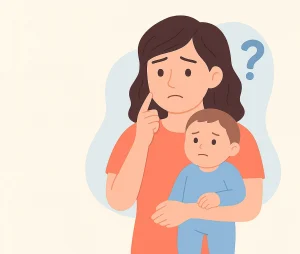
If you’ve ever found yourself wondering whether you should be “teaching” gestures—or just waiting for them to show up on their own—you’re in very good company. Many parents notice their child reaching, grabbing, tugging, or making little movements that seem meaningful and then they second-guess what to do next.
Should you show them how to point? Encourage waving? Ask for “more” with hands? Or will that feel like pressure?
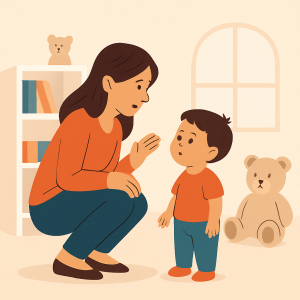
A calm, surprisingly powerful middle ground is this: instead of trying to teach gestures, you can match your child. When you copy your child’s gestures in a warm, playful way, you’re sending a simple message: “I see you. That movement means something. I’m with you.” For many children, that makes gestures feel easier, more worthwhile, and more likely to happen again.
Why gestures matter before words and alongside them
Gestures are often a child’s first “real” way of communicating on purpose. Pointing, reaching, giving, showing, waving, nodding yes, shaking head no, or pushing something away—these are all ways children can request, refuse, and share long before they can say everything they want to say.
And gestures aren’t just about getting needs met. They’re also about connection. When your child shows you something interesting, hands you a toy, or looks at you while reaching for a snack, they’re practicing the back-and-forth rhythm that communication is made of. Those small exchanges build confidence: “When I do something, you respond. I can make things happen. I can share my world.”
That’s a big deal—even when it looks tiny.
“Should I teach gestures or wait?”
This question usually comes from a loving place; parents don’t want to miss an opportunity, but they also don’t want to turn everyday life into a lesson.
The reassuring truth is that gestures often grow best in the middle of real life—during play, snacks, getting dressed, bath time, and all the ordinary moments you already share. You don’t have to “drill” gestures for them to develop. And you don’t have to sit back and hope, either.
Copying your child’s gestures is a gentle way to support communication without making it feel like a test.
Also read: Gestures During Meals: How to Support Pointing, Choosing, and ‘All Done’ Moments
What mirroring does for your child
When you mirror a child’s movement, you’re doing more than copying. You’re making communication feel safe, shared, and successful.
For a child who is still figuring out how to express wants and feelings, mirroring can help in a few important ways:
- It makes their gesture feel meaningful. Sometimes children aren’t sure whether their movement “counts.” When you match it and respond, you’re showing them it matters.
- It slows the moment down. Many children move quickly from want to action—reaching, grabbing, fussing, pulling. When you mirror, you naturally create a small pause where your child can notice the interaction.
- It builds back-and-forth. Communication isn’t just a skill; it’s a relationship. Mirroring turns a one-way moment (“I want that”) into a shared moment (“You see me, and we’re doing this together”).
- It supports confidence. Children are more likely to repeat gestures that work. When their gesture leads to understanding—especially with a warm, delighted response—it becomes worth using again.
Why copying can lead to more gestures over time
Parents sometimes worry: “If I copy my child, won’t they just keep doing the same thing? Shouldn’t I be showing them the ‘right’ gesture?”
In early communication, “more of the same” is often exactly how growth happens. Repetition is practice. When a child repeats a gesture and sees it consistently leads to connection—getting help, getting a turn, being understood—they start using it more often and with more purpose.
Over time, gestures often become clearer and more varied. A child who used to tug your hand toward the fridge might begin reaching and looking at you. A child who used to grab might start giving an item to you to open. A child who used to fuss might push something away to refuse. These are meaningful steps. Progress doesn’t always look like a brand-new gesture appearing overnight. Often it looks like a gesture becoming more intentional, more frequent, and more connected to you.
What mirroring looks like in real family life
Mirroring doesn’t have to be big or obvious. It can be almost subtle—something you do naturally while staying tuned in.
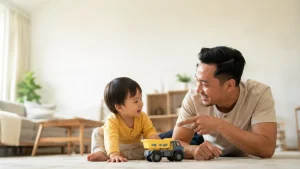
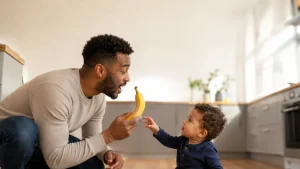
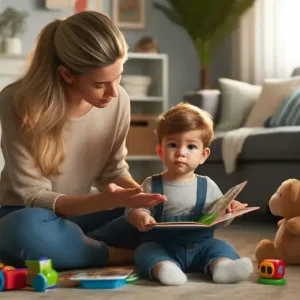
If your child reaches toward bubbles, you might reach too and look at them as if you’re sharing the idea together. If they hold up a toy, you might hold up your toy in the same way and meet their eyes. If they push food away, you might gently mirror that “no” feeling with your own hands and a calm face that says, “Got it.”
A lot of parents already do versions of this without realizing it—especially when they’re being playful. The difference is doing it on purpose sometimes, especially in moments where your child is trying to communicate but doesn’t quite have an easy way to do it.
“My child doesn’t copy me back—does mirroring still help?”
Yes. This is a common worry, and it makes sense. Parents often expect mirroring to turn into an imitation game right away: “I do it, then you do it.”
But the first benefit of mirroring isn’t that your child copies you. The first benefit is that your child feels seen and understood.
Some children will notice quickly and find it funny or interesting. Others may barely react at first. That doesn’t mean it isn’t working. It may simply mean your child is still learning that gestures can be shared and that you’re a partner in the moment. Even if your child doesn’t imitate you back, your mirroring can still strengthen the connection and make gestures feel more natural during everyday routines.
What “success” with gestures can look like without perfection
It’s easy to picture success as a child pointing clearly on cue or waving at every goodbye. But gesture growth is usually more gradual—and it counts even when it’s messy.
You might start noticing small shifts like these: your child reaches and then looks at you; they hand you something to help; they show you a toy and wait for your reaction; they nod or shake their head in a way that feels more intentional; gestures pop up more often during play and routines.
Keeping it light: the tone matters more than the technique
If there’s one thing that makes mirroring work well, it’s the feeling behind it. Children are sensitive to pressure, even when it’s subtle. When copying feels playful, warm, and responsive, it invites communication. When it feels like a demand—“Do this, do it right, do it now”—many children shut down or avoid it.
You don’t need to correct gestures. You don’t need to ask for them repeatedly. You’re simply noticing what your child is already doing and treating it like communication.
That alone can be a powerful shift.
When you want a little extra support without turning it into homework
Some parents feel comfortable following their child’s lead and trusting that gestures will grow with time. Others like having a bit more structure—especially if they’re not sure what to look for or how to respond in the moment.
If that’s you, tools like BASICS can be a helpful, low-pressure option. It’s designed to support goals like using gestures to request, refuse, and share through everyday interactions, with simple guidance that fits into real family life. Not because you need a program to connect with your child—but because sometimes it’s reassuring to have a clear next step.
A gentle note to end on
If your child isn’t using many gestures yet, it doesn’t mean you’ve missed a window or that you’re doing something wrong. Communication grows through thousands of small moments, not one perfect strategy.
Copying your child’s gestures is one of those small moments that can add up. It tells your child, again and again, “I notice you. I understand you. We’re doing this together.” And for many children, that feeling of being understood is what makes gestures worth using more—and what helps communication keep unfolding, one shared moment at a time.
Book your Free Consultation Today
Parent/Caregiver Info:
Client’s Details:
* Error Message