What Games Help With Eye Contact During Play When My Child Keeps Moving?
By Wellness Hub
Last Updated: March 27, 2026
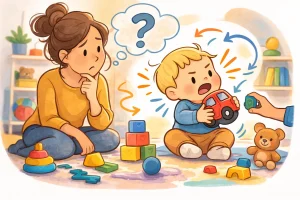
If your child is always on the go, it can feel like eye contact is simply not possible. You sit down for play, they zoom off. You try to get in front of them, they twist away. Many parents end up searching for games to encourage eye contact and hoping for something that finally works with a high energy, constantly moving little person.
Here is the reassuring part. Movement is not the enemy of connection. For many toddlers and young children, movement is how they regulate, focus, and stay engaged. The goal is not getting your child to sit still and look. It is creating tiny, natural “check in” moments while they are already moving, playing, and having fun.
Also read: How To Encourage Eye Contact During Play Using Turn Taking, Not Prompts
Why Eye Contact Feels Harder When Your Child Is Always in Motion
Some children connect best while their bodies are busy. They may be the kind of child who listens while climbing, who giggles while spinning, who learns best while running a toy car back and forth. When you ask for stillness, you might accidentally remove the very thing that helps them stay present.
A few common reasons eye contact during play can feel tricky with a mover:
- Your child is focused on the action, not the faces. Fast play can pull attention toward objects and away from people.
- They are seeking sensory input. Jumping, crashing, and running can help them feel organized inside.
- They prefer side by side connection. Some kids find face to face interaction intense, even with a parent they adore.
- They are anticipating the next moment. If the play is exciting, they may not pause long enough to look up.
None of this means your child is not connected to you. Often, it means they are connected in a different “body first” way. Your job is to gently add moments where your child notices your face as part of the fun, not as a demand.
What Counts As Eye Contact During Play for a Busy Child
Many parents picture eye contact as a steady gaze. In real life, especially with toddlers, it is usually quick and sprinkled throughout an activity. A glance counts. A shared smile counts. Looking up right before you do something silly counts.
For a child who keeps moving, progress often looks like:
- A quick look right before they run off again
- A glance when you pause and wait
- Looking at your face to see what you will do next
- A grin that shows they know you are part of the game
- Looking back at you after something surprising happens
These are the building blocks of connection. Over time, those brief moments can become more frequent and easier to notice. If you are also working on eye contact during routines like meals, bath, or getting dressed, you may see the same pattern there too. Tiny looks, then back to the action.
Learn More: 6 Eye Contact Activities for Toddlers That Fit Into Short Play Bursts
What Kinds of Games To Encourage Eye Contact Work Best for Kids Who Keep Moving?
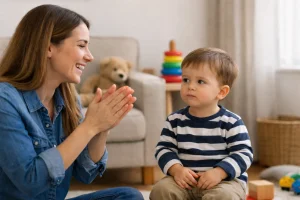
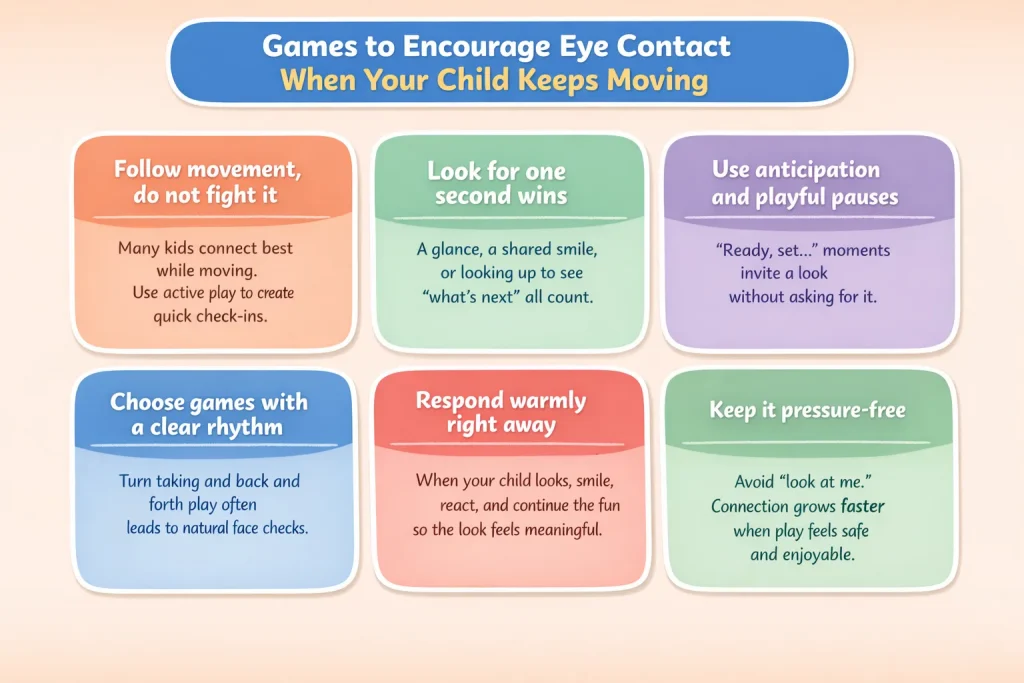
The best fit is usually a game that has three ingredients: anticipation, a playful pause, and a warm response from you. You are not stopping the movement. You are simply adding a moment where your child has a reason to look at you.
Here are game styles that tend to work well for active kids, with examples you can recognize from everyday play. This is not a set of steps, just a way to choose what matches your child.
1. Chase style games with a “ready, set…” moment
Many movers naturally look up when they are waiting for the “go.” That tiny pause is your opening. You might notice this in hallway games, tickle games, or any playful chase where your face signals what happens next.
2. Pop and surprise games
Bubbles, pop up toys, or anything that appears and disappears often pulls a quick glance. The look is usually “Are you going to do it again?” That is shared attention, even if it lasts one second.
3. Turn taking games with a clear “my turn, your turn” rhythm
Rolling a ball, sending a toy car, or pushing something back and forth can create a natural moment where your child checks your face to time the next turn. For some kids, this works better when they can stand, kneel, or move around rather than sit.
4. Silly face and sound games that match your child’s energy
Funny faces, animal sounds, playful singing, or exaggerated “uh oh” moments can invite a look because your child wants to see what you are doing. This is especially helpful for kids who are less interested in toys and more interested in action.
5. Mirror and reflection play
Some children find it easier to look at a reflection than directly at a face. Mirror play can feel less intense and more playful, while still building awareness of faces and expressions.
6. Snack and routine based “pause” moments
Even busy kids pause for something they want. A tiny wait before a sip, a bite, or a favorite part of the routine can create a quick look, especially when your expression is warm and predictable.
7. Book moments, but only if books are already enjoyable
For a child who rarely sits, books may work best in short bursts. The goal is not finishing the story. It is a quick shared moment, like looking at a funny picture and then checking your face.
If you recognized activities like Peekaboo Pause and Reveal, Bubble Time, Rolling Ball, Funny Faces and Sounds, Singing Face to Face, Mirror Play, or Greeting Rituals, you are already in the right territory. The “right” game is the one that makes your child want to come back for more.
Small Tweaks That Make Eye Contact More Likely, Without Turning Play Into a Test
Parents often tell me, “I tried the game, but they still didn’t look.” Usually, the game is fine. The tweak is in how the moment is set up.
Try thinking in terms of “inviting” rather than “asking.”
Positioning helps, but it should feel natural
Getting at your child’s level can make it easier for them to catch your face in their peripheral vision. For movers, side by side can work better than face to face. You can still be close enough that a glance finds you.
Your face is part of the fun
A warm, animated expression gives your child a reason to look. If your face stays neutral while the toy does all the exciting things, many kids will keep watching the toy.
Pause is powerful, but only for a beat
A short pause creates anticipation. A long pause can feel confusing or frustrating, especially for a child who is used to fast play. Think quick and playful.
Notice what your child already does
Some kids look right before they jump. Others look right after they crash a block tower. Some look when they hand you something. Those are your natural openings. You are not creating eye contact from scratch. You are catching it and making it rewarding.
Keep your response simple
When your child looks, you do not need big praise that stops the play. Often a smile, a quick “I see you,” or continuing the game is the best reward. Too much excitement can actually pull them away again.
Also read: It’s Okay if Your Toddler Only Gives Quick Glances During Play
What To Avoid When You’re Trying To Build Connection With a High Energy Child
Most parents are trying their best, and a lot of common advice unintentionally adds pressure. If your child already struggles to pause, pressure can make them avoid looking even more.
Here are a few approaches that usually do not help:
- Repeatedly saying “Look at me”
It turns a shared moment into a demand. Many kids will resist, not because they are being difficult, but because it feels controlling or intense. - Holding your child’s face or trying to physically direct their gaze
Even when done gently, it can feel uncomfortable. Eye contact is most meaningful when it is chosen. - Stopping the fun until they look
This can create a power struggle fast, especially with active kids. It also teaches that connection is a requirement, not a joy. - Pushing for long eye contact
Long staring is not the goal. Real life connection is made of quick looks that come and go. - Comparing your child to calmer kids
A child who moves constantly can still be deeply social. They may just show it differently.
If you want a simple reframe, aim for “more often,” not “longer.”
When To Get Extra Support, and What That Support Can Look Like
If you are seeing some quick glances here and there, you are already building the foundation. Support can be helpful when you feel stuck, when play feels one sided most of the time, or when you want someone to watch what is happening and offer gentle coaching that fits your child.
Some families also consider developmental screening to better understand communication delays or possible autism-related differences, especially if concerns persist across many settings and over time. That is not about jumping to conclusions. It is about getting clearer information and support that feels right for your family.
You deserve help that feels practical and respectful. Sometimes a few small adjustments in timing, routines, and play style make a big difference.
A gentle closing thought for parents of kids who never stop moving
If your child keeps moving, it does not mean they cannot connect. It often means they connect through action first, then through quick looks. Those tiny check-ins are real relationship moments, even when they last only a second.
When you choose movement-friendly games to encourage eye contact, you are working with your child’s wiring, not against it. Over time, those brief glances can show up more often in play, and you may notice them during everyday moments too, like getting shoes on or waiting for a snack.
Connection is the goal. The look is just one small, meaningful way it shows up.
About the Author:
Shravanaveena Gajula
M.Sc ., Speech and Language Pathology (5+ years of experience)
Shravanaveena Gajula is a dedicated Speech-Language Pathologist with a BASLP and an M.Sc in Speech and Language Pathology. With experience spanning multiple settings, including Wellness Hub , Veena specializes in a wide range of disorders from developmental issues in children to speech and language assessments in adults. Her expertise includes parent counseling, managing speech sound and fluency disorders, and creating individualized therapy programs. Veena is also PROMPT certified and an author of several insightful blogs on speech and language pathology, aiming to educate and assist caregivers in supporting their loved ones.
Book your Free Consultation Today
Parent/Caregiver Info:
Client’s Details:
* Error Message