Using Pauses to Invite Your Child to Make a Sound Without Pressure
By Rajini D
Last Updated: February 28, 2026
If you’ve ever finished a routine and thought, “I talked the whole time… and my child didn’t make a single sound,” you’re not alone. Many parents exploring using pauses for communication notice this exact moment.
Many caring parents naturally narrate everything. Bath time. Snack time. Shoes. Car seat. It comes from love and connection. You’re trying to support language and keep things smooth and predictable. But without realizing it, we can sometimes fill every small space with words. And those tiny spaces are exactly where a child might have tried a sound.
The reassuring truth is that you don’t need to teach communication all day long. Often, what helps most is simply making room. A small, gentle pause can be an invitation. A quiet moment that says, “I’m listening.”
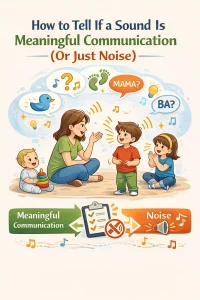
And for many children, that’s when a sound appears. An “mm.” A squeal. A breathy “uh.” A little protest noise. An excited burst during play.
Those sounds matter. They are early, meaningful ways your child can request, comment, get attention, or share a feeling.
Why it can feel like your child “never gets a chance” to vocalize
Daily life moves fast. Parents juggle routines, chores, and emotions. Talking can feel like the glue that keeps everything together.
And sometimes it does. But constant talking can also create a pattern where your child doesn’t need to do anything to be understood. You anticipate the snack. You open the toy. You refill the bubbles. Your child learns, “Things happen without me needing to signal.”
That isn’t a mistake. It’s a very common family rhythm.
Pausing gently changes that rhythm. It creates a moment where your child can take part, not with perfect words, but with whatever sound they have right now.
Using Pauses for Communication in Daily Life
When we talk about purposeful sounds, we are not talking about clear speech or saying certain words on cue. We are talking about your child discovering that their voice can do something.
Purposeful sounds might sound like excitement during a favorite game, a louder noise to pull you in when you turn away, a frustrated sound when something doesn’t work, or a little “uh!” when they want you to continue.
Sometimes it’s a repeated sound in a familiar moment. A happy squeal when the swing starts. A short protest when the TV turns off.
These are real communication attempts. Your child is saying, in the way they can right now, “More,” “Help,” “No,” “Look,” “I’m here,” or “That’s fun.”
When you start hearing sounds as communication and not just noise, your day can feel more connected.
Also read: What to Do When Your Child Grunts, Whines, or Yells Instead of Pointing
Why pauses work so well and why they don’t have to feel like pressure
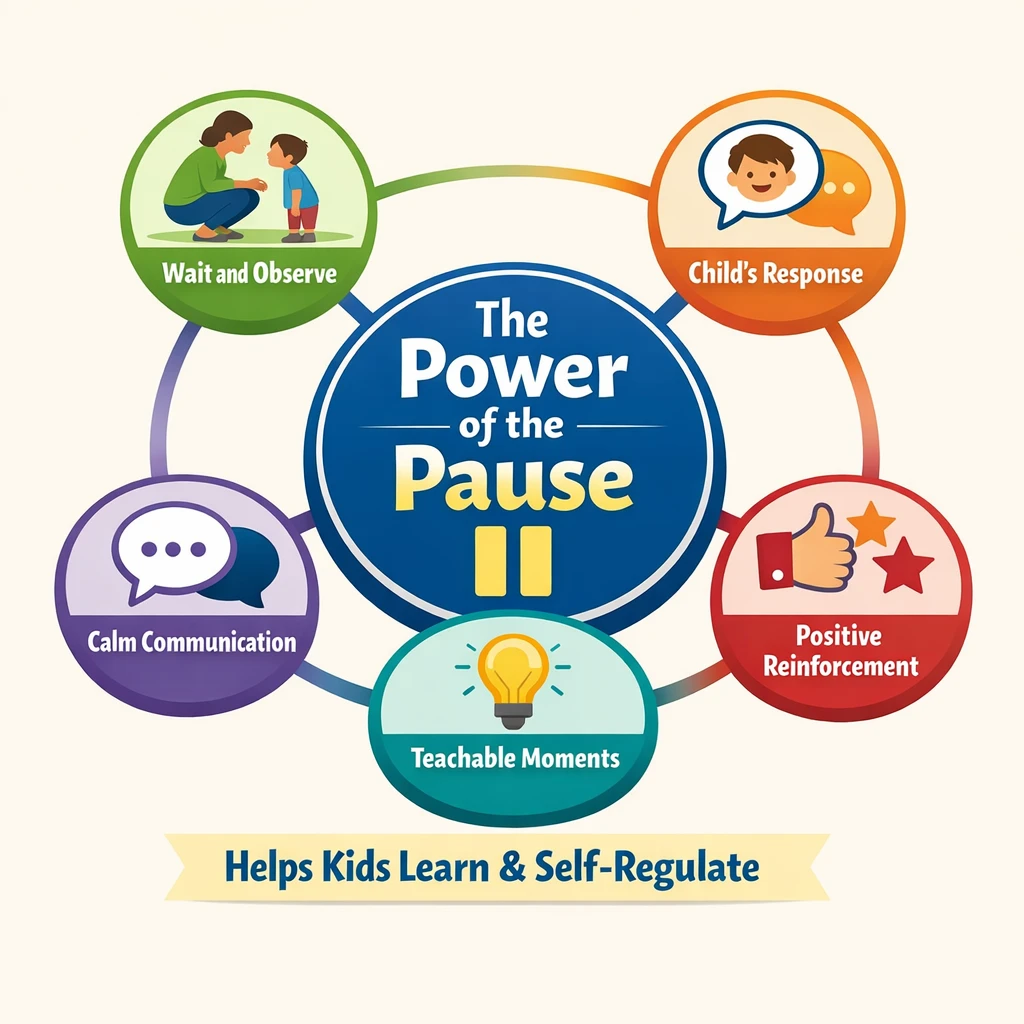
A pause gives your child time. Time to notice what’s happening. Time to notice you. Time to decide whether they want to join in. It also makes moments predictable. When a child senses, “This is where something happens,” they are more likely to try a sound to keep it going.
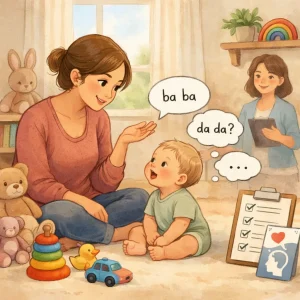
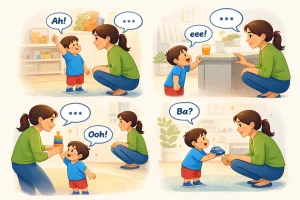
Think about playful routines where you already pause. Before you tickle. Before you push the swing. Before you blow bubbles again. That tiny wait often brings a look, a wiggle, a smile, or a sound.
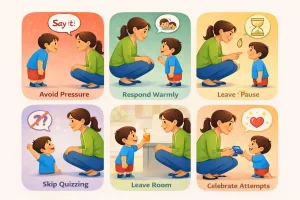
A pause does not have to feel like a test. You are not staring and thinking, “Say it.” You are simply leaving a comfortable space where your child can add something if they want to. And if they don’t, you continue. Connection stays safe. Nothing went wrong.
This part changes everything. How you respond. When your child makes a sound, treat it like it matters. Not dramatically, but warmly and clearly. You might respond by continuing the game, giving the item, or naming what you think they mean.
“You want more.”
“I hear you.”
“That was an excited sound.”
The exact words are not important. The message is: your voice works.
This is how children learn that communication has power. They try something. You respond. The loop becomes meaningful. This is the heart of using pauses for communication.
Over time, you may notice your child using sounds more often to get attention, to request, to protest, or to share excitement. You may hear more variety too. That is growth. Not perfect speech, but purposeful participation.
What if your child stays silent during the pause?
This is where many parents feel discouraged, so it’s important to say this clearly. Silence does not mean you are doing it wrong.
Some children need more time to understand that it’s their turn. Some are naturally quieter. Some are focused on the object, not the interaction. Some communicate more with their bodies than with their voices at first.
If your child looks at you, reaches, smiles, or pauses with you, that still counts. Engagement often comes before sound.
The goal is not to get a sound every time. The goal is to create repeated, gentle opportunities for your child to discover their voice in daily life through using pauses for communication.
What progress can look like often quieter than you expect
When pauses begin to help, progress shows up in small ways.
You may notice more sounds during your favorite routines.
You may hear a sound to get your attention.
You may hear a new noise when your child wants help.
You may see more confidence in starting interaction.
These moments can be easy to miss if you are waiting for words. But they are meaningful. They show your child practicing communication in the safest place possible, with you.
Keeping it calm and connected
Pauses work best when they feel like part of your relationship, not a technique you must perform perfectly.
If it feels awkward at first, that’s normal.
If you forget to pause all day, that’s normal too.
This is not about doing more. It is about slowing down in a few predictable moments and noticing what your child does with the space. And if you talk a lot, you do not need to stop. Your voice is comforting. The shift is simply leaving a small opening now and then so your child’s voice can join yours. This is how using pauses for communication becomes natural.
When you want a little extra support
Some parents like having help focusing on one communication goal at a time, especially when they are unsure what to watch for or how to make routines feel more interactive.
Speech and Autism therapy apps like BASICS can be a gentle, optional support. They offer simple examples of how to encourage early communication naturally, without turning your day into a lesson.
A gentle takeaway
Your child does not need constant teaching to begin using sounds meaningfully. They need repeated chances to take a turn in a way that feels safe. A small pause is one of the kindest invitations you can offer. It says, “You can take a turn here.”
And when your child answers with a sound, whether it is a squeal, a hum, a protest, or a tiny “uh,” it is not just noise.
It is a connection. It is your child discovering that their voice matters.
About the Author:
Rajini Darugupally
M.Sc., Speech-Language Pathologist (9+ years of experience)
Rajini is a passionate and dedicated Speech-Language Pathologist with over 9+ years of experience, specializing in both developmental speech and language disorders in children and rehabilitation in adults. Driven by a desire to empower each individual to find their voice, Rajini brings a wealth of experience and a warm, genuine approach to therapy. Currently, at Wellness Hub, she thrives in a team environment that values innovation, compassion, and achieving results for their clients. Connect with Rajini to learn more about how she can help you or your loved one find their voice.
Book your Free Consultation Today
Parent/Caregiver Info:
Client’s Details:
* Error Message