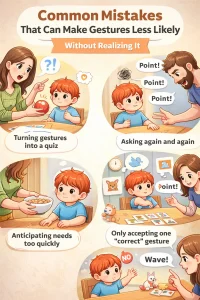
Common Mistakes That Can Shut Down Babbling Even When You Mean Well
Last Updated: February 28, 2026
Babbling is one of those everyday wonders. One week you hear a few quiet coos, and the next there’s a bright little “ba!” or “ma!” floating out during play. It feels exciting, and of course, you want to encourage it.
But many parents notice something puzzling. The more they try to help their child make sounds, the quieter their child seems to become. You repeat the cute sound. You wait for it again. You try to “practice.” And suddenly, the babbling that once felt so natural starts to fade or even shut down babbling moments that once felt easy.
If this sounds familiar, it doesn’t mean you’ve done anything wrong. It usually means your child is picking up on the feeling of the moment. Babbling grows best when it feels like play, not like a performance. The goal isn’t perfect sounds. It’s curiosity and variety, trying different consonants like b, m, d, g, p, mixing them in new ways, and exploring pitch and volume in everyday moments.
This article gently clears up a few well-meaning habits that can accidentally quiet sound play or shut down babbling, and shows how to keep your child in that sweet spot of “I want to try!”
Also read: What Progress Looks Like When Babbling Starts Expanding (Small Signs to Notice)
Why well-meaning help can shut down babbling
Babbling is your child experimenting. They’re testing what their mouth can do and watching what happens when a sound comes out. When adult responses feel warm and easy, children usually keep going. When responses start to feel like a quiz, “Say it again. No, like this. Try this one,” some children decide it’s safer to stop.
Not because they’re stubborn. Not because they can’t. Often it’s simply because the pressure rises and the fun disappears, which can quietly shut down babbling over time.
A helpful way to look at it is this: your child is more likely to explore new sounds when they feel successful even before they’re accurate.
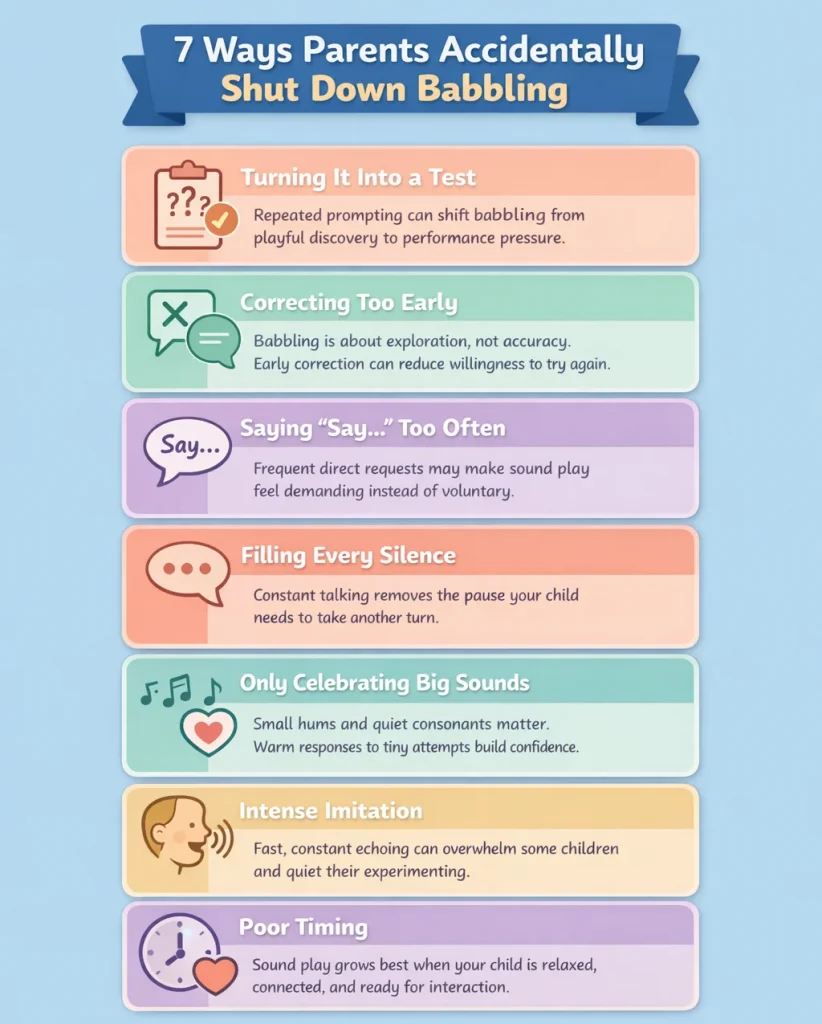
Mistake 1: Turning babbling into a test without meaning to
It often begins with excitement. Your child says “ba,” and you light up: “Ba! Say ba! Can you say ba? Ba-ba-ba!” You’re engaged and encouraging.
But to a child, repeated prompting can change the mood. Instead of “I made a cool sound,” it becomes “Now I’m supposed to do it again.” Some children respond by getting quiet, turning away, or moving on to something else.
A more supportive approach is to treat babbling as something you share, not something to perform. When you respond as if you’re simply enjoying the sound they made, rather than asking for a repeat, you leave space for more experimenting.
Mistake 2: Correcting the sound even gently
Parents correct because they care. If your child tries “ga” and it sounds closer to “da,” it’s tempting to guide them: “Almost! Say ‘ga.’ G-g-g.”
The challenge is that babbling isn’t about being right. It’s about trying out sounds and combinations. When correction comes in too early, your child may feel their attempts aren’t good enough to share.
What helps most is letting attempts count. If your child offers any sound, especially one with new consonants like b, m, d, g, p, they’re doing exactly what they should be doing. Your warm attention is what makes them want to try again.
Mistake 3: Asking for “say” too often
“Say mama.” “Say bye-bye.” “Say ball.” These phrases feel helpful and natural.
And sometimes children do respond. But when “say” becomes the main way sounds are invited, it can lead to a pattern where your child waits for prompts or avoids the interaction because it feels demanding.
Babbling grows best when children feel free to contribute on their own terms. Many parents notice that when they reduce direct requests, their child suddenly becomes more vocal again, almost as if thinking, “Oh, I can just play.”
Also read: Why Your Baby Babble Changes in Some Rooms (And Disappears in Others
Mistake 4: Filling every silence with more talking
When you want to hear babbling, silence can feel uncomfortable. So you narrate more, prompt more, and keep things moving. It comes from love, but it can leave little room for your child to take a turn.
Babbling is part of early back-and-forth. Your child makes a sound, you respond, and then there’s a small space where they get to decide, “Do I want to go again?” If that space disappears, the exchange becomes one-sided.
A gentle pause can be powerful. Not a dramatic waiting game, just a natural moment where your face and body say, “I’m here. I’m listening.” Many children use that quiet moment to try a new sound or change their voice.
Mistake 5: Overreacting to “big” sounds and missing the small ones
It’s easy to celebrate the loud, clear babbles and miss the tiny experiments, the soft lip pops, quiet hums, or little “mm” sounds while concentrating. But those small sounds are often where new consonants begin.
When only the biggest babbling gets attention, some children become cautious. When every attempt gets a warm response, children take more risks, trying a new p sound, stretching into a higher pitch, or mixing sounds differently.
The message becomes, “Any sound I make is worth sharing.”
Mistake 6: Copying your child too intensely
Imitating your child can be wonderful. It says, “I heard you,” and it often invites more back-and-forth. But there’s a point where imitation can start to feel like pressure, especially if it’s fast and constant.
Some children love being echoed. Others feel overwhelmed and go quiet. If you notice your child turning away or tensing after you imitate, it may help to soften things. Sometimes respond with a smile or a comment. Other times, gently add a different sound in the same moment.
Think of it as keeping things playful, not locked into a loop.
Mistake 7: Practicing sounds when your child is tired, hungry, or busy
Babbling shows up best when your child has energy for social play. If you try to encourage sounds during a frustrating diaper change, right before nap time, or when they’re deeply focused on a toy, you may hear less vocalizing.
That’s not a setback. It’s timing. Many children are most playful with sounds when they’re comfortable and connected, during relaxed floor play, bath time, meals, or silly routines where everyone is already smiling.
When the moment feels good, sound play usually follows.
What it looks like when your child is in the I want to try zone
You don’t need nonstop babbling to know things are going well. Progress often shows up slowly. You may notice a wider range of sounds during play, new consonants like b, m, d, g, p, or more experimenting with combinations. You might hear changes in pitch, louder and softer sounds, and see that little spark of pride when your child discovers something new.
Those are strong signs that sound exploration is alive and growing.
A calmer way to think about “supporting” babbling
Supporting babbling doesn’t have to mean teaching. It can simply mean creating a space where sounds feel welcome.
When you model playful sounds during routines, respond warmly to attempts, and keep the mood relaxed, you’re giving your child exactly what they need, a safe place to experiment. The best support often looks like enjoyment, not effort.
If you’d like extra guidance without turning your day into practice time, tools like BASICS can help parents choose a communication goal, such as expanding sound variety, and notice simple ways to support it during everyday routines. It’s meant to feel doable and low-pressure, especially when you’re unsure what helps and what might accidentally get in the way.
Also read: How to Model New Sounds Without Feeling Like You’re “Drilling” Your Baby
A gentle note to end on
If you’ve been prompting, correcting, or trying hard to get more babbling, you were doing it for the best reason: you care and you’re paying attention. The good news is that babbling is resilient. When the pressure eases and play returns, many children find their voice again, often with more variety and confidence.
Your child doesn’t need a perfect coach. They need a warm partner who makes communication feel safe and fun. And if you’re reading this, you’re already being that person.
About the Author:
Shravanaveena Gajula
M.Sc ., Speech and Language Pathology (5+ years of experience)
Shravanaveena Gajula is a dedicated Speech-Language Pathologist with a BASLP and an M.Sc in Speech and Language Pathology. With experience spanning multiple settings, including Wellness Hub , Veena specializes in a wide range of disorders from developmental issues in children to speech and language assessments in adults. Her expertise includes parent counseling, managing speech sound and fluency disorders, and creating individualized therapy programs. Veena is also PROMPT certified and an author of several insightful blogs on speech and language pathology, aiming to educate and assist caregivers in supporting their loved ones.
Book your Free Consultation Today
Parent/Caregiver Info:
Client’s Details:
* Error Message