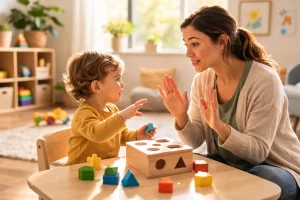
Am I Over-Talking During Play? How Too Many Words Can Make It Harder to Share Attention
By Wellness Hub
Last Updated: March 12, 2026
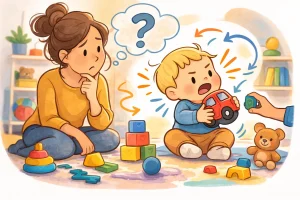
If you’ve ever found yourself narrating every second of play—“Look, the car is going fast! Now it’s turning! Now it’s parking! Do you see it? Can you say car?”—and then notice your child drifting away, you’re not alone.
Many loving parents fill the silence because they care. You want to be present. You want to help your child learn. And sometimes, especially if you’re worried you’re not doing enough, talking can feel like the safest way to show you’re engaged.
But here’s the gentle truth: during play, “more words” don’t always create “more connection”. Sometimes they make it harder for your child to find the most important part of the moment—your face, your gaze, your point, your shared excitement—especially when you’re supporting joint attention for a toddler who is still learning to share attention. This isn’t about being too much or doing play wrong. It’s about pacing. And once you notice it, it’s surprisingly easy to shift in a way that feels calmer for you and clearer for your child.
Also read: How to Build Joint Attention During Everyday Routines Meals, Bath, Getting Dressed
Why Too Many Words Can Make Joint Attention for a Toddler Harder
Joint attention is one of those quietly powerful skills that makes everyday life feel more connected. It’s when your child notices what you’re looking at or pointing to, and then shifts attention between you and the object or event, almost like you’re sharing the same little spotlight — a key moment in building joint attention for a toddler.
That might look like your child glancing at your face when you say “Wow,” following your point to a bird outside, or looking back at you as if to say, “Did you see that too?” When we talk a lot during play, we can accidentally compete with the very thing we’re hoping to build. Your child may be trying to do several big jobs at once: watch the toy, process your words, figure out what you want them to do, and manage their own excitement or focus. Even for children who understand plenty of language, that’s a lot of input at one time.
And if your words keep coming without a pause, your child doesn’t get a clear “opening” to look up, check your face, or follow your point. It can start to feel like the play is being carried by your voice rather than shared between two people — something that can be especially challenging for a joint attention toddler learning to follow your signals.
If your child tunes out, it doesn’t mean they’re not connected to you
You can feel reassured if your child looks away or keeps playing without responding, it’s often not rejection or disinterest in you. Many children simply stay focused on what’s in their hands. Others need extra time to notice social cues like gaze and pointing, especially when something else is already capturing their attention.
Sometimes a child is actually trying to connect, but the moment moves too quickly. If your child tends to respond after a delay, or only responds when things are calm, that’s a meaningful clue: they may do best when play has more space in it — something that often supports a joint attention toddler who needs time to notice and respond.
And if you’re the parent who talks a lot, it usually comes from a good place. You’re trying to be supportive. You’re trying to make play educational. You’re trying to keep things warm and engaging. Those are strengths, not problems. We’re just refining how that warmth lands.
Also read: What Joint Attention Looks Like at Home (Small Signs You Might Be Missing)
What joint attention really needs: clear signals and a little breathing room
Joint attention grows through tiny, repeated experiences of “We’re noticing this together.”
Often, the clearest signals are not long sentences. They’re simple, easy-to-read moments: a pause, a point, a look, a smile, a shared “wow.” When your child has time to notice those signals, they’re more likely to follow your gaze, follow your pointing, and shift attention back to you — the kind of moments that support joint attention in toddlers during everyday play.
Think of it like watching a movie together. If someone is constantly talking over the scene, it’s harder to track what matters. But if they go quiet at the interesting part and simply react—“Oh!”—you naturally look where they’re looking. That’s the feeling we’re aiming for in play: not a running commentary, but a shared moment.
Signs you might be over-talking and it’s okay if you are
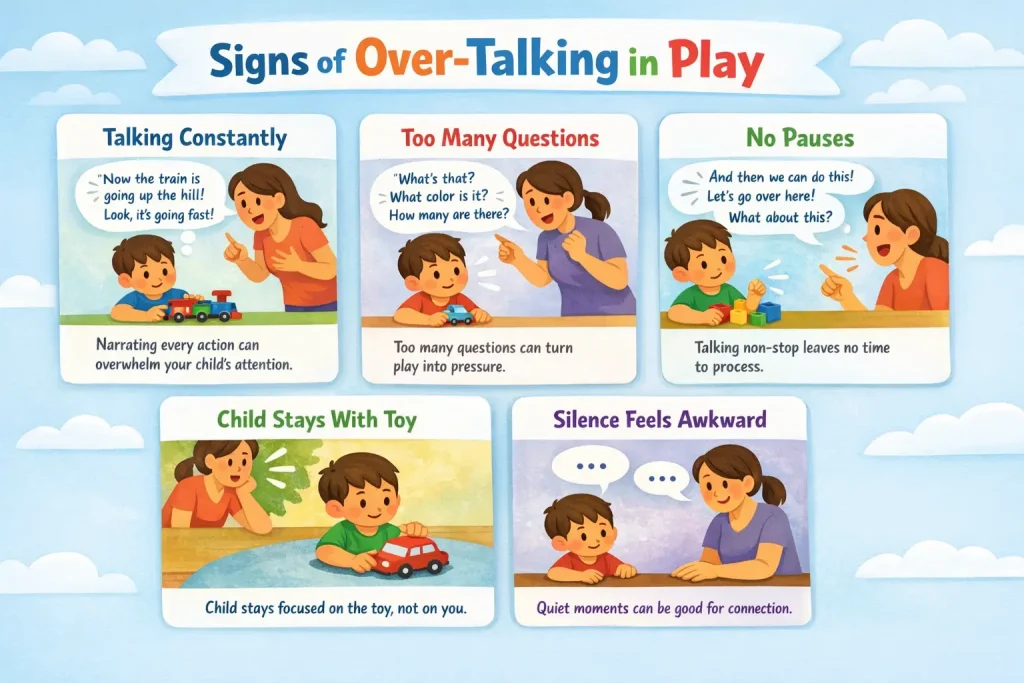
Over-talking during play is incredibly common. You might notice it if you often feel like:
- You’re working hard to “keep play going”
- You ask lots of questions in a row
- You repeat prompts quickly (“Look, look, look!”)
- You don’t leave much silence because it feels awkward
- Your child seems more focused on the toy than on you, even when you’re right there
None of these mean you’re doing anything wrong. They just suggest your child may benefit from fewer words and more time to process what you’re showing them.
What better pacing can sound like in real life
This doesn’t mean being silent or stiff. It means letting your words support the moment instead of filling it.
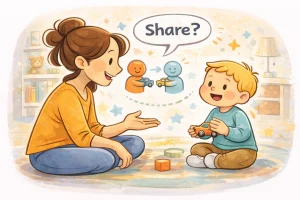
Many parents find it helpful to think in short, simple language—then a pause. For example, instead of a full explanation, you might offer a small label or a shared reaction: “Bubbles!” “Uh-oh.” “Wow!” “Car!” Then you give your child a chance to look, react, or check your face.
Even your facial expression can do a lot of the work. A bright, expectant look—without extra talking—often invites a child to glance up. And when they do, it creates the exact kind of back-and-forth that strengthens joint attention: looking at the object, then looking at you, then back again.
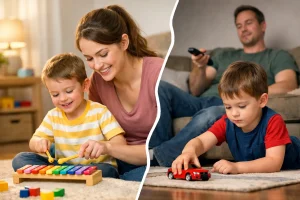
It can also help to notice the difference between talking at play and talking with play. Talking with play tends to match the child’s pace and interest. It leaves room for the child to lead, respond, and share the moment in their own way.
Also read: Why Does My Child Follow My Eyes Sometimes but Not Other Times?
Why questions can sometimes shut the moment down
Questions are not bad. Parents naturally ask them. But during play, lots of questions, especially back-to-back can unintentionally turn connection into a performance.
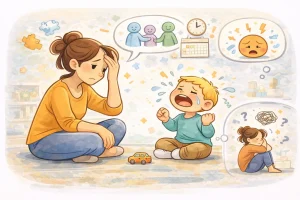
When a child hears repeated questions like “What’s that? What color is it? What does the cow say?” they may feel pressure to answer, even if they’re not ready. Some children respond by avoiding eye contact, moving away, or focusing harder on the toy. Not because they’re being difficult; it’s because the play no longer feels like a shared experience.
Joint attention is built more through shared noticing than through testing. Often, a simple comment (“Cow!”) or shared reaction (“Moo!”) keeps the moment light and inviting, which makes it easier for your child to look back at you and stay connected.
The quiet power of waiting (even when it feels awkward)
Silence can feel uncomfortable, especially if you’re an engaged, chatty parent. But in child development, waiting is not “doing nothing.” Waiting is giving your child time to:
- Notice your gaze
- Track your pointing
- Process what you said
- Decide whether to look back at you
- Share the moment in their own way
Many children need that extra beat. And when you give it, you may start to see more of the small signs of joint attention: a quick glance to your eyes, a pause in their hands, a tiny smile, a look toward what you indicated.
Those small moments count. They are the building blocks of a bigger connection.
What progress can look like without expecting perfection
Joint attention doesn’t appear all at once. It grows gradually, and it often shows up in subtle ways before it becomes consistent.
You might begin noticing that your child looks where you point more often, or that they glance back at you when something interesting happens. You may see more shared smiles, more “Did you see that?” energy, or more curiosity about what you’re looking at.
And it’s normal for this to vary by day. Busy environments, tiredness, hunger, or exciting toys can all make shared attention harder. Progress is less about getting it “right” in every moment and more about creating many low-pressure chances for connection.
If you want support, you don’t have to figure it out alone
Some parents find it reassuring to have a simple framework for communication goals like joint attention, especially if they’re not sure what to watch for or how to adjust their style without overthinking it.
Tools like BASICS can offer gentle guidance through short videos and everyday examples, helping you notice what supports shared attention in real life, during books, snacks, bubbles, or looking out the window without turning your home into a therapy space. It’s optional support, not a requirement, and many families simply use it as a confidence boost.
If you have concerns about your child’s communication or shared attention during play, speaking with a speech-language pathologist or your paediatrician can be a helpful first step.
A calming reminder to take with you
If you’ve been over-talking during play, it doesn’t mean you’re doing too much “wrong.” It means you’re trying hard to connect. Sometimes the most connecting thing you can do is soften the pace: fewer words, clearer signals, and a little more space for your child to look, process, and share the moment with you.
Joint attention is built in those tiny, ordinary seconds when you and your child notice the same thing together. And when you make room for that to happen, you may find that your child doesn’t need you to say more, they just need you to be there, calmly, with space to meet you in the moment.
About the Author:
Anuradha Karanam
Speech-language pathologist (7+ years of experience)
Anuradha Karanam is a skilled speech-language pathologist with over 6 years of experience. Fluent in Tamil, Telugu, Hindi, and English, she specializes in parent counseling, speech sound disorders, fluency assessment, and speech-language evaluations. Anuradha excels at working with children with developmental disorders, offering creative and effective therapy programs. Currently, at Wellness Hub, she holds a BASLP degree and is registered with the RCI (CRR No A85500). Her patience, ambition, and dedication make her a trusted expert in her field.
Book your Free Consultation Today
Parent/Caregiver Info:
Client’s Details:
* Error Message