What Counts as “Imitating Sounds” (It’s More Than First Words)
By Wellness Hub
Last Updated: March 2, 2026
If you’ve ever caught yourself thinking, “My child makes lots of noises… but do they really count as imitating sounds?” you’re not alone.
Many parents expect “imitating sounds” to mean clear, speech-like sounds right away, something close to a first word, or at least a crisp “ba” or “da.” So when what you hear instead is squeals, raspberries, growls, or long strings of happy babbling, it’s natural to wonder whether your child is actually imitating anything at all.
Here’s the reassuring truth: imitating sounds is often bigger, messier, and more playful than most people expect. And that playful sound copying matters because it’s one of the earliest ways children join in, connect, and practice the back-and-forth rhythm that later supports conversation.
What “imitating sounds” really means (in everyday life)
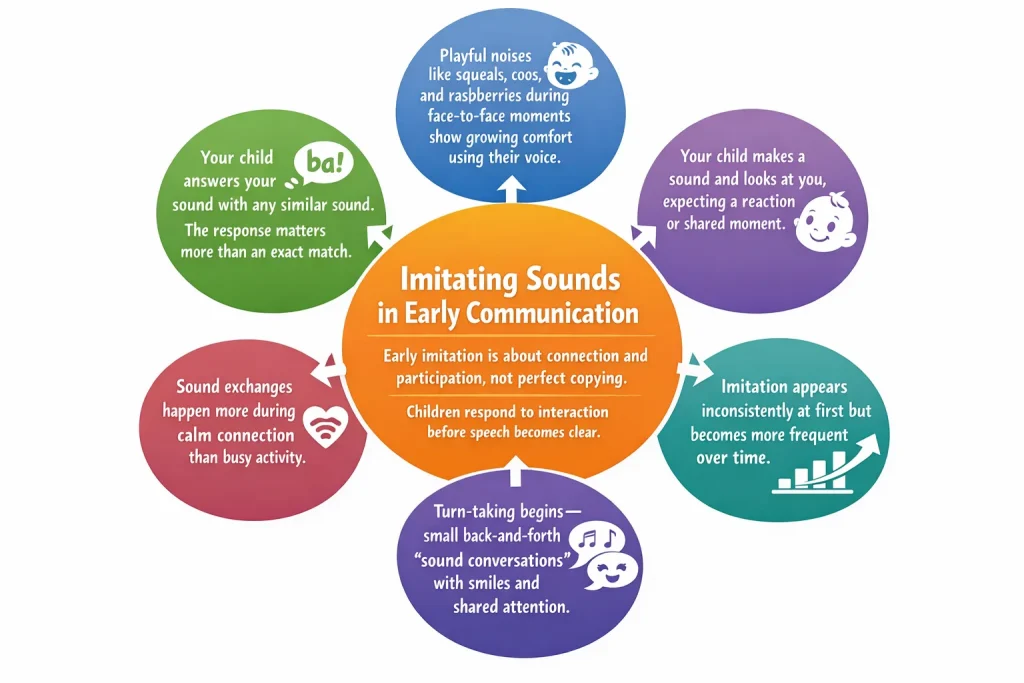
In early communication, imitation is not a performance. It’s not about your child proving they can copy something perfectly on cue. It’s about your child experimenting with their voice in response to you—sometimes right away, sometimes after a pause, and sometimes in their own slightly different version.
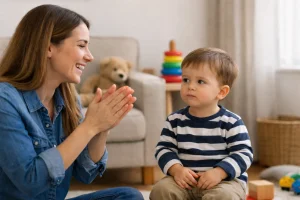
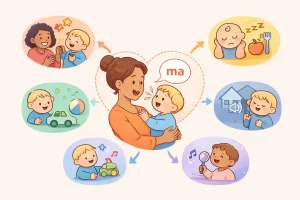
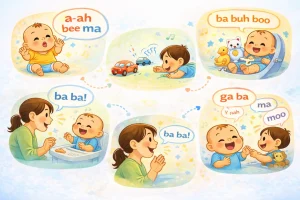
Imitating sounds and playful noises can include repeating coos, squeals, raspberries, animal-like sounds, or echoing the fun vocalizations you use during everyday moments. It’s often less about accuracy and more about participation: “I heard you, I’m engaged, and I want to try something too.”
That’s why so many “silly” sounds truly count. They are part of your child learning that sounds can be shared.
Yes, raspberries and squeals can count
Parents often ask about specific sounds, so it helps to name what commonly fits under “imitating sounds” in real life.
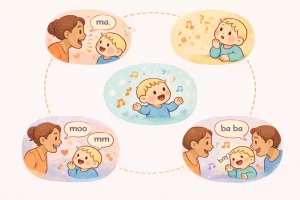
If you make a playful sound—like a raspberry, a long “oooo,” a squeal, or a funny “buh-buh-buh”—and your child responds with something similar, that is imitation. It may not sound identical. They might make it quieter, louder, shorter, or with a different mouth shape. But if it feels like they are echoing the idea of your sound, it counts.
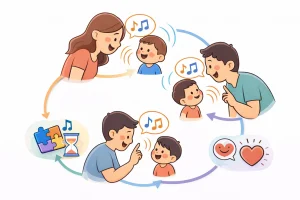
The same goes for animal-like noises. If you say “moo” and your child responds with “mmm,” or you growl like a bear and they answer with a rough “grrr,” that is a meaningful step. It shows they are listening, noticing patterns, and trying to match what they heard with what their own voice can do. Sometimes imitation looks more like a “sound conversation” than a single copy. You squeal, they squeal. You squeal again, they squeal again—both of you laughing. That shared loop is powerful communication practice, even if it does not resemble a word yet.
What if my child’s imitation doesn’t sound exact?
Many parents miss early imitation because they are listening for a perfect match.
But early sound imitation often looks like “close enough.” Your child may copy the rhythm rather than the exact sound. Or they may copy the pitch—going high when you go high. Or they may repeat the same type of mouth movement (like lip sounds), even if the sound itself changes.
For example, you might make a “pop pop pop” with your lips, and your child responds with “buh buh” or a raspberry. That can still be imitated because they are attempting the same kind of vocal play.
Think of it like dancing together. Your child does not need to mirror your exact steps to be dancing with you. If they are responding in the same spirit, they are participating—and that participation is the point.
The most important sign: your child is joining you
One of the clearest markers of imitating sounds is not the sound itself, but the social moment around it.
You may notice your child makes a sound and then looks at you, as if waiting to see what you will do next. Or they pause and repeat the sound when you respond. Or they seem delighted when you copy them back.
Those little “check-ins” matter. They show your child is learning that sounds create reactions and that communication is something you do together.
Over time, many parents notice that vocal play happens more often and lasts longer. There may be more shared laughter, more back-and-forth, and more creative combinations of sounds. That is often what progress looks like: more engagement, more experimenting, and more “your turn, my turn” moments.
Also read: My Baby Isn’t Imitating Sounds Yet Is That Normal?
Why playful sound imitation matters for communication
It can be tempting to think of sound play as random noise. But for young children, sound play is how they explore what their voice can do and how it affects other people.
When your child imitates your coos, squeals, raspberries, or animal sounds, they are practicing important foundations without anyone needing to formally teach them. They are building comfort and confidence with their voice. They are learning that making sounds can be enjoyable and shared. And they are beginning to feel the rhythm of interaction: one person makes a sound, the other responds, and the exchange continues.
These early patterns support later communication, not because squeals suddenly turn into sentences, but because your child is learning the social flow of conversation in the most natural way possible—through play.
What “success” can look like (without turning it into a test)
Many parents feel pressure to know whether their child is “doing it right.” It can help to think of success as a growing pattern rather than a single moment.
You might notice your child begins to echo your sounds during play more often. They may experiment with different playful noises, including coos and raspberries. They may look toward you after making a sound, as if inviting you into the moment. Over time, you may hear them combine sounds in new ways—little sound creations that feel uniquely theirs.
None of this has to happen on a strict timeline, and it does not need to look the same every day. Some days your child is chatty and playful; other days they are quieter or focused on something else. That variation is normal.
Gentle ways to encourage more sound copying in daily life
Support for this goal works best when it feels like connection, not practice.
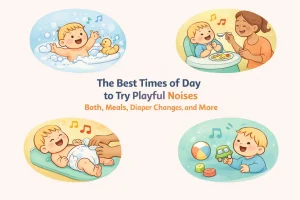
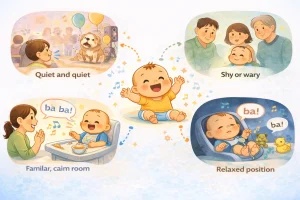
Face-to-face moments often make sound play easier—during cuddles, diaper changes, bath time, or those silly minutes before bedtime. Routines are especially friendly for imitation because your child already knows what is coming next, leaving more space for playful interaction.
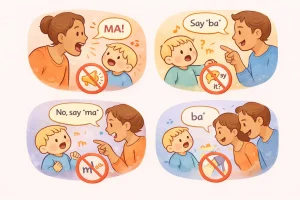
Many parents also find that exaggerated, fun sounds—coos, squeals, lip noises, or animal sounds—invite participation more than “say this” requests. And when your child makes any attempt, warm reactions (a smile, a laugh, or a playful echo back) often encourage them to try again.
If your child makes a sound that seems random, you do not need to interpret it. You can simply treat it as communication: notice it, enjoy it, and respond. That alone can turn a single noise into a shared moment.
When you’re not sure if it’s happening
Some parents say, “I think they’re imitating, but I can’t tell.” That uncertainty is understandable—early imitation can be subtle.
If it helps, look for patterns instead of isolated moments. Does your child make more sounds when you are playful? Do they repeat a sound you just made, even if it is not exact? Do they watch your face or wait for your response after they vocalize? These are meaningful clues.
And if you are feeling unsure or want more clarity, some families like having a simple guide to what to listen for and how to keep things light. Tools like BASICS can support parents by breaking communication goals into everyday examples and short videos—so you can feel more confident without turning your home into a therapy space.
A calm reminder for parents
Imitating sounds is not a “first words” milestone that either happens or does not happen. It is a playful, growing skill that often shows up as squeals, raspberries, coos, and silly sound exchanges long before clear speech.
If your child is experimenting with their voice, responding to your playful noises, and sharing small back-and-forth moments with you, that matters. Those sounds are not “nothing.” They are your child learning how communication feels, one joyful noise at a time.
About the Author:
Rajini Darugupally
M.Sc., Speech-Language Pathologist (9+ years of experience)
Rajini is a passionate and dedicated Speech-Language Pathologist with over 9+ years of experience, specializing in both developmental speech and language disorders in children and rehabilitation in adults. Driven by a desire to empower each individual to find their voice, Rajini brings a wealth of experience and a warm, genuine approach to therapy. Currently, at Wellness Hub, she thrives in a team environment that values innovation, compassion, and achieving results for their clients. Connect with Rajini to learn more about how she can help you or your loved one find their voice.
Book your Free Consultation Today
Parent/Caregiver Info:
Client’s Details:
* Error Message