Eye Contact Milestones by Age, What’s Typical in Toddlers and Preschoolers
By Wellness Hub
Last Updated: March 27, 2026
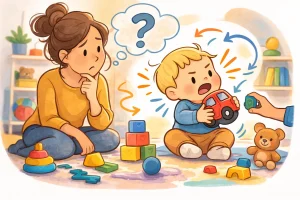
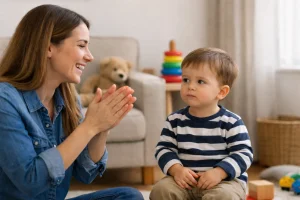
If you have been searching for eye contact milestones by age, you are probably trying to answer a very human question: “Is this typical, or should I be worried?” Most parents are not looking for perfect eye contact. They are looking for little signs of connection, like a quick glance during play, a shared smile, or that sweet moment when your child checks your face to see what you think.
A helpful starting point is this: eye contact in early childhood is usually brief, flexible, and tied to comfort and interest. It often shows up more with familiar people, in predictable routines, and during playful moments that invite a “look and share” feeling.
What Counts As Eye Contact in Real Life (and What Parents Often Expect)
Many parents picture eye contact as steady looking, almost like a child is “holding” your gaze. That can happen sometimes, but it is not the only kind that matters.
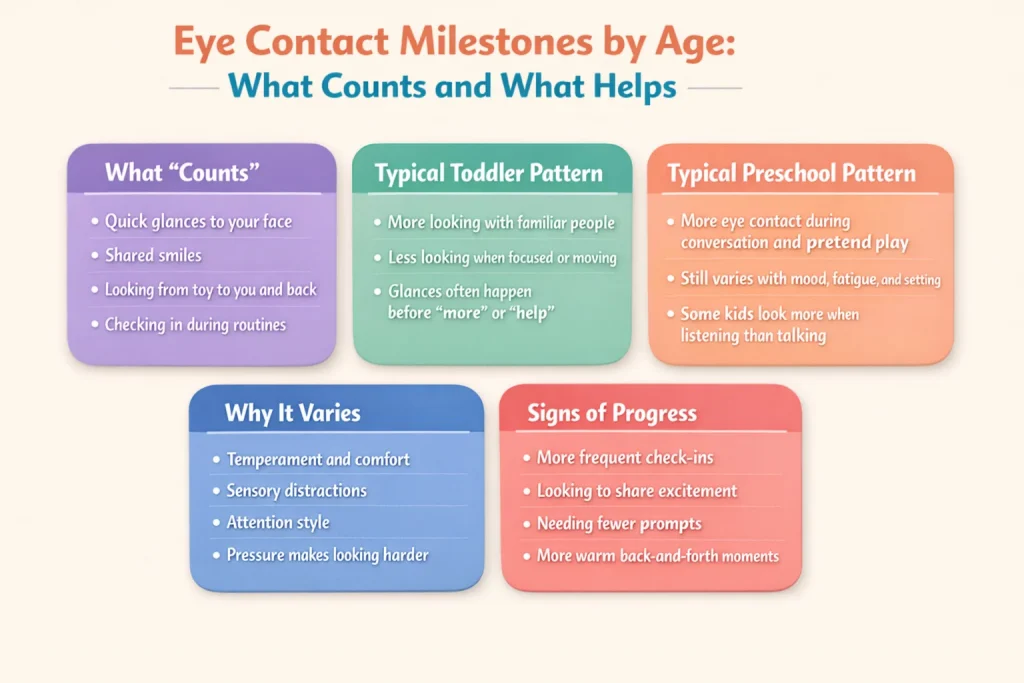
In everyday life, eye contact often looks like:
- A quick glance up when something exciting happens, then back to the toy.
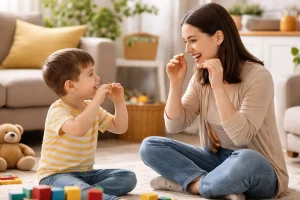
- A shared smile when you do something silly.
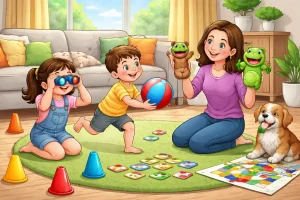
- Looking at your face right before you blow bubbles, roll the ball, or open a snack.
- Checking in during routines, like bath time or getting shoes on.
- Looking at you more when they want help, want more, or want you to notice something.
Those small “check-ins” are meaningful. They show your child is starting to treat you as part of the moment, not just the person nearby.
It also helps to remember that some children are naturally more observant than expressive. They may take in your voice, your body language, and your tone without doing much looking. Others are busy movers and look less because their bodies are doing the learning. Neither is automatically a problem. It is information, not a verdict.
Eye Contact Milestones by Age, From Babies to Preschoolers (a Gentle Timeline)
Parents deserve a timeline that feels grounding, not like a test. So here is a broad, parent-friendly view of how eye contact often develops. Think of these as common patterns, with lots of room for individual pace.
Birth to 3 months
Early eye contact is often fleeting. Babies may briefly look toward a face, especially during feeding or when you are very close. You might notice a moment of stillness, then a look, then they drift away again. That drifting is normal. Their systems get tired easily.
4 to 6 months
Many babies begin to look longer at familiar faces and may start to pair eye contact with smiles. You might see more “back and forth” during simple interactions, like you talk, they look, you smile, they respond.
7 to 12 months
This is when a lot of families notice more social looking. Many babies start checking your face during play, especially when something changes or surprises them. They may look to you when they want help, when they want more, or when they are unsure. You might also see more looking during familiar games like peekaboo.
12 to 18 months
Toddlers are often on the move. Eye contact can look more like quick glances while they explore. Many children look at you to share excitement, to request, or to make sure you are still there. It can be very normal for a toddler to look less when they are deeply focused on a toy, climbing, or figuring out a new skill.
18 to 24 months
Many toddlers start using eye contact more intentionally. You might notice they look at you before doing something funny, or they look to see your reaction after they do it. During play, they may glance up as if to say, “Did you see that?” This is also a stage where routines matter. Eye contact often shows up during meals, dressing, and bedtime because those moments are predictable.
2 to 3 years
Preschool-style social skills begin to grow here, but they are still early. Many children look at you more during conversation, during pretend play, and when they need help solving a problem. Eye contact may still be inconsistent when they are excited, tired, or in a new environment.
3 to 5 years
Many preschoolers use eye contact as part of communication more regularly, especially with familiar adults. They may look at you while telling a story, asking a question, or waiting for your response. Even at this age, it is common for eye contact to come and go depending on attention, comfort, and personality. Some kids look more when listening than when talking. Some look more when they feel calm than when they feel put on the spot.
If you are reading this with a toddler or preschooler in mind, it may help to focus less on “How long do they look?” and more on “Do they ever check in, even briefly, during play or routines?”
Why Eye Contact Can Look Different From One Child to Another
Two children can be developing beautifully and still look very different in how they use eye contact. Here are a few common reasons:
1. Temperament and personality
Some children are naturally more direct and social. Others are more cautious, more independent, or slower to warm up. A cautious child may watch from the side first and look less until they feel safe.
2. Attention style
Some kids concentrate by looking at what they are doing. They might listen better when they are not looking. This can be especially true during building, puzzles, or sensory play.
3. Sensory preferences
Bright lights, busy rooms, loud sounds, or lots of movement can make it harder to look at faces. A child may avoid eye contact in a crowded place but look more at home.
4. New people versus safe people
Many children look more with parents and less with unfamiliar adults. That difference often matters. Comfort changes behavior.
5. Pressure changes everything
When a child feels tested, eye contact often drops. If a child hears “Look at me” repeatedly, they may start to avoid the moment altogether, not because they cannot do it, but because it feels uncomfortable.
If you are noticing limited eye contact during play, it can help to observe when it happens more easily. Is it during silly moments? During snack time? When you pause before doing something fun? Those clues tell you what motivates connection for your child.
Signs Your Child Is Building Connection, Even if Eye Contact Is Brief
Parents often miss progress because it does not look like “good eye contact” yet. It looks like small shifts that happen naturally.
You might notice:
- Your child glances at you right before something fun happens, like bubbles or a tickle.
- They look at you after doing something new, as if checking your reaction.
- They bring a toy closer to you, then look up briefly.
- They smile more during back-and-forth games.
- They look more during daily routines, especially when you pause for a moment.
- These are strong building blocks. They show your child is starting to understand that interaction is shared.
If you are comparing your child to another child, try comparing your child to your child from a month ago. That is usually the comparison that tells the truth.
When Eye Contact Milestones by Age Feel Off, What Can You Do Next (Without Pressure)
If your child is not matching what you expected from an age timeline, it does not mean you have done anything wrong. It usually means your child needs a different doorway into connection.
A few gentle, practical shifts often help:
1. Look for “easy moments” first
Many children look more during predictable routines than during open-ended play. Meals, bath, dressing, and bedtime are full of natural pauses where connection can happen.
2. Follow interest, then add a tiny pause
Eye contact often grows out of anticipation. When your child expects something fun, they are more likely to glance at your face to keep it going. This is one reason playful social games tend to bring more looking than direct requests.
3. Get on their level
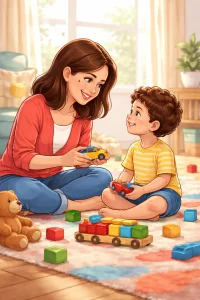
Face-to-face does not have to mean close and intense. It can simply mean you are nearby, at eye height, with a warm expression that is easy to notice.
4. Respond to any glance like it matters
A quick smile, continuing the fun, or a gentle comment can be enough. Big, loud praise can sometimes interrupt the moment and make a child less likely to look again.
If you want support that feels calm and doable, the BASICS App can be a nice option. It is parent-guided and self-paced, and it helps you notice what counts as progress in everyday moments.
When To Seek Extra Support, and How To Keep It Calm and Practical
Sometimes parents have a steady feeling that connection is hard, not just eye contact. If that is where you are, it is okay to ask for help. Support can be very practical, like getting ideas for routines, play set-ups, and ways to reduce pressure.
You might consider reaching out if:
- Eye contact and “checking in” are rare across most settings, even with familiar caregivers.
- Your child seems to stay in their own world during play most of the time, and it is hard to get a back-and-forth going.
- You feel like you are working very hard for small moments, and it is wearing you down.
- You would like a professional to watch a few everyday interactions and offer gentle coaching.
In the final third of this article, one additional note for families who want it: if concerns persist, some families consider developmental screening to better understand communication delays or possible autism-related differences. This is not about jumping to conclusions. It is about getting clearer information and support that fits your child.
A Reassuring Takeaway on Eye Contact Milestones by Age
Age ranges can be helpful, but they are not a measure of your parenting or your child’s potential. The most important thing to watch is whether connection is growing over time, in the ways that fit your child.
If you came here looking for eye contact milestones by age , I hope you leave with a steadier picture: eye contact is often brief, it changes by setting and mood, and it can build gently through playful, familiar moments. Those quick glances and shared smiles count. They are real communication.
About the Author:
Shravanaveena Gajula
M.Sc ., Speech and Language Pathology (5+ years of experience)
Shravanaveena Gajula is a dedicated Speech-Language Pathologist with a BASLP and an M.Sc in Speech and Language Pathology. With experience spanning multiple settings, including Wellness Hub , Veena specializes in a wide range of disorders from developmental issues in children to speech and language assessments in adults. Her expertise includes parent counseling, managing speech sound and fluency disorders, and creating individualized therapy programs. Veena is also PROMPT certified and an author of several insightful blogs on speech and language pathology, aiming to educate and assist caregivers in supporting their loved ones.
Book your Free Consultation Today
Parent/Caregiver Info:
Client’s Details:
* Error Message