What Progress Looks Like When Babbling Starts Expanding Small Signs to Notice
By Wellness Hub
Last Updated: February 27, 2026
It’s tempting to measure progress by waiting for one clear sound, a strong “ba,” a confident “da,” something that feels like it’s finally pointing toward a first word.
But early communication almost never grows in a straight line. More often, it grows through tiny changes you only notice later, when you suddenly realize your child’s babbling sounds different than it did a few weeks ago. A bit more varied. A bit more playful. A bit more intentional, even if it still isn’t a real word.
If you’ve been wondering whether your child is truly making progress with expanding babbling, this is a gentle guide to the small signs that really matter. Because “more variety” often shows up long before speech becomes clear.
Why more sounds matters in expanding babbling even before words
When children begin using a wider range of sounds in their babbling, especially new consonants like b, m, d, g, and p, they’re doing something important. They’re experimenting. They’re discovering what their mouth can do, how their voice can change, and what happens when a sound gets your attention.
This kind of sound play helps children tune into the rhythm and melody of speech. It’s also deeply social. When your child makes a new sound and looks at you with that “Did you hear that?” expression, they’re not just making noise. They’re reaching out for connection.
That’s why progress can feel quieter than you expect. It isn’t always a new word-like sound. Sometimes it’s simply more curiosity and more variety as expanding babbling unfolds.
Also Read: Why Your Baby Babble Changes in Some Rooms And Disappears in Others
Progress often starts with new mouth shapes
One of the earliest signs that babbling is growing doesn’t always come through your ears. It comes through your eyes.
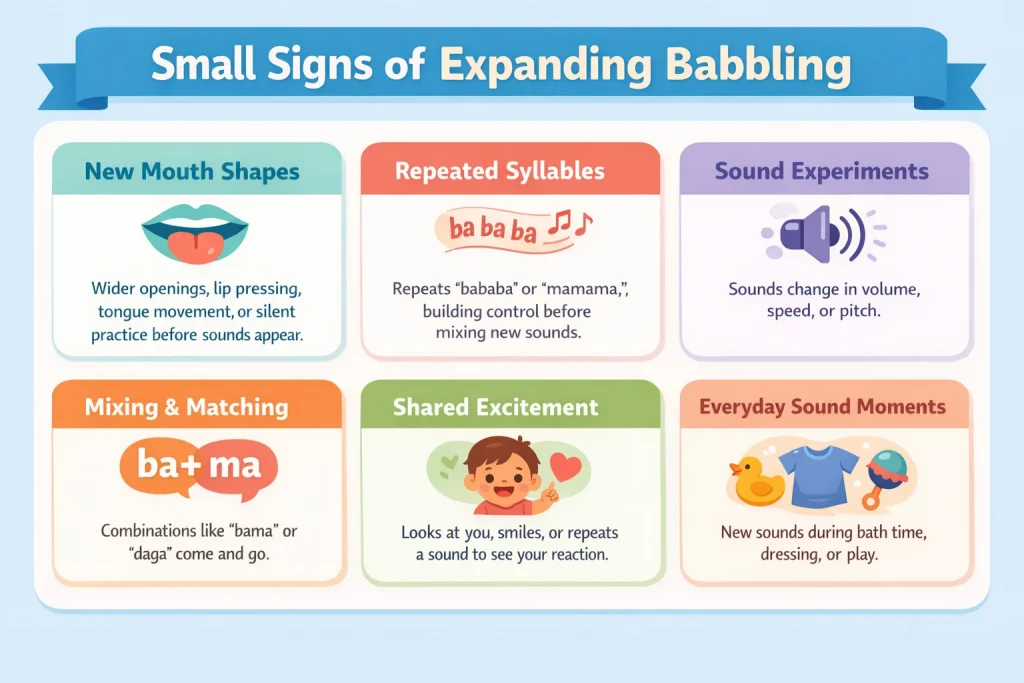
You may notice your child making new mouth movements during play, opening wider, pressing their lips together, moving their tongue differently, or pausing as if they’re getting ready to make a sound. Sometimes it even looks like silent practice.
These moments are easy to miss because they don’t always come with a clear consonant. But they’re part of the same story. Your child is exploring how sounds are formed. If you’ve ever seen your child watch your mouth while you talk and then try a similar shape right after, that counts too. It shows they’re paying attention to how communication works.
You may hear repetition before you hear clarity
Many parents expect progress to sound like lots of different sounds right away. For many children, it doesn’t work that way. Variety often grows through repetition first.
You might hear one syllable again and again, “bababa,” “mamama,” or “dadada.” It can feel like your child is stuck, but repetition is usually how control develops. They practice a pattern until it feels easy, and only then do they start mixing in new sounds.
This can also show up in daily routines. Maybe your child babbles most during bath time or always makes a certain sound while getting dressed. That consistency matters. It means their voice is becoming part of how they take part in everyday life.
Small sound changes are a big deal
Another subtle sign of progress is when your child starts changing their sounds on purpose.
Instead of one steady babble, you might hear little experiments. A sound gets louder, then softer. Faster, then slower. Higher, then lower. Or one sound shifts into another, like “ba” becoming “pa,” or “ma” drifting closer to “da.” These changes can sound playful or random, but they usually mean your child is learning how much control they have over their voice.
Sometimes this shows up as sound effects during play, little bursts of sound while pushing a car, stacking blocks, or bouncing. The sound may not match the toy, but the timing matters. Your child is starting to connect voice with action, which is an early step toward more intentional communication.
Variety can look like mixing and matching
As expanding babbling grows, you may hear your child putting sounds together in new ways.
It doesn’t have to sound like a word. It might just feel less predictable than before. Instead of mostly vowel sounds like “ahhh” and “ooo,” you may hear more consonants mixed in. Or instead of one repeated syllable, you might hear little combinations like “bama,” “daga,” or “mapa.”
These mixes are often messy. They may appear once, disappear, and then come back again later. That’s a normal part of learning. Children try something new, move on, and then return to it when they’re ready.
If you ever find yourself thinking, “That sounded different,” you’re probably noticing real growth in expanding babbling.
Also read: How to Model New Sounds Without Feeling Like You’re “Drilling” Your Baby
Watch for excitement and trying again
One of the most encouraging signs of progress is how your child reacts to their own sounds.
You might see their eyes widen or a smile spread across their face when a new noise comes out. Some children repeat the sound right away, almost to see if they can do it again. Others look straight at you, waiting for your response.
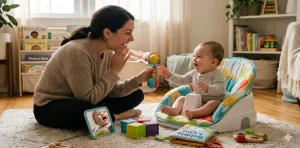
That moment is important. It shows your child is beginning to understand that their voice can be shared and enjoyed with someone else. You may also notice more babbling when you’re nearby, more sounds in the high chair when you’re facing them, or more vocal play during peekaboo. This tells you their voice is becoming part of interaction, not just background noise.
Why progress can come and go
Many parents hear a new sound… and then it seems to vanish.
This can be surprisingly common. Children often rotate through skills. One week they may focus on movement, the next on sounds. They may try something new and then return to familiar babble because it feels safe. Or they may use a sound at bedtime but not when you pick them up from daycare.
That doesn’t mean progress is lost. It usually means the skill is still settling in. A helpful image is this: early communication is less like flipping a switch and more like slowly turning up a dimmer. Some days are brighter than others, but the overall direction is what matters.
What it can feel like at home real parent moments
Progress with babbling often shows up in ordinary scenes.
You’re buckling the car seat and hear a new “puh” between giggles. You’re washing hands and suddenly a “g” sound appears that you’ve never heard before. You’re reading a book and your child starts making little “mm” sounds while watching your mouth. Or you notice the babble has more rhythm to it, more starts and stops, more variety, even if you can’t name the exact sounds.
These moments don’t come with announcements. They slip into daily life. But they are real signs of growth.
Keeping it light helps sounds grow
Babbling tends to expand best in a relaxed, playful space, when your child feels safe to experiment without being corrected or tested.
If you respond with interest when your child makes a sound, smiling, echoing it, or simply pausing to listen, you’re already supporting this in a powerful way. The message they receive is simple: “Your voice matters here.”
Some families like having a gentle guide for what to notice and how to keep things playful during routines. If that feels helpful, BASICS is an optional tool that supports parents in choosing communication goals, like expanding babbling, and following easy, everyday ideas without turning the day into practice time.
A calm reminder to end on
If you’re not hearing clear words yet, it doesn’t mean nothing is happening.
Progress in expanding babbling often looks like new mouth shapes, repeated syllables, playful sound changes, new consonants appearing now and then, and a child who seems more and more delighted by their own voice. These are meaningful steps. They show curiosity, growing confidence, and a deeper back-and-forth connection with you.
And when you notice those small signs and treat them as real progress, you’re doing more than tracking development. You’re creating the warm, responsive space where communication grows naturally, one playful sound at a time.
About the Author:
Anuradha Karanam
Speech-language pathologist (7+ years of experience)
Anuradha Karanam is a skilled speech-language pathologist with over 6 years of experience. Fluent in Tamil, Telugu, Hindi, and English, she specializes in parent counseling, speech sound disorders, fluency assessment, and speech-language evaluations. Anuradha excels at working with children with developmental disorders, offering creative and effective therapy programs. Currently, at Wellness Hub, she holds a BASLP degree and is registered with the RCI (CRR No A85500). Her patience, ambition, and dedication make her a trusted expert in her field.
Book your Free Consultation Today
Parent/Caregiver Info:
Client’s Details:
* Error Message