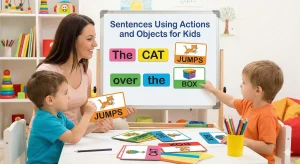
Color-Based Sentence Worksheets for Kids: Learn Sentences Using Colors
By Wellness Hub
Last Updated: December 22, 2025
Color-based sentence worksheets help children move from single-word responses to meaningful, complete sentences.
If your child can name colors but struggles to say full sentences like “The car is red” or “These balloons are blue”, this is a common and important language development stage.
Colors are one of the earliest concepts children understand. When used intentionally, they become powerful tools for teaching sentence structure, grammar, vocabulary, and expressive language—especially for preschoolers, early learners, and children with speech delay or autism.
This guide explains what color-based sentence worksheets are, why they matter, how parents and therapists use them, and how to teach sentence skills at home step by step using structured printable resources.
Why Color-Based Sentence Worksheets Help Early Language Development
Young children learn best when the cognitive load is reduced.
Colors are familiar. Children see them daily—in clothes, toys, books, food, and their environment. Because the concept of color is already understood, the child can focus on how to say something rather than what to say.
Color-based sentence worksheets support:
- Vocabulary expansion
- Sentence structure awareness
- Grammar development (is / are, singular / plural)
- Listening and comprehension
- Early literacy readiness
Instead of asking children to generate new ideas, these worksheets guide them to organize words into correct sentences.
This is especially helpful for children who:
- Speak in one-word or two-word phrases
- Mix up word order
- Struggle with grammar
- Need visual support to express language
What Are Color-Based Sentences? (With Clear Examples)
Color-based sentences combine:
- A color word
- An object
- A describing or linking word
Examples:
- “The apple is red.”
- “I see a blue car.”
- “These flowers are yellow.”
- “The green ball is big.”
These sentences teach children:
- How words connect
- Where verbs belong
- How to describe objects clearly
They also prepare children for:
- WH questions (What color is it?)
- Reading simple sentences
- Writing early sentences
Who Should Use Color-Based Sentence Worksheets?
Toddlers (2–3 Years)
At this stage, children begin combining words.
Color worksheets help toddlers:
- Move from “red” to “red ball”
- Build 2–3 word phrases
- Improve attention and labeling skills
Preschoolers (3–5 Years)
Preschoolers are ready for full sentences.
These worksheets help:
- Expand phrases into sentences
- Improve grammar naturally
- Answer simple questions
Early Learners (5–7 Years)
Older children benefit from:
- Sentence correction
- Grammar accuracy
- Sentence writing practice
Children With Speech Delay or Autism
For children who need visual structure, color-based worksheets:
- Reduce verbal pressure
- Offer predictable sentence patterns
- Support expressive language safely
Types of Color-Based Sentence Worksheets for Kids
1. Color and Object Sentences
Children learn to pair colors with familiar objects using structured sentence frames.
Example:
- “The ___ is ___.”
This builds foundational sentence awareness.
2. Jumbled Sentences Using Colors
Words are mixed, and the child rearranges them into a correct sentence.
This improves:
- Word order
- Syntax
- Sentence planning
3. Grammar Practice Using Colors (Is / Are)
Colors help children visually understand:
- Singular vs plural
- Correct verb usage
Example:
- “The ball is red.”
- “The balls are red.”
Printable Color-Based Sentence Worksheets (Structured Practice)
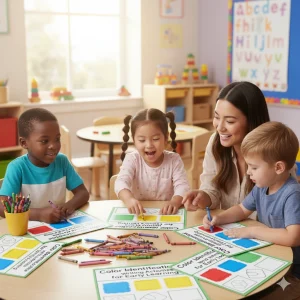
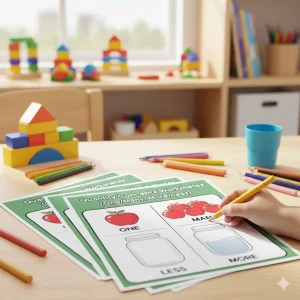
These printable resources are designed to follow a clear skill progression—from recognition to expression—without overwhelming the child.
| Worksheet Type | Skill Focus | Resource Link |
|---|---|---|
| Color and Object Sentences | Vocabulary + sentence formation | Download PDF |
| Jumbled Sentences (Colors) | Word order + syntax | Download PDF |
| Sentences Using Colors | Expressive language | Download PDF |
| Colors with Is/Are (Write) | Grammar application | Download PDF |
| Colors with Is/Are (Circle) | Grammar recognition | Download PDF |
How to Teach Sentences Using Colors at Home
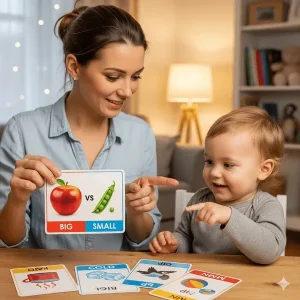
Step 1: Model the Sentence
- Say the full sentence clearly.
- “The apple is red.”
Step 2: Encourage Repetition
Ask your child to repeat or complete the sentence.
Step 3: Expand Short Responses
- Child: “Red.”
- Parent: “Yes, the apple is red.”
Step 4: Use Daily Objects
- Clothes, toys, fruits, books—real-life practice reinforces learning.
- Short, consistent practice (10–15 minutes) works better than long sessions.
How Speech Therapists Use Color-Based Sentence Worksheets
Speech therapists use these worksheets to:
- Control sentence length
- Teach grammar visually
- Reduce verbal overload
- Track progress over time
The structured format allows therapists to:
- Start with pointing and labeling
- Move to sentence repetition
- Encourage spontaneous sentence use
This step-by-step approach builds comprehension before expression, which is critical for long-term language development.
Common Mistakes Parents Make (And How to Fix Them)
| Common Parent Mistake | Why It Slows Language Progress | What Parents Should Do Instead |
|---|---|---|
| Asking too many questions during practice | Children may feel tested or pressured, which can reduce confidence and speech attempts | Model the full sentence first and invite the child to repeat or complete it |
| Expecting long sentences too early | Children need time to move from single words to full sentences | Start with short phrases and gradually expand them into complete sentences |
| Correcting every mistake immediately | Frequent correction can discourage children from trying to speak | Repeat the correct sentence naturally without pointing out the mistake |
| Skipping visual support | Without visuals, children may struggle to understand or recall words | Always pair sentences with pictures, objects, or worksheets |
| Practicing for too long in one session | Long sessions can cause fatigue and frustration | Keep practice short (10–15 minutes) and consistent |
| Focusing only on color naming | Naming colors alone does not build sentence skills | Encourage full sentences using color + object + verb |
| Using random activities without structure | Lack of structure makes progress harder to track | Use step-by-step worksheets that build skills gradually |
| Comparing progress with other children | Every child develops language at a different pace | Focus on your child’s individual progress and small improvements |
Why Structured Worksheets Work Better Than Random Practice
Random practice lacks:
- Skill progression
- Predictability
- Measurable improvement
Structured worksheets:
- Build confidence gradually
- Reinforce patterns
- Support independent language use
Children learn best when they know what comes next.
Why Parents Trust Wellness Hub for Language Resources
Wellness Hub creates therapy-informed resources designed with real developmental milestones in mind.
Each worksheet is created to:
- Support natural language growth
- Work for both home and therapy use
- Be simple, visual, and effective
The focus is always on functional communication, not rote learning.
Frequently Asked Questions
1. What are color-based sentence worksheets for kids?
Color-based sentence worksheets help children learn how to form complete sentences using familiar color words and objects. Instead of only naming colors, children practice saying sentences like “The apple is red” or “These balls are blue,” which supports grammar, vocabulary, and sentence structure.
2. At what age should children start using color-based sentence worksheets?
Most children can start using color-based sentence worksheets between 2 and 3 years, once they begin recognizing colors. Younger toddlers may focus on short phrases, while preschool and early school-age children can practice full sentences and grammar.
3. How do color-based sentence worksheets support language development?
These worksheets reduce thinking load by using familiar colors. This allows children to focus on:
- Word order
- Sentence structure
- Grammar like is/are
- Expressing ideas clearly
They are especially useful for building expressive language skills step by step.
4. Are color-based sentence worksheets helpful for children with speech delay?
Yes. Children with speech delay often understand more than they can say. Color-based sentence worksheets provide visual support and predictable sentence patterns, which makes it easier for them to practice speaking without pressure.
5. Can children with autism benefit from color-based sentence worksheets?
Yes. Many children with autism learn best with visual structure and repetition. Color-based sentence worksheets offer clear models, reduce language overload, and support communication in a calm, predictable way.
6. How often should parents use color-based sentence worksheets at home?
Parents can use these worksheets 3 to 4 times a week for 10–15 minutes per session. Short, consistent practice works better than long sessions and helps children stay engaged without frustration.
7. Do color-based sentence worksheets teach grammar?
Yes. These worksheets naturally teach grammar concepts such as:
- Singular and plural nouns
- Correct use of is and are
- Sentence word order
Children learn grammar through repetition and visual examples rather than memorization.
8. What should parents do if a child says the sentence incorrectly?
Parents should avoid correcting directly. Instead, repeat the sentence correctly in a natural way. For example, if the child says “Ball red,” the parent can say, “Yes, the ball is red.” This helps children learn without feeling corrected.
9. Can parents use color-based sentence worksheets without a speech therapist?
Yes. These worksheets are designed for parent-led home practice. They are easy to use, visually clear, and effective even without professional training. Many therapists also recommend them for home reinforcement.
10. How are color-based sentence worksheets different from simple coloring activities?
Coloring activities focus mainly on fine motor skills. Color-based sentence worksheets focus on language use, helping children describe, explain, and form complete sentences using colors, objects, and grammar.
11. Why Parents Choose Wellness Hub Resources
Wellness Hub creates language resources that are:
- Therapy-informed
- Easy for parents to use
- Structured for real communication skills
Book your Free Consultation Today
Parent/Caregiver Info:
Client’s Details:
* Error Message