My Child Switches Hands or Grips Constantly, Is That Normal?
By Wellness Hub
Last Updated: January 31, 2026
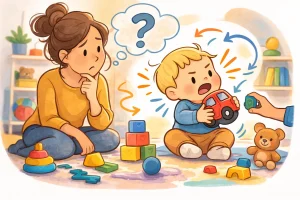
You hand your child a crayon and they start in the left hand, then switch to the right. They pick up a spoon with one grip, then adjust it three times before taking a bite. They hold scissors one way, then flip them, then try again. If you’ve found yourself watching all this switching and wondering, “Shouldn’t they have a ‘right’ way by now?” you’re in very good company.
For many children, changing hands and grips is a normal part of learning how their hands work. It can look messy from the outside, but often it means your child is doing something useful: experimenting, problem-solving, and searching for comfort and control.
This article will help you understand why grip changes happen, what “helpful variety” can look like, and when a small change in the setup can make things feel easier for your child and calmer for you.
Why kids switch hands and grips so much
Adults tend to forget how many tiny decisions are involved in using our hands. Holding, pressing, pulling, turning, pinching, squeezing, and letting go all require your child to coordinate muscles, adjust pressure, and plan movements in real time. That larger skill, using hands and fingers with smooth, controlled movements, develops gradually through everyday play and routines.
So when your child keeps changing how they hold something, it is often because they are trying to answer questions their body is still learning, such as:
This feels awkward, can I make it feel better?
If I hold it higher, will I have more control?
If I switch hands, will it be easier?
How hard do I need to press to make this work?
That kind of experimenting is not a sign of “doing it wrong.” It is often the path toward doing it well.
Switching can be a sign of learning, not confusion
It is easy to assume that consistency equals progress. But with hand skills, progress often looks like variety first.
As children build fine motor control, they naturally try different grasp patterns depending on the object and the task. A chunky marker, a tiny sticker, a slippery cup, a fork, a zipper pull, all of these invite different hand positions. Even the same object can feel different when your child is tired, excited, sitting differently, or working on a new surface.
In many cases, switching hands or grips is your child’s way of finding a “just right” amount of effort. They are learning to regulate force, how hard to squeeze, how gently to place, how firmly to press, so the tool responds the way they want it to.
And that is a meaningful life skill. It helps children handle toys without breaking them, turn pages without tearing them, use utensils with less mess, and draw with more comfort over time.
What “helpful variety” often looks like
Parents often ask what is normal versus what is worth paying attention to. A helpful way to think about it is this: does the switching seem to support your child’s success, or does it seem to interrupt it?
Helpful variety often looks like a child who changes grips briefly and then continues the activity. They might adjust their fingers on a crayon and keep coloring. They might switch hands while building and still stay engaged. The overall feeling is, “They’re figuring it out,” even if it is not tidy.
You may also notice that your child uses different hands for different jobs. One hand might do the main work, such as drawing, cutting, or placing, while the other hand helps by holding the paper, stabilizing the bowl, or keeping the toy steady. That teamwork between hands is part of growing control too, and it does not always show up in a perfectly consistent way at first.
Another reassuring sign is when your child seems proud of what they can do, even if their grip changes along the way. Confidence and engagement matter. A comfortable, effective grasp is less about looking a certain way and more about helping your child participate with less frustration.
Why some days look more “all over the place” than others
If you have noticed that the switching increases at certain times, you are not imagining it. Hand control is closely tied to energy, attention, and overall comfort.
On days when your child is tired, hungry, excited, or rushing, you might see more grip changes, more pressing too hard, or more dropping and re-grabbing. In busy environments, children may also move faster and use more effort than they need, which can make their hands look less steady.
This is one reason it can be unhelpful to judge your child’s hand use based on one moment at the table or one craft attempt. Development is not a straight line. It is much more like a spiral, revisiting the same skill again and again with small improvements over time.
When a small tweak can reduce frustration
Sometimes switching is simply exploration. Other times, it is your child trying to cope with a setup that does not feel manageable yet. If you are seeing more frustration than curiosity, it may help to look at the fit between your child and the task.
For example, some tools are harder to control than they look. A thin crayon can be tricky for small hands. A slippery cup can encourage constant re-gripping. A utensil that is a bit too heavy can lead to frequent hand switching just to keep going. Even the surface matters. Coloring on a slick table versus on paper that slides can change everything.
You do not need to correct your child’s grip or coach them through every adjustment. Often, the most supportive change is simply making the activity feel more comfortable so your child can focus on the fun part, not the struggle part. If your child relaxes and stays with the activity when the materials are easier to hold, that is useful information. It suggests their hands are learning best when the task matches their current level of control.
What about hand preference, should my child pick one hand?
Many parents expect a clear dominant hand early on, and it can be surprising when a child switches back and forth. In reality, hand preference can take time to settle, and it often becomes clearer through repeated, meaningful use rather than through reminders to “pick a hand.”
It is also common for children to use one hand for some activities and the other hand for different activities for a while. That does not automatically mean anything is wrong. It can simply be part of how they are organizing their skills.
If you are unsure, it can help to notice patterns without turning it into a test. Over time, you may see your child naturally choose one hand more often for tasks that require precision, while the other hand becomes the helper. That shift can happen gradually and quietly.
When it may be worth getting extra input
Most grip switching is part of learning. Still, parents know their child best, and it is okay to want guidance if something feels consistently hard.
Extra support can be helpful if your child regularly seems upset during hand-based activities, avoids them altogether, or if everyday tasks like eating, drawing, or simple play feel like a constant battle. Sometimes families also seek input when they are not sure how to make activities feel easier without hovering or correcting.
Getting a second set of eyes does not mean you are looking for a problem. It simply means you want your child to feel more comfortable and capable, and you want your home life to feel less tense around daily tasks.
Some parents like using a gentle, structured support tool such as BASICS, which helps you understand goals related to hand and finger control and offers simple, everyday ways to encourage progress through play and routines. It can be a reassuring option when you want ideas and clarity, without turning your day into practice time.
A calm takeaway for parents
If your child switches hands or grips often, there is a good chance you are watching learning in real time. They are building the ability to use their hands and fingers with controlled movements, figuring out pressure, comfort, and coordination through everyday experiences.
You do not need to police their grip or push for perfect consistency. In many cases, the most supportive thing you can do is stay relaxed, notice what helps your child feel successful, and let their hands gain confidence through play, meals, and daily routines.
Over time, those frequent little adjustments often turn into something that looks much steadier: a more comfortable grasp, smoother movements, and a child who can focus on what they are making, not on how hard it is to hold the tool.
Book your Free Consultation Today
Parent/Caregiver Info:
Client’s Details:
* Error Message