Teaching Numbers and Early Math at Home with the BASICS App
By Wellness Hub
Last Updated: August 27, 2026
Build counting and number sense through everyday play—with guided numbers and counting games in the BASICS app.
Children begin learning about numbers long before formal school math. They notice who has more, count steps, share snacks, sort toys and recognise patterns in songs and routines. These everyday experiences help children understand what numbers mean.
Short answer: Start with small groups of real objects. Count each object once, talk about more and less, make simple patterns, and use number words during play and routines. The BASICS app can provide additional numbers and counting practice, but children still need hands-on experiences with objects and people.
The goal is not to push early academics or make a child memorise answers. It is to help numbers become useful and understandable. Children develop these skills at different rates, so follow your child’s current understanding and look for gradual progress rather than speed.
Number Sense is More Than Counting
It is easy to mistake reciting “one, two, three” for understanding numbers. Reciting is one part of learning, but number sense includes several connected skills:
- Counting words: Knowing the number sequence in the correct order.
- One-to-one correspondence: Using one number word for each object counted.
- Cardinality: Understanding that the final number said tells how many objects there are altogether.
- Recognising quantities: Noticing small amounts and comparing more, less or the same.
- Written numerals: Connecting a symbol such as 3 with a quantity of three.
A child may count aloud to 20 and still find it difficult to give you exactly four blocks. This does not mean the child has failed. It shows which connection still needs practice: matching number words to real quantities.
Counting with meaning matters more than counting as high as possible. Begin with small groups your child can see, touch or move.
How Early Math Skills Grow With Age
Early math develops gradually. These examples are flexible signposts, not tests or deadlines.
Toddlers may join in with parts of a counting rhyme, use a few number words, notice “more,” and sort familiar objects by colour or size. Their counting may not yet follow the correct order.
Around age three, many children begin counting small groups with adult support. They may touch or move each object while saying a number word and start answering “how many?” for familiar quantities.
Around ages four to five, many children count larger groups more accurately, recognise some written numerals, compare quantities and solve simple adding, taking-away or sharing problems with real objects.
Development is often uneven. A child may recognise numerals but lose track while counting objects, or make patterns without naming every shape. Language, attention, movement, learning opportunities and developmental differences can all affect how a child demonstrates understanding.
Everyday Ways to Build Number Sense
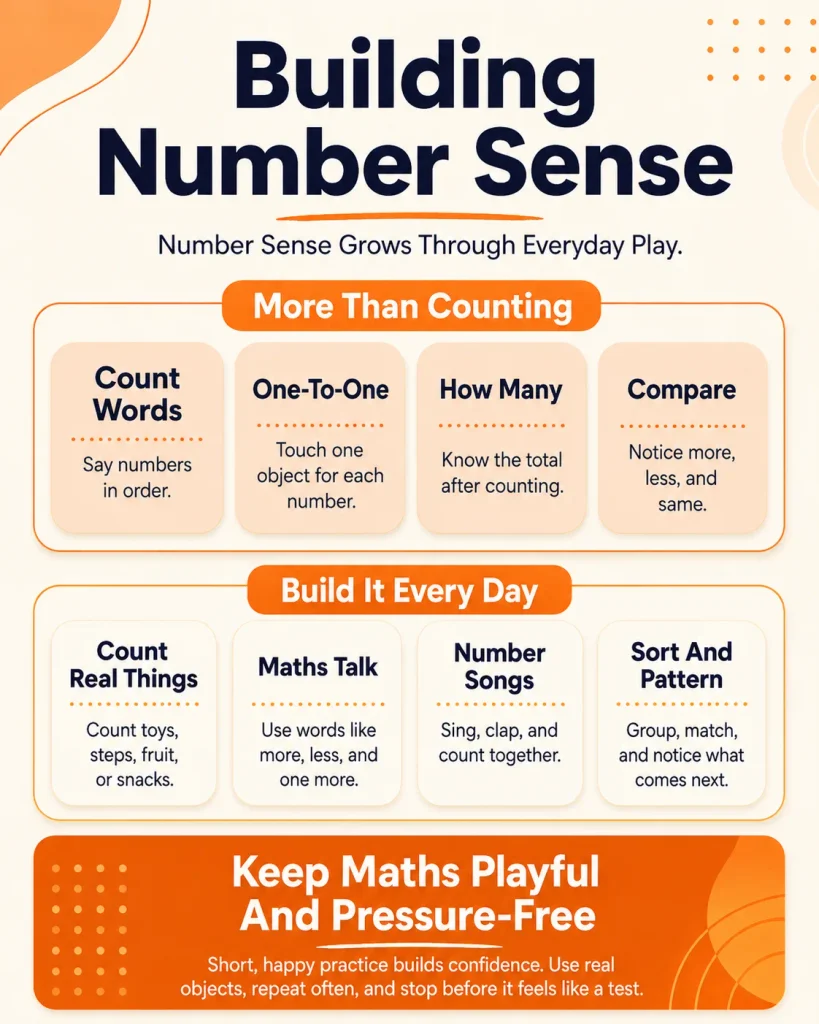
1. Count Real Things, All Day
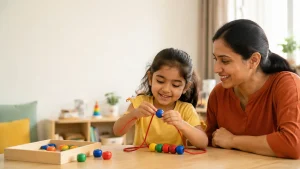
Count steps while climbing, pieces of fruit on a plate, toys while tidying or cups for the table. Encourage your child to touch, point to or move one object for every number word.
Start with two or three objects. After counting, ask, “How many altogether?” If your child counts them again, model the total without pressure: “One, two, three—there are three.”
You can also ask your child to make a quantity: “Can you give me two blocks?” This checks whether the number word is connected to an amount rather than only memorised as part of a sequence.
2. Talk Math in Daily Life
Use simple number and comparison words during ordinary routines:
- “We need two more spoons.”
- “Your tower is taller than mine.”
- “You have more grapes. How can we make it the same?”
- “First we wash, then we dry.”
- “Which cup do you think will hold more water?”
Mix questions with comments so the interaction does not feel like a quiz. Give your child time to look, touch or move objects before answering.
Children can show mathematical understanding by speaking, pointing, moving objects, signing or using AAC. They can also learn math in the language your family uses naturally at home.
3. Sing Counting Songs and Rhymes
Songs such as “Five Little Ducks” and “Ten in the Bed” help children hear number words in a predictable sequence. Songs that count backward also introduce the idea that a group becomes smaller when one item leaves.
Use fingers, toys or simple actions while singing. The visible movement helps connect the words to changing quantities. Pause before a familiar number and let your child join in if they want to.
4. Play With Sorting and Patterns
Sort toys, socks or blocks by colour, shape, type or size. Ask what belongs together and let your child explain or show their rule.
Make a short repeating pattern such as red-blue-red-blue or clap-stomp-clap-stomp. Pause and ask, “What comes next?” Once your child understands the pattern, invite them to create one for you.
Shapes and spatial words can fit naturally into the same play: round, straight, inside, under, beside and behind. For example, ask your child to place the round block inside the box or the long piece beside the short one.
5. Cook, Build and Play Games
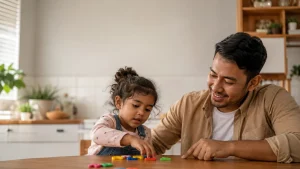
Cooking provides natural opportunities to count spoonfuls, compare containers and follow steps in order. Building helps children compare tall and short, long and short, and which structure uses more blocks.
Simple dice or path games can support counting when the child moves one space for each count. Choose games with short rules and a manageable playing time. Use large, age-appropriate pieces and supervise young children closely.
You can also explore simple adding and taking away with real objects: “You have two cars. Here is one more. How many now?” Let your child move the objects while thinking instead of expecting a mental or written answer.
Keep Math Playful and Pressure-Free
Early math should feel like exploration, not an examination. Keep practice short, use objects your child enjoys and stop before frustration takes over.
Focus on what your child is doing: touching each object once, checking the count, noticing a pattern or trying another way. Avoid comparing your child with siblings or other children. Worksheets and digital games may provide extra practice, but they should not replace counting, building, sorting, measuring and sharing in real situations.
Children develop at different rates, but that phrase should not dismiss a persistent concern. Speak with your child’s teacher, paediatrician or another qualified developmental or learning professional if early math remains unusually difficult across different activities, causes significant distress or is not progressing even with simplified, hands-on support. An app cannot assess or diagnose a learning difficulty.
Common Questions Parents Ask
“My Child Can Count to 20 but Cannot Count Objects.”
Reciting number words and counting objects are different skills. Object counting requires the child to keep the number sequence in order, match one number to each item and understand that the last number tells the total.
Practise with three or four objects placed in a line. Let your child touch or move each object while counting, then ask, “How many altogether?” Increase the group only when the smaller quantity becomes manageable.
“My Child Mixes Up or Reverses Written Numbers.”
Writing some numerals backward is common while young children are learning to write. A reversal by itself does not mean that a child has dyslexia or does not understand math.
Model the correct direction without criticism. Try tracing one numeral at a time in sand, forming it with dough or copying it from a clear example. If frequent reversals continue beyond about age seven, or appear alongside broader difficulties with reading, writing or math, discuss them with your child’s teacher or another qualified professional.
“Should I Be Teaching Written Sums Already?”
Written sums should not be the starting point. Children usually understand adding and taking away more easily when they can move real objects and see what changes.
If your child enjoys numerals, show how the written sum represents what they just did with toys or food. If your child attends preschool or school, align home practice with the teacher’s guidance.
How the BASICS App Helps You Teach Numbers
Numbers become meaningful through repeated practice with quantities, comparisons and counting. The BASICS app includes an Academics game world where children can practise numbers and counting through focused visual activities. These games work best as an additional practice tool alongside real objects, play and daily routines.
Numbers and Counting Games in BASICS
BASICS includes more than 250 learning games across Speech & Language, Academics, and Feelings & Friendships. Within Academics, children can practise content involving letters, letter sounds, numbers, counting and spelling.
A counting game may show a small group of objects and ask the child to choose the matching numeral. This provides structured practice with one specific idea. It does not prove that the child understands the same idea in every setting.
Use the Games Together
Sit with your child when possible. Describe what is happening and give them time to respond by touching, pointing, speaking, signing or using AAC. If an answer is difficult, model it calmly instead of repeating the question until the child becomes frustrated.
The goal is not to complete as many games as possible. Watch how your child approaches the task: whether they count each object once, recognise a small quantity or choose a numeral by guessing.
Connect App Practice to Everyday Math
After a numbers or counting game, repeat the idea away from the screen:
- Make the same quantity with blocks.
- Count fruit onto a plate.
- Find the numeral in a book, calendar or lift button.
- Compare two small groups and ask which has more.
This connection helps parents see whether a child can use the idea with different materials and in everyday situations. BASICS supports practice; it does not replace hands-on learning, classroom teaching, assessment or professional care.
Explore Numbers and Counting Games in BASICS

Speech and Autism Learning App for Kids Ages 2–8


A Gentle Last Word
Early math is not about counting highest or finishing written sums first. It is about understanding that numbers represent real amounts and that quantities, patterns, shapes and measurements are part of everyday life.
Count what your child can touch. Compare what they can see. Sort, build, share, pour and sing together. Use the BASICS app for focused numbers and counting practice, then bring the same idea back into play and routines. That is how number words gradually become meaningful mathematical thinking.
Numbers are everywhere. Help your child notice what they mean.
Related Reading
- Quantity Concepts Worksheets: One, Many, More and Less
- BASICS Learning Games for Kids: Speech, Academics and Social-Emotional Play
- BASICS App for Preschool and Kindergarten Readiness
References and Further Reading
- National Association for the Education of Young Children. Play Games, Learn Math! Explore Numbers and Counting With Dot Card and Finger Games.
- National Association for the Education of Young Children. Math Talk With Infants and Toddlers.
- Development and Research in Early Math Education. The Why and What of Counting.
- ZERO TO THREE. Help Your Child Develop Early Math Skills.
- American Academy of Pediatrics. Developmental Milestones: 3 to 4 Year Olds.
- Understood. Why Do Some Kids Write Numbers Backward?.
Book your Free Consultation Today
Parent/Caregiver Info:
Client’s Details:
* Error Message