Gross Motor Activities for Kids: Balance, Strength and Coordination
By Wellness Hub
Last Updated: August 18, 2026
Big-body play that builds the foundation – with the Animal Walks video library in the BASICS app.
Running, jumping, climbing and balancing use the large muscles of the body and are commonly called gross motor skills. These movements support active play and everyday participation. They also involve abilities such as postural control, balance, coordination and body awareness. This guide shares six gross motor activities for kids at home and explains how the BASICS app can support guided movement practice.
Every child moves at their own pace and in their own way. The goal is not to force a milestone or compare children. Offer frequent, enjoyable chances to move, adjust each game to your child’s current ability and stop when movement becomes painful, exhausting or distressing.
Why Big Movement Matters So Much
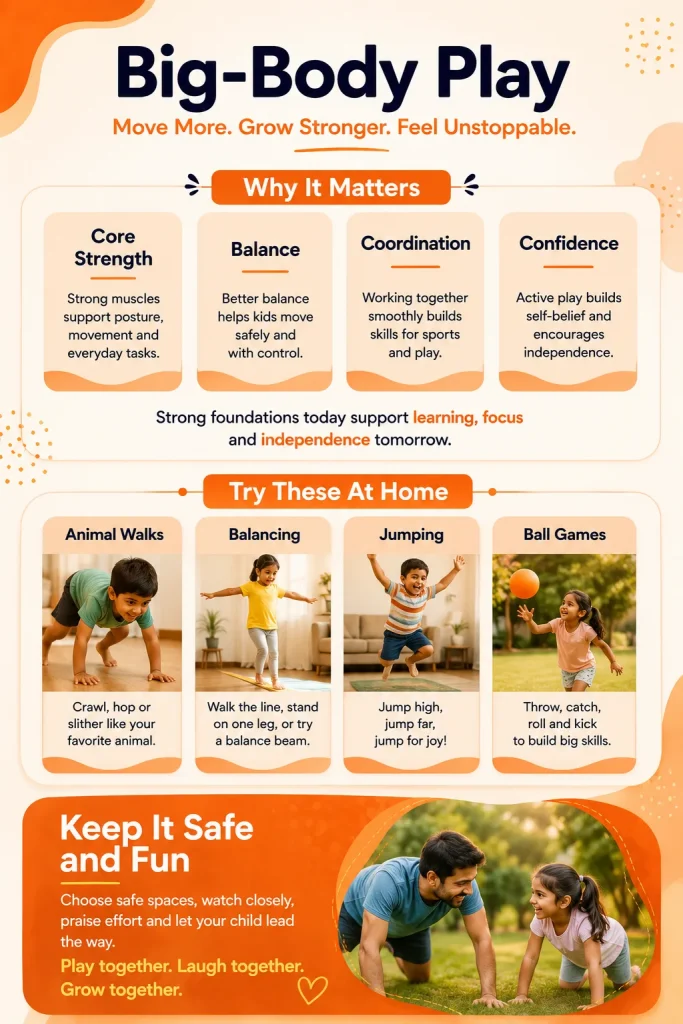
Gross motor development supports more than energetic play:
- Core strength and stability: a steady trunk supports posture and controlled movement.
- Balance and coordination: these help a child start, stop and change direction with greater control.
- Body awareness: understanding where the body is in space supports safer movement.
- A foundation for fine motor tasks: shoulder and trunk stability can give the hands a steadier base for drawing and other table-top activities.
- Confidence and participation: manageable movement challenges can help a child join play and practise new skills.
- Movement and learning are connected, but avoid overclaiming the link. Regular physical activity supports children’s health, and the CDC summary of health benefits includes muscular fitness, endurance, bone health, attention and memory. However, a single movement activity cannot be expected to fix attention, handwriting or behaviour; those concerns can have several causes.
How Gross Motor Skills Grow With Age
Big-body skills develop over time. Current CDC movement signposts include jumping off the ground with both feet by 30 months, catching a large ball most of the time by age four and hopping on one foot by age five. More complex skills continue developing through the school years as children gain experience and opportunities to practise.
Treat milestones as broad signposts, not a scorecard. Children may show skills at different times and in different settings. Use the CDC milestone checklists for your child’s age and speak with the child’s doctor if a skill has been lost or you have another developmental concern.
Gross Motor Activities to Try at Home
You do not need specialist equipment. Use a clear, dry, non-slip space; move furniture and loose objects out of the route; supervise balance, jumping and climbing; and keep devices away from feet. Choose one or two games that fit your child’s current movement and energy rather than turning the activity into a test.
1. Animal walks
Bear crawls, crab walks, bunny hops and frog jumps combine imagination with whole-body coordination. Begin with one animal over a short distance. Make it easier by keeping knees down for a crawl or copying only the arm movement while sitting. Bear walks load the hands and shoulders, while frog jumps add landing demands, so skip any movement that causes pain or conflicts with professional guidance.
2. Balancing games
Walk beside or along a wide tape line, stand on one foot with support, or freeze in a comfortable pose. Use two parallel lines for a wider path, offer stable hand support, or let a seated child tap alternating feet on secure floor marks. Make sure tape and markers cannot slide, and increase the challenge only when the child can stop safely.
3. Jumping, hopping, and skipping
Try stepping over a line, jumping with two feet, or hopping between close floor spots. Start on a level, non-slip surface and use a low-pressure version the child can control. Stepping, supported weight shifting or a small two-foot jump are valid starting points; hopping and skipping can come later. Do not use furniture or high steps as launch points.
4. Climbing and clambering
Use age-appropriate playground equipment or professionally designed soft-play with close adult supervision. At home, create a floor-level route around secure objects rather than climbing stacked cushions, chairs or furniture. Start low, keep the landing area clear and stop if the child becomes frightened, unsteady or tired.
5. Ball games
Rolling, stopping, throwing, catching and kicking can practise timing and hand-eye or foot-eye coordination. Start close together with a large, soft ball. Rolling may be easier than catching in the air, and a child can participate sitting, standing or with stable support. Change only one feature at a time, such as distance, target size or ball speed.
6. Dancing and action songs
Dancing, action rhymes and follow-the-leader games combine movement, rhythm and imitation. Use a familiar song, demonstrate one action at a time and accept movement from sitting, standing or using mobility equipment. A visual cue can replace a spoken instruction, and lower the volume if sound is uncomfortable.
Follow your child, keep it safe and fun
Meet your child where they are, celebrate effort and keep movement playful rather than pressured. Stop for pain, dizziness, unusual breathlessness, repeated falls, marked fatigue or distress. Seek professional advice if movement difficulties are persistent, affect play or daily life, or involve frequent injuries, clear asymmetry or loss of a previously used skill. Seek prompt medical care for sudden weakness, a new inability to walk or use a limb, severe pain or an acute change in movement.
Common Worries – and What They Often Mean
“They seem clumsy and bump into everything.”
Some bumps happen while coordination and body awareness are developing, but “clumsy” does not explain the cause. Notice frequency, injuries, pain, fatigue, progress and the effect on everyday participation. The NHS guidance on developmental coordination disorder recommends looking at the broader pattern; an occupational therapist, physiotherapist or doctor can assess persistent concerns.
“They avoid the playground or physical play.”
Avoidance can mean that movement feels difficult, unpredictable, tiring, painful, noisy or socially uncomfortable. Begin with a version the child can control, provide a clear way to stop and build from successful participation. Do not force climbing, jumping or contact play.
“They can’t sit still.”
Regular movement supports health and may help some children feel ready for the next routine, but movement is not a guaranteed fix for attention or regulation. Notice what happens before and after different activities. If restlessness regularly limits learning, sleep, safety or family life, discuss the full pattern with a qualified professional.
How the BASICS App Helps You Build Gross Motor Skills
Knowing that movement matters is easy; choosing suitable activities and adapting them can be harder. Wellness Hub develops the BASICS app, which provides parent-guided occupational-therapy activities, demonstrations and practical prompts that can support short periods of home practice. It does not replace free play, outdoor activity or an individual assessment.
Animal Walks: follow-along movement videos
The BASICS Animal Walks library includes guided movements such as bear walks and frog jumps. Watch the demonstration, place the device safely outside the movement path and let the child practise in the real space. Use a shorter, slower or seated version when needed; the child learns through active movement, not by watching alone.
Activities that use everyday space
BASICS activities are designed for parent-supported practice using everyday spaces and materials. Follow each safety instruction, keep the device away from the movement route and use professional guidance when a child has movement restrictions or an individual therapy programme.
A foundation that supports everything else
Gross motor practice can support posture, balance, coordination and participation in active play. It may also give the shoulders and trunk a steadier base for some table-top tasks. BASICS can organise practice, but it cannot diagnose a movement difficulty or guarantee improvements in attention, handwriting or behaviour. For a product-focused explanation, read Gross Motor Skills App for Kids: Guided Movement at Home.
A Gentle Last Word
A strong, coordinated and confident body develops through repeated opportunities to move – crawling like a bear, balancing on a line, jumping, rolling a ball or dancing in the kitchen. Keep it playful, celebrate effort, keep the space safe and follow your child’s lead. If you are concerned about pain, regression, frequent falls or the effect of movement difficulties on daily life, ask a paediatrician, occupational therapist or physiotherapist for individual guidance.
Move, climb, balance, play – you’re building a strong foundation for everything.
Related reading
- My Child Won’t Hold a Pencil or Crayon: What It Can Mean and How to Help
- Gross Motor Skills App for Kids: Guided Movement at Home
References and further reading
- CDC: Milestones by 30 Months
- CDC: Milestones by 4 Years
- CDC: Milestones by 5 Years
- CDC: Health Benefits of Physical Activity for Children
- CDC: Child Activity – An Overview
- NHS: Symptoms – Developmental co-ordination disorder (dyspraxia) in children
- HealthyChildren.org: Developmental Milestones: 3 to 4 Year Olds
- HealthyChildren.org: What should I do if I am worried about my child’s development?
- World Health Organization: Guidelines on physical activity, sedentary behaviour and sleep for children under 5 years of age
- Nemours KidsHealth: Developmental Milestones at 4 Years
Book your Free Consultation Today
Parent/Caregiver Info:
Client’s Details:
* Error Message