My Child Won’t Hold a Pencil or Crayon: What It Can Mean and How to Help
By Wellness Hub
Last Updated: August 17, 2026
A practical guide to pencil and crayon avoidance, functional grasp, age-aware expectations and low-pressure practice – with optional support from the BASICS app.
Short answer: If your child will not hold a pencil or crayon, do not begin by correcting their fingers. First notice whether they avoid touching the tool, use a whole-hand grasp, tire quickly, press unusually hard or soft, or appear uncomfortable. Change one part of the task – the tool, surface, size, position or expectation – and offer a brief, meaningful chance to make marks. Ask a paediatrician or occupational therapist about pain, loss of a skill, clear one-sided difficulty, marked fatigue or problems that regularly limit play, self-care or school participation.
First, Work Out What ‘Won’t Hold’ Means
Parents often use the same sentence for very different situations. One child will not touch crayons. Another happily scribbles with a fist. Another starts drawing but stops after a minute. These patterns do not point to one cause, and they should not receive one standard solution.
Observe one ordinary attempt before changing anything. Look at the child’s comfort, attention, posture, two-hand use, pressure and endurance. The table below is a starting point for choosing one low-pressure adjustment; it is not a diagnostic tool.
| What you notice | What it may suggest | A useful first adjustment |
| Avoids touching the tool | The texture, smell, sound, mess, demand or previous experience may feel unpleasant; the child may also have little interest in drawing. | Offer a different material or let the child make marks with a finger, sponge, stamp or easy-flow marker without requiring a finished picture. |
| Uses a whole-hand or fisted grasp | This can be an early developmental grasp, especially in a younger child. Age, control and comfort matter more than appearance alone. | Offer a tool that fits the hand and watch whether the child can make intended marks without pain or excessive effort. Do not reposition every finger. |
| Starts but stops quickly | The task may require too much effort, attention or precision, or the child may be experiencing fatigue or discomfort. | Shorten the task, stabilise the paper, use a tool that marks easily and stop before quality drops. Ask about pain rather than assuming refusal. |
| Presses very hard or barely marks | The child may still be learning force control, or the tool and surface may not provide useful feedback. | Try a softer pencil, marker, chalk or textured surface. Compare what makes a visible mark with the least effort. |
| Uses one hand much less | Hand preference can develop gradually, but persistent weakness, pain or avoidance on one side needs closer attention. | Do not force a preferred hand. Note the pattern across play, eating and dressing, and discuss clear asymmetry or sudden change with a clinician. |
Does My Child Need the ‘Correct’ Pencil Grip?
The goal is not one perfect-looking grip. A functional pencil grasp lets a child control the tool, make the marks they intend and continue without pain, marked fatigue or excessive effort. Several finger-based grasp patterns can be functional.
In a study of 120 typically developing fourth-grade children, four common mature grasp patterns showed no significant difference in handwriting speed or legibility. That finding does not mean grasp never matters; it means appearance alone should not drive correction. See the American Journal of Occupational Therapy study on pencil grasp.
A whole-hand grasp in an early scribbler can be part of development. For an older child, the more useful questions are: Is writing comfortable? Can the child control the tool? Can they complete an age-relevant task? The CliniKids guide to developing a pencil grasp similarly emphasizes comfort and effectiveness rather than treating the dynamic tripod as the only acceptable grasp.
What Pencil and Crayon Skills Are Typical by Age?
Pencil-grasp development is gradual and variable. Toddlers often explore crayons with the whole hand and use movement from the shoulder or arm. Through the preschool years, many children begin using the fingers more, adjust pressure with greater control and copy increasingly purposeful marks and shapes. A settled functional grasp may emerge anywhere across the later preschool and early school years.
The CDC’s milestones by four years include holding a crayon or pencil between the fingers and thumb rather than in a fist. The American Academy of Pediatrics’ preschool hand-and-finger guide describes rapidly improving finger control during the preschool period. Milestones are broad monitoring guides, not pass-or-fail tests, and a single grasp does not diagnose a developmental condition.
Look for change over time and across tasks. A child may use fingertips for snacks or stickers but still choose a whole-hand grasp for a thick marker. Interest, practice, tool shape and task difficulty can change what you see from one setting to another.
Why Might a Child Avoid Pencils and Crayons?
Avoidance is information, not proof that a child is lazy, defiant or unable to learn. Possible contributors include:
- Pain, joint discomfort, an awkward position or rapid hand fatigue;
- A tool that is too thin, slippery, heavy, faint or difficult to control;
- Sensitivity to wax, chalk dust, marker smell, paper texture or the feeling of messy materials;
- Difficulty coordinating vision, the working hand and the hand that steadies the paper;
- A task that asks for shapes, letters or neat colouring before the child can make easier marks comfortably;
- Low interest, limited experience or an activity offered when the child is tired, hungry or overloaded; or
- Fear of being corrected, compared or judged for the result.
A child may have enough hand strength and still struggle with tool use. Fine-motor performance also depends on dexterity, sensation, visual-motor integration, two-hand coordination, motor planning, attention, posture and the design of the task.
How Can I Help Without Forcing the Grip?
Change one variable at a time so you can see what actually helps. The aim is comfortable participation and purposeful marks, not a long practice session or a perfect picture.
Remove the Performance Test
Start with an invitation such as ‘Want to make a road for the car?’ rather than ‘Hold it properly’ or ‘Finish this page.’ Scribbles, dots, tracks and one short line are valid early practice. If the child says no, reduce the demand and offer another opportunity later instead of turning the tool into a battle.
Choose a Tool That Makes Success Easier
Try a non-toxic marker, soft-lead pencil, triangular crayon, short crayon or chalk that makes a visible mark without heavy pressure. Short tools can encourage fingertip use for some children, but they do not guarantee a tripod grasp. Avoid small broken pieces for children who mouth objects, and choose a size the child can hold safely.
Change the Surface and Position
Tape paper securely so the helper hand does not have to chase it. Try a vertical or gently sloped surface, drawing on the floor, or standing at a low table. One position may improve wrist, shoulder or visual access for one child and make another child less stable, so keep the option that improves comfort and control.
Give Mark-Making a Real Purpose
A child may care more about making tickets for a pretend bus, adding rain to a picture, drawing a path to a toy or choosing a colour for a family note than completing a generic worksheet. Begin with a mark the child can make now, then add only one small challenge.
Build Hand Skills Through Everyday Play
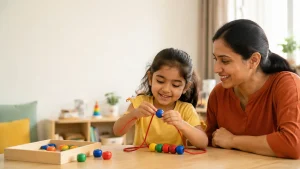
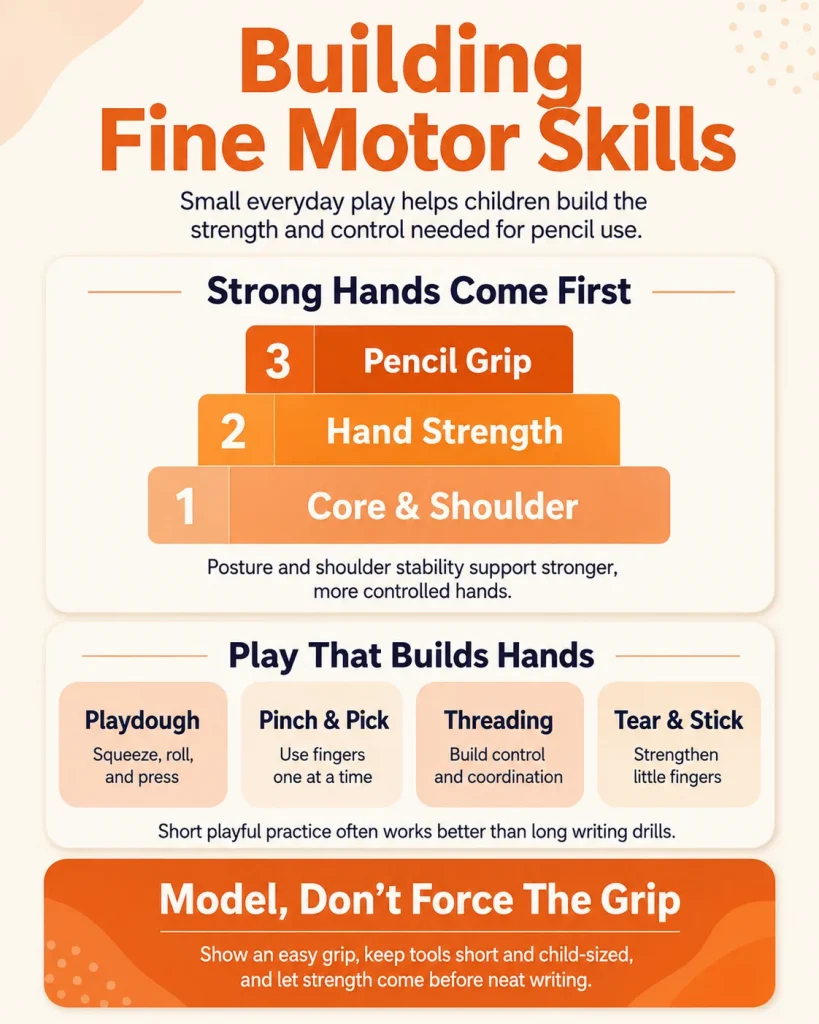
Playdough, peeling stickers, opening containers, using kitchen tongs, turning pages, dressing toys and helping with food preparation can practise resistance, fingertip control and two-hand coordination. These activities are useful experiences, but a pincer grasp does not automatically create a pencil grasp and children do not need to finish a hand-strength program before they are allowed to draw.
Practise the Actual Task in Small Doses
For children learning to draw or write, playful hand activities should sit alongside brief practice with the real tool and task. The American Occupational Therapy Association reports strong evidence for therapeutic handwriting practice in children and youth ages 5 to 21, while isolated work on underlying components alone is not supported as a handwriting intervention. Match direct practice to the child’s age: scribbling and simple marks for an early learner, and task-specific writing for a school-age child.
Stop Before Discomfort Becomes Avoidance
Pause if the child reports pain, repeatedly rubs or shakes the hand, becomes increasingly tense, loses control of the tool or shows marked fatigue. Record what was easier: the tool, position, surface, time of day or task length. Useful progress may be touching the material, staying comfortable for longer, using the helper hand or returning voluntarily another day.
Safety note: Supervise scissors, beads, buttons, counters, cords and water activities. Use child-safe scissors, non-toxic art materials and a clean water-only spray bottle that has never contained chemicals. Loose small parts can be a choking hazard, especially for children under three or any child who mouths objects.
See the US Consumer Product Safety Commission guidance on small parts.
Common Worries About Pencil Grip and Fine-Motor Skills
My Child Holds the Crayon in a Fist. Should I Correct It?
A fisted grasp can be expected in an early scribbler. Observe age, progress, comfort and control instead of correcting on every attempt. If an older preschool or school-age child continues using a whole-hand grasp and also has pain, fatigue or difficulty completing age-relevant tasks, an occupational therapist can look at the whole activity rather than simply repositioning the fingers.
My Child Presses Too Hard or Too Soft
Pressure control develops through experience, but it is not always a strength problem. Use a tool that gives a clear mark with less effort and compare surfaces with different feedback. Notice whether pressure changes with fatigue, speed or anxiety. Persistent pain, paper tearing, broken tools or marks that remain too faint for the task deserve closer assessment.
My Child Can Build and Dress but Refuses to Colour
Fine-motor ability is task-specific. A child may manage blocks, spoons and fasteners but dislike drawing because the sensory experience, visual demand or expectation is different. Use the child’s successful tasks as evidence of strengths, then make one drawing variable easier instead of assuming all hand skills are delayed.
Should I Buy a Pencil Grip?
A grip aid is not automatically the first or best answer. It may help when it solves a specific problem and the child can use it comfortably, but the wrong grip can add bulk, tension or another demand. First check tool size, paper position, seating, task length and pain. For an older child with persistent difficulty, ask an occupational therapist to trial and review an adaptation rather than buying several at random.
When Should I Ask an Occupational Therapist?
Speak with your child’s paediatrician or a qualified occupational therapist when pencil or crayon difficulty is persistent and affects participation, or when you are unsure whether the task matches your child’s development. An OT can assess the child, activity and environment together – something a general activity list or app cannot do.
Ask for professional guidance when your child:
- reports pain, numbness or frequent cramping during hand tasks;
- tires much faster than expected or repeatedly rubs and shakes the hand;
- uses one hand or side much less than the other, especially if the difference is new or pronounced;
- has lost a grasping, drawing, feeding, dressing or play skill they previously used;
- regularly avoids hand activities across play, self-care and learning, not only colouring;
- struggles to complete age-relevant classroom or daily-living tasks despite appropriate opportunities and adjustments; or
- becomes highly distressed whenever drawing, cutting or tool use is introduced.
Seek prompt medical advice for sudden weakness, a new inability to use one hand, significant swelling, injury or severe pain. Developmental monitoring should never delay care for an acute change.
Wellness Hub also provides online occupational therapy for children for families who want an individual assessment and guided support.
How Can BASICS Support Fine-Motor Practice?
BASICS is a parent-guided early-intervention and home-support app. Parents answer questions, receive developmental goals, complete three guided activities, watch demonstrations and rate how practice went. Activities include steps and therapist guidance for the adult.
Use the App as the Guide, Not the Exercise
Fine-motor learning happens through handling real objects and tools. Watch the demonstration with your child when useful, then put the device aside and try the activity with the material in front of you. The app can organise practice; it cannot build hand function through screen tapping alone.
Connect One Goal to One Everyday Situation
Choose one observable goal, such as using the helper hand, making a visible mark with less effort or opening a familiar container. Practise it during play, dressing, food preparation or drawing, then rate what happened. Keep the activity only if it improves access, comfort, control or participation without adding distress.
Know What BASICS Cannot Decide
BASICS cannot identify why a child avoids pencils, diagnose a motor or sensory condition, choose specialist equipment for an individual child or guarantee that practice will transfer to handwriting. Use it alongside professional guidance when an OT or paediatrician is involved, and seek assessment when pain, regression, asymmetry or daily-life limitations are present.
Try BASICS for Guided Hands-On Practice
Explore BASICS on Google Play or the Apple App Store. BASICS Premium currently offers a seven-day trial with monthly and yearly subscription options. Apple subscriptions renew automatically unless cancelled at least 24 hours before the current period ends. Prices, eligibility and cancellation steps can vary by store or region, so check the terms shown at checkout.
A Practical Takeaway for Parents
Start with one recurring situation, one observation and one adjustment. If your child avoids the tool, make the experience easier to approach. If they use a fist but draw comfortably, watch development rather than correcting every finger, and they tire, hurt or lose control, shorten the task and investigate why. Build varied hand use through everyday play while continuing brief, age-appropriate practice with the real tool. The goal is not a textbook grip; it is comfortable, effective participation.
Related Reading
- BASICS Fine Motor Skills App: Guided Hand Practice for Kids at Home
- What Fine Motor Control Really Means
- Online Occupational Therapy for Kids
References and Further Reading
- CDC: Milestones by 4 Years
- American Academy of Pediatrics: Hand and Finger Skills of Your Preschooler
- American Occupational Therapy Association: Evidence-Informed Handwriting Interventions for Children and Youth 5-21
- Schwellnus et al.: Effect of Pencil Grasp on the Speed and Legibility of Handwriting in Children
- CliniKids: Developing a Pencil Grasp
- US Consumer Product Safety Commission: Small Parts Ban and Choking Hazard Labeling
Book your Free Consultation Today
Parent/Caregiver Info:
Client’s Details:
* Error Message