How to Help Your Child Speak in Full Sentences
Last Updated: July 7, 2026
Learn how to help your child move from short phrases to longer sentences using expansion, extension, everyday conversation, and guided BASICS sentence-building games.
If your child is saying short phrases like “want juice,” “big truck,” or “daddy go,” the next step is helping those phrases grow into longer, clearer sentences. You can do this by adding one small piece to what your child already says, modelling full sentences during daily routines, and giving them many chances to hear and use language naturally.
This guide shows you how, and how the BASICS app turns it into an easy daily routine.. You’ll learn how to expand your child’s words, add more detail, model grammar gently, and use everyday moments like play, meals, books, and routines to support sentence growth.
And this applies to every way your child communicates. A longer string of signs, gestures, or symbols on a communication device can count as a sentence too. What matters is that your child is learning to share a fuller thought.
What Does “Speaking in Sentences” Really Mean?
A sentence isn’t just more words — it’s words working together to carry a complete thought. Growing sentences means helping your child with two things at once: making their utterances a little longer, and filling in the grammar that makes them clear. That includes the small pieces that early phrases usually skip:
- Little connecting words: “the,” “a,” “is,” “in,” “on.”
- Verb endings and tenses: “jumping,” “jumped,” “wants.”
- Plurals: “one dog,” “two dogs.”
- Pronouns: “he,” “she,” “they,” “mine.”
These pieces arrive gradually, and rarely all at once. Your child might master plurals long before tenses, or use “me” for “I” for months. That’s completely normal — grammar assembles itself piece by piece, over time and with lots of gentle modelling.
The Core Technique: Expand, Then Extend
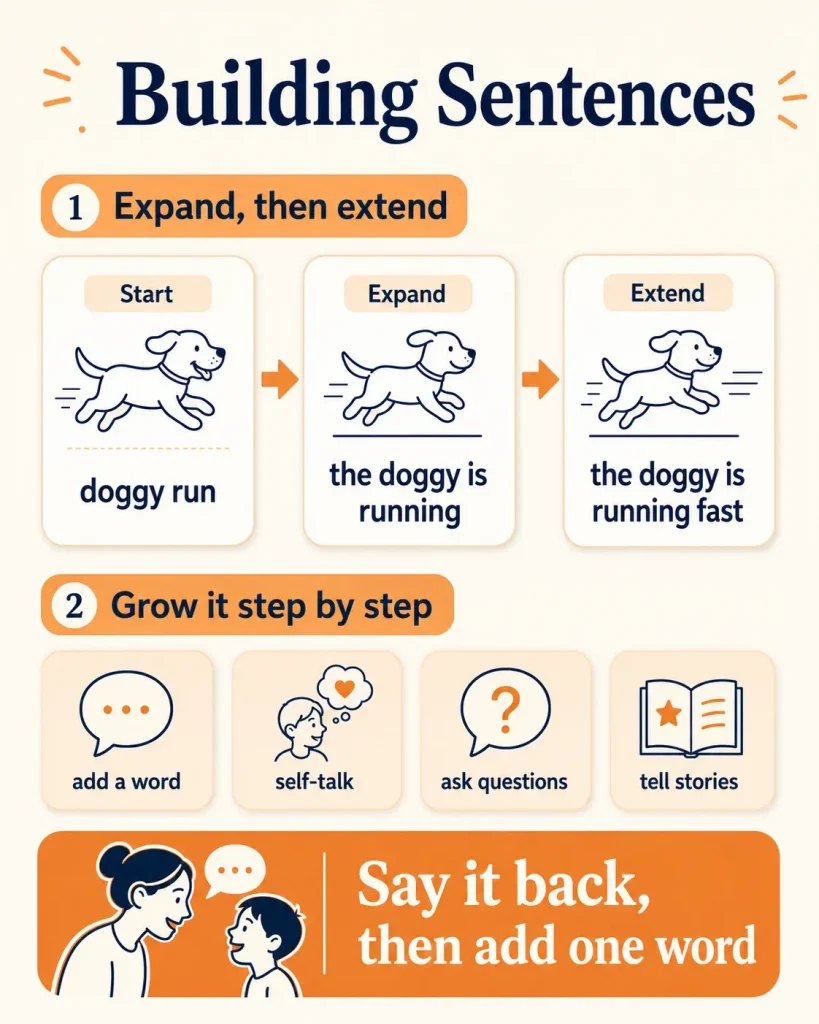
One of the easiest ways to help your child use longer sentences is to build on what they already say. You do this in two steps: expand their words, then extend the idea.
Expansion means you repeat your child’s message with the missing words or grammar added.
Extension means you add one new idea to make the sentence a little richer.
| Child says | Expansion | Extension |
|---|---|---|
| “Doggy run” | “The doggy is running.” | “The doggy is running fast.” |
| “Want juice” | “I want juice.” | “I want cold juice.” |
| “Daddy go” | “Daddy is going.” | “Daddy is going to work.” |
| “Baby cry” | “The baby is crying.” | “The baby is crying loudly.” |
| “More blocks” | “I want more blocks.” | “I want more blue blocks.” |
The goal is not to correct your child or make them repeat after you. The goal is to give them a slightly better version of what they already tried to say.
For example, if your child says, “Car go,” you can say, “Yes, the car is going.” That is enough. Avoid making the sentence too long, such as, “The big red car is going very fast on the road near our house.” That may be too much for a child who is still learning short sentences.
A good rule is: add one small piece at a time. If your child uses two words, model three or four words. If your child uses three words, model four or five words.
You can use this during normal routines:
- At snack time: “Want banana” → “I want banana.”
- During play: “Train go” → “The train is going.”
- While dressing: “Shoe on” → “Your shoe is on.”
- During bath time: “Water splash” → “The water is splashing.”
- While reading: “Bear sleep” → “The bear is sleeping.”
This also works if your child uses signs, gestures, or a communication device. If your child signs “more juice,” you can say and model, “I want more juice.” If your child taps symbols for “dog run,” you can model, “The dog is running.”
You do not need to say, “Now you say it.” Repeated modelling is more helpful than testing. When your child hears a clearer sentence built from their own idea, they learn grammar without feeling wrong.
Use this many times across the day, especially during moments your child already enjoys. Small sentence models, repeated often, are what help short phrases grow into clearer sentences.
Everyday Ways to Grow Sentences
1. Add one piece at a time
Aim just one step beyond your child. If they use three-word phrases, model four or five words — not ten. One step up is the sweet spot; a giant leap only overwhelms.
2. Use self-talk and parallel talk
Narrate your own actions in full sentences (“I’m washing the red cup”) and describe what your child is doing (“You’re building a tall tower”). This floods their day with well-formed sentences, tied to the here and now.
3. Ask questions that invite more
Open questions stretch sentences further than yes/no ones. “What is the puppy doing?” invites a sentence; “Is that a puppy?” invites a nod. Give them time to answer, and expand whatever comes back.
4. Tell and retell little stories
Talk through what just happened in order: “First we put on shoes, then we went outside, and we saw a bus!” Simple sequences model how sentences link together into connected talk — the foundation of storytelling later on.
5. Read, pause, and talk about books
Books are packed with full sentences. Pause to wonder aloud (“I think the bear is hungry…”), ask what might happen next, and let your child add their ideas. Shared books gently pull language into longer, richer forms.
Model, don’t correct
When your child makes a grammar slip — “me runned fast” — resist the urge to correct directly. Instead, simply say it back the right way: “Yes, you ran fast!” This shows the correct form without any sense of getting it wrong, which keeps your child confident and talking. If your child works with a speech therapist, these strategies sit comfortably alongside that professional guidance.
How Long Should Children’s Sentences Be by Age?
Every child grows at their own pace, but a rough guide helps you know what to aim for and what to celebrate. Around age two, many children use two- and three-word phrases. By around three, sentences often stretch to three, four or more words and start including little connecting words. By around four, many children tell short stories, use a range of tenses, and speak in sentences that familiar adults understand almost all of the time.
| Age | What many children may do |
|---|---|
| Around 2 years | Use 2–3 word phrases |
| Around 3 years | Use longer phrases and short sentences |
| Around 4 years | Use clearer sentences and short stories |
Treat these as gentle signposts, not a scorecard. What matters far more than hitting an exact length is steady movement forward — sentences that are gradually getting longer, clearer, and richer over the months. If your child’s sentences aren’t growing over time, or you find yourself struggling to understand them well beyond these ages, it’s always worth a friendly conversation with a speech-language professional. Trust your instincts; early support is a gift, never a verdict.
When Should You Speak With a Speech-Language Professional?
Home practice can help many children build longer sentences, but it should not replace professional support when a child needs it. Consider speaking with a speech-language professional if your child’s sentences are not growing over time, if they mostly use single words or very short phrases beyond the expected age range, or if familiar adults often struggle to understand what they are saying.
It is also worth seeking guidance if your child seems frustrated when trying to communicate, has trouble following simple directions, has lost words or communication skills they used before, or if you have concerns about hearing, attention, autism, or overall development.
You do not need to wait until the problem feels serious. A speech-language professional can check your child’s communication skills, explain what is typical for their age, and suggest the right next steps. Early support does not mean something is “wrong” with your child. It simply gives them more help at the right time.
How BASICS Helps Children Practice Sentence Building
Growing sentences means juggling length and grammar at the same time — and knowing which piece to focus on next isn’t always obvious. The BASICS app is built by speech therapists and child-development specialists to make that clear, turning sentence-building into a structured routine you can follow a few minutes at a time.
Guided sentence-development activities
Within the BASICS Communication module, the Phrases & Sentence Development area carries your child from two-word combinations into fuller, well-formed sentences. It focuses on one manageable step at a time — with clear activities, ready-to-use parent prompts, gentle progressions and therapist tips — so you’re never guessing whether to work on length, tenses, plurals or connecting words next.
Sentence Symphony games for grammar practice
BASICS includes a rich set of sentence-building games in Sentence Symphony, designed to grow exactly the skills this stage needs — subjects and verbs, tenses, plurals, pronouns and the small connecting words that make sentences complete. Because they’re playful and repeatable, your child gets the many gentle repetitions grammar needs to settle in, without it ever feeling like a lesson. And true to how BASICS is built, wrong answers gently teach rather than simply redirect — so every attempt moves learning forward.
Videos that model clear sentences
BASICS models language in short, predictable clips your child can watch again and again — hearing well-formed sentences in a calm, consistent format that many children learn best from. You watch together, pause, and try, with no pressure and no testing.
Printables for screen-free sentence practice
For screen-free moments, BASICS printables give you simple, tactile ways to build and extend sentences at the table or on the go — sequencing pictures, describing scenes, and telling little stories together.
Support for speech, signs, gestures, and AAC
Signs, gestures and communication devices are treated as fully equal to speech throughout BASICS. A child who strings several signs or symbols together to share a complete thought is building sentences — and BASICS is built to recognise, honour and grow that, whatever form it takes.
Try Sentence-Building Practice in BASICS – Try free for 7 days — no pressure, cancel anytime.
A Gentle Last Word
Full sentences don’t arrive on a set day, and they don’t arrive because we drilled them. They grow, quietly and steadily, from thousands of small, warm exchanges — you saying a little more, your child reaching a little further. Keep expanding and extending, keep the moments playful, and celebrate every longer thought, however it comes out. Bit by bit, phrases become sentences, and sentences become conversation.
A little more each time — that’s how sentences, and conversations, are built.
Clinically Reviewed By
Reviewed by Shilpa Deshpande, Bsc(ASLP), Speech and Language Therapist at Wellness Hub.
Shilpa supports children and families with speech and language assessments, speech sound concerns, language and communication difficulties, autism-related communication needs, and caregiver guidance. This article was reviewed for clinical accuracy, parent-friendly language, and safe guidance on helping children move from short phrases to longer sentences.
This content is for educational purposes only and does not replace professional assessment, diagnosis, or therapy.
View Shilpa Deshpande’s Profile
FAQs About Helping Children Speak in Sentences
At what age should a child speak in sentences?
Many children start using two- or three-word phrases around age 2. By around age 3, many children begin using longer phrases and short sentences. By around age 4, many children can speak in clearer sentences and tell simple stories. These are general milestones, not strict deadlines, so look for steady progress over time.
How can I help my child move from phrases to sentences?
The easiest way is to repeat what your child says and add a little more. If your child says, “dog run,” you can say, “The dog is running.” You can also add one new idea, such as “The dog is running fast.” This gives your child a clear model without pressure.
Should I correct my child when they use the wrong grammar?
It is better to model the correct sentence instead of directly correcting them. If your child says, “me goed park,” you can say, “Yes, you went to the park.” This helps your child hear the right form while keeping the conversation positive.
What if my child only uses two-word phrases?
Two-word phrases can be a normal stage of language development, especially around age 2. You can help by adding one word or idea at a time. For example, if your child says, “want ball,” you can say, “I want the ball.” If your child’s sentences are not growing over time, it may help to speak with a speech-language professional.
Do signs, gestures, or AAC count as sentences?
Yes. A sentence does not have to be spoken to count. If your child combines signs, gestures, pictures, or AAC symbols to share a complete thought, they are building sentence skills. These forms of communication should be accepted and encouraged.
How long should my child’s sentences be?
Sentence length depends on your child’s age, language level, and development. A helpful goal is to model one small step above what your child already says. If your child uses two words, model three or four words. If they use short sentences, model slightly longer sentences with more detail.
When should I speak with a speech-language professional?
Consider speaking with a speech-language professional if your child’s sentences are not getting longer over time, they are very hard to understand, they lose words or communication skills, or you have concerns about hearing, speech, language, autism, or overall development. Early support can help you understand what your child needs.
Can the BASICS app help my child practice sentences?
The BASICS app can support sentence practice through guided activities, sentence-building games, videos, and printables. It can help parents model longer sentences during daily practice. It should be used as a support tool and does not replace professional assessment, diagnosis, or therapy when a child needs extra help.
Related reading
- How to Help Your Child Combine Words into Phrase
- How to Teach First Words at Home
- 2-Year-Old Speech Milestones: Is Your Child on Track?
- How to Teach WH Questions to Kids: Parent’s Guide
- How to Help a Child with Speech Delay at Home
References & further reading
The strategies above reflect widely used, evidence-based language approaches described by the following authoritative sources.
- American Speech-Language-Hearing Association. Communication Milestones: 2 to 3 Years.
- American Speech-Language-Hearing Association. Communication Milestones: 3 to 4 Years.
- National Institute on Deafness and Other Communication Disorders. Speech and Language Developmental Milestones.
- HealthyChildren.org, American Academy of Pediatrics. Language Delays in Toddlers: Information for Parents.
- American Speech-Language-Hearing Association. Augmentative and Alternative Communication (AAC).
- The Hanen Centre. How to Help Your Child Use Early Sentences.
- Oxford Health NHS. Building Sentences.
Book your Free Consultation Today
Parent/Caregiver Info:
Client’s Details:
* Error Message