It Is Not Your Fault If Joint Attention Feels Hard Right Now
Last Updated: April 9, 2026
If joint attention feels hard in your home right now, it can quietly mess with your confidence. You point at something cute, you look at your child, you wait, and nothing happens. Or they glance for a split second and then go right back to what they were doing. It is easy to start wondering if you are doing something wrong, or if you missed a window you were supposed to catch.
You did not cause this. And you are not failing your child.
Joint attention is one of those skills that looks simple from the outside, but it is actually a mix of attention, timing, interest, and comfort. Many loving, responsive parents still find it tricky to get those shared moments going consistently. The goal is connection, not performance.
Read More: It Can Be Normal If Your Toddler Hears You but Does Not Look Up to Their Name
Why does joint attention feel hard even when I am trying?
A lot of parents assume joint attention should happen automatically if they are warm, playful, and present. Those things matter, but they are only part of the picture. Joint attention asks your child to do several things close together, sometimes in a busy environment.
Here are a few very normal reasons it can be slow to show up:
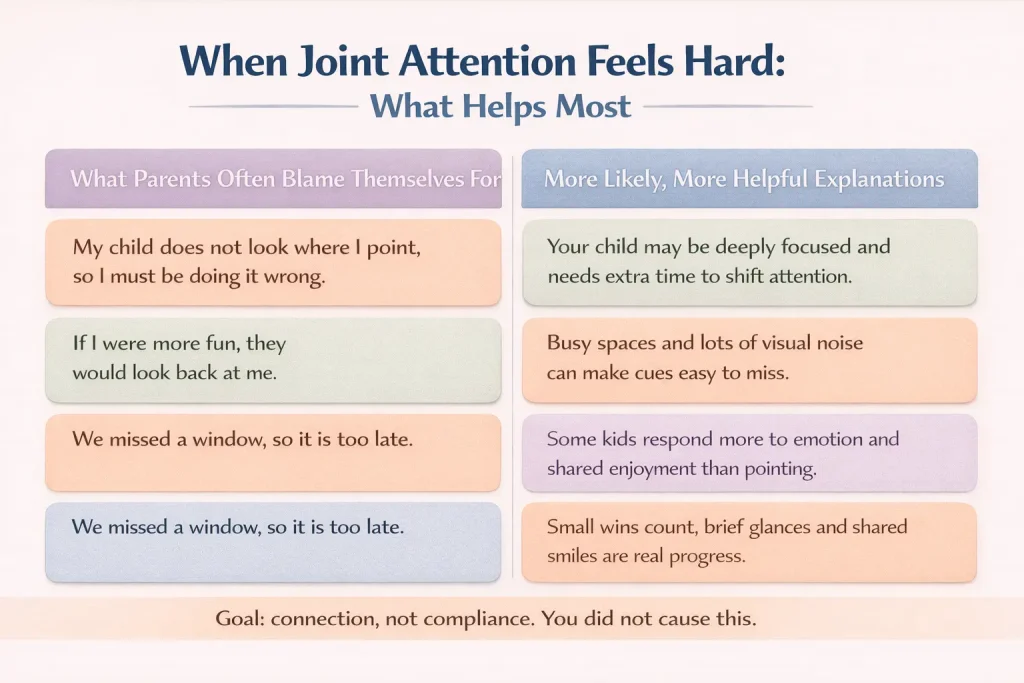
Some kids get deeply focused. If your child can lock onto a toy, a pattern, a spinning wheel, a book page, or a snack, that focus can be a strength. It can also mean they do not easily break attention to check your face or follow your point. They are not ignoring you. They are absorbed.
Some kids need more time to process. When you point or shift your gaze, your child has to notice it, understand it, and then move their eyes or body to match. For some children, that sequence just takes longer. If you are used to quick responses, the pause can feel like a no.
Some kids are more body-first than eye-first. A child who learns through moving, touching, climbing, or exploring may not naturally stop to look back and forth. They might show interest by going toward the thing instead of looking at you about it.
Some environments are simply too loud visually. Bright lights, background screens, lots of toys out at once, or a busy room can make it harder to pick out your cue. Even a fun space can be distracting.
And sometimes, your child is protecting their calm. If a child feels pressured, rushed, or repeatedly “tested,” they may look away more. Not because they cannot do it, but because the interaction starts to feel tense. Many parents do this without meaning to, especially when worry is sitting in the background.
None of these reasons point to a parenting problem. They point to a child who is learning in their own way.
Read More: Why Does My Toddler Not Respond to Their Name When They Are Busy Playing?
What Counts As Joint Attention, Really?
Parents often picture joint attention as a clear moment: you point at a dog, your child looks at the dog, then looks back at you and smiles. That is one version, and it is lovely when it happens. But early joint attention can be much smaller and easier to miss.
- It can look like your child briefly tracking where you are looking, even if they do not turn all the way.
- It can look like a quick glance at your face when something interesting happens, like a loud sound, bubbles, or a toy that surprises them.
- It can look like your child bringing you an object, not to “show” in a big way, but to place it near you or in your hand.
- It can look like shared enjoyment without pointing at all, like both of you watching the fan, the washing machine, or a bird outside the window.
- It can also look like your child noticing your excitement. Some children respond more to emotion than to pointing. Your “wow!” might land before your finger does.
If you have been measuring success only by “follows my point every time,” you may be missing real progress that is already happening in quieter forms. Joint attention is a relationship skill. It grows through many tiny moments that add up.
Is It Normal if Joint Attention Feels Hard for My Toddler Right Now?
Yes, it can be normal, especially when you zoom out and remember how many moving parts are involved. Development is not a straight line, and attention skills can be uneven. A child might be great at puzzles but not at shared looking. Another might love social games but struggle to shift attention away from a favorite toy.
It also helps to remember that toddlers are built to explore. Many toddlers are busy, fast, and curious. They may not pause to “check in” because their whole body is saying, “I want to go see it myself.” That is not a lack of connection. It is a different style of engaging.
Temperament plays a role too. Some children are naturally more observant and people-focused. Others are more independent in play. Neither is wrong. It just changes how joint attention shows up.
If you are comparing your child to a friend’s child, or to short clips online, it can feel like everyone else has constant shared pointing and big reactions. Real life is messier. Many families have joint attention moments that are brief, inconsistent, or only happen in certain routines.
If joint attention feels hard, it does not mean it will always feel hard. It often grows when the interaction becomes easier, more predictable, and more rewarding for your child.
What Helps Most at Home When Joint Attention is Slow?
Most parents do not need a bigger bag of tricks. They need a kinder lens, and a few simple shifts in how they read the moment.
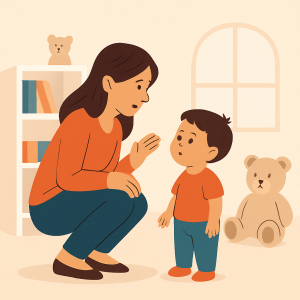
One helpful mindset is to trade “testing” for “inviting.” Testing sounds like, “Look, look, look,” while you wait for the correct response. Inviting sounds like, “Oh wow,” with a pause that leaves room for your child to join if they want to. The second one tends to feel safer, and safety supports attention.
Another shift is to notice timing. Many children need an extra beat. If you point and immediately repeat yourself, or move on quickly, your child may not have had time to respond. A quiet pause can be surprisingly powerful.
It also helps to simplify the scene. You do not have to create a perfect environment, but reducing background distractions when you can makes your cues easier to find. Fewer toys out, a calmer corner of the room, or turning off a screen in the background can change the whole feel of an interaction.
Following your child’s interest matters more than choosing the “right” toy. Joint attention grows best when the thing you are sharing is already meaningful to them. That might be bubbles, a snack, a car going by, water running in the sink, or a favorite song. When your child cares, looking and sharing becomes more likely.
And finally, keep your expectations gentle. Joint attention is not all-or-nothing. A half-second glance is not “nothing.” It is a starting point.
If you are looking for ideas that fit your day, the master guide on joint attention activities can be a helpful next read, especially if you want options for books, snack time, outdoor moments, and quick play routines. For this article, the main point is simpler: your presence and patience matter, even when the response is small.
Learn More: You Are Not Doing Anything Wrong If Your Toddler Not Responding to Name
What Progress Looks Like When Joint Attention Feels Hard
When parents are worried, they often scan for big proof. Big proof is rare at first. Progress usually shows up as small changes in frequency, ease, or warmth.
You might notice your child starts to look where you are looking once in a while, especially when the thing is exciting.
You might get more “check back” glances, even if they are quick. A glance that says, “Are you seeing this too?” can be very brief.
You may see more shared smiles, little sounds, or body movements that match your excitement.
Some children begin to bring you closer to what they want you to notice, like pulling your hand toward a shelf or leading you to a window. That is communication and shared attention, even if it is not pointing.
You might also notice that joint attention is easier in certain routines. Many families see more shared looking during books, snacks, bubbles, or outdoor noticing than during open-ended toy play. That is not a flaw. It is information. It tells you where your child feels most ready to connect.
Progress can also look like you feeling calmer. When you are less tense, your child often has more room to engage. Your nervous system and your child’s nervous system are connected more than most people realize.
When should I get extra support, and what would it focus on?
Sometimes parents read reassurance and still feel stuck, not because they did anything wrong, but because they want a clearer plan or a second set of eyes. Support can be useful when you have been trying for a while and it still feels hard to create shared moments, even around things your child loves.
Extra support can also help if interactions start to feel stressful for you. Not because you are doing harm, but because parenting is heavy when you are carrying worry alone. A good coach will focus on making daily routines feel easier, not turning your home into a therapy room.
If you choose to seek support, it often focuses on small adjustments: how to position yourself, how to time your cues, how to make the “interesting thing” obvious, and how to respond to tiny attempts so your child wants to do it again. Some families like a structured home plan, while others prefer a few coaching sessions to troubleshoot real-life routines.
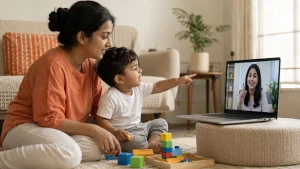
If remote support is easier, some families explore online options such as joint attention therapy online, where the focus is usually on parent coaching and practical changes inside your normal day.
Read More: How to Get My Child to Respond to Their Name Using Everyday Routines
A gentle note if joint attention feels hard, and you are blaming yourself
If joint attention feels hard, please hear this clearly: your child is not giving you a grade, and you are not failing a test. You are building a relationship skill that grows through repetition, comfort, and shared enjoyment. That takes time.
Try to measure the right thing. Not “Did they follow my point perfectly?” but “Did we have even one moment of shared interest today?” A glance, a smile, a pause where they stayed with you, those count.
If you have ongoing concerns about communication overall, some families consider developmental screening to better understand communication delays or possible autism-related differences. It is not about jumping to conclusions. It is about getting clarity and support that fits your child.
For today, you can let go of the guilt. Keep showing up and noticing what your child enjoys. Keep inviting, not testing. Those small, steady moments are how joint attention grows, even when it feels slow.
About the Author:
Rajini Darugupally
M.Sc., Speech-Language Pathologist (9+ years of experience)
Rajini is a passionate and dedicated Speech-Language Pathologist with over 9+ years of experience, specializing in both developmental speech and language disorders in children and rehabilitation in adults. Driven by a desire to empower each individual to find their voice, Rajini brings a wealth of experience and a warm, genuine approach to therapy. Currently, at Wellness Hub, she thrives in a team environment that values innovation, compassion, and achieving results for their clients. Connect with Rajini to learn more about how she can help you or your loved one find their voice.
Book your Free Consultation Today
Parent/Caregiver Info:
Client’s Details:
* Error Message